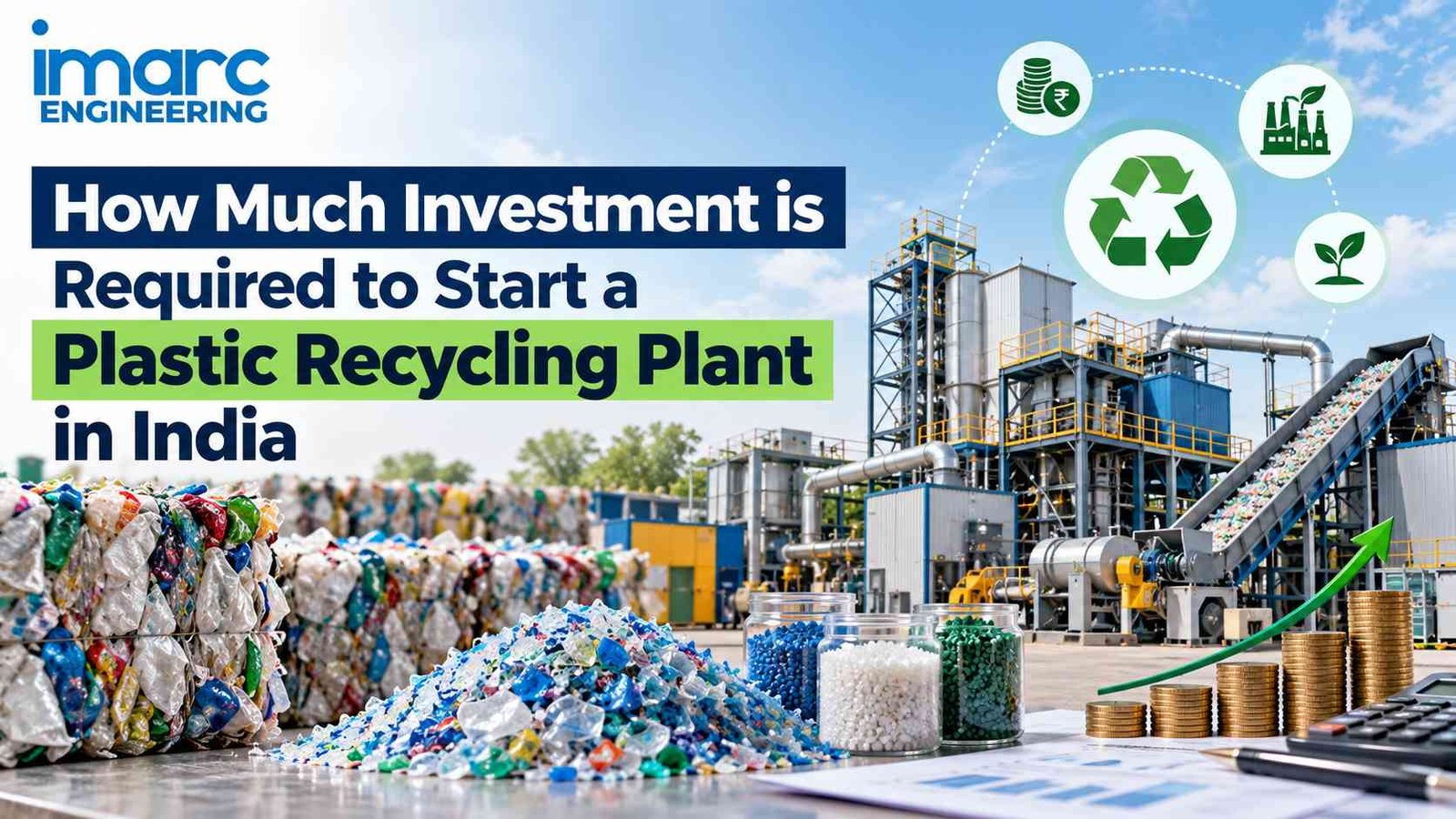
India generated about 4.14 million tonnes of plastic waste in 2022-23, roughly 23% more than five years earlier. At the same time, mandatory recycled-content targets now create assured demand for clean, traceable recycled plastic.
For investors, the first question is always the budget. The honest answer is a wide one: from INR 1 crore to INR 400 crore, depending on the polymer, the technology and the scale. A single headline number rarely helps, because a small granule unit and a food-grade rPET plant are very different businesses.
This guide explains what a realistic budget for a plastic recycling plant in India looks like, where the capital goes, what operating costs and returns to expect, and how to keep the investment productive.
How Much Does It Cost to Set Up a Plastic Recycling Plant in India?
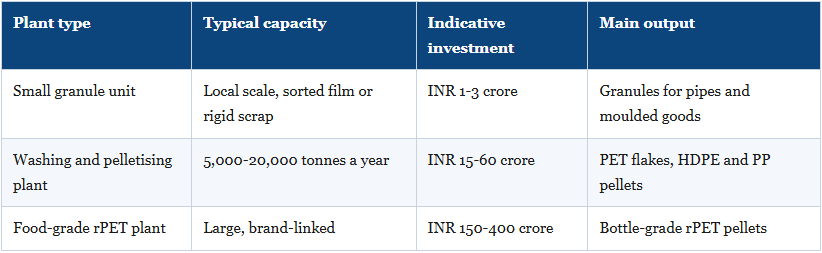
A small granule unit costs about INR 1-3 crore. A washing and pelletising plant of 5,000 to 20,000 tonnes a year costs about INR 15-60 crore. A large food-grade rPET plant costs INR 150-400 crore. A well-run plant typically earns a 10-20% net margin and pays back in 3-5 years.
What Decides the Size of the Investment?
- Polymer and product: fibre-grade PET flakes, HDPE and PP granules, and food-grade rPET each need a different machinery set.
- Capacity: most commercial plants run at 5,000 to 20,000 tonnes a year, and cost rises steeply with each step up in scale.
- Sorting automation: NIR and colour sorters raise capital cost but improve yield and access to premium buyers.
- Food-grade decontamination: solid-state polymerisation reactors and stricter controls add the largest single jump in cost.
- Water treatment and fire safety: effluent treatment and fire protection are mandatory design items, not optional extras.
- Regulation: recycled content for rigid packaging rises from 30% in 2025-26 to 60% by 2028-29, and food-grade rPET guidelines under IS 14534:2023 took effect from April 2026.
Targets for flexible packaging are also moving, from 10% to 20% recycled content. Together with tighter verification of EPR certificates, this rewards plants that invest in documented supply chains and consistent quality, and it explains why the higher-spec end of the budget range often earns better returns.
Investment by Plant Type
Where Does the Capital Go?
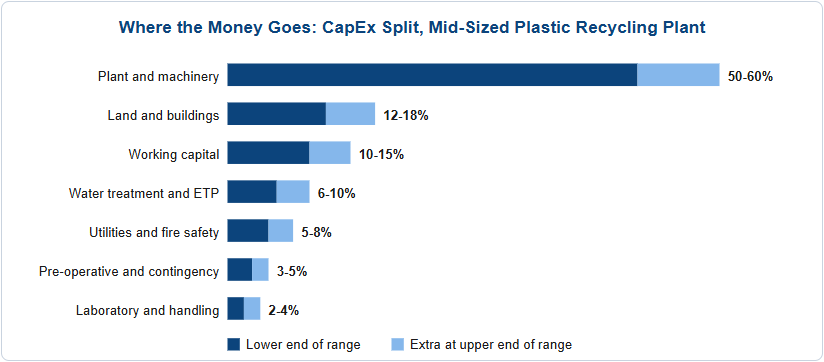
Machinery dominates the budget of a mid-sized washing and pelletising plant. Water treatment, fire safety and working capital are the items that investors most often under-budget.
- Plant and machinery: 50-60% of total CapEx, covering sorting, washing, drying, extrusion and pelletising.
- Land and buildings: 12-18%, including processing halls, bale storage and warehouse.
- Working capital: 10-15%, because bales are bought in advance while customers take credit.
- Water treatment and ETP: 6-10%, and critical for pollution consent.
- Utilities and fire safety: 5-8%.
- Pre-operative and contingency: 3-5%, covering installation, trials, DPR and approvals.
- Laboratory and handling equipment: 2-4%.
What Does a Mid-Sized Budget Look Like in Rupees?
As a simple illustration, apply those shares to an INR 15 crore washing and pelletising plant:
- Machinery: about INR 7.5-9 crore.
- Land and buildings: about INR 1.8-2.7 crore.
- Working capital: about INR 1.5-2.25 crore.
- ETP: about INR 0.9-1.5 crore.
The arithmetic is indicative only. Actual figures depend on polymer, location and vendor quotations obtained during the DPR stage.
What Land, Power and Infrastructure Should You Plan For?
Physical requirements shape both the land budget and the running cost. A mid-sized plant typically needs the following:
- Land: 2-8 acres for bale storage, processing halls and future expansion.
- Power: 1-5 MW of stable supply with backup.
- Effluent system: a treatment and water-recycling plant, which is critical for consent.
- Fire protection: adequate spacing, detection and firefighting, because stocks of bales and flakes carry significant fire risk.
- Laboratory: testing for melt flow, moisture and contamination, linked to batch traceability for EPR reporting.
Watch the video for a closer look:
Which States Offer the Best Locations?
- Gujarat (Surat, Vapi, Ahmedabad): polyester and plastics hub, ideal for PET flake customers.
- Maharashtra (Bhiwandi, Pune): large waste volumes and established processors.
- Delhi-NCR and Haryana: major recycling markets with northern customers.
- Tamil Nadu (Chennai, Coimbatore): textile and plastics demand in the south.
- Telangana and West Bengal: growing regional markets with land and incentive advantages.
Feedstock proximity, customer access, water and effluent capacity and approval timelines should decide the final choice, not land price alone.
What Are the Operating Costs and Returns?
- Raw materials: 50-60% of operating cost, led by sorted waste plastic bales.
- Utilities: 20-25%, driven by hot washing, drying and extrusion.
- Labour: 6-9%, followed by maintenance and spares at 4-6%.
- Margins: 25-35% gross and 10-20% net, with the higher end for food-grade output.
- Returns: 18-25% IRR and a 3-5 year payback.
- Utilisation: 65-85% in stable operation, with break-even at 40-50%.
How Long Does Setup Take, and Which Approvals Are Needed?
A disciplined programme runs 10 to 18 months from kickoff to commercial operation. Most plants then take another 6 to 12 months to reach steady-state performance. Approvals usually include:
- CPCB EPR registration: as a plastic waste processor, needed to generate EPR certificates.
- SPCB consents: Consent to Establish before construction and Consent to Operate before production.
- Safety and statutory: factory license and fire NOC.
- Food-contact approvals: FSSAI requirements and process approval for food-grade rPET.
Which Risks Can Erode Returns?
- Feedstock competition: demand for clean bales rises as recycled-content targets bite, which lifts prices.
- Virgin plastic prices: a fall narrows the premium that recycled material earns.
- Quality gaps: poor sorting and washing reduce yield and block access to brand buyers.
- Cash cycle: bales are paid for quickly while customers take credit, so under-sized working capital strains the ramp-up.
How Can Investors Keep the Budget Lean?
- Secure feedstock early: contract 60-80% of design-capacity feedstock before financial close.
- Start with one or two clean polymer streams: add food-grade lines as customers and approvals develop.
- Buy on life-cycle cost: weigh spares, support and yield, not only the initial machinery price.
- Design water recycling in: it cuts operating cost and supports consent conditions.
- Verify EPR paperwork: authorities are tightening checks on counterfeit certificates, which favours credible recyclers.
How IMARC Engineering’s Expertise Can Help in Plastic Recycling Plant Investment Planning
- Feasibility study and DPR: polymer, capacity and financial modelling that lenders can rely on.
- Site selection: feedstock proximity, utilities, zoning and state incentives compared side by side.
- Machinery selection: vendor evaluation focused on yield, after-sales support and life-cycle cost.
- Licensing roadmap: CPCB, SPCB, factory and fire approvals sequenced into the project calendar.
- Turnkey execution: engineering, procurement and project management through commissioning.
Consult With Our Experts: https://www.imarcengineering.com/contact-us
Conclusion
The investment needed for plastic recycling in India depends on three choices: the polymer, the scale and the product grade. Machinery, water treatment and working capital deserve the most careful budgeting. Investors who secure feedstock early, phase their technology and plan approvals alongside engineering are best placed to reach the 3-5 year payback that well-run plants achieve as recycled-content targets rise.
Frequently Asked Questions
What is the minimum investment for a plastic recycling plant in India?
A small granule unit starts at about INR 1-3 crore.
How much does a food-grade rPET plant cost?
Large food-grade rPET plants cost about INR 150-400 crore.
What is the payback period?
Well-run plants typically pay back in 3-5 years, with an IRR of 18-25%.
Which approvals are mandatory?
CPCB EPR registration, SPCB consents, a factory license and fire NOC, plus FSSAI approval for food-grade output.
Contact Us:
IMARC Engineering
Phone: +91-120-433-0800
Email: sales@imarcengineering.com
India: C-130, Sector 2, Noida, Uttar Pradesh 201301
LinkedIn: https://www.linkedin.com/showcase/imarc-engineering/
About the Author