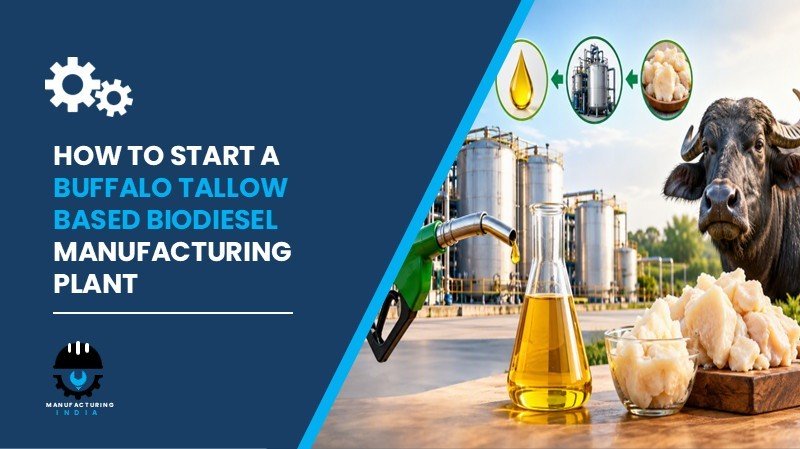
A buffalo tallow based biodiesel manufacturing plant setup in India presents a compelling investment case as the country’s automotive, transportation, agriculture, industrial machinery, power generation, construction equipment, and renewable energy sectors look for reliable, cost-effective diesel substitutes. This second-generation biofuel is synthesized from the rendered fat of buffaloes, sourced as a by-product from slaughterhouses and meat-processing industries, and its high cetane number, excellent lubricity, and lower carbon footprint versus petroleum diesel make it an important lever for energy security that does not compete with food resources.
India’s position as a major source of buffalo meat and hides gives it a naturally abundant, locally available tallow feedstock base. Combined with the Make in India initiative’s emphasis on domestic energy manufacturing and rising interest in blending mandates, clusters with meat-processing and rendering operations in states such as Maharashtra, Uttar Pradesh, Punjab, and Andhra Pradesh are well positioned to host this kind of unit. Proximity of tallow supply to processing capacity, along with cost-competitive construction and labour economics, makes India a strategically sound base for this facility.
With gross profit margins of 18-28% and net margins of 6-13%, this production plant combines a low-cost, non-edible feedstock, policy support for renewable fuels, and steady demand from automotive, agriculture, and industrial sectors into a financially viable, break-even-capable investment.
What is Buffalo Tallow Based Biodiesel?
This product is a renewable, eco-friendly biofuel synthesized from the rendered fat (tallow) of buffaloes, sourced as a by-product from slaughterhouses and meat processing industries. The process relies on transesterification, where purified animal fat reacts with methanol in the presence of a catalyst such as sodium hydroxide, yielding fatty acid methyl esters (FAME) and glycerin. As a second-generation biofuel, it offers a high cetane number, excellent lubricity, and a lower carbon footprint than petroleum diesel, converting non-edible waste into usable energy without competing with food security, and can be used as a standalone diesel substitute or blending component.
End-use industries served include automotive, transportation, agriculture, industrial machinery, power generation, construction equipment, and renewable energy, with applications spanning diesel engines, commercial vehicles, agricultural machinery, generators, and industrial boilers.
Cost of Setting Up a Buffalo Tallow Based Biodiesel Manufacturing Plant in India
The overall cost of setting up a buffalo tallow based biodiesel manufacturing plant depends on capacity, technology, location, automation level, and regulatory compliance requirements.
1. Capital Expenditure (CapEx)
Land and site development covers acquisition, registration, and site preparation; investors may evaluate SEZ or industrial estate plots near tallow rendering clusters to cut logistics costs. Civil works cover the processing shed, quality-control lab, storage, effluent treatment infrastructure, and admin block. Key machinery required includes:
- Tallow melting/rendering tanks
- Filtration units
- Pretreatment reactors
- Methanol storage and mixing systems
- Catalyst preparation tanks
- Transesterification reactors
- Settling or centrifuge units for glycerol separation
- Methanol recovery systems
- Biodiesel washing and drying units
- Purification systems
- Storage tanks
- Packaging or bulk-loading equipment
Other capital costs include ETP installation, pre-operative and commissioning expenses, and applicable import duties on specialized equipment. Scale and automation level determine the overall machinery cost.
Request a Sample Report for In-Depth Market Insights: https://www.imarcgroup.com/buffalo-tallow-based-biodiesel-manufacturing-plant-project-report/requestsample
2. Operational Expenditure (OpEx)
Raw material cost is the largest OpEx component, driven by buffalo tallow, methanol, and sodium hydroxide (NaOH) or potassium hydroxide (KOH), together accounting for approximately 55-68% of total OpEx. Long-term supplier contracts with nearby rendering operations help stabilize pricing and secure feedstock supply. Utility cost – electricity, water, and steam – accounts for approximately 10-14% of OpEx. Other operating costs include transportation, packaging, salaries, maintenance, depreciation, and taxes, with total operating cost expected to rise substantially by year five due to inflation and market fluctuations.
3. Plant Capacity
The proposed facility is designed with an annual production capacity ranging between 10,000-30,000 KL, enabling economies of scale while maintaining operational flexibility. Capacity can be customized to investor requirements, and profitability generally improves as capacity utilisation increases.
4. Profit Margins and Financial Projections
Financial projections are developed around capital investment, operating costs, capacity utilisation, and demand outlook, typically covering ROI, NPV, IRR, payback period, and profit and loss projections. Gross profit margins typically range between 18-28%, while net profit margins range between 6-13%, supported by stable demand across end-use sectors.
Why Set Up a Buffalo Tallow Based Biodiesel Plant in India?
Abundant, Cost-Effective Feedstock Base: Buffalo tallow converts a low-value slaughterhouse by-product into renewable fuel for diesel engines and industrial equipment – a practical waste-valorisation route in India’s large meat-processing sector.
Megatrend Alignment with Renewable Fuel Demand: Growing emphasis on renewable fuels, circular-economy practices, and decarbonization is driving interest in animal-fat-based biodiesel and rising demand across transportation, agriculture, and industrial applications.
Policy and Regulatory Tailwinds: Government initiatives supporting biofuels, renewable energy, and emissions reduction strengthen the broader ecosystem, and blending mandates can indirectly support demand.
Cost-Competitive Production: Moderate capital requirements versus advanced biofuel technologies, plus India’s competitive land and labour costs, make this an accessible entry point for efficiency-focused producers.
Localization and Dependability in Feedstock Supply Chains: Producers benefit from sourcing tallow locally from slaughterhouses and rendering operations, cutting transport costs and improving availability.
Technology-Driven Efficiency Gains: Improvements in pretreatment, esterification, heterogeneous catalysts, and enzymatic processing are boosting conversion efficiency for adopters of updated technology.
Manufacturing Process – Step by Step
The buffalo tallow based biodiesel manufacturing process uses transesterification as the primary production method, supported by a series of upstream and downstream unit operations.
- Tallow Rendering and Melting: Raw tallow from slaughterhouses is rendered and melted for processing.
- Filtration: The melted tallow is filtered to remove solid impurities.
- Pretreatment: The filtered tallow is conditioned for transesterification.
- Methanol-Catalyst Preparation: Methanol is combined with a catalyst, typically NaOH or KOH, in preparation tanks.
- Transesterification: The pretreated tallow reacts with the methanol-catalyst mixture to produce FAME and glycerin.
- Glycerol Separation: Settling or centrifuge units separate glycerol, with methanol recovery systems reclaiming unreacted methanol.
- Washing and Drying: The biodiesel is washed and dried to remove residual catalyst and moisture.
- Biodiesel Purification: The product passes through purification systems to meet fuel quality specifications.
The finished product is then held in storage tanks and moved to packaging or bulk-loading equipment for dispatch to automotive, transportation, agriculture, and industrial customers.
Key Applications
This fuel serves a range of compression-ignition applications across several end-use industries.
- Automotive: Biodiesel for diesel engines, commercial vehicles, buses, trucks, and agricultural machinery.
- Transportation: Fuel for diesel-powered fleets, logistics vehicles, marine engines, and rail applications.
- Agriculture: Fuel for tractors, harvesters, irrigation pumps, and other farm equipment.
- Industrial: Fuel for generators, boilers, furnaces, and diesel-powered machinery.
Timeline to Start the Plant
- Feasibility study and project report preparation
- Land acquisition and site development
- Regulatory approvals and environmental clearances
- Factory licence and fire safety compliance
- Machinery procurement and installation
- Raw material supplier agreements and supply chain setup
- Trial production and quality testing
- Commercial production launch
Licences and Regulatory Requirements
Starting a buffalo tallow based biodiesel production unit in India requires several approvals:
- Business registration (Proprietorship, LLP, or Pvt Ltd)
- Factory Licence under the Factories Act
- Environmental Clearance from the State Pollution Control Board
- GST Registration
- Fire Safety NOC
- Hazardous/chemical compliance for methanol and catalyst handling
- Effluent Treatment Plant (ETP) operational clearance
- Occupational Health and Safety compliance
Key Challenges to Consider
High Capital Requirements: Machinery costs, especially transesterification reactors and purification equipment, dominate capital expenditure.
Raw Material Price Volatility: Buffalo tallow, methanol, and NaOH or KOH together make up 55-68% of operating costs, so price swings affect margins.
Regulatory Compliance: Environmental clearances, effluent treatment obligations, and hazardous-chemical handling add complexity.
Technology and Innovation Pressure: Ongoing improvements in pretreatment, esterification, and enzymatic processing mean producers must continually evaluate upgrades.
Competition from Multinational Players: The industry includes multinational manufacturers with extensive capacities, so new entrants must focus on quality and efficiency.
Skilled Manpower: Operating rendering, transesterification, and purification systems reliably requires trained staff familiar with process control.
Frequently Asked Questions
1. How much does it cost to set up a buffalo tallow based biodiesel manufacturing plant in India?
Cost depends on capacity, technology, automation, and location, covering land, civil works, machinery, and other capital costs; detailed CapEx figures are available in the full feasibility report.
2. Is buffalo tallow based biodiesel manufacturing profitable in India in 2026?
Yes – the project shows healthy potential, with gross margins typically between 18-28% and net margins between 6-13% under normal operating conditions.
3. What machinery is required for a buffalo tallow based biodiesel plant in India?
Key machinery includes rendering tanks, filtration units, pretreatment reactors, methanol and catalyst systems, transesterification reactors, glycerol separation units, washing/drying units, purification systems, and storage and packaging equipment.
4. What licences and approvals are required to start a buffalo tallow based biodiesel manufacturing plant in India?
Requirements include business registration, a Factory Licence, Environmental Clearance, GST Registration, Fire Safety NOC, hazardous-chemical compliance, ETP clearance, and Occupational Health and Safety compliance.
5. What raw materials are needed for buffalo tallow based biodiesel manufacturing?
The primary raw materials are buffalo tallow, methanol, and NaOH or KOH, together accounting for approximately 55-68% of operating expenditure.
6. What are the environmental compliance requirements for a buffalo tallow based biodiesel plant in India?
Requirements include Environmental Clearance from the State Pollution Control Board, ETP operation, and hazardous-chemical handling compliance.
7. What is the best location to set up a buffalo tallow based biodiesel plant in India?
Locations with easy access to tallow rendering and slaughterhouse operations, reliable utilities and transport, and proximity to target markets are best suited.
8. What is the break-even period for this type of plant in India?
Break-even depends on capacity utilisation, pricing, and cost structure; the feasibility report provides payback period, NPV, and IRR projections for the chosen configuration.
9. What government incentives are available for manufacturers in India?
Blending mandates, renewable fuel programmes, and domestic biofuel development initiatives support demand for this fuel, alongside government initiatives on renewable energy and waste management.
Key Takeaways for Investors
This production plant taps into steady demand from automotive, transportation, agriculture, industrial machinery, power generation, construction equipment, and renewable energy sectors, using a low-cost, non-edible feedstock that supports waste valorisation. Financial viability holds across the proposed 10,000-30,000 KL capacity range, with gross margins of 18-28% and net margins of 6-13%. Supportive clean-energy policies and the shift toward circular-economy, waste-to-value production are expected to sustain long-term demand, making this a strategically sound, cost-competitive investment opportunity for India’s growing renewable fuels sector.
About the Author