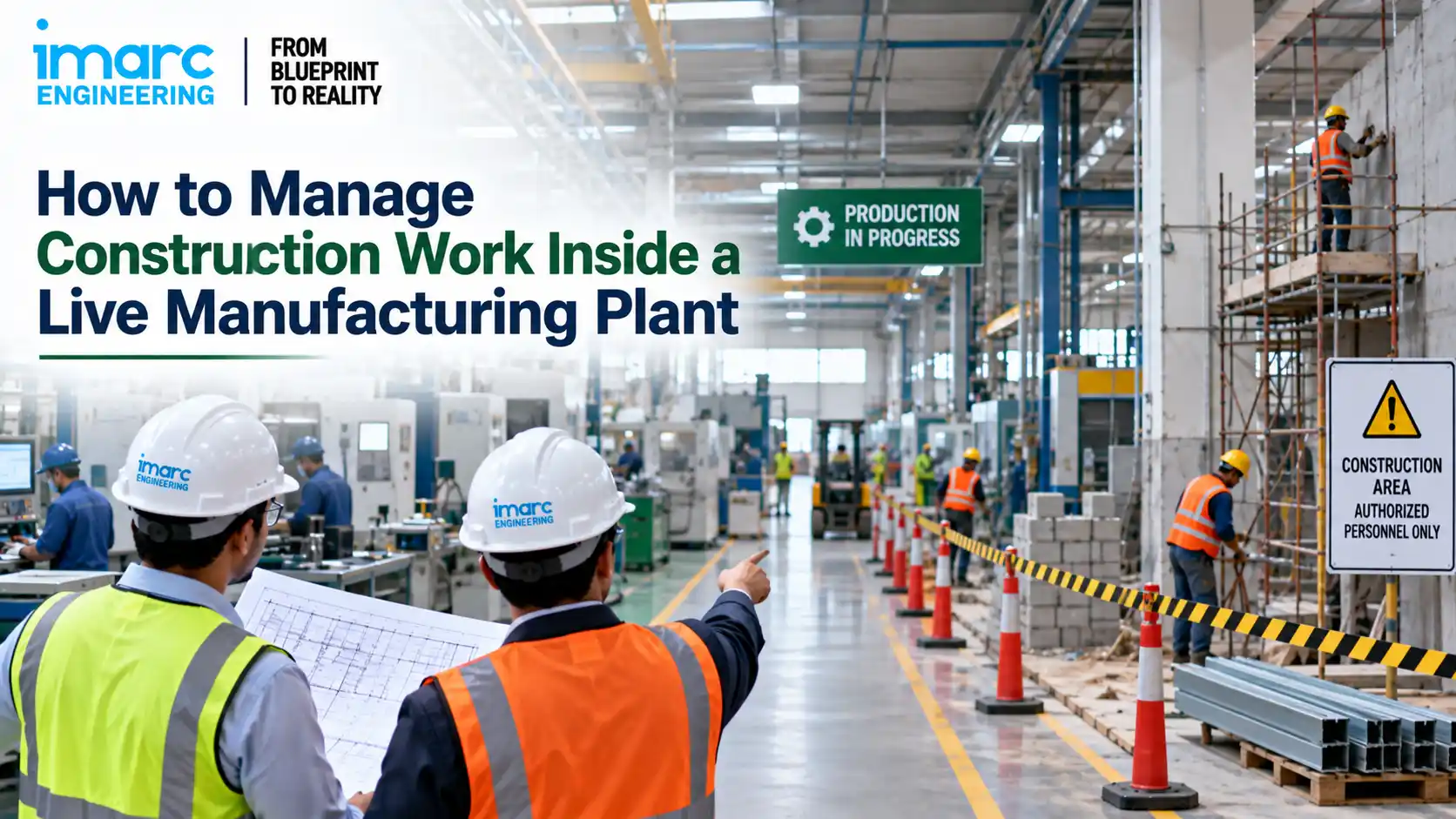
Construction work rarely waits for a convenient moment. A plant that needs a new line, a warehouse extension or a modified process area usually needs it while the existing operation keeps running. Orders still have to ship, machines still have to run, and people still have to move through the same aisles the construction crew now needs.
This is what makes construction inside a live manufacturing plant different from building on an empty site. The project has to fit around production, not the other way around. Many manufacturers turn to specialised Construction Management Services in India once they realise how many operational interfaces a brownfield project actually touches.
Getting this wrong doesn’t just delay the project — it can interrupt production, damage equipment, create safety incidents or draw regulatory attention. Getting it right means construction and operations can run in the same building without working against each other.
This article covers how to plan that overlap: zoning, contractor movement, dust and utility control, shutdown planning, and the mistakes that most often derail live-plant projects.
Why Construction Inside a Live Manufacturing Plant Is Different
On a greenfield site, the construction team effectively owns the site — no production to protect, no employees crossing the work area, no existing equipment a stray spark could damage.
A live plant flips this:
- Production keeps running — delivery commitments don’t pause for the new bay next door.
- Existing machinery is exposed to vibration, dust or an accidental utility trip.
- Utilities are shared — power, air, steam, water and piping often run through the work zone.
- People and vehicles mix — employees and forklifts share routes contractors now need.
- Space is limited — laydown areas must be found within a working footprint, not a blank layout.
This doesn’t make live-plant construction riskier by default — it means planning has to be built around interfaces with the existing facility, not around the construction sequence alone.
What Can Go Wrong During Live-Plant Construction
Most problems trace back to one cause: construction and operations planned separately instead of together.
- Production disruption from vibration, power interruption or blocked access.
- Contractor–operations conflicts over aisles, docks or lifting equipment.
- Construction traffic conflicts between trucks, cranes and forklifts.
- Dust contamination, especially in food, pharma or electronics areas.
- Damage to cabling, piping or machinery from work done without checking drawings against site reality.
- Unplanned utility interruption, blocked emergency routes, or unsafe work interfaces such as hot work near occupied production.
- Schedule and quality conflicts from access assumptions operations never approved, or from contamination and environmental excursions.
- Poor coordination between construction and production schedules generally.
The rest of this article looks at how each of these is prevented.
How to Plan Construction Zones in an Operating Factory
Start with a clear, physical definition of where construction happens and where production continues undisturbed:
- Construction and production areas, clearly bounded and separated.
- Restricted areas near hazardous processes or critical utilities.
- Contractor entry/exit points, separate from employee entrances where possible.
- Delivery, waste and emergency routes, kept clear of each other.
- Temporary storage, laydown and utility connections, kept separate from plant supply where feasible.
Physical segregation — hoarding, barricades, sheeting — matters because it turns planning assumptions into something workers can see. A fabrication shop may tolerate a taped-off zone with signage; a cleanroom or active chemical area may need sealed, pressure-controlled partitions. The adjoining process should decide the level of segregation, not a standard template.
How to Protect Ongoing Production
Zoning defines the boundary; protecting production is about what happens inside it. This means identifying, before work starts:
- Which equipment and areas cannot tolerate interruption, vibration or contamination.
- Which shared utilities can be isolated without affecting other users.
- Existing production and maintenance schedules, so work is timed around them.
- Material routes and activities that genuinely cannot be disturbed while the plant is running.
The aim isn’t zero disruption — that isn’t realistic for most brownfield work. It’s making disruption planned rather than a surprise. A tie-in that’s scheduled and communicated is a very different event from the same tie-in done without notice.
Contractor, Worker and Traffic Control
With zones defined, the next layer is controlling how people, vehicles and equipment move — where many live-plant projects lose control day to day.
- Contractor induction covering site-specific hazards, not generic content, and access authorisation that’s checked rather than assumed.
- Defined, separated vehicle and pedestrian routes, with delivery windows that avoid shift changes and peak forklift movement.
- Permit-to-work for hot work, height, confined space and energy isolation, backed by daily coordination briefings between construction and plant EHS.
A permit-to-work system turns a general safety policy into a checked authorisation for a specific task, location and time — the level of control a live plant needs. In India, factory safety and working conditions now fall under the Occupational Safety, Health and Working Conditions Code, 2020, which came into force on 21 November 2025 and consolidated the earlier central labour laws, including the Factories Act, 1948. DGFASLI and state factory inspectorates remain relevant to factory safety administration and oversight.
How to Control Construction Dust, Noise and Vibration
Dust, noise and vibration control protects both workers and the process next door.
- Physical dust barriers between the work zone and occupied areas, with local extraction at the source rather than general ventilation.
- Controlled, sequenced demolition instead of unplanned breaking, and cleaning protocols at zone boundaries.
- Noise scheduling around shift patterns, and vibration assessment near precision equipment before heavy activities begin.
Requirements vary by sector: pharma and food plants guard against particulate reaching product; electronics plants guard against static and contamination; chemical plants watch ignition sources; heavy manufacturing tolerates dust better but not vibration near precision machine tools.
The Central Pollution Control Board has issued dust-mitigation guidance for construction and demolition activities, including measures related to barricading and material handling. In an operating manufacturing plant, similar principles can inform controlled construction zones, while the exact controls should be determined by the process, material and site conditions. In the United States, SMACNA’s IAQ Guidelines for Occupied Buildings Under Construction is a widely referenced resource for managing air quality around people who continue to occupy a space during construction, with principles that translate directly to a manufacturing floor.
How to Protect Existing Machinery and Utilities
Existing machinery, panels, cabling and piping are usually the most vulnerable part of a live-plant project, since damage here can affect areas well beyond the construction zone.
- Verify drawings against actual site conditions. As-built drawings are often outdated, so a physical survey — cable tracing, utility mapping, structural checks — before excavation or drilling is what prevents an unplanned strike on a live line.
- Control hazardous energy properly. Work requiring isolation of electrical, pneumatic, hydraulic or thermal energy should go through a formal lockout/isolation and permit process, confirmed by both the construction team and plant maintenance beforehand.
This is a planning and coordination responsibility. The actual isolation work should always be carried out by competent, authorised personnel following the plant’s own procedures and applicable regulations.
Safety and Emergency Access During Construction
Construction changes a plant’s layout, sometimes daily — controls adequate on day one may not be adequate by week six. Areas needing ongoing attention, not a one-time check:
- Emergency exits and evacuation routes, confirmed clear rather than assumed clear.
- Fire access routes and equipment, including anything temporarily relocated.
- Hot work, height, confined-space and lifting operations, each with its own permit.
- Temporary structures — scaffolding, hoardings, cabins — inspected on a schedule.
- Electrical isolation status, reviewed as connections change.
- Contractor PPE matched to the specific plant environment.
This is why live-plant safety works better as a recurring review than a one-time audit. The applicable occupational safety framework also covers workplace safety, risk management and welfare requirements, making ongoing coordination important when construction and production operate in the same facility.
Phased Construction and Shutdown Planning
Not every activity needs a shutdown. Treating everything as shutdown-dependent wastes production time; treating everything as independent risks safety problems. A phased approach works better:
- Phase 1 — Preparation: surveys, utility verification, zoning, permits.
- Phase 2 — Independent construction: civil and structural work in separated zones.
- Phase 3 — Interface work: activity near live systems, needing active coordination.
- Phase 4 — Shutdown-dependent work: tie-ins that genuinely require the system to be down.
- Phase 5 — Testing and commissioning: verifying new systems before handover.
- Phase 6 — Ramp-up: returning to normal production, with monitoring.
Identifying Phase 4 activities early — ideally at design stage — lets a shutdown window be negotiated with production planning and used efficiently, rather than discovered late.
Common Mistakes to Avoid
- Treating the project like a greenfield site, without adapting to an occupied facility.
- Setting up a construction zone with no traffic plan.
- Ignoring the actual condition of existing utilities, relying on old drawings.
- Protecting equipment but ignoring production flow around it.
- Leaving shutdown planning too late.
- Allowing uncontrolled contractor access under schedule pressure.
- Treating safety as a one-time audit, not revisiting as layout changes.
- Failing to update the construction plan when production conditions or site constraints change.
- Ignoring emergency access.
- Locking in a design before verifying site conditions.
Most of these share one root cause: construction planning and plant operations planning happening in separate silos.
When Does a Manufacturer Need Dedicated Construction Management Support?
Smaller modifications can often be handled internally. Dedicated support becomes useful once several of these apply together:
- Expansion or new-line installation inside an operating facility, with multiple contractors working in overlapping areas.
- Limited or tightly negotiated shutdown windows, and new equipment connecting into existing utilities or controls.
- Construction adjacent to sensitive production — pharma, food or electronics — with strict quality or regulatory requirements at stake.
- Limited internal bandwidth to run construction and operations coordination in parallel.
The value here isn’t just construction knowledge — it’s actively managing the interface between the construction schedule and the plant’s operating reality, day to day, for the project’s duration.
| Project Situation | Main Management Challenge | What Needs to Be Controlled |
| Construction beside active production | Preventing dust, noise and vibration reaching the line | Zoning, barriers, work scheduling |
| New equipment installation | Coordinating delivery and rigging without blocking operations | Access routes, lifting plan, tie-in timing |
| Utility tie-in | Isolating shared systems without affecting other users | Isolation planning, shutdown windows |
| Multiple contractors on site | Avoiding overlapping work and inconsistent safety standards | Induction, permits, daily coordination |
| Shutdown-dependent work | Completing critical-path work in a limited window | Sequencing, readiness, resourcing |
| Sensitive production area | Preventing contamination or environmental excursions | Sealed segregation, pressure control, cleaning |
| Brownfield structural tie-ins | Connecting new work to existing systems safely | As-built verification, phased handover |
How IMARC Engineering Supports Live-Plant Construction
IMARC Engineering works across greenfield facilities, brownfield extensions, plant modifications and phased manufacturing developments, which makes live-plant construction coordination a recurring part of the projects it supports.
Relevant support areas include:
- Construction-zone planning appropriate to the adjoining process, and access control and contractor coordination for multiple trades on site.
- Construction schedule coordination with production planning, including shutdown coordination and identifying dependent work early.
- Existing equipment and utility interface management, including drawing verification and installation coordination for new equipment and tie-ins.
- Safety and statutory compliance monitoring, quality inspections at key milestones, and commissioning coordination with punch-list/handover support.
These map directly to the planning steps discussed above — zoning, production protection, contractor control, dust and utility management, and phased shutdown planning — applied to a specific plant’s layout and constraints. Manufacturers evaluating this can review the full scope on the Construction Management Services in India page.
Planning Construction Inside an Operating Manufacturing Plant?
If your manufacturing facility needs expansion, modification or new equipment installation while production continues, IMARC Engineering can help coordinate construction activities, contractor interfaces, safety controls, shutdowns and commissioning.
Discuss your live-plant construction requirements with IMARC Engineering: https://www.imarcengineering.com/contact?service=construction-management-services
Conclusion
Construction inside a live manufacturing plant is a different discipline from building on an empty site. Production continuity, existing equipment, shared utilities, contractor and employee movement, and statutory safety requirements all have to be planned as part of the construction sequence, not treated as an afterthought.
Clear zoning, controlled contractor and traffic movement, dust and vibration management, verified utility conditions and a phased approach to shutdown-dependent work together turn a potentially disruptive project into a controlled one. None of this removes every risk, but it replaces guesswork with a planned, reviewed process.
For manufacturers taking on an expansion, modification or brownfield project, the earlier these interfaces are mapped — ideally before design is finalised — the more control the plant retains over both the construction outcome and its ongoing production.
Contact Us:
IMARC Engineering
Phone: +91-120-433-0800
Email: sales@imarcengineering.com
India: C-130, Sector 2, Noida, Uttar Pradesh 201301
LinkedIn: https://www.linkedin.com/showcase/imarc-engineering/
About the Author