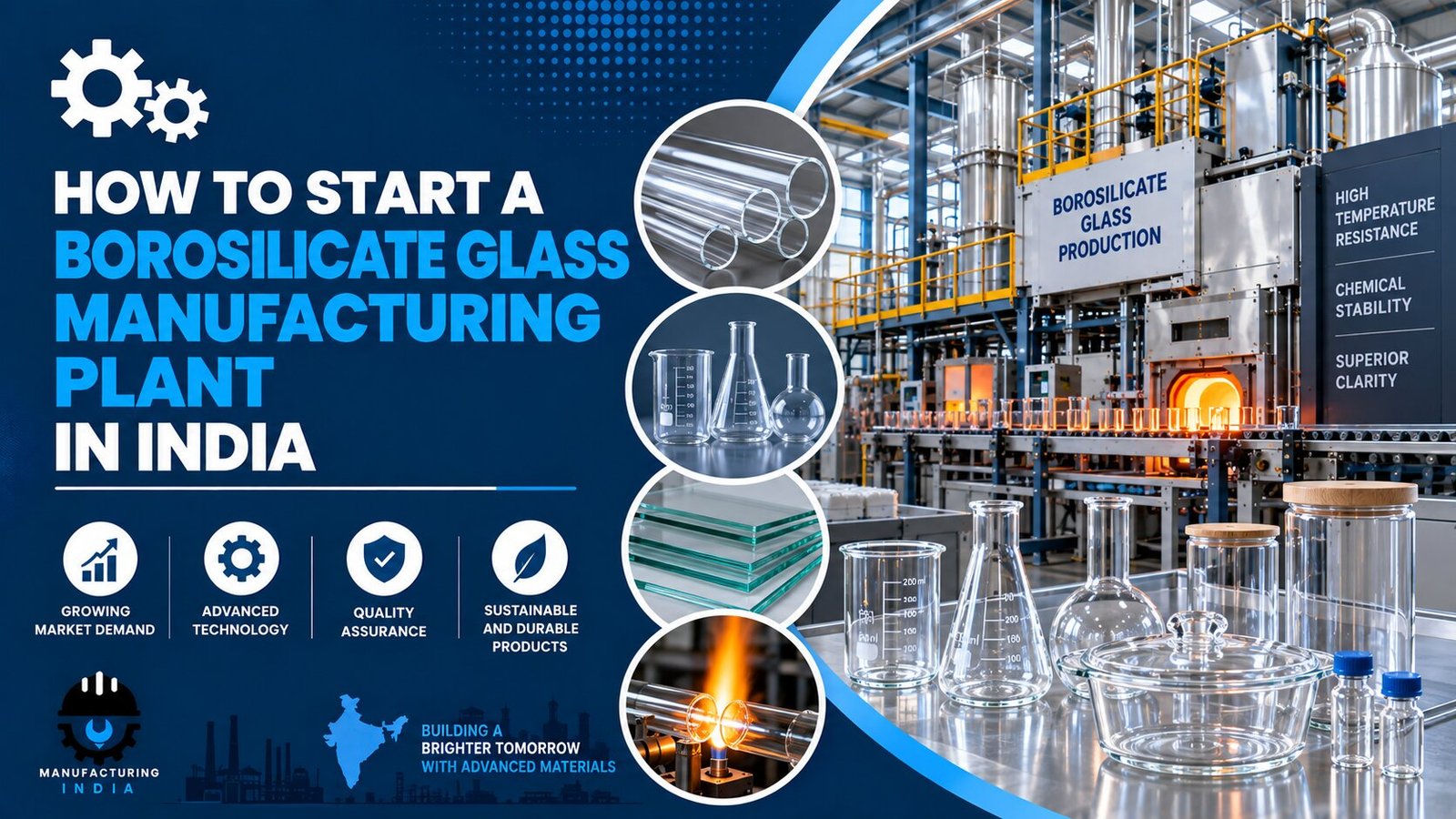
Setting up a borosilicate glass manufacturing plant in India presents a compelling investment case, given demand from pharmaceuticals, laboratory equipment, chemical processing, cookware, lighting, healthcare, and industrial manufacturing. High thermal resistance and chemical stability make this material essential to those sectors, and it is increasingly favored by the pharmaceutical industry for vials that must withstand sterilization.
India’s pharmaceutical base makes the country a strategically sound location for this production. Per India’s Department of Commerce, drugs and pharmaceuticals rank among its top export commodities and, with petroleum products, electronic goods, and engineering goods, account for 57% of total exports — a trade base expected to support demand for high-quality pharmaceutical glass packaging.
Backed by a global market valued at USD 2.80 Billion in 2025 and growing at a 6.5% CAGR, healthy gross margins of 25–35%, and India’s pharmaceutical export strength, this investment offers a cost-competitive route into specialty glass, with steady demand from pharmaceutical, laboratory, and chemical-processing end-users supporting sound break-even viability.
What is Borosilicate Glass?
Borosilicate glass is composed of silica and boron trioxide, known for superior thermal resistance and durability. Clear and smooth, it suits applications demanding precision and clarity. Available in various thicknesses and custom shapes, it withstands sudden temperature changes and comes in several grades suited to different levels of chemical exposure or thermal shock. Its non-reactive properties make it widely used for beakers and test tubes, high-quality kitchenware, and heat-resistant lighting.
The borosilicate glass manufacturing process uses raw-material batching, melting, refining, forming, annealing, cutting and finishing, and quality inspection. This method serves end-use industries such as pharmaceuticals, laboratory equipment, chemical processing, cookware, lighting, healthcare, and industrial manufacturing.
Cost of Setting Up a Borosilicate Glass Manufacturing Plant in India
The cost of a borosilicate glass manufacturing plant depends on capacity, technology, location, automation, and regulatory compliance.
1. Capital Expenditure (CapEx)
Capital investment covers land acquisition, site preparation, and infrastructure, optimized through industrial estates or SEZ-linked plots with developed utilities and faster approvals. Civil works cover the production shed, laboratory, storage areas, and administrative block.
Machinery is the largest portion of capital expenditure for a borosilicate glass manufacturing plant, since equipment costs scale with automation level and capacity. Key machinery required includes:
- Raw-material storage and batching systems
- Batch mixers
- Glass melting furnace
- Electric or gas-fired heating system
- Refining equipment
- Forehearth
- Forming machines
- Tube or sheet-forming equipment depending on the product
- Annealing lehr
- Cutting and grinding machines
- Polishing equipment
- Washing systems
- Inspection equipment
- Automated packaging systems
Other capital costs include effluent treatment systems, pre-operative and commissioning expenses, and import duties on specialized machinery.
Request a Sample Report for In-Depth Market Insights: https://www.imarcgroup.com/borosilicate-glass-manufacturing-plant-project-report/requestsample
2. Operational Expenditure (OpEx)
Raw material cost is approximately 35–45% of OpEx, comprising boron-silicate sand, soda ash, ground lime, and alumina. Long-term supplier contracts help stabilize pricing and secure consistent supply.
Utility cost, covering electricity, water, and steam, is unusually heavy at approximately 40–50% of OpEx, reflecting the energy intensity of continuous melting. Other costs include transportation, packaging, salaries, maintenance, depreciation, and taxes. By the fifth year, operational cost is expected to rise on inflation, market fluctuations, and supply chain disruptions.
3. Plant Capacity
The proposed facility is designed with an annual production capacity of 100,000–300,000 MT, enabling economies of scale while maintaining flexibility. Capacity can be customized to investor requirements, and profitability improves with higher capacity utilisation as fixed costs spread across greater output.
4. Profit Margins and Financial Projections
Financial projections cover net present value (NPV), internal rate of return (IRR), payback period, liquidity, and profitability analysis. Under normal conditions, a borosilicate glass manufacturing plant typically shows gross margins of 25–35% and net margins of 10–15%, reflecting profitability supported by stable demand and value-added applications.
Why Set Up a Borosilicate Glass Plant in India?
Superior Thermal-Shock Resistance: Low thermal expansion suits applications involving rapid temperature changes, a property ordinary glass cannot match, underpinning demand across cookware, lighting, and high-temperature industrial equipment.
Chemical Resistance: Strong resistance to many chemicals supports demand from laboratories, pharmaceutical manufacturing, and chemical processing, where corrosive exposure rules out conventional glass.
Pharmaceutical Applications: Rising pharmaceutical and biotechnology production creates demand for high-quality containers and specialized components, with vials and ampoules requiring proven sterilization performance.
High-Value Specialty Material and Product Diversification: It serves technically demanding applications ordinary glass cannot, and producers can diversify across tubes, rods, sheets, laboratory vessels, pharmaceutical containers, cookware, and custom components.
Industrial and Consumer Demand: Heat resistance, transparency, and durability together create opportunities across industrial and household applications, broadening the customer base beyond a single end-use sector.
Active Industry Investment: In March 2026, Borosil Limited approved a ₹50 crore investment to expand furnace capacity at its Jaipur plant from 25 to 32 tonnes per day and add a third forming line. The facility was running at around 90% capacity utilization; the project aligns with the furnace rebuild cycle set for January 2028, with commissioning expected by Q4 FY2028.
Manufacturing Process – Step by Step
The borosilicate glass manufacturing process uses raw-material batching as the primary production method, followed by a series of unit operations, material handling steps, and quality checks.
- Raw-Material Batching: Storage and batching systems and batch mixers proportion boron-silicate sand, soda ash, ground lime, and alumina.
- Melting: The glass melting furnace, with an electric or gas-fired heating system, converts the batch into molten glass.
- Refining: Refining equipment and the forehearth remove bubbles and condition the melt to a uniform temperature.
- Forming: Forming machines and tube or sheet-forming equipment shape the molten glass according to the intended product.
- Annealing: The annealing lehr relieves internal stresses through controlled cooling.
- Cutting and Finishing: Cutting and grinding machines, polishing equipment, and washing systems set final dimensions and surface quality.
- Quality Inspection: Inspection equipment verifies dimensional, optical, and structural conformance.
- Packaging: Automated packaging systems complete the process, preparing goods for dispatch to pharmaceutical, laboratory, and industrial end-users.
Key Applications
This material serves a broad set of end-use industries spanning regulated and consumer markets:
- Pharmaceutical Packaging: Vials, ampoules, bottles, and other containers requiring high chemical and thermal resistance.
- Laboratory Glassware: Beakers, flasks, test tubes, burettes, and other scientific equipment.
- Cookware and Bakeware: Oven-safe dishes, baking trays, and heat-resistant kitchen products.
- Chemical Processing: Pipes, reactors, sight glasses, and other components exposed to corrosive chemicals.
- Lighting: Lamp envelopes, tubes, and specialized lighting components.
- Solar and Industrial Equipment: Selected high-temperature and chemically demanding industrial applications.
- Scientific Instruments: Components requiring optical clarity, dimensional stability, and thermal resistance.
Leading Manufacturers
Leading manufacturers in this global industry include several innovative firms with broad product portfolios and advanced technological capabilities. Key players include:
- Corning Incorporated
- Schott AG
- Nippon Electric Glass Co., Ltd.
- Borosil Limited
Timeline to Start the Plant
- Feasibility study and project report preparation
- Land acquisition and site development
- Regulatory approvals and environmental clearances
- Factory licence and fire safety compliance
- Machinery procurement and installation
- Raw material supplier agreements and supply chain setup
- Trial production and quality testing
- Commercial production launch
Licences and Regulatory Requirements
Starting a borosilicate glass manufacturing unit in India requires several approvals:
- Business registration (Proprietorship, LLP, or Pvt Ltd)
- Factory Licence under the Factories Act
- Environmental Clearance from State Pollution Control Board
- GST Registration
- Fire Safety NOC
- Effluent Treatment Plant (ETP) operational clearance
- Occupational Health and Safety compliance
Key Challenges to Consider
High Capital Requirements: Machinery is the largest share of capital expenditure, and the melting furnace demands significant investment before operations begin.
Raw Material and Energy Price Volatility: Boron-silicate sand, soda ash, ground lime, and alumina fluctuate in price, while utilities at 40–50% of OpEx expose margins to energy costs.
Regulatory Compliance: GMP guidelines, batch records, international-standard testing, validation, and audits govern each phase of pharmaceutical-grade output.
Competition from Established Players: Corning Incorporated, Schott AG, Nippon Electric Glass Co., Ltd., and Borosil Limited hold broad portfolios and advanced technological capabilities.
Technology and Quality Pressure: Grade-specific performance across chemical exposure and thermal shock requires sustained investment in process control.
Skilled Manpower: Furnace operation, forming, and quality control require trained personnel to maintain consistent standards.
Frequently Asked Questions
1. How much does it cost to set up a borosilicate glass manufacturing plant in India?
Cost depends on capacity, automation level, land and site development, and civil works; a detailed CapEx and OpEx breakdown is covered in the full feasibility report.
2. Is borosilicate glass manufacturing profitable in India in 2026?
The facility demonstrates healthy profitability potential, with gross margins of 25–35% and net margins of 10–15% under normal operating conditions.
3. What machinery is required for a borosilicate glass plant in India?
Key machinery includes raw-material storage and batching systems, batch mixers, a glass melting furnace, heating system, refining equipment, forehearth, forming machines, tube or sheet-forming equipment, annealing lehr, cutting and grinding machines, polishing equipment, washing systems, inspection equipment, and automated packaging systems.
4. What licences and approvals are required to start a borosilicate glass plant in India?
Requirements include business registration, a Factory Licence, Environmental Clearance, GST Registration, Fire Safety NOC, ETP clearance, and occupational health and safety compliance.
5. What raw materials are needed for borosilicate glass manufacturing?
Boron-silicate sand, soda ash, ground lime, and alumina are the primary raw materials.
6. What are the environmental compliance requirements for a borosilicate glass plant in India?
Plants require Environmental Clearance from the State Pollution Control Board, an operational Effluent Treatment Plant, and adherence to emission and safety monitoring standards.
7. What is the best location to set up a borosilicate glass plant in India?
Sites should offer access to raw materials, proximity to target markets, robust transportation and utility infrastructure, and compliance with zoning and environmental regulations.
8. What is the break-even period for this type of plant in India?
Break-even timing depends on capacity utilisation, pricing, and cost structure, assessed through payback period and net present value analysis.
9. What government incentives are available for manufacturers in India?
Incentives vary by state and are typically tied to industrial estate or SEZ location, land and infrastructure support, and regulatory compliance.
Key Takeaways for Investors
A borosilicate glass manufacturing plant offers a compelling opportunity supported by demand from pharmaceuticals, laboratory equipment, chemical processing, cookware, lighting, healthcare, and industrial manufacturing. Financial projections indicate sound viability across capacities of 100,000–300,000 MT annually, with gross margins of 25–35% and net margins of 10–15%. The global market, valued at USD 2.80 Billion in 2025 and expected to reach USD 4.94 Billion by 2034 at a 6.5% CAGR, points to sustained demand, positioning a well-planned facility for durable relevance.
About the Author