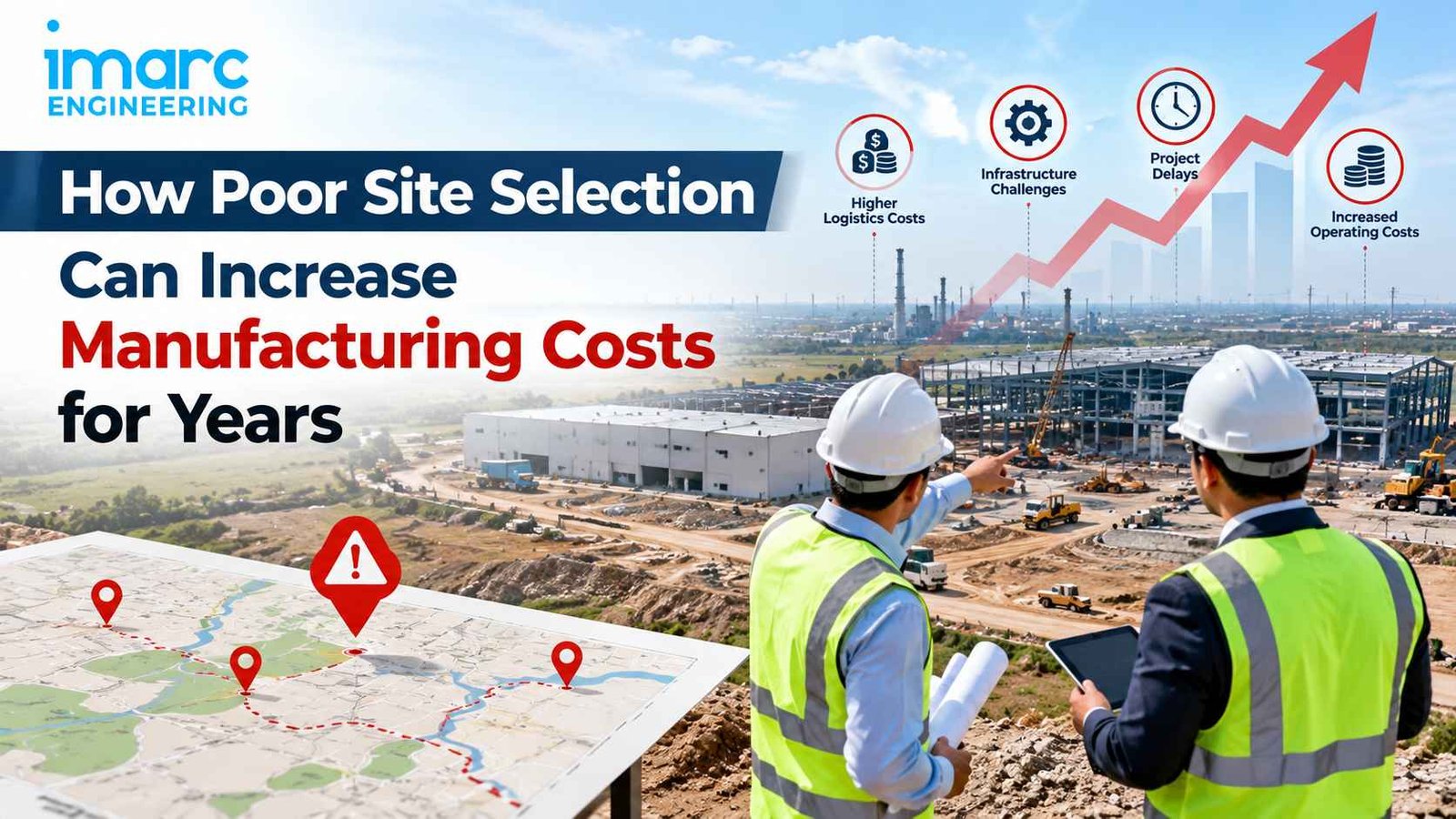
A manufacturing site is one of the few project decisions that cannot be reversed cheaply. Once land is bought and utilities are connected, the choice stays with the plant for 20 to 40 years, and every weakness in it shows up again in the annual cost sheet.
The pressure to decide quickly is rising. India’s industrial and logistics absorption reached 24.3 million sq ft in Q3 2026, up 14.1% year on year, with manufacturing taking 31% of it. Tier-I cities captured 82% of take-up, and JLL notes that scarce affordable land is pushing manufacturers toward rushed or capex-light choices.
Structured location analysis and site selection costs a fraction of what a wrong site costs later. This article explains where poor site selection adds cost, with the latest benchmarks for each area.
In Short: Poor site selection raises costs through utility connection gaps (15% to 25% of capex at isolated sites against 2% to 5% in organised estates), approval delays of 3 to 12 months, foundation surprises above ₹1 crore, weak logistics access and no room to expand.
1. Why Does a Wrong Site Keep Costing Money for Decades?
Site-linked costs repeat every year, while the cost of choosing well is paid once.
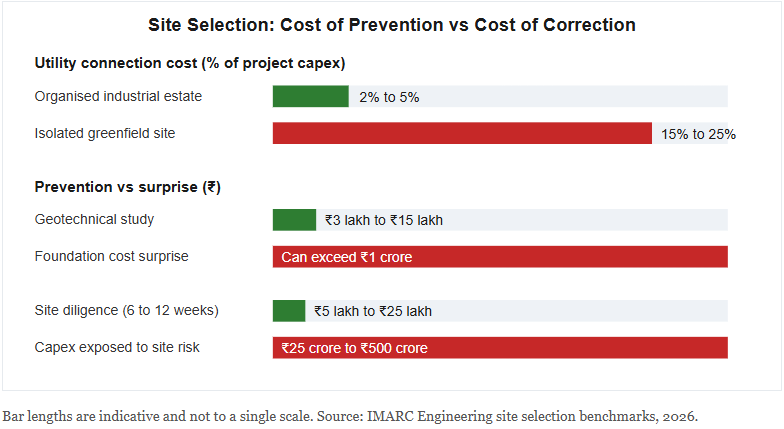
- Structured site evaluation typically costs ₹5 lakh to ₹25 lakh, against project capex of ₹25 crore to ₹500 crore.
- A complete evaluation takes 6 to 12 weeks, covering desk research, site visits and statutory verification.
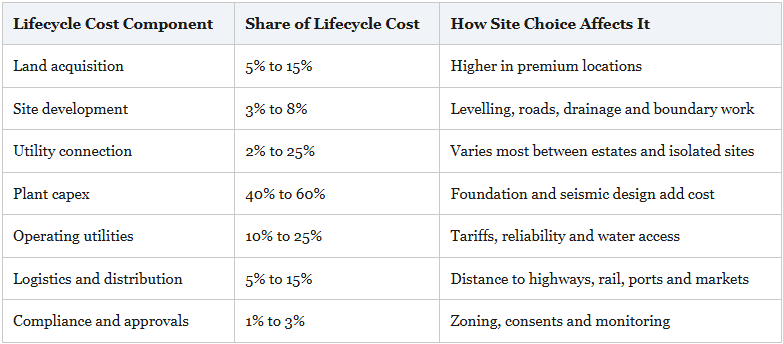
- Operating utilities form 10% to 25% of lifecycle cost, and logistics another 5% to 15%, both set largely by location.
- Lower land cost often hides higher total cost of ownership once utilities, logistics and compliance are added.
- Tier-I cities took 82% of Q3 2026 absorption, yet Tier-II and III cities, at 18%, offer lower land costs that only pay off if utilities and logistics are verified first.
2. How Do Utility Gaps Inflate Capex?
Utility connection is the largest and most variable site-linked cost, and it is paid before the first product ships.
- Organised industrial estates need 2% to 5% of project capex for utility connections. Isolated greenfield sites need 15% to 25%.
- HT power line extension costs ₹30 lakh to ₹5 crore per km, and water pipelines ₹20 lakh to ₹2 crore per km.
- Groundwater in CGWA critical or over-exploited zones faces withdrawal limits, and Zero Liquid Discharge is mandatory for CPCB-notified sectors.
- Water and wastewater constraints are now a leading cause of project delay.
- Industrial estates run by agencies such as MIDC, GIDC, KIADB and SIPCOT typically provide substations, roads and drainage already in place.
3. How Do Zoning, Title and Approval Gaps Delay Production?
Legal and zoning errors do not add a line item. They add months of idle capital.
- Agricultural land needs Change of Land Use (CLU) or NA conversion, which typically takes 3 to 12 months.
- Stamp duty runs 5% to 8% of transaction value, plus about 1% registration charges.
- A proper industrial land checklist has 40 to 60 items across title, encumbrance, litigation and possession.
- Skipping diligence to save 4 to 6 weeks routinely produces years of downstream disputes.
- India Industrial Land Bank data shows over 4,500 industrial parks across about 7.70 lakh hectares, of which 1.35 lakh hectares remain available, so approved industrial zoning is often an option.
- Approvals needed on site include Environmental Clearance, Consent to Establish, Consent to Operate, Fire NOC and CGWA NOC where notified.
Specialist land acquisition services help identify and address these gaps before payment by verifying land titles, encumbrances, zoning regulations, and Change of Land Use (CLU) status through a structured due diligence process.
4. What Hidden Costs Come from Weak Logistics and Workforce Access?
A cheap plot far from highways, rail or skilled labour raises cost on every truck and every shift.
- Sites within 5 to 10 km of major highways enjoy strong logistics economics. Farther sites need dedicated approach roads.
- Rail siding access and Dedicated Freight Corridors cut bulk transport cost, which road-only sites cannot match.
- Land prices run ₹5,000 to ₹25,000 per sq m in Tier-I peripheries, ₹2,000 to ₹10,000 in Tier-II clusters and ₹500 to ₹3,000 in Tier-III areas.
- Estate plots in corridors are typically priced 20% to 40% below open-market land, and 99-year leases at 20% to 40% of freehold.
- Colliers reported industrial vacancy at 17.2% in H1 2026, so well-connected Grade A space is available in some markets without buying land.
JLL observes that Tier-II markets are seeing manufacturers buy land for customisation and long-term control. That choice works only when title, power and water have been verified in advance.
5. Why Do Soil, Flood and Seismic Risks Create Long-Term Cost?
Physical risks are invisible on a land brochure and expensive once construction starts.
- Geotechnical testing costs ₹3 lakh to ₹15 lakh but can prevent foundation surprises above ₹1 crore.
- Seismic Zones IV and V need enhanced structural detailing, which raises civil cost.
- Flood-prone plots face operational disruption and higher insurance premiums.
- Cyclone, extreme heat and water stress affect building design, cooling cost and long-term water availability.
6. How Does Missing Expansion Land Lock in Higher Costs?
A site sized only for phase one forces expensive land purchases and utility retrofits later.
- Plan expansion land equal to 50% to 100% of the initial requirement.
- Size utility infrastructure at 110% to 125% of initial demand to avoid retrofits.
- Land requirement ranges from 2,000 to 5,000 sq m for small units to 20,000 to 100,000 sq m or more for large integrated plants.
The table below shows how site choice influences each part of the lifecycle cost.
7. How Can Manufacturers Avoid Costly Site Decisions?
A disciplined process turns a one-time decision into a lasting cost advantage.
- Compare shortlisted sites on total cost of ownership over 20 to 30 years, not on land price alone.
- Prefer corridor-aligned sites and state industrial estates, which typically complete 20% to 40% faster than standalone development.
- Verify title, zoning, utilities and environmental sensitivity before any payment.
- Commission geotechnical, seismic and flood assessments early.
- Provision expansion land and utility capacity at the start.
How IMARC Engineering’s Expertise Can Help in Location Analysis and Site Selection
IMARC Engineering supports manufacturers before capital is committed:
- Market, workforce and supplier accessibility analysis across shortlisted locations
- Title, encumbrance, zoning and CLU validation
- Utility availability assessment with connection cost estimates
- Logistics scoring, geotechnical coordination, and seismic and flood risk screening
- Expansion land provisioning and total lifecycle cost comparison
Consult With Our Experts: https://www.imarcengineering.com/contact?service=location-analysis-and-site-selection
Conclusion
Poor site selection rarely fails loudly. It adds higher utility bills, slower approvals, costly retrofits and blocked expansion year after year. Manufacturers that invest 6 to 12 weeks in structured evaluation protect capex of ₹25 crore to ₹500 crore from avoidable risk. Treat site selection as a lifecycle cost decision, verify title, zoning and utilities before buying, and plan growth room from day one, so the plant stays competitive for the next two to four decades.
Contact Us:
IMARC Engineering
Phone: +91-120-433-0800
Email: sales@imarcengineering.com
India: C-130, Sector 2, Noida, Uttar Pradesh 201301
LinkedIn: https://www.linkedin.com/showcase/imarc-engineering/
About the Author