Cosmetics manufacturers entering or expanding in India in 2026 face one non-negotiable gatekeeper before commercial production can begin. Without the correct licence under the Cosmetics Rules, 2020, no facility can legally formulate, fill, pack, or sell cosmetic products, regardless of how ready the plant or product line is.
Getting this right matters more than most manufacturers expect. A cosmetic manufacturing license in India determines market access, buyer qualification for export and modern trade, and business continuity, since a suspended or cancelled licence halts operations immediately. This guide walks through licence routes, requirements, documentation, timelines, and post-grant compliance for 2026.
What Is a Cosmetic Manufacturing License in India?
A cosmetic manufacturing licence, granted in Form COS-8, is the legal permit issued by the State Licensing Authority (SLA) under Rule 26 of the Cosmetics Rules, 2020 authorising a manufacturer to formulate, fill, pack, label, and sell cosmetics from a specified facility. The application is filed in Form COS-5. The licence is valid in perpetuity, subject to a retention fee payable every 5 years.
- Governing law: Drugs and Cosmetics Act, 1940 and Cosmetics Rules, 2020 (notified by MoHFW)
- Issuing authority for domestic manufacturing: State Licensing Authority
- Issuing authority for imports and new cosmetics: Central Licensing Authority (CDSCO)
- Product standards authority: BIS, per the Ninth Schedule
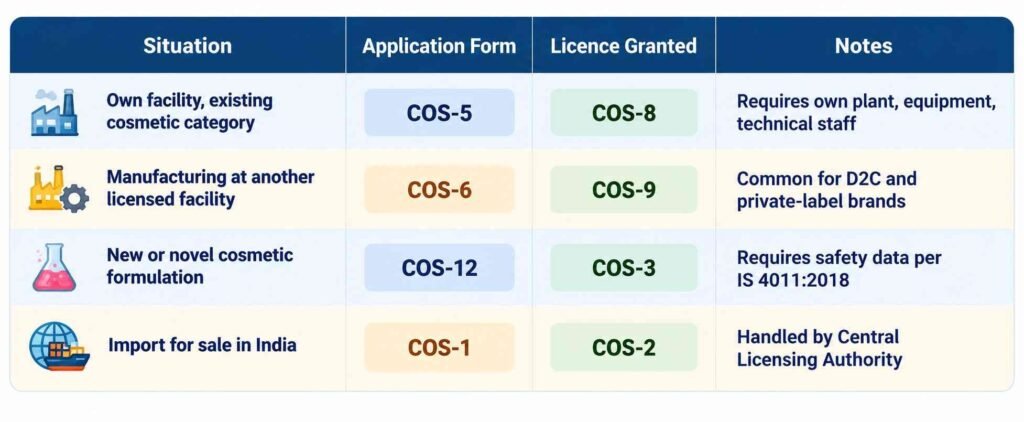
Licensing Routes: Which One Applies to You
The correct route depends on premises ownership and product novelty:
Need a Cosmetic Manufacturing License? Consult IMARC Engineering today: https://www.imarcengineering.com/contact?service=regulatory-approval-and-licensing&subservice=cosmetic-manufacturing-license
Core Requirements Before Filing
- Premises compliant with the Seventh Schedule: separate zones for raw material storage, weighing, manufacturing, filling, finished goods, and quality control, with potable water supply and adequate drainage
- Plant and equipment matched to product category (homogenizers for creams, sifters for powders, bead mills for nail polish, and similar category-specific machinery)
- At least one whole-time technical person meeting Rule 26 qualifications: a Pharmacy Council diploma, Pharmacy Act registration, Intermediate with Chemistry, or a Cosmetic Technology degree
- Testing arrangement, either an in-house laboratory meeting Eleventh Schedule GLP requirements or an NABL-accredited external laboratory
- GMP systems aligned to the Seventh Schedule, with ISO 22716:2007 as the international benchmark for export-facing manufacturers
Documentation That Determines Approval Speed
Second Schedule Part II sets the documentation baseline. Applications commonly get delayed for a handful of repeat reasons:
- Incomplete site master file or layout inconsistent with the intended product list
- Technical staff qualification proofs not matching Rule 26 criteria
- Missing Ninth Schedule BIS specification citations for the applicable product category
- Incomplete draft labelling submitted in triplicate under Rule 34
- Consent to Establish/Operate or fire NOC not filed alongside the core application
Preparing an audit-ready dossier against the state-specific SLA checklist before submission is the single most effective way to reduce query cycles.
Application Timeline: What to Actually Expect
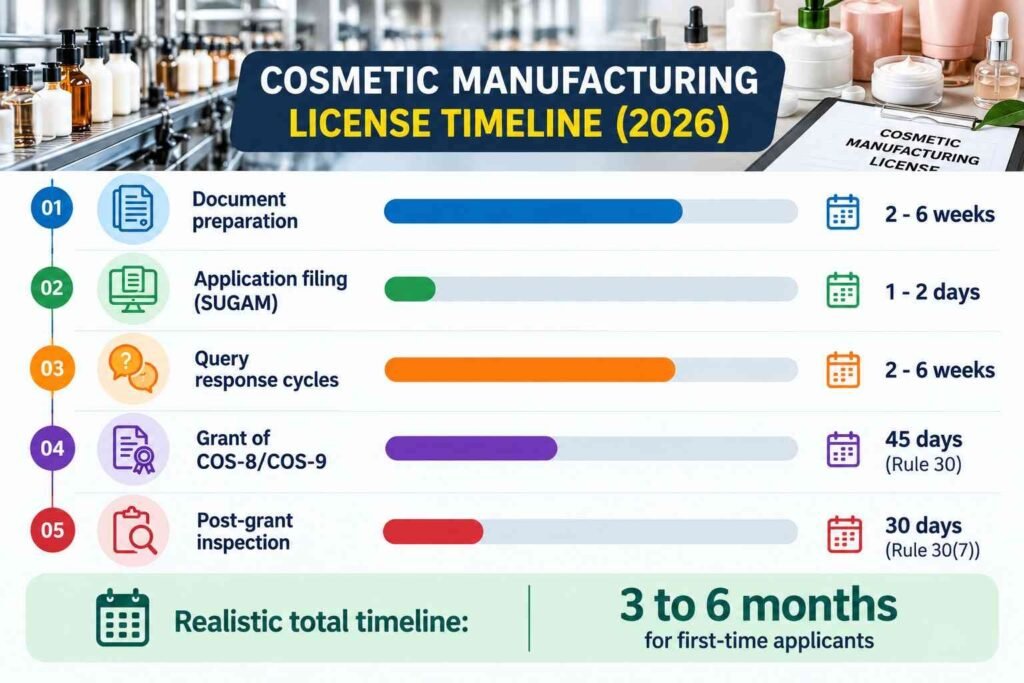
The licence itself is granted within 45 days of scrutiny under Rule 30. A GMP inspection follows within 30 days of grant, and if the SLA fails to inspect within that window, the licence is deemed valid for all purposes.
Why This Matters More in 2026
India’s cosmetics market has entered a phase where licensing discipline directly affects commercial opportunity:
- The India cosmetics market was valued at USD 25.57 billion in 2025, with Fortune Business Insights projecting growth to USD 44.63 billion by 2032 at an 8.28% CAGR
- Industry organisers at Cosmetica 2026 placed India’s broader beauty and personal care market above USD 30 billion in 2026, positioning the country as a manufacturing and innovation hub, not just a consumer market
- India exported USD 2.6 billion worth of essential oils, perfumes, cosmetics, and toiletries in FY2024-25, reaching 200 countries
- Export buyers in the EU, US, ASEAN, and Middle East increasingly request COS-8 licence copies, GMP certificates, and Ninth Schedule BIS test reports as supplier qualification proof
Manufacturers with clean, disciplined licences access this growth and export opportunity in a way unlicensed or non-compliant peers cannot.
Post-Licensing Compliance: The Perpetual Licence Is Not a Free Pass
- SLA inspection cycle: at least once every 3 years for licensed sites, with Form COS-11 maintained on-site
- Retention fee: due before the 5-year anniversary of licence issue, with a late fee of 2% per month if paid within 180 days
- Deemed cancellation: applies if the retention fee remains unpaid 180 days beyond the due date
- Change notifications: labelling, composition, or specification changes must be reported to the SLA within 30 days; a change in firm constitution requires a fresh licence within 6 months
- Record retention: batch manufacturing records under the Eighth Schedule must be kept for 3 years after the batch’s expiry date
How IMARC Engineering Supports Cosmetic Manufacturing Licensing
- Selecting the correct licence route between own-facility, loan-licence, and new cosmetic permission based on manufacturing arrangement
- Designing Seventh Schedule-compliant plant layouts and equipment specifications before construction begins
- Compiling the Second Schedule Part II document dossier against state-specific SLA checklists to reduce query cycles
- Coordinating GMP documentation, technical staff qualification records, and NABL laboratory arrangements
- Managing post-grant inspection readiness, retention fee tracking, and change notification compliance
Read our detailed guide here: https://www.imarcengineering.com/blog/how-to-get-cosmetic-manufacturing-license-in-india
Conclusion
Securing a cosmetic manufacturing licence in India in 2026 comes down to three disciplines: choosing the correct route between COS-8, COS-9, and COS-3, submitting a complete Second Schedule dossier the first time, and sustaining GMP and reporting compliance after grant. With India’s cosmetics market crossing USD 25 billion and exports reaching 200 countries, licensing discipline is now a direct driver of market and export access, not just a regulatory formality.
FAQs
What is a cosmetic manufacturing license in India?
It is a legal permit issued by the State Licensing Authority under the Cosmetics Rules, 2020, authorising a manufacturer to formulate, fill, pack, and sell cosmetics. Application is made in Form COS-5; the licence is granted in Form COS-8.
Who issues a cosmetic manufacturing license in India?
The State Licensing Authority issues COS-8 manufacturing licences and COS-9 loan licences. CDSCO, the Central Licensing Authority, separately handles import registration and new cosmetic permissions.
How long does it take to get a cosmetic manufacturing license?
The licence is granted within 45 days of scrutiny under Rule 30. Including document preparation and premises readiness, the realistic total timeline is 3 to 6 months for first-time applicants.
How long is a cosmetic manufacturing license valid?
COS-8 and COS-9 licences are valid in perpetuity, subject to a retention fee every 5 years. Non-payment for 180 days beyond the due date results in deemed cancellation.
What documents are required for a cosmetic manufacturing license?
Per Second Schedule Part II: a site master file, plant layout, technical staff qualification proofs, product list, GMP compliance undertaking, premises ownership or lease proof, and fee payment receipt from the SUGAM portal.
Contact Us:
IMARC Engineering
Phone: +91-120-433-0800
Email: sales@imarcengineering.com
India: C-130, Sector 2, Noida, Uttar Pradesh 201301
LinkedIn: https://www.linkedin.com/showcase/imarc-engineering/
About the Author