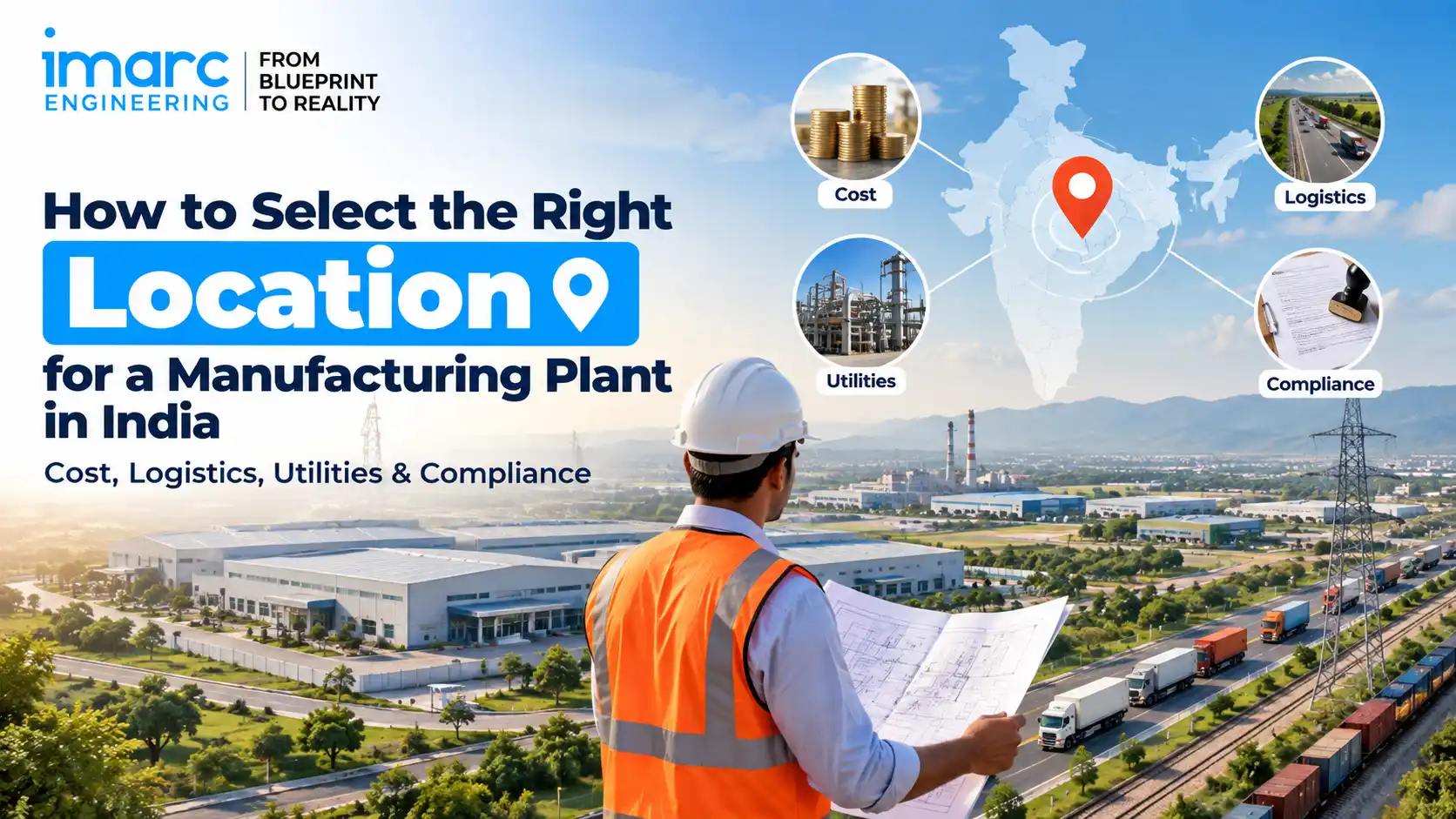
A parcel of industrial land can look like a bargain on paper — low per-acre cost, an attractive state incentive, or an apparently suitable industrial parcel. Then the plant gets commissioned, and the real costs show up: trucks queuing for hours to reach the highway, a grid connection that trips during peak summer load, a groundwater source that runs dry by March, or a compliance requirement nobody flagged during due diligence.
This is the recurring problem with manufacturing plant location selection in India the visible cost of land is rarely the real cost of a site. Logistics, utilities, statutory approvals, site development, and room to expand can materially affect a plant’s long-term operating cost and viability — and most of that only becomes clear after the land is already bought.
Manufacturing plant site selection has to be treated as a single, integrated decision rather than a checklist ticked off department by department. Land, raw materials, customer proximity, logistics, power, water, compliance, labour availability, the surrounding industrial ecosystem, incentives, and future expansion all interact with each other. A location that scores well on one factor can quietly fail on another — and that failure usually surfaces only after construction has started.
Why Manufacturing Plant Location Selection Matters
India’s manufacturing sector is being pushed to grow faster and contribute more to national output. The Economic Survey 2025-26 describes the National Mission on Manufacturing as a foundational policy blueprint, targeting an increase in manufacturing’s share of GDP from 12.9% in 2023 to 25% by 2035, alongside 143 million jobs and USD 1.2 trillion in merchandise exports. Manufacturing accounted for 12.9% of India’s GDP in 2023, according to the Economic Survey 2025-26. The National Mission on Manufacturing aims to raise manufacturing’s contribution to 25% of GDP by 2035.
This growth push means more capacity is being planned across sectors simultaneously — automotive, electronics, pharmaceuticals, engineering goods, and process industries are all expanding. It also means competition for good industrial land, skilled labour, and reliable utility connections is intensifying in established clusters.
Relocating a commissioned plant is not a practical fallback. Civil structures, utility connections, statutory approvals, and the local supply chain are all fixed once construction begins. A site problem discovered after commissioning usually gets solved with recurring operating cost — extra transport, standby power, water tankers — rather than a clean fix.
Start With the Manufacturing Process
Before comparing locations, define what the process actually requires. Site selection criteria should follow from the plant, not the other way round.
This means understanding:
- Raw material form, volume, and how it’s transported (bulk, liquid, hazardous, temperature-sensitive)
- Continuous versus batch production, and sensitivity to power interruption
- Water intensity — process water, cooling water, boiler feed, effluent volume
- Workforce mix — skilled operators, technicians, and unskilled labour ratios
- Outbound logistics — finished goods volume, packaging, and mode of dispatch
- Waste and effluent streams that will need treatment or disposal
- Space needed now, and space likely to be needed for the next expansion phase
A location that suits a light assembly operation may be entirely unsuitable for a water-intensive process plant. This is why site comparisons done before the process is defined tend to be generic and get revisited later, at higher cost.
Evaluate Land Cost Beyond the Purchase Price
Land price per acre is only the starting point. A thorough evaluation covers:
- Clear title and absence of litigation or encumbrance
- Zoning and permitted land use for the intended industry
- Plot shape, dimensions, and suitability for the planned layout
- Natural drainage, flood history, and soil-bearing capacity
- Existing site access versus the access the plant will actually need
- Grading, levelling, and site development costs
- Internal road and boundary infrastructure requirements
- Room left over for future expansion after the current layout is built
Two plots priced identically per acre can differ substantially in total development cost once grading, drainage, and access roads are priced in.
Analyse Raw-Material and Market Access
Manufacturing plant location selection in India has to weigh two directions of movement: raw materials coming in, and finished goods going out.
- Proximity to key suppliers, and the resilience of that supply if a single supplier is disrupted
- Seasonal availability of agricultural or other variable-supply raw materials
- Distance to the primary customer base or distribution clusters
- Export or import requirements, including proximity to ports, ICDs, or air cargo
- Overall supply-chain resilience — single-corridor dependence is a common, underestimated risk
A site close to raw material sources but far from customers (or vice versa) can still work, but only if the freight economics are modelled honestly rather than assumed.
Check Road, Rail, Port and Multimodal Connectivity
Geographic proximity to a highway, railway line, or port on a map is not the same as usable connectivity. What matters is whether heavy vehicles can actually reach the site efficiently, day to day.
The PM GatiShakti National Master Plan, launched to bring together infrastructure planning across ministries including Railways and Roadways for coordinated implementation of connectivity projects, is a useful reference layer for understanding planned road, rail, and multimodal infrastructure around a candidate site, since it covers economic zones such as industrial corridors, textile clusters, and logistics infrastructure intended to improve business competitiveness (Source: PIB). According to the Press Information Bureau, In a government progress update, PM GatiShakti was reported to have been used for planning more than 8,891 km of roads and over 27,000 km of railway lines.
At the project level, what needs verification is different from national planning data:
- Last-mile road condition and width for laden trucks and trailers
- Weight and height restrictions on approach roads and bridges
- Distance and turnaround time to the nearest functional rail siding or ICD
- Port handling capacity relevant to the product (bulk, container, liquid)
- Congestion patterns at peak hours, not just distance on a map
Validate Power and Water Availability
Utility assumptions are one of the most common causes of post-commissioning cost overrun. Availability on paper and reliable supply at the site are not the same thing.
- Confirm actual substation capacity and headroom, not just stated grid availability
- Check historical outage frequency and voltage stability in the area
- Assess feasibility and cost of the required power connection, including any augmentation
- Plan backup power sizing based on real process criticality
- Verify process and cooling water source, quantity, and seasonal variation
- Confirm groundwater permissions or surface water allocation, where applicable
- Test water quality against process requirements, not just general potability
Utility validation should involve a site visit and, where possible, direct confirmation from the relevant discom or water authority — not developer assurances alone.
Assess Environmental and Regulatory Constraints
Environmental and regulatory requirements vary by industry category, production capacity, process type, and location — there is no single checklist that applies to every plant. Site due diligence should map out:
- Applicable environmental clearance or consent requirements (state or central level, depending on category)
- Water and air emission norms relevant to the process
- Solid and hazardous waste handling and disposal obligations
- Fire and industrial safety approvals
- Land-use restrictions, including proximity to ecologically sensitive or residential areas
These requirements should be confirmed with the relevant state pollution control board and other statutory authorities early, since clearance timelines directly affect the project schedule.
Evaluate Labour and Industrial Ecosystem
A plant does not operate in isolation — it depends on the ecosystem around it.
- Availability of skilled and semi-skilled workers within reasonable commuting distance
- Presence of ITIs, polytechnics, or engineering colleges feeding relevant trades
- Access to component suppliers, job-work vendors, and contract manufacturers
- Local testing labs, calibration services, and maintenance contractors
- Warehousing and third-party logistics support nearby
- Whether the site sits within or near an established industrial cluster for the sector
Established industrial ecosystems reduce vendor development time and maintenance turnaround, which matters more over a plant’s operating life than most one-time incentives.
Consider Government Incentives Carefully
State industrial incentive packages — capital subsidies, SGST reimbursement, duty concessions, or plug-and-play infrastructure — can meaningfully improve project economics. But an incentive should never be the deciding factor by itself.
Incentives need to be evaluated alongside total project economics: logistics cost over the plant’s life, utility reliability, compliance timelines, and labour availability. A location with a smaller incentive but materially lower long-term operating cost may still offer stronger overall project economics.
Plan for Future Expansion
Site selection should account for growth beyond the initial phase:
- Reserved land for additional production lines or warehousing
- Utility connections sized (or upgradable) for future capacity
- Space for expanded parking, effluent treatment, and waste systems
- Internal road layout that won’t need to be redone for expansion
- Zoning and approvals that permit future built-up area increases
Site Selection Comparison Table
| Factor | What to Check | Potential Project Impact |
|---|---|---|
| Land | Title, zoning, soil, drainage, development cost | Hidden site development cost, delayed construction |
| Raw materials | Supplier distance, seasonal supply, resilience | Inventory cost, production disruption risk |
| Logistics | Road/rail/port access, last-mile condition | Higher freight cost, delivery delays |
| Power | Substation capacity, reliability, connection cost | Downtime, backup power capex |
| Water | Source, permissions, quality, seasonality | Production stoppage, treatment cost |
| Compliance | Applicable clearances, timelines | Project delay, penalty risk |
| Labour | Skilled workforce availability, institutes nearby | Hiring delay, training cost |
| Ecosystem | Vendors, contractors, industrial cluster presence | Maintenance turnaround, vendor cost |
| Incentives | Eligibility, disbursement track record | Cash flow timing, not a standalone driver |
| Expansion | Reserved land, scalable utilities | Cost of retrofitting later |
How to Compare Shortlisted Sites
A structured, weighted evaluation reduces the risk of a decision driven by whichever site was visited last.
- Define criteria specific to the project’s process and supply chain
- Assign weights to each criterion based on how critical it is to this particular plant
- Collect verified evidence for every site — not developer claims
- Compare capital cost and ongoing operating cost together, not capex alone
- Conduct physical site visits and legal due diligence before shortlisting narrows further
- Document assumptions made at each stage, so decisions can be traced back later
Common Manufacturing Site-Selection Mistakes
- Choosing land based on price per acre alone
- Selecting a site primarily because of an incentive package
- Assuming utility availability without direct verification
- Ignoring last-mile connectivity in favour of headline distance figures
- Overlooking seasonal water availability
- Underestimating actual logistics cost over the plant’s life
- Ignoring environmental and regulatory constraints until late in the project
- Failing to assess local labour availability and skill match
- Leaving no land reserved for future expansion
- Finalising a site before completing adequate due diligence
Manufacturing Plant Location Selection Checklist
- Process requirements clearly defined
- Land title, zoning, and legal suitability confirmed
- Raw material access and supply resilience assessed
- Market and distribution access evaluated
- Road, rail, and port connectivity verified at ground level
- Power capacity and reliability confirmed with the discom
- Water source, quality, and permissions validated
- Environmental and regulatory requirements mapped
- Labour availability and skill match assessed
- Industrial ecosystem and vendor base evaluated
- Incentives reviewed as part of total project economics
- Expansion land and scalable utilities planned
- Total project economics compared across shortlisted sites
- Physical and legal site due diligence completed
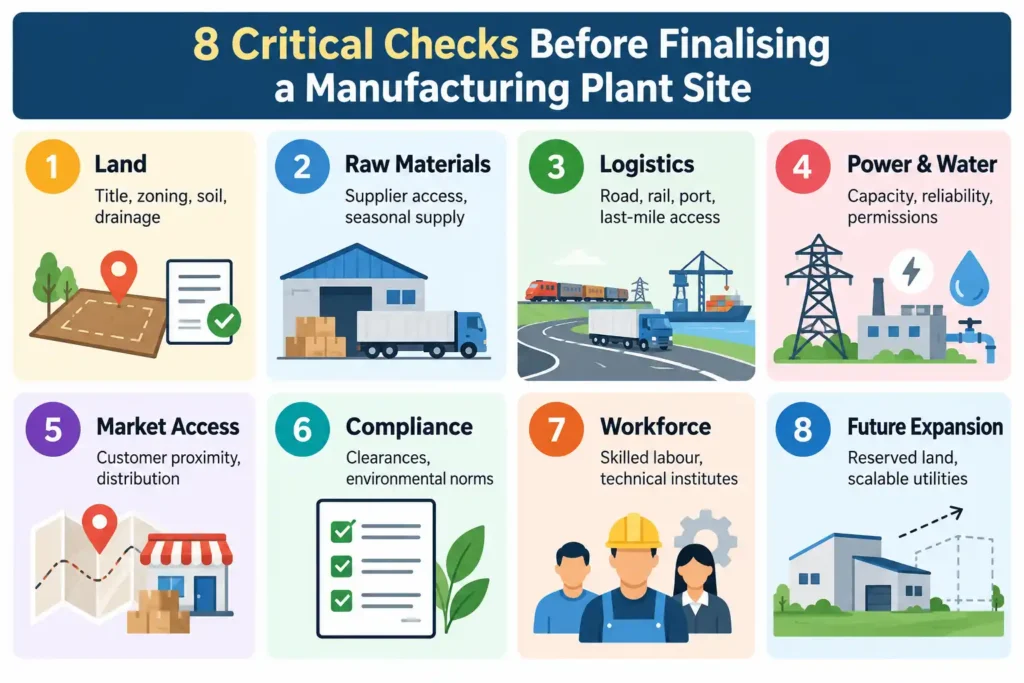
Compare total project economics — not land price alone.
How IMARC Engineering Can Help
Evaluating a manufacturing site properly requires engineering judgement, not just a checklist. IMARC Engineering supports manufacturers and project developers with:
- Manufacturing site-selection assessment
- Location screening and comparative evaluation
- Land and infrastructure assessment
- Logistics and supply-chain analysis
- Utility (power and water) assessment
- Regulatory and environmental consideration mapping
- Site due-diligence inputs
- Manufacturing plant feasibility and project planning
Planning a new manufacturing plant? IMARC Engineering can help evaluate potential locations across land, logistics, utilities, compliance, workforce and future expansion requirements before you commit capital: https://www.imarcengineering.com/contact?service=location-analysis-and-site-selection
Conclusion
There is no universally “best” state, city, or industrial area for a manufacturing plant — the right site is the one that works for that specific process, supply chain, market, and regulatory profile. Manufacturing plant location selection in India is ultimately a question of total project economics, evaluated across land, logistics, utilities, compliance, labour, and expansion together.
The sites that perform well over the long run are the ones evaluated with this level of rigour before capital is committed — not adjusted for after the plant is already built.
Contact Us:
IMARC Engineering
Phone: +91-120-433-0800
Email: sales@imarcengineering.com
India: C-130, Sector 2, Noida, Uttar Pradesh 201301
LinkedIn: https://www.linkedin.com/showcase/imarc-engineering/
About the Author