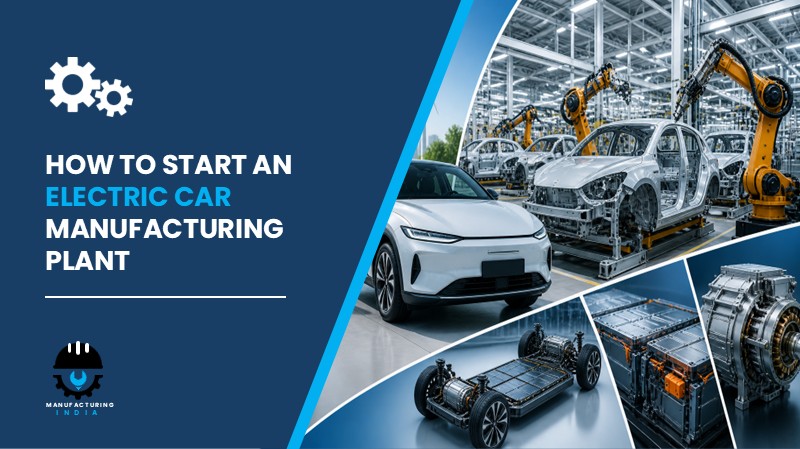
Setting up an electric car manufacturing plant in India presents a compelling investment case driven by surging demand across passenger transportation, ride-hailing fleets, logistics and delivery services, and government and municipal transport. Electric cars – automobiles powered by electric motors drawing energy from rechargeable battery systems rather than internal combustion engines – are increasingly regarded as essential infrastructure for India’s urban mobility transformation. As the country’s cities expand rapidly and air quality concerns intensify, the shift toward zero-emission vehicles is accelerating across both private and public sectors, creating robust long-term demand for domestic electric car production.
India’s structural advantages make it a strategically sound location for this investment. The country’s rapid urbanisation, expanding road and highway infrastructure, and the central government’s Make in India initiative collectively create favourable conditions for domestic electric vehicle production. Key manufacturing states such as Gujarat, Maharashtra, and Tamil Nadu offer industrial estates, SEZ options, and established automotive supply chains that can significantly reduce setup timelines and logistics costs. With fleet operators and automakers now actively preferring locally manufactured vehicles to reduce import dependence and improve delivery speed, the case for establishing production capacity within India has never been stronger.
Establishing an electric car manufacturing plant in India combines strong policy support, cost-competitive manufacturing conditions, and multi-sector demand from passenger mobility, commercial fleets, and government transport. With gross profit margins ranging between 15-25% and a global market projected to reach USD 749.21 Billion by 2034, the investment offers viable break-even prospects across a range of production capacities.
What is an Electric Car?
Electric cars are automobiles that operate through electric motors which draw power from rechargeable batteries, replacing the traditional internal combustion engine with a fully electrified powertrain. These vehicles utilise lithium-ion batteries and advanced solid-state battery systems, combined with power electronics, electric drivetrains, and regenerative braking systems to deliver efficient, low-emission transportation.
Electric cars offer significantly lower operational expenses compared to conventional vehicles, require minimal maintenance, produce no exhaust emissions, and operate with substantially reduced noise levels – attributes that make them attractive to both private buyers and institutional fleet managers. The production process involves body fabrication, chassis assembly, battery pack assembly, motor integration, power electronics installation, vehicle assembly, testing, and quality inspection.
End-use industries served by electric cars include passenger transportation, ride-hailing fleets, logistics and delivery services, and government and municipal transport. Applications span personal mobility, commercial fleet vehicles, urban transport solutions, and last-mile connectivity.
Cost of Setting Up an Electric Car Manufacturing Plant in India
The cost of establishing an electric car manufacturing plant depends on capacity, technology selection, plant location, level of automation, and regulatory compliance requirements. A thorough feasibility study is essential before committing capital, covering all CapEx and OpEx components in detail.
1. Capital Expenditure (CapEx)
Land and Site Development: represents a substantial portion of total capital investment. This covers land registration, boundary development, and related charges. Investors should evaluate industrial estates and Special Economic Zones (SEZs) in states such as Gujarat and Maharashtra, which offer infrastructure advantages and potential fiscal benefits.
Civil Works and Construction: costs encompass the main manufacturing shed, battery assembly hall, quality control laboratory, raw material and finished goods storage, and administrative block. Proper civil planning is critical given the scale and safety requirements of electric car production facilities.
Machinery and Equipment: accounts for the largest share of CapEx. Key machinery required includes:
- Advanced robotics systems
- Assembly lines
- Battery pack assembly units
- Testing rigs
Other Capital Cost: include the Effluent Treatment Plant (ETP), pre-operative expenses, commissioning charges, and applicable import duties on specialised machinery and components.
Request a Sample Report for In-Depth Market Insights: https://www.imarcgroup.com/electric-car-manufacturing-plant-project-report/requestsample
2. Operational Expenditure (OpEx)
Raw Material Cost: is the dominant component of the operating cost structure, accounting for approximately 80-85% of total OpEx. Key raw materials required include battery packs, electric motors and controllers, the glider (body-in-white), and chassis and interior components. Securing long-term contracts with reliable suppliers is essential to mitigate price volatility and ensure continuity of supply.
Utility Cost: covers electricity, water, and other energy requirements essential to sustain assembly operations and quality testing, accounting for approximately 5-8% of OpEx.
Other Operating Cost: include transportation, packaging, salaries and wages, maintenance, depreciation, and taxes. By the fifth year of operations, total operational costs are expected to increase substantially due to inflation, market fluctuations, potential rises in raw material costs, and supply chain pressures.
3. Plant Capacity
The proposed manufacturing facility referenced by IMARC Group is designed with an annual production capacity of approximately 30,000 vehicles, enabling economies of scale while maintaining operational flexibility. Capacity can be customised to match individual investor requirements, with profitability improving progressively as capacity utilisation increases toward optimal operating levels.
4. Profit Margins and Financial Projections
The electric car manufacturing plant demonstrates healthy profitability under normal operating conditions. Gross profit margins typically range between 15-25%, supported by stable end-use demand and value-added applications across fleet, passenger, and government segments. Net profit margins range between 5-12%. A comprehensive financial analysis – covering Net Present Value (NPV), Internal Rate of Return (IRR), payback period, liquidity analysis, uncertainty analysis, and sensitivity analysis – is necessary for investor decision-making and project financing.
Why Set Up an Electric Car Plant in India?
Zero-Emission Mobility Demand: The accelerating global and domestic shift toward zero-emission transportation is creating structural demand for electric cars across India’s urban and peri-urban centres. Passenger transportation and ride-hailing fleets are rapidly electrifying, providing a consistent and expanding customer base for domestic manufacturers.
Integration into Urban Mobility Ecosystems: Electric vehicles are becoming embedded in India’s urban infrastructure, including shared mobility, car-sharing, and subscription-based EV services. This diversified demand base – spanning personal, commercial, and government applications – reduces single-segment risk for plant operators.
Policy and Regulatory Tailwinds: The capital-intensive nature of electric car production has attracted multiple forms of financial support, including policy incentives, tax exemptions, subsidies, and production-linked incentive (PLI) schemes from both central and state governments. These mechanisms reduce effective capital costs and improve return on investment timelines.
Cost-Competitive Manufacturing: India offers competitive land acquisition costs, a large available workforce, and established automotive supply chains in key states. Fleet operators and automakers are actively shifting toward local sourcing to reduce import dependency and improve delivery speed, benefiting new domestic manufacturing entrants.
Active Industry Investment: In January 2026, VinFast partnered with Autobrains to develop advanced L2++ autonomous driving technologies – including an AI-driven “Robo-Car” system using seven cameras enabling scalable Level 4 autonomy – reflecting the pace of technology investment in the sector. In December 2025, Ford and Renault Group formed a strategic partnership to develop Ford-branded electric vehicles on Renault’s Ampere platform, signalling accelerating global OEM commitment to electric car production.
Local Supply Chain Preference: Automakers and fleet operators across India are increasingly choosing to source components and finished vehicles locally, reducing exposure to imported goods and enhancing supply chain resilience – a dynamic that favours well-positioned domestic electric car manufacturers.
Manufacturing Process – Step by Step
The electric car manufacturing process uses body fabrication, chassis assembly, battery pack assembly, motor integration, power electronics installation, vehicle assembly, testing, and quality inspection as the primary production method. Each stage involves dedicated unit operations, material handling, and quality assurance checks.
- Body Fabrication: Stamping and welding of the glider (body-in-white) to form the structural shell of the vehicle
- Chassis Assembly: Integration of the chassis structure with suspension, axles, and underbody components
- Battery Pack Assembly: Assembly of lithium-ion or solid-state battery cells into modules and packs using battery pack assembly units
- Motor Integration: Installation of electric motors and controllers into the drivetrain system
- Power Electronics Installation: Fitting of inverters, onboard chargers, and energy management systems using specialised assembly lines
- Vehicle Assembly: Full integration of powertrain, interior components, body shell, and trim using advanced robotics and assembly line systems
- Testing and Quality Inspection: Performance validation, safety testing, and quality assurance checks using testing rigs
- Dispatch: Finished vehicles packaged and dispatched to passenger transport operators, ride-hailing fleets, logistics companies, and government buyers
Key Applications
Electric cars serve a broad set of end-use industries and applications sourced from the IMARC Group report:
- Passenger Vehicles: Widely used for daily commuting and personal transportation
- Commercial Fleets: Deployed in ride-hailing, logistics, and delivery vehicle operations
- Government Use: Employed in public sector and municipal transport fleets
- Shared Mobility: Utilised in car-sharing and subscription-based EV services
Leading Manufacturers
The global electric car industry is served by several multinational companies with extensive production capacities and diverse portfolios across passenger and commercial segments. Key players include:
- Tesla, Inc.
- BYD Company Ltd.
- Volkswagen AG
- General Motors Company
- Ford Motor Company
- Hyundai Motor Company
- Kia Corporation
- Nissan Motor Co., Ltd.
- BMW AG
- Mercedes-Benz AG
- Toyota Motor Corporation
- Rivian Automotive, Inc.
- Lucid Group, Inc.
Timeline to Start the Plant
- Feasibility study and project report preparation
- Land acquisition and site development
- Regulatory approvals and environmental clearances
- Factory licence and fire safety compliance
- Machinery procurement and installation
- Raw material supplier agreements and supply chain setup
- Trial production and quality testing
- Commercial production launch
Licences and Regulatory Requirements
Starting an electric car manufacturing unit in India requires several approvals:
- Business registration (Proprietorship, LLP, or Private Limited Company)
- Factory Licence under the Factories Act
- Environmental Clearance from the State Pollution Control Board
- GST Registration
- Fire Safety NOC
- Hazardous/Chemical compliance (relevant for battery handling and chemical storage)
- Effluent Treatment Plant (ETP) operational clearance
- Occupational Health and Safety compliance
Key Challenges to Consider
High Capital Requirements: Establishing an electric car manufacturing plant demands significant upfront investment in land, civil works, advanced robotics, assembly lines, battery pack assembly units, and testing rigs, making access to long-term financing critical.
Raw Material Price Volatility: Battery packs, electric motors and controllers, glider components, and chassis and interior components are subject to global supply chain fluctuations and commodity price movements, which can materially impact operating margins.
Regulatory Compliance: Meeting environmental clearances, ETP requirements, battery storage safety norms, and evolving emission and vehicle safety regulations demands ongoing investment in compliance infrastructure.
Technology and Innovation Pressure: Rapid advancements in battery technology – including improvements in energy density, charging speed, and battery lifespan – require manufacturers to continually upgrade production capabilities to remain competitive.
Competition: The global market is dominated by players including Tesla, BYD, Volkswagen, General Motors, Ford, Hyundai, and Toyota, whose scale and technology investments set a high competitive benchmark for new entrants.
Skilled Manpower: Recruiting and retaining qualified engineers, technicians, and quality control specialists with expertise in EV assembly, battery systems, and power electronics is a persistent operational challenge in India.
Frequently Asked Questions
1. How much does it cost to set up an electric car manufacturing plant in India?
The total cost depends on plant capacity, technology, location, and automation level. Costs cover land and site development, civil works, advanced robotics, assembly lines, battery pack assembly units, and testing rigs. A detailed feasibility study is recommended to determine project-specific investment requirements.
2. Is electric car manufacturing profitable in India in 2026?
Yes. The electric car manufacturing plant demonstrates gross profit margins of 15-25% and net margins of 5-12% under normal operating conditions, supported by stable demand from passenger transport, fleet, and government segments.
3. What machinery is required for an electric car plant in India?
Key machinery includes advanced robotics systems, assembly lines, battery pack assembly units, and testing rigs, all of which must meet industry standards for safety, efficiency, and reliability.
4. What licences and approvals are required to start an electric car plant in India?
Required approvals include business registration, a Factory Licence under the Factories Act, Environmental Clearance from the State Pollution Control Board, GST Registration, Fire Safety NOC, ETP operational clearance, and Occupational Health and Safety compliance.
5. What raw materials are needed for electric car manufacturing?
Key raw materials include battery packs, electric motors and controllers, the glider (body-in-white), and chassis and interior components.
6. What are the environmental compliance requirements for an electric car plant in India?
Plants must obtain Environmental Clearance from the State Pollution Control Board, operate a functional Effluent Treatment Plant, comply with battery chemical storage and hazardous material norms, and adhere to emission standards throughout the manufacturing process.
7. What is the best location to set up an electric car plant in India?
Ideal locations include industrial estates and SEZs in states with established automotive supply chains, good transportation infrastructure, proximity to battery pack and component suppliers, and access to reliable utilities. Gujarat, Maharashtra, and Tamil Nadu are well-suited options.
8. What is the break-even period for this type of plant in India?
The break-even period depends on plant capacity, capital investment, capacity utilisation rates, and prevailing market prices. A detailed financial analysis including NPV, IRR, and payback period calculations is included in the IMARC Group feasibility report.
9. What government incentives are available for manufacturers in India?
Electric car manufacturers in India may access production-linked incentive (PLI) schemes, policy incentives, tax exemptions, and subsidies designed to encourage domestic EV production and reduce import dependency.
Key Takeaways for Investors
The electric car manufacturing plant opportunity in India is underpinned by sustained demand growth across passenger transportation, ride-hailing fleets, logistics and delivery services, and government and municipal transport – sectors that are all actively electrifying. The investment demonstrates financial viability across plant capacities, with gross margins of 15-25% and net margins of 5-12% achievable under normal operating conditions. The global electric car market was valued at USD 205.62 Billion in 2025 and is projected by IMARC Group to reach USD 749.21 Billion by 2034, reflecting a CAGR of 15.5% between 2026 and 2034. With global decarbonisation commitments, tightening emission regulations, expanding charging infrastructure, and the integration of EVs into smart city ecosystems all reinforcing long-term demand, the fundamentals for this investment remain structurally sound well beyond the near term.
About the Author