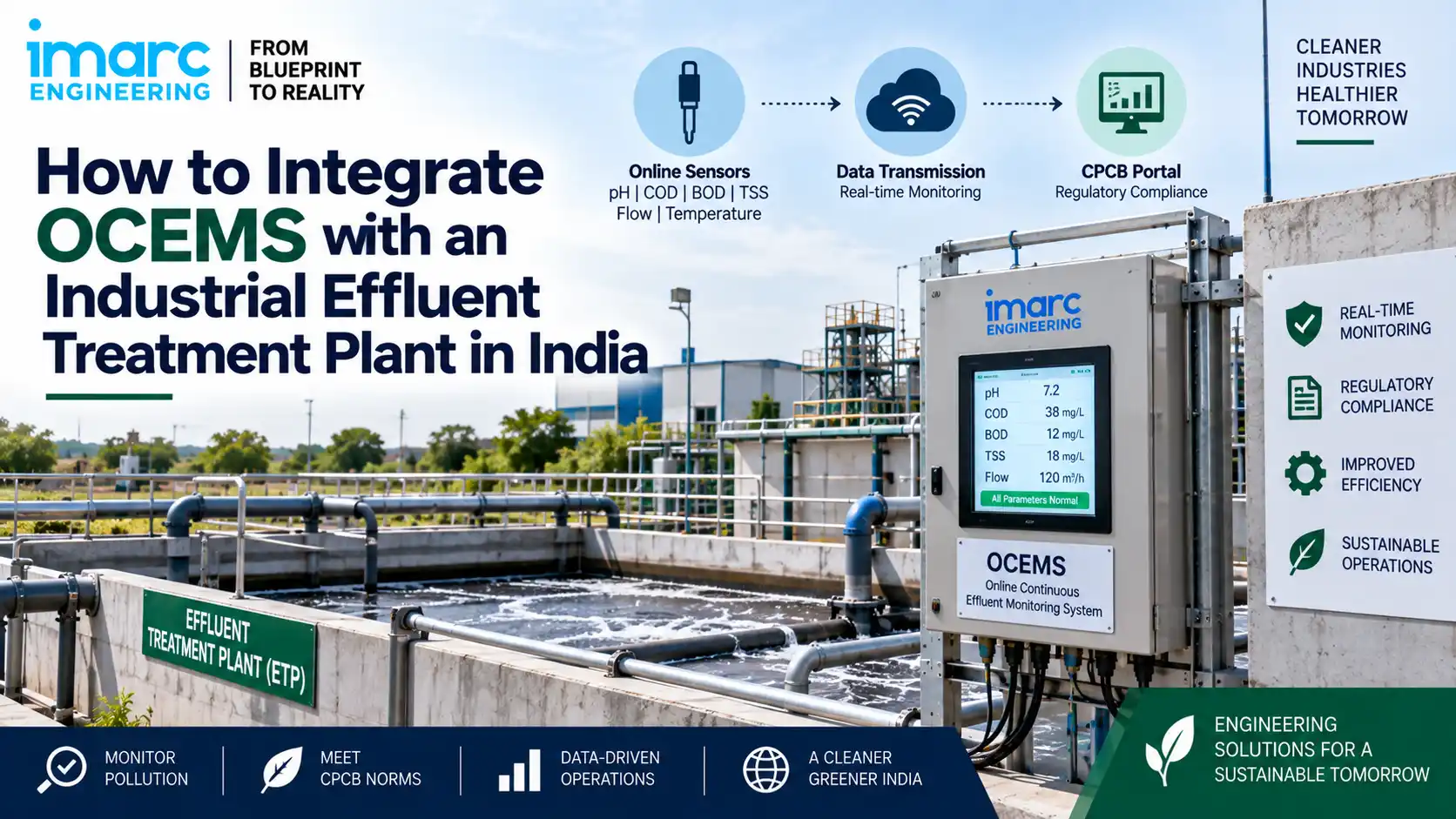
The ETP is running and the analyser is installed, yet the pH trace jumps without explanation, COD readings do not match the lab report, sensors need cleaning every few days, and data disappears from the State Pollution Control Board (SPCB) dashboard whenever the network or power fails.
Other plants face the earlier version of the problem. A new ETP is being planned, or an existing one expanded, and nobody has settled where the monitoring point will sit, which parameters apply, or who connects the analyser to the treatment process and the regulator’s server.
These are integration problems, not analyser problems. OCEMS integration with ETP means connecting the Online Continuous Emission/Effluent Monitoring System to the treatment process: the right monitoring point and parameters, reliable sampling, calibration, data acquisition, communication and regulatory connectivity. This guide explains how to get each right for OCEMS installation in India, using CPCB documents as the reference.
Why OCEMS Integration Matters for Industrial ETPs
Laboratory samples taken monthly or quarterly capture only brief moments of ETP performance. CPCB’s guidelines note that continuous measurement gives a far fuller picture of compliance. A well-integrated online effluent monitoring system turns industrial wastewater monitoring into a continuous record, providing:
- Real-time visibility at the discharge point
- ETP performance monitoring through trends
- Compliance monitoring against consent limits
- Early identification of abnormal readings through alarms
- Data transmission to CPCB and the SPCB
- Less dependence on periodic manual sampling
CPCB’s 2018 guidelines say manual sampling and laboratory analysis continue to support regulatory action, so OCEMS complements them.
Current Regulatory Context for OCEMS in India
A PIB release on the Commission for Air Quality Management (CAQM), dated 8 February 2026, reports:
| Figure | What it represents |
|---|---|
| 865 industries | OCEMS installations verified |
| 530 cases | Notices recommended to SPCBs/PCCs |
| 648 industries | Uttar Pradesh NCR units under the installation requirement |
| 320 industries | Uttar Pradesh NCR units reported with installation or purchase-order status |
These figures measure different things. The 320 figure reflects installation or purchase-order status, not confirmed operation. The release concerns NCR air-emission monitoring, so it is not an effluent count, but it shows how closely installation and connectivity are now checked. Source: PIB/CAQM, Status of OCEMS as on 08.02.2026.
Note: These figures relate to NCR air-emission OCEMS monitoring and should not be interpreted as an effluent-OCEMS installation count. The figures represent different stages of verification, notices and installation/purchase-order status.
How Does OCEMS Integrate with an Industrial ETP?
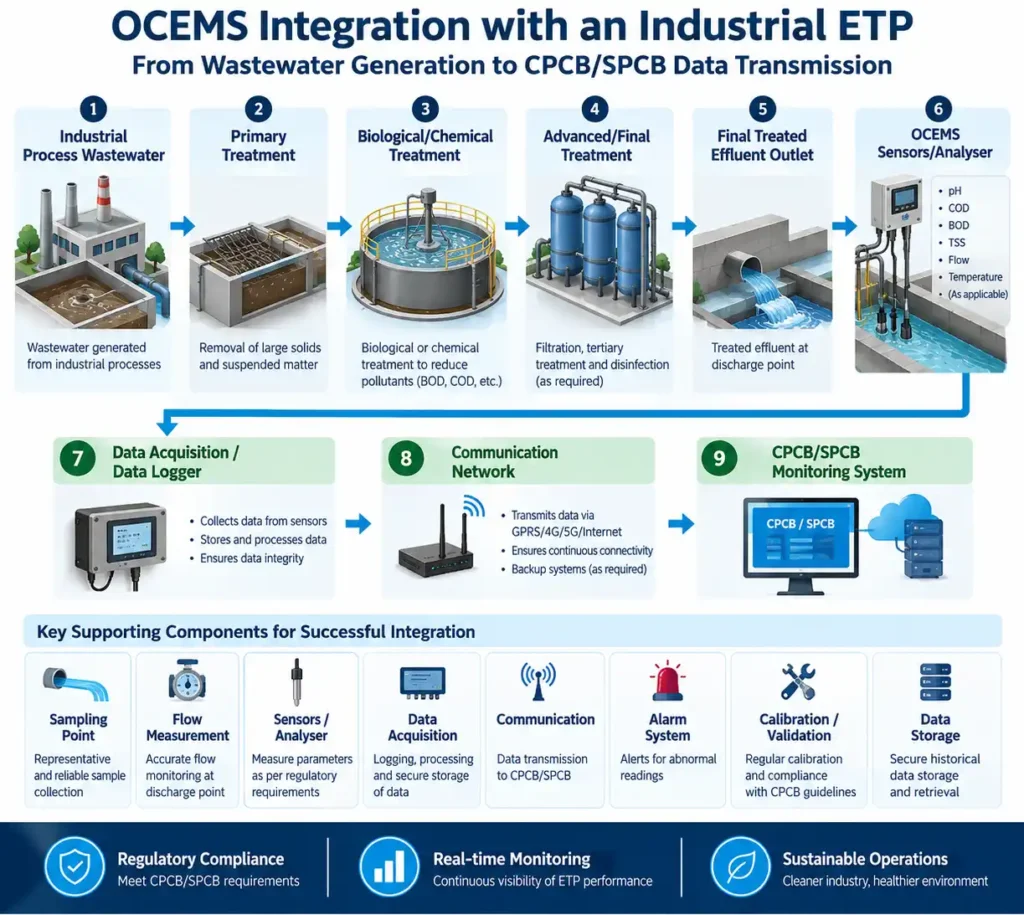
Monitoring sits after the final treatment stage. Wastewater passes through primary, biological or chemical, and advanced treatment to the final outlet. Sensors or an analyser at that outlet feed a data logger, and the data travels over a communication network to the CPCB/SPCB systems.
Supporting components hold the ETP monitoring system together: sampling point, flow measurement, sensors or analyser, data acquisition, communication, alarms, calibration and validation records, and data storage.
CPCB’s 2018 guidelines stress that sensor location matters. They prefer submersible in-situ sensors in the treated-effluent channel, with a flow-cell or extractive system where the site does not allow it, and require a camera focused on the sensors or sample inlet.
Related Insight: https://www.imarcengineering.com/blog/how-to-set-up-a-manufacturing-plant-in-india
Which Effluent Parameters Should the OCEMS Monitor?
It depends on industry category, effluent characteristics, applicable regulatory requirements, consent conditions and the treatment process. CPCB’s sector list shows the spread: cement has no real-time effluent requirement, power plants are listed for pH, TSS and temperature, and textile units for pH, COD, TSS and flow.
| Parameter | Why It Matters |
|---|---|
| pH | Acidity or alkalinity |
| BOD | Organic pollution |
| COD | Chemical oxygen demand |
| TSS | Suspended solids |
| Flow | Discharge quantity |
| Temperature | Process or discharge condition |
| Other industry-specific parameters | Depends on industry and applicable requirements |
Where a consent parameter has no well-established online technique, CPCB allows laboratory testing at least quarterly, or at the consent frequency if higher.
The exact parameter list should not be assumed to be identical for every industrial ETP. It should be mapped against the applicable industry requirements, consent conditions and CPCB/SPCB/PCC directions before specifying the OCEMS.
Is OCEMS Mandatory for Every Industrial ETP?
OCEMS requirements are not identical for every industrial ETP. Applicability depends on factors such as industry category, effluent characteristics, consent conditions and applicable CPCB/SPCB/PCC requirements. The facility-specific regulatory requirement should be confirmed before selecting or installing an OCEMS system.
7 Steps to Integrate OCEMS with an Industrial ETP
Step 1: Assess the Existing ETP
Record ETP capacity, current flow, treatment stages, the final discharge point, existing instrumentation and expansion plans. An analyser sized for today’s effluent may not suit the plant after expansion.
Step 2: Identify Applicable Monitoring Parameters
Map consent conditions, SPCB directions and CPCB sector requirements against the actual effluent, and confirm the list with the SPCB before specifying instruments.
Step 3: Select the Correct Monitoring Location
Choose the final treated-effluent point, after the last treatment stage. CPCB says the ETP discharge point must be selected deliberately for sensors or sample extraction. In practice, look for stable flow, safe access for cleaning and a representative sample, away from turbulent or stagnant zones.
Step 4: Select Appropriate OCEMS Technology
Compare technologies on parameter, measurement range, accuracy, fouling potential, maintenance and calibration effort. CPCB notes that UV-Vis and TOC-based COD and BOD values are indirect, and their correlation factors need revalidation when the effluent changes. Instrument principle and installation must conform to CPCB guidelines.
Step 5: Integrate Data Acquisition and Communication
Specify the data logger, storage, communication and remote access as one digital monitoring package. The 2018 guidelines call for one-minute averages sent every 15 minutes, buffered data after outages, five-year storage and two to three hours of backup power.
CPCB has developed a New OCEMS Portal for direct transmission of monitoring data from industries to the CPCB server. CPCB’s December 2025 notice directed applicable industries to register on the new portal and transmit OCEMS data through the prescribed system.
Before commissioning the connectivity setup, industries should verify the latest CPCB requirements and any additional instructions issued by their applicable SPCB/PCC.
.
Step 6: Calibration and Validation
Under the 2018 guidelines, pH is calibrated weekly, temperature validated monthly, and COD, BOD, TOC and TSS validated at least quarterly against laboratory results on flow-based composite samples. Permitted variation is ±10 percent for COD, BOD and TSS, and ±0.2 for pH. CPCB has since issued further SOPs, so confirm the current protocol and keep every record.
Step 7: Commissioning and Continuous Monitoring
Test readings against the laboratory, verify alarms, test transmission including outage recovery, and check sensor performance. Then fix a maintenance schedule: CPCB expects daily checks of transmission and diagnostics, monthly cleaning and backup, and at least 85 percent data availability.
Common OCEMS + ETP Integration Problems
CPCB’s guidelines acknowledge that early Indian systems often gave unreliable or no data because they were not properly operated or maintained. The same gaps recur:
| Problem | Consequence | What to Check |
|---|---|---|
| Wrong location or unrepresentative sampling | Readings do not reflect the actual discharge | Sensor position against final outlet; online versus composite lab results |
| Sensor fouling or inconsistent sample flow | Drift, gaps, frequent cleaning | Cleaning routine; pump and flow-cell condition |
| Poor accessibility | Maintenance is skipped | Safe access to sensors and cabinet |
| Power interruptions | Data gaps, analyser restarts | Backup power and restart behaviour |
| Incorrect parameter selection | Missing or unnecessary measurements | Parameters against consent and CPCB list |
| Data transmission failure | Gaps at SPCB/CPCB end | Connectivity, buffering, portal registration |
| Calibration gaps and poor maintenance | Data loses credibility | Calibration records; service contract |
| OCEMS not linked to ETP operation | Alarms never reach operators | Whether ETP staff see and act on readings |
| ETP modified without updating OCEMS | Changed effluent can invalidate correlations | Revalidation after any process change |
How to Plan OCEMS Integration During a New ETP Project
Treating OCEMS as an afterthought pushes decisions on location, power and cabling onto a finished plant. Planning it within the industrial water treatment plant design avoids that. Retrofitting is workable, but usually means working around existing channels and cable routes.
For a new ETP, OCEMS planning should be coordinated with the process design, final discharge arrangement, instrumentation layout, power supply, communication infrastructure and maintenance access. This reduces the need for avoidable modifications after the ETP is commissioned.
Design Stage
- Monitoring point provision and sampling arrangement
- Instrument location
- Power supply and communication infrastructure
Installation Stage
- Sensor and analyser installation, data acquisition and connectivity
Commissioning Stage
- Calibration, validation, performance verification and data transmission testing
Watch Our Related Vidoe: How to Set Up a Manufacturing Plant in India: Cost, Timeline, Approvals & Common Mistakes
What Information Should You Prepare Before Planning OCEMS Integration?
Before requesting quotations, confirm:
- Applicable parameters and measurement range
- ETP capacity and effluent characteristics
- Sampling location
- Calibration method
- Data transmission and CPCB/SPCB connectivity
- Power availability
- Maintenance requirements and sensor accessibility
- Future expansion
- Integration with existing instrumentation
| The right OCEMS is not simply the system with the highest number of sensors; it needs to be matched to the plant’s effluent characteristics, monitoring requirements, installation conditions and integration requirements. |
| Project Requirement | IMARC Engineering Support |
|---|---|
| Existing ETP assessment | Technical assessment |
| Monitoring point identification | Engineering/design support |
| Parameter requirement mapping | Technical planning |
| OCEMS integration | System integration planning |
| Sampling arrangement | Technical planning |
| Data connectivity | Integration coordination |
| Calibration/validation planning | Commissioning support |
| New ETP projects | Integrated project planning |
| Plant expansion | Retrofit/integration planning |
How IMARC Engineering Can Support OCEMS–ETP Integration
OCEMS analysers are normally supplied by specialist technology providers; the integration around them is an engineering task. IMARC Engineering supports manufacturers on ETP and water-infrastructure projects, from characterisation and process design to commissioning, and can help you evaluate:
- ETP process requirements and design basis
- Monitoring locations and sampling arrangements
- Integration between analysers, ETP controls and data systems
- Instrumentation planning
- Turnkey project management across the ETP contractor and OCEMS supplier
- New plant planning, expansion and retrofit needs
- Commissioning, including equipment calibration and vendor coordination
Regulatory approvals and portal acceptance remain with CPCB and the SPCB; IMARC’s role is technical assessment and planning support.
| Planning a new ETP, upgrading an existing wastewater treatment system, or evaluating OCEMS integration for an industrial plant? Contact IMARC Engineering to discuss your project requirements: https://www.imarcengineering.com/contact-us |
Conclusion
Successful ETP and OCEMS integration is the result of coordination, not a single purchase. The ETP process, monitoring point, parameters, instrumentation, calibration, data acquisition, connectivity and ongoing maintenance each decide whether readings can be trusted, and one weak link undermines the rest.
Because CPCB directions and portals have changed in recent years, verify current SPCB instructions before finalising the design. For a new ETP, an expansion or an installation that is not performing, a structured technical assessment is the practical starting point. To discuss your plant, contact IMARC Engineering.
Contact Us:
IMARC Engineering
Phone: +91-120-433-0800
Email: sales@imarcengineering.com
India: C-130, Sector 2, Noida, Uttar Pradesh 201301
LinkedIn: https://www.linkedin.com/showcase/imarc-engineering/
About the Author