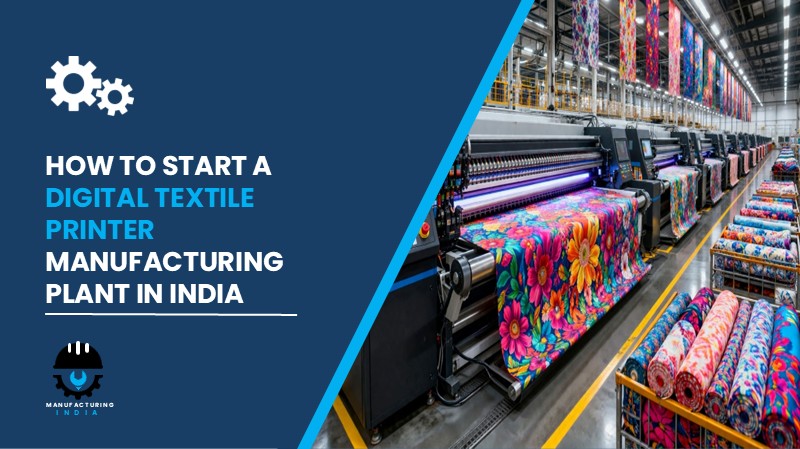
Setting up a digital textile printer manufacturing plant in India presents a compelling investment case, driven by strong and growing demand from the textile and apparel industry, home decor, fashion, advertising, and custom printing services. As Indian consumers increasingly seek personalised designs on garments, furnishings, and interior products, digital textile printers have become indispensable tools for manufacturers aiming to serve both domestic and export markets. The technology’s ability to produce intricate, high-resolution prints with faster turnaround times and lower waste compared to conventional methods makes it a strategically relevant product for India’s evolving industrial ecosystem.
India’s advantages in this sector are considerable. A large and expanding textile manufacturing base, a booming e-commerce sector driving on-demand printing, and a young urban population with rising discretionary spending all reinforce demand. The government’s Make in India initiative actively encourages domestic production of precision equipment, and industrial estates across states such as Gujarat, Maharashtra, Tamil Nadu, and Uttar Pradesh offer plug-and-play infrastructure for new manufacturing ventures. Taken together, these factors make India a strategically sound location for establishing a digital textile printer manufacturing plant that can serve both domestic and international buyers.
India’s policy environment, cost-competitive labour and land markets, and surging demand from fashion, home decor, and promotional industries together create a compelling case for investing in a digital textile printer manufacturing plant in India. With gross margins of 40-50% and net margins of 15-25%, this is a financially viable venture with strong break-even potential across a range of plant capacities.
What is a Digital Textile Printer?
A digital textile printer is an advanced industrial machine that prints artwork directly onto fabric using digital inkjet technology, delivering high accuracy and high-quality resolution. Unlike conventional printing methods, digital textile printing is capable of reproducing complex details, powerful colours, and rapid output that is efficient for both large and small production orders. The technology supports customisation, short lead times, and eco-friendly operations, significantly reducing water and ink consumption compared to traditional processes.
The main product variants include direct-to-garment (DTG) printers, designed specifically for clothing; dye-sublimation printers suited for polyester and synthetic fabrics; and pigment ink printers that cater to all natural fibres. The versatility and print quality of these machines have driven their increasing adoption across modern textile production. The production process involves raw material preparation, digital design creation, printing on fabric, drying and curing, and packaging a streamlined multi-step operation that lends itself to automation and quality control. End-use industries served include the textile and apparel industry, home decor, fashion, advertising, and custom printing services.
Cost of Setting Up a Digital Textile Printer Manufacturing Plant in India
The cost of establishing this facility depends on multiple variables including plant capacity, level of automation, technology sourced, geographic location, and regulatory compliance requirements.
1. Capital Expenditure (CapEx)
The total capital investment in a digital textile printer manufacturing plant covers several major heads. Land and site development costs include expenditure on land acquisition, boundary development, land registration charges, and related infrastructure costs that vary significantly between an SEZ or government-notified industrial estate and a standalone private plot. Opting for a dedicated industrial estate in Gujarat or Maharashtra can reduce upfront site costs and accelerate regulatory clearances.
Civil works and construction cover the manufacturing shed, laboratory, raw material and finished goods storage, administrative block, and utilities infrastructure. These are designed to accommodate safe handling of electronics, precision components, and assembly operations. Machinery and equipment represent the largest single component of capital expenditure.
Key machinery required includes:
- Printers
- Inkjet systems
- Curing units
- Packaging machines
Other capital costs include effluent treatment plant (ETP) installation, pre-operative expenses, commissioning costs, and import duties applicable on specialised components or sub-assemblies sourced internationally.
Request a Sample Report for In-Depth Market Insights: https://www.imarcgroup.com/digital-textile-printer-manufacturing-plant-project-report/requestsample
2. Operational Expenditure (OpEx)
Raw material cost is the dominant driver of operational expenditure, accounting for approximately 60–70% of total OpEx. Key raw materials required for the digital textile printer manufacturing process include steel frames, print heads (Piezo), electronics such as PCBs and controllers, ink supply systems, and rollers. Securing long-term supply contracts with reliable domestic and international vendors is recommended to stabilise input costs and reduce exposure to global supply chain disruptions.
Utility costs covering electricity, water, and steam account for a further 5-10% of OpEx. Additional ongoing operating costs include transportation, packaging, salaries and wages, maintenance, depreciation, and taxes. By the fifth year of operations, total operational costs are projected to increase substantially due to inflation, market fluctuations, and potential rises in the cost of key materials such as steel frames and electronic components.
3. Plant Capacity
The proposed manufacturing facility is designed with an annual production capacity ranging between 2,500 and 4,000 machines, enabling economies of scale while maintaining operational flexibility. Capacity can be customised per investor requirements, and profitability improves progressively with higher capacity utilisation, particularly as fixed costs are absorbed over larger output volumes.
4. Profit Margins and Financial Projections
The project demonstrates healthy profitability under normal operating conditions, with gross profit margins ranging between 40–50% and net profit margins between 15–25%. A detailed financial projection for this facility includes income and expenditure forecasts, fixed and variable cost separation, NPV and IRR calculations, payback period analysis, and sensitivity analysis under varying demand and input cost scenarios. These projections confirm the long-term financial viability of the investment across different scales of production.
Why Set Up a Digital Textile Printer Plant in India?
Customisation and Personalisation Demand. The growing demand for customised fabrics and apparel is a primary driver of digital textile printer adoption in India. Consumers increasingly seek intricate, personalised designs on clothing, home furnishings, and promotional materials, and digital printing enables these at lower unit costs and faster turnaround than conventional methods.
Sustainability and Eco-Friendly Manufacturing. Digital textile printing uses significantly less water and energy compared to traditional textile printing, making it an environmentally preferred option for brands and buyers alike. Industry research cited by IMARC Group indicates that Digital Textile Printing can reduce electricity costs by 30% and water usage by 95% compared to traditional methods. Additionally, for the same design, rotary-screen printing uses 34 kg of urea while digital textile printing requires only 22.5 kg a meaningful chemical reduction.
Expanding E-Commerce and On-Demand Printing. The rapid rise of e-commerce and on-demand printing services has generated growing demand for digital textile printing in India. Consumers order unique, custom designs on clothing, home decor, and other textile products through digital platforms, creating a sustained and scalable revenue base for manufacturers.
Scalable Production Capability. The flexibility of digital textile printing technology allows for scalable production, catering to both small businesses and large-scale industrial manufacturers. This makes a digital textile printer plant in India suitable for both niche and volume-driven business models.
Active Industry Investment. In October 2025, SPGPrints unveiled a new digital textile printer at ITMA Asia + CITME 2025, emphasising high-quality, fast, and sustainable printing alongside its full portfolio including Teak and Eucalyptus rotary systems and the eco-friendly Larch laser engraver. In September 2025, MS Printing Solutions and JK Group launched five new MP Series digital textile printers, offering enhanced speed, durability, and versatility for sublimation, fashion, and sportswear applications with advanced Qwizard touchscreen controls and Color Pack software.
Cost-Competitive Manufacturing Base. India offers competitive land and labour costs relative to other global production hubs, along with a growing domestic supply chain for electronics and engineering components. Local sourcing of raw materials such as steel frames and standard electronic sub-assemblies from India’s manufacturing ecosystem reduces import dependency and improves margin stability.
Manufacturing Process Step by Step
The digital textile printer manufacturing process uses raw material preparation, digital design creation, printing on fabric, drying and curing, and packaging as its primary production method.
- Raw Material Preparation: Incoming materials including steel frames, print heads (Piezo), electronics (PCBs, controllers), ink supply systems, and rollers are inspected, sorted, and staged for production.
- Digital Design Creation: Design files are prepared and calibrated to match fabric type, ink formulation, and resolution requirements. Software integration ensures accurate colour profiling.
- Printing on Fabric: Fabric or substrate is loaded and passed through the inkjet printing system. Precision heads deposit ink in defined patterns with high resolution and colour accuracy.
- Drying and Curing: Printed fabric passes through curing units to fix the ink and ensure durability, washability, and colour fastness across different fabric types.
- Packaging: Finished printed textiles or assembled printer units are inspected, quality-tested, packed, and prepared for dispatch to end-use industries including apparel manufacturers, home decor producers, and promotional product suppliers.
Key Applications
Digital textile printers serve a diverse range of industries that require high-quality, customisable fabric output:
- Apparel and Fashion Industry: Enables the creation of custom prints and patterns on garments, supporting both mass production and limited-edition fashion collections.
- Home Decor: Widely used for printing on cushions, curtains, upholstery, and other home furnishing textiles.
- Promotional and Marketing Products: Used by businesses to create custom banners, flags, and promotional items with intricate, full-colour designs.
- Interior Design: Supports personalised production of wallpapers, fabric-covered furniture, and other interior decor textiles.
Leading Manufacturers
The global digital textile printer market is served by several large multinational manufacturers with extensive production capacities and diverse end-use application portfolios. Key players include:
- Seiko Epson Corporation
- Mimaki Engineering
- Kornit Digital
- Electronics for Imaging
- Roland DG Corporation
- Durst Phototechnik
- Konica Minolta
Timeline to Start the Plant
- Feasibility study and project report preparation
- Land acquisition and site development
- Regulatory approvals and environmental clearances
- Factory licence and fire safety compliance
- Machinery procurement and installation
- Raw material supplier agreements and supply chain setup
- Trial production and quality testing
- Commercial production launch
Licences and Regulatory Requirements
Starting a digital textile printer manufacturing unit in India requires several approvals:
- Business registration (Proprietorship, LLP, or Pvt Ltd)
- Factory Licence under the Factories Act
- Environmental Clearance from State Pollution Control Board
- GST Registration
- Fire Safety NOC
- Effluent Treatment Plant (ETP) operational clearance
- Occupational Health and Safety compliance
Key Challenges to Consider
- High Capital Requirements: Establishing the facility involves substantial investment in precision machinery such as inkjet systems, curing units, and electronics assembly infrastructure, requiring careful financial planning and funding strategy.
- Raw Material Price Volatility: Key inputs including steel frames, print heads (Piezo), electronics (PCBs, controllers), ink supply systems, and rollers are subject to global price fluctuations, particularly given dependence on specialised electronic components.
- Regulatory Compliance: Meeting environmental clearance, ETP, and factory licence requirements across Indian states demands dedicated compliance resources and ongoing monitoring.
- Technology and Innovation Pressure: The market is characterised by continual technological advancements including higher printing speeds, greater precision, and versatile ink formulations requiring regular investment in equipment upgrades to remain competitive.
- Competition from Global Players: Established manufacturers such as Seiko Epson Corporation, Mimaki Engineering, Kornit Digital, Electronics for Imaging, Roland DG Corporation, Durst Phototechnik, and Konica Minolta maintain strong market positions and technological capabilities.
- Skilled Manpower: Operating precision digital textile printer manufacturing lines requires trained engineers, electronics technicians, and quality control personnel, which may be challenging to recruit and retain in certain locations.
Frequently Asked Questions
1. How much does it cost to set up a digital textile printer manufacturing plant in India? The total cost depends on plant capacity, technology level, location, and automation. The investment covers land, civil works, machinery including printers, inkjet systems, curing units, and packaging machines, plus pre-operative costs. Request a sample report for detailed CapEx figures.
2. Is digital textile printer manufacturing profitable in India in 2026? Yes. The project demonstrates gross profit margins of 40–50% and net profit margins of 15–25% under normal operating conditions, supported by stable demand from fashion, home decor, and promotional industries.
3. What machinery is required for a digital textile printer plant in India? Core equipment includes printers, inkjet systems, curing units, and packaging machines, sized according to a target annual capacity of 2,500–4,000 machines.
4. What licences and approvals are required to start a digital textile printer plant in India? Key approvals include business registration, Factory Licence under the Factories Act, Environmental Clearance from the State Pollution Control Board, GST Registration, Fire Safety NOC, ETP clearance, and Occupational Health and Safety compliance.
5. What raw materials are needed for digital textile printer manufacturing? Primary raw materials include steel frames, print heads (Piezo), electronics (PCBs, controllers), ink supply systems, and rollers.
6. What are the environmental compliance requirements for a digital textile printer plant in India? Compliance requirements include obtaining Environmental Clearance from the State Pollution Control Board, operating a certified Effluent Treatment Plant, and adhering to emission and chemical use standards.
7. What is the best location to set up a digital textile printer plant in India? Industrial estates in Gujarat, Maharashtra, Tamil Nadu, and Uttar Pradesh offer strong infrastructure, supply chain connectivity, and regulatory support. Sites near textile manufacturing clusters reduce logistics costs.
8. What is the break-even period for this type of plant in India? Break-even timelines vary by capacity and utilisation rate. A detailed payback period analysis, NPV, and IRR are covered in the full feasibility report available on request.
9. What government incentives are available for manufacturers in India? The Make in India initiative, state-level industrial promotion schemes, SEZ benefits, and capital subsidy programmes for manufacturing equipment are available to eligible investors in this sector.
Key Takeaways for Investors
A digital textile printer manufacturing plant in India represents a well-founded investment opportunity with end-market demand anchored across the textile and apparel industry, home decor, fashion, advertising, and custom printing services all sectors exhibiting sustained growth. The financial profile is robust across plant capacities, with gross margins of 40–50% and net margins of 15–25% supporting a compelling return on capital. The global digital textile printer market was valued at USD 3.06 billion in 2025 and is projected to reach USD 5.69 billion by 2034 at a CAGR of 7.1%, confirming strong long-term growth fundamentals. Continued adoption of sustainable, eco-friendly textile production technologies and the structural shift toward on-demand and customised printing ensure that demand for this facility’s output will remain durable well into the next decade.
About the Author