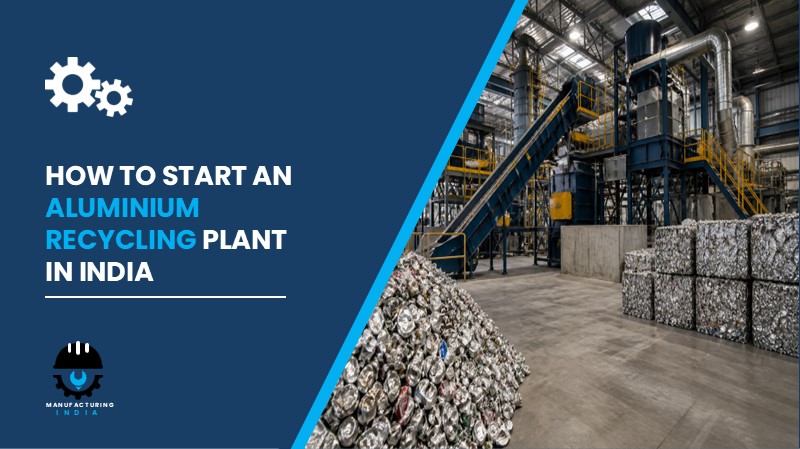
Setting up an aluminium recycling plant in India presents a compelling investment case driven by surging demand from the automotive and transportation, construction and infrastructure, packaging, and electrical and electronics industries. As India accelerates its shift toward sustainable industrial practices and circular economy frameworks, recycled aluminium has emerged as a critical secondary metal powering everything from lightweight electric vehicle components to structural building extrusions. The metal’s infinite recyclability, combined with its lightweight characteristics, corrosion resistance, and excellent thermal and electrical conductivity, makes it indispensable to India’s most capital-intensive sectors.
India’s rapid urbanisation, large-scale infrastructure expansion under national programmes, and the Make in India initiative together create a powerful tailwind for secondary aluminium producers. States such as Gujarat, Maharashtra, and Uttar Pradesh offer established industrial estates, reliable utility infrastructure, and proximity to key scrap collection networks, all of which reduce input logistics costs and improve working capital cycles. The country’s growing base of automotive assemblers, packaging converters, construction developers, and electronics manufacturers increasingly seeks locally sourced recycled aluminium to meet both cost efficiency and sustainability compliance requirements — making India strategically sound for establishing large-scale secondary aluminium production.
India’s aluminium recycling investment case is reinforced by strong policy support under Make in India, cost-competitive manufacturing, and robust demand from automotive, construction, and packaging sectors. With gross profit margins ranging between 15–25% and a well-established scrap supply ecosystem, an aluminium recycling plant in India offers attractive financial viability and a credible break-even trajectory across mid-to-large production capacities.
What is Recycled Aluminium?
Recycled aluminium refers to aluminium produced through the reprocessing of post-consumer and post-industrial scrap rather than primary extraction from bauxite ore. The recycling process retains the metal’s inherent properties — including lightweight characteristics, corrosion resistance, high thermal and electrical conductivity, and excellent formability — without substantial loss of quality across multiple recycling cycles. This capacity for indefinite reuse makes recycled aluminium uniquely valuable within closed-loop manufacturing systems.
Recycled aluminium requires significantly less energy compared to primary aluminium production, making it environmentally advantageous and cost competitive. Depending on processing and alloying requirements, recycled aluminium is supplied in ingots, billets, slabs, or molten metal form. There are two primary scrap variants used in production: post-consumer scrap, which includes beverage cans, packaging, and household goods, and pre-consumer or post-industrial scrap, which comes from fabrication offcuts and industrial process waste.
The primary production method is a multi-step recycling process involving scrap collection, sorting and segregation, shredding, decoating, melting in a furnace, alloy adjustment, refining and degassing, casting, cooling, quality inspection, and packaging. End-use industries served include automotive and transportation, construction and infrastructure, packaging, electrical and electronics, and industrial machinery.
Cost of Setting Up an Aluminium Recycling Plant in India
The total cost of establishing an aluminium recycling plant in India depends on several interconnected variables: plant capacity, technology selection, degree of automation, geographic location, and regulatory compliance requirements. Investors should model both capital expenditure at project inception and operating expenditure across a rolling five-year horizon.
1. Capital Expenditure (CapEx)
The capital investment for an aluminium recycling plant covers land acquisition and site preparation, civil construction, machinery procurement, and other pre-operative expenses. Land and site development costs — including charges for land registration and boundary development — form a substantial part of the overall investment and must account for environmental impact assessments and zoning clearances. Locating the facility within a Special Economic Zone or notified industrial estate can reduce land costs and attract state-level incentive packages.
Civil works and construction costs cover the production shed, raw material storage bays, finished goods warehouse, quality control laboratory, administrative block, and effluent treatment facility. These structures must be designed to accommodate safe handling of aluminium scrap and molten metal.
Machinery costs account for the largest single portion of total capital expenditure. Key machinery required for an aluminium recycling plant includes:
- Scrap sorting systems
- Shredders and crushers
- Decoating kilns
- Melting furnaces
- Holding furnaces
- Casting machines
- Spectrometers
- Emission control and filtration systems
Other capital costs include effluent treatment plant construction, pre-operative expenses, import duties on specialised equipment, commissioning charges, and working capital margin requirements.
Request a Sample Report for In-Depth Market Insights: https://www.imarcgroup.com/aluminium-recycling-plant-project-report/requestsample
2. Operational Expenditure (OpEx)
The operating cost structure of an aluminium recycling plant is primarily driven by raw material consumption. Aluminium scrap, fluxes, and alloying elements together constitute approximately 85–90% of total OpEx, making scrap price management a strategic priority. Investors are advised to negotiate long-term supply contracts with reliable scrap aggregators and industrial waste recovery operators to mitigate price volatility and ensure consistent feed quality.
Utility costs — covering electricity, water, and fuel for furnace operations — account for approximately 5–10% of total OpEx. Melting operations are particularly energy intensive, and proximity to stable grid infrastructure or captive power availability meaningfully reduces this burden. Other recurring operating costs include transportation, packaging of finished ingots and billets, salaries and wages for technicians and plant staff, equipment maintenance, depreciation of capital assets, and applicable taxes. By the fifth year of operations, total operational costs are expected to increase substantially due to inflation, market fluctuations, rising raw material costs, supply chain pressures, and shifts in global economic conditions.
3. Plant Capacity
The proposed recycling facility structure referenced in the source report is designed for an annual production capacity ranging between 50,000 and 200,000 metric tonnes, enabling significant economies of scale while maintaining operational flexibility. Capacity can be customised per investor requirements, with smaller entry-level units also viable depending on local scrap availability and target markets. As with most process industries, profitability improves materially with higher capacity utilisation, and investors should model a realistic ramp-up curve in year one through year three.
4. Profit Margins and Financial Projections
This investment demonstrates healthy profitability potential under normal operating conditions. Gross profit margins typically range between 15–25%, while net profit margins range between 5–12%, supported by stable end-use demand and value-added product applications. Financial projections cover key metrics including net present value (NPV), internal rate of return (IRR), payback period, gross margin, net margin, liquidity analysis, taxation, depreciation, and sensitivity analysis across different pricing and capacity scenarios. A comprehensive profit and loss account and break-even analysis form part of detailed project economics.
Why Set Up an Aluminium Recycling Plant in India?
Surging Automotive and EV Demand. India’s automotive sector — one of the largest globally — is accelerating its adoption of lightweight materials to improve fuel efficiency and reduce vehicle emissions. Automotive manufacturers are incorporating higher proportions of recycled aluminium in body panels, structural components, wheels, and EV battery housings, creating sustained procurement demand for secondary aluminium producers.
Infrastructure Growth and Construction Activity. Rapid infrastructure expansion across India is driving consumption of aluminium in window systems, façade panels, roofing materials, structural extrusions, and curtain walls. The durability and corrosion resistance of recycled aluminium make it well suited for construction applications, and the ongoing urban development pipeline sustains long-term demand.
Packaging Sector Expansion. The packaging industry continues to promote aluminium cans and foil as a sustainable alternative to other materials. Recycled aluminium is widely used in beverage cans, food containers, and foil packaging due to its recyclability and superior barrier properties, with Indian FMCG and food processing sectors representing a growing consumer base.
Policy and Regulatory Tailwinds. Stringent carbon emission regulations, government sustainability mandates, and the Make in India initiative collectively support domestic secondary aluminium manufacturing. Regulatory requirements for increased recycling rates and greater energy efficiency across industries are creating structural demand for recycled metal supply chains.
Active Global Industry Investment. In July 2025, RTE, in partnership with Nexans, introduced a comprehensive industrial aluminium recycling solution dedicated to power cable production, including the first recycling and reuse of transmission cables in France on high and extra-high voltage lines. In February 2025, Phinix LLC unveiled a $1.8 million two-year project to develop a commercially scalable method for eliminating iron and manganese contaminants from molten aluminium scrap. In June 2024, Speira announced a €40 million investment to expand aluminium recycling at its Rheinwerk plant, targeting reductions of up to 1.5 million tonnes of CO₂ annually. In April 2024, Trimet expanded its Gelsenkirchen recycling plant by 20%, adding a tilting rotary furnace and additional casting wheel to reach 80,000 tonnes of annual production capacity.
Local Supply Chain and Circular Economy Alignment. Aluminium’s infinite recyclability supports closed-loop production systems and compliance with environmental regulations increasingly mandated by India’s automotive OEMs, construction developers, and electronics manufacturers. Growing scrap collection networks and industrial waste recovery infrastructure are steadily strengthening domestic raw material availability.
Recycling Process – Step by Step
The aluminium recycling process uses a multi-step recycling operation as the primary production method, encompassing material collection through to dispatch of finished metal products.
- Scrap Collection: Post-consumer scrap from beverage cans, packaging, and household goods, along with post-industrial scrap from fabrication and machining processes, is procured from aggregators and industrial waste recovery networks.
- Sorting and Segregation: Incoming scrap is sorted by alloy type, grade, and contamination level using scrap sorting systems to ensure consistent feed quality for downstream processing.
- Shredding and Crushing: Sorted scrap is processed through shredders and crushers to reduce particle size, increase bulk density, and improve melting efficiency.
- Decoating: Shredded scrap passes through decoating kilns to remove surface coatings, paints, and organic contaminants, reducing impurities in the melt.
- Melting in Furnace: Decoated scrap is charged into melting furnaces where it is melted at controlled temperatures, with fluxes added to separate impurities and dross.
- Alloy Adjustment: Alloying elements are added to the molten metal in holding furnaces to achieve the targeted alloy specification and chemical composition.
- Refining and Degassing: The molten aluminium is refined and degassed to remove dissolved hydrogen and residual impurities, ensuring homogeneity and structural integrity.
- Casting: Refined molten metal is cast using casting machines into ingots, billets, slabs, or other product forms, depending on customer requirements.
- Cooling and Quality Inspection: Cast products are cooled under controlled conditions and inspected using spectrometers and other quality testing instruments to verify composition and conformance.
- Packaging and Dispatch: Finished recycled aluminium products are packaged and dispatched to automotive, construction, packaging, electrical, and industrial machinery end-use industries.
Key Applications
Recycled aluminium from this plant serves a diverse range of end-use industries across industrial, consumer, and infrastructure segments:
- Automotive and Transportation: Lightweight vehicle structures, engine components, wheels, and EV battery housings to improve fuel efficiency and reduce emissions.
- Construction and Infrastructure: Window systems, façade panels, roofing materials, structural extrusions, and curtain walls, valued for durability and corrosion resistance.
- Packaging Industry: Beverage cans, food containers, and aluminium foils, preferred for their recyclability and superior barrier properties.
- Electrical and Electronics: Conductors, busbars, heat sinks, and electronic enclosures requiring high thermal and electrical conductivity.
- Industrial Machinery: Cast components, machine parts, and fabrication structures where a high strength-to-weight ratio is critical.
Leading Recycling
The global aluminium recycling market is served by several multinational companies with extensive production capacities and diversified application portfolios. Key players in the global aluminium recycling industry include:
- Norsk Hydro ASA
- Novelis Inc.
- REAL ALLOY
- Matalco Inc.
- Constellium
Timeline to Start the Plant
- Feasibility study and project report preparation
- Land acquisition and site development
- Regulatory approvals and environmental clearances
- Factory licence and fire safety compliance
- Machinery procurement and installation
- Raw material supplier agreements and supply chain setup
- Trial production and quality testing
- Commercial production launch
Licences and Regulatory Requirements
Starting an aluminium recycling manufacturing unit in India requires several approvals:
- Business registration (Proprietorship, LLP, or Pvt Ltd)
- Factory Licence under the Factories Act
- Environmental Clearance from State Pollution Control Board
- GST Registration
- Fire Safety NOC
- Hazardous and chemical waste handling compliance under applicable environmental regulations
- Effluent Treatment Plant (ETP) operational clearance
- Occupational Health and Safety compliance
Key Challenges to Consider
High Capital Requirements. Establishing an aluminium recycling plant demands significant upfront investment covering land, civil works, and specialised machinery including melting furnaces, decoating kilns, casting machines, and emission control systems. Securing structured project funding is critical to maintaining financial headroom through the ramp-up phase.
Raw Material Price Volatility. Aluminium scrap, fluxes, and alloying elements — which collectively account for 85–90% of total operating costs — are subject to commodity price fluctuations driven by global demand, export restrictions, and scrap availability cycles. Long-term supplier contracts and diversified sourcing are essential risk mitigation strategies.
Regulatory Compliance. Aluminium recycling operations involve high-temperature furnace processes, dross generation, and gaseous emissions, requiring robust compliance with environmental clearance conditions, effluent treatment norms, and occupational safety standards. Non-compliance exposes operators to production stoppages and reputational risk.
Technology and Innovation Pressure. As highlighted by Phinix LLC’s 2025 initiative to eliminate metallic contaminants from molten scrap, the industry is actively evolving its processing technology. Investors must plan for periodic capital upgrades to maintain product quality and competitiveness.
Competition from Global Players. The presence of established multinational players — including Norsk Hydro ASA, Novelis Inc., REAL ALLOY, Matalco Inc., and Constellium — means that Indian producers must build operational efficiency, product consistency, and local supply chain depth to compete effectively on quality and cost.
Skilled Manpower. Operating high-temperature metallurgical processes, spectrometric quality testing, and emission control systems requires trained technicians and plant managers. Workforce recruitment, training, and retention in specialised roles represent an ongoing operational cost and risk.
Frequently Asked Questions
1. How much does it cost to set up an aluminium recycling plant in India?
The total setup cost depends on plant capacity, location, technology selection, and degree of automation. The investment covers land and site development, civil construction, machinery including melting furnaces and casting machines, utilities, and pre-operative expenses. A detailed CapEx breakdown is available in the full project report.
2. Is aluminium recycling profitable in India in 2026?
Yes. The project demonstrates healthy gross profit margins of 15–25% and net profit margins of 5–12% under normal operating conditions, supported by stable demand from automotive, construction, packaging, and electrical end-use sectors.
3. What machinery is required for an aluminium recycling plant in India?
Key machinery includes scrap sorting systems, shredders and crushers, decoating kilns, melting furnaces, holding furnaces, casting machines, spectrometers, and emission control and filtration systems.
4. What licences and approvals are required to start an aluminium recycling plant in India?
Required approvals include business registration, Factory Licence, Environmental Clearance from the State Pollution Control Board, GST Registration, Fire Safety NOC, ETP clearance, hazardous waste handling compliance, and Occupational Health and Safety certification.
5. What raw materials are needed for aluminium recycling?
The primary raw materials are aluminium scrap (post-consumer and post-industrial), fluxes, and alloying elements. Scrap constitutes approximately 85–90% of total operating costs.
6. What are the environmental compliance requirements for an aluminium recycling plant in India?
Plants must obtain Environmental Clearance from the State Pollution Control Board, install and operate an Effluent Treatment Plant, comply with emission control norms for furnace operations, manage dross and hazardous waste under applicable regulations, and implement advanced monitoring systems to detect process deviations.
7. What is the best location to set up an aluminium recycling plant in India?
Optimal locations offer proximity to scrap collection networks, reliable utility infrastructure, access to key end-use markets such as automotive clusters and construction hubs, and availability of industrial land within notified estates or SEZs. States such as Gujarat, Maharashtra, and Uttar Pradesh are well suited.
8. What is the break-even period for this type of plant in India?
The break-even period depends on plant capacity, utilisation rate, product pricing, and operating cost management. Detailed payback period analysis, NPV, and IRR calculations are covered in the full project report, with profitability improving substantially at higher capacity utilisation levels.
9. What government incentives are available for recycling in India?
Eligible investors may access incentives under the Make in India programme, state industrial policies, capital subsidy schemes for manufacturing units, GST input credit benefits, export promotion incentives, and SEZ-specific fiscal benefits including duty exemptions and tax holidays.
Key Takeaways for Investors
The aluminium recycling plant opportunity in India is underpinned by durable demand from the automotive and transportation, construction and infrastructure, packaging, and electrical and electronics sectors — industries that are collectively expanding at scale within the Indian economy. Financial projections confirm viability across a range of production capacities, with gross profit margins of 15–25% and net margins of 5–12% achievable under realistic operating assumptions. The global aluminium recycling market was valued at 37.89 million tonnes in 2025 and is projected to reach 56.94 million tonnes by 2034, growing at a CAGR of 4.6% from 2026 to 2034 — a trajectory that confirms sustained long-term demand for secondary aluminium production capacity. With aluminium’s unique property of infinite recyclability, combined with rising scrap collection infrastructure, tightening carbon emission mandates, and growing corporate commitments to circular economy practices, India-based aluminium recycling manufacturers are positioned to benefit from structurally durable and growing end-market demand well into the next decade.
About the Author