Setting up a hot rolled coils manufacturing plant in India presents a compelling investment case driven by surging demand from the automotive, construction, shipbuilding, and energy sectors. Hot rolled coils (HRC) are indispensable flat-rolled steel products that feed India’s most capital-intensive industries — from vehicle body panels and structural steel beams to oil pipelines and shipbuilding hull plates. As India accelerates urbanisation, expands its infrastructure network, and scales its automobile production, the domestic appetite for high-strength, formable steel continues to outpace available supply, creating a decisive window for new investors.
India’s manufacturing ecosystem reinforces this opportunity from multiple angles. The Make in India initiative, combined with industrial corridor development across Gujarat, Maharashtra, Odisha, and Jharkhand, has lowered the barriers to greenfield steel plant establishment. India’s automobile exports rose 19% to over 5.3 million units in FY25, while 1,00,000 electric vehicles were sold in CY24 — both milestones that directly intensify demand for high-quality steel coils. Proximity to domestic iron ore reserves, a cost-competitive labour pool, and expanding port infrastructure make India a strategically sound location for this type of production.
A hot rolled coils manufacturing facility in India combines policy support, cost-competitive raw material access, and robust demand from automotive and construction sectors to deliver gross margins of 15–25%. With the global market projected to reach 489.14 million tons by 2034, early movers in India stand to capture significant domestic and export market share at a viable break-even.
What are Hot Rolled Coils?
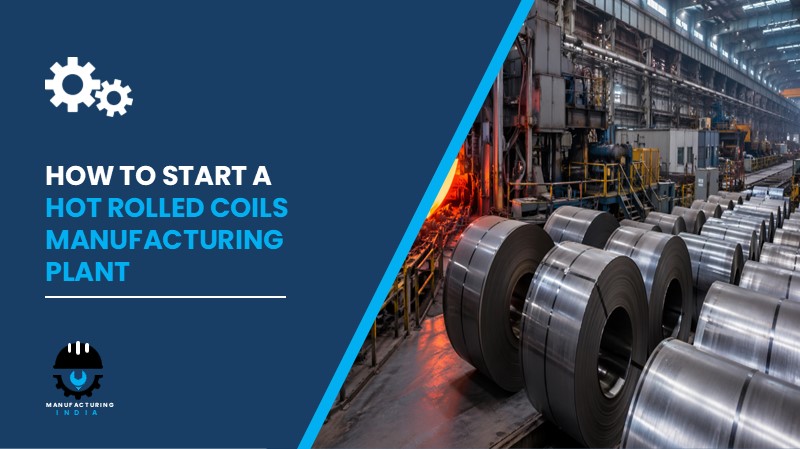
Hot rolled coils are flat-rolled steel products produced by heating steel slabs above their recrystallisation temperature and rolling them into thin coils. The hot rolling process allows for easier shaping of the steel, making it ideal for a wide range of structural and industrial applications. HRC is characterised by excellent formability, high strength, and the ability to withstand heavy loads — properties that make it a foundational material across multiple sectors. The surface of hot rolled coils is typically rough and scale-covered, but further processing such as pickling or galvanising can be applied to improve surface quality and corrosion resistance.
The production process is a multi-step operation involving steel slab heating, hot rolling, cooling, coiling, surface treatment, quality control, and packaging. Hot rolled coils serve end-use industries including automotive, construction, shipbuilding, energy, and machinery and equipment manufacturing — industries that collectively represent the structural backbone of India’s industrial economy.
Cost of Setting Up a Hot Rolled Coils Manufacturing Plant in India
The total investment required for a hot rolled coils manufacturing plant depends on several variables: plant capacity, technology selection, degree of automation, geographic location, and regulatory compliance requirements. Understanding the full cost architecture — from capital expenditure to operating costs — is essential before committing resources.
1. Capital Expenditure (CapEx)
Capital investment is the most significant financial commitment at project inception, and machinery costs account for the largest portion of total CapEx in this type of plant.
Land and Site Development represents a substantial component of total capital outlay. Industrial estates and Special Economic Zones (SEZs) in steel-producing states like Odisha, Jharkhand, and Chhattisgarh offer cost advantages through subsidised land, pre-cleared infrastructure, and single-window approvals. Costs here include land registration charges, boundary development, and site levelling.
Civil Works and Construction encompass the main production shed, raw material storage yards, a laboratory for quality control, administrative offices, and worker amenity blocks. Given the scale of a hot rolling facility, civil construction forms a meaningful share of upfront spend.
Machinery and Equipment represent the dominant CapEx item. Key machinery required includes:
- Reheating furnaces
- Rolling mills
- Pickling and coating lines
- Coiling machines
Other Capital Costs include effluent treatment plant (ETP) infrastructure, pre-operative expenses such as feasibility studies and consultancy fees, commissioning costs, and applicable import duties on specialised equipment components.
Request a Sample Report for In-Depth Market Insights: https://www.imarcgroup.com/hot-rolled-coils-manufacturing-plant-project-report/requestsample
2. Operational Expenditure (OpEx)
Raw Material Cost is the single largest operating expense in a hot rolled coils plant, accounting for approximately 80–85% of total OpEx. The two primary raw materials are steel slabs and rolling oils. Given the outsized weight of raw material costs in the total cost structure, investors are strongly advised to negotiate long-term supply contracts with reliable domestic and international suppliers to mitigate price volatility and ensure a consistent production input.
Utility Cost — covering electricity, water, and steam — represents the second-largest operating cost category at 10–15% of total OpEx. Reheating furnaces and rolling mills are energy-intensive, making access to reliable and competitively priced power a key site selection criterion.
Other Operating Costs include transportation to downstream customers, packaging materials, salaries and wages for skilled and semi-skilled personnel, routine equipment maintenance, depreciation on capital assets, and applicable taxes. By the fifth year of operations, total OpEx is projected to increase substantially due to inflation, market fluctuations, rising input costs, and supply chain dynamics.
3. Plant Capacity
The proposed manufacturing facility is designed with an annual production capacity ranging between 500,000 and 2 million metric tons, enabling economies of scale while maintaining operational flexibility. Capacity can be customised based on investor requirements and target market size. Importantly, profitability improves with higher capacity utilisation — a critical financial lever investors should model carefully during project planning.
4. Profit Margins and Financial Projections
The hot rolled coils manufacturing plant demonstrates healthy profitability under normal operating conditions. Gross profit margins typically range between 15–25%, supported by stable demand and value-added applications. Net profit margins range between 5–12%. A comprehensive financial analysis — including Net Present Value (NPV), Internal Rate of Return (IRR), payback period, and sensitivity analysis — is essential to assess project viability across different capacity and pricing scenarios. These projections should be developed based on realistic assumptions regarding capital investment, operating costs, capacity utilisation, and demand outlook.
Why Set Up a Hot Rolled Coils Plant in India?
High Demand from Automotive and Construction Sectors. The rising need for strong, durable materials in the automotive and construction sectors is the primary driver of HRC demand. India’s automobile exports surged 19% to over 5.3 million units in FY25, while one lakh electric vehicles were sold in CY24 — both indicators of an expanding automotive production base that requires high-quality steel coils for body panels, frames, and structural parts.
Growth of Electric Vehicles and Lightweight Manufacturing. The rise of electric vehicles and lightweight automobile manufacturing is intensifying demand for high-strength steel that can be easily formed. As passenger vehicles, two-wheelers, and commercial vehicles all scale production, the need for hot rolled coils as a foundational input grows proportionally.
Urbanisation and Infrastructure Development. Rapid urbanisation and ongoing infrastructure development are boosting demand for structural steel across India. Construction applications including steel beams, columns, and reinforcement bars depend on HRC, making every new infrastructure project a demand event for domestic producers.
Versatility Across Industries. Hot rolled coils are versatile products used across shipbuilding, the energy sector, and machinery and equipment manufacturing — in addition to automotive and construction. This diversification of end markets provides revenue resilience and reduces demand-side concentration risk for plant investors.
Policy and Regulatory Tailwinds. The Make in India initiative actively supports domestic steel manufacturing through incentives, industrial corridor development, and import substitution policies. State-level investment promotion schemes across key manufacturing states further reduce effective investment costs for greenfield facility developers.
Active Industry Investment. The sector continues to attract large-scale capital. In October 2025, Uzmetkombinat JSC secured a €132.5 million seven-year loan to finalise construction of Uzbekistan’s first hot-rolled coil facility, financed by KfW IPEX-Bank GmbH and Standard Chartered Bank. In August 2024, NMDC Steel Limited (NSL) reached the milestone of producing 1 million tons of HRC at its state-of-the-art plant — reinforcing that modern, technology-driven facilities can achieve efficient scale quickly.
Manufacturing Process – Step by Step
The hot rolled coils manufacturing process uses steel slab heating and multi-stand hot rolling as the primary production method. The process is a multi-step operation that integrates material handling, thermal treatment, mechanical forming, and surface preparation:
- Steel Slab Heating: Steel slabs are loaded into reheating furnaces and raised above their recrystallisation temperature, making the steel malleable for forming.
- Hot Rolling: Heated slabs pass through rolling mills in multiple reduction passes to achieve the desired thickness and width, forming a continuous flat strip.
- Cooling: The rolled strip is cooled in a controlled manner on the run-out table to achieve target mechanical properties.
- Coiling: The cooled strip is wound into coils by coiling machines for ease of handling, transport, and downstream processing.
- Surface Treatment: Pickling and coating lines remove mill scale from the coil surface; galvanising or other coatings may be applied to enhance corrosion resistance and surface quality.
- Quality Control: Finished coils undergo technical tests and quality assurance checks against dimensional, mechanical, and surface specifications.
- Packaging and Dispatch: Approved coils are packaged and dispatched to end-use industries including automotive, construction, shipbuilding, energy, and machinery manufacturing.
Key Applications
Hot rolled coils serve a broad range of industrial sectors, each with distinct performance requirements:
- Automotive Industry: Used to produce body panels, frames, and structural components requiring high strength, formability, and lightweight properties.
- Construction Industry: Applied in structural components such as beams, columns, and reinforcement bars due to durability and load-bearing capacity.
- Shipbuilding: Used for hull plates, bulkheads, and structural parts that must withstand harsh marine environments and heavy loads.
- Energy Sector: Essential for pipelines, pressure vessels, and storage tanks used in oil, gas, and renewable energy industries.
- Machinery and Equipment Manufacturing: Used to manufacture frames and structural parts requiring high strength and resistance to wear and tear.
Leading Manufacturers
The global hot rolled coils industry is characterised by large multinational players with extensive production capacities and integrated supply chains. Key players include:
- ArcelorMittal
- Baowu Steel Group
- Benxi Steel Group
- Hesteel Group
- JFE Steel Corporation
- Nippon Steel Corporation
- Nucor Corporation
- Tata Steel
Timeline to Start the Plant
Establishing a hot rolled coils manufacturing plant in India from conception to commercial production typically involves the following phases:
- Feasibility study and project report preparation
- Land acquisition and site development
- Regulatory approvals and environmental clearances
- Factory licence and fire safety compliance
- Machinery procurement and installation
- Raw material supplier agreements and supply chain setup
- Trial production and quality testing
- Commercial production launch
Licences and Regulatory Requirements
Starting a hot rolled coils manufacturing unit in India requires several approvals:
- Business registration (Proprietorship, LLP, or Pvt Ltd)
- Factory Licence under the Factories Act
- Environmental Clearance from the State Pollution Control Board
- GST Registration
- Fire Safety NOC
- Hazardous and chemical handling compliance (applicable given the use of rolling oils and pickling chemicals)
- Effluent Treatment Plant (ETP) operational clearance
- Occupational Health and Safety compliance
Key Challenges to Consider
High Capital Requirements. Reheating furnaces, rolling mills, pickling lines, and coiling machines collectively represent a very large upfront investment, making access to project finance and equity partnerships critical to plant viability.
Raw Material Price Volatility. Steel slabs and rolling oils together account for 80–85% of operating costs. Global steel slab prices are subject to significant fluctuations driven by iron ore markets, energy costs, and geopolitical events — creating margin pressure during price spikes.
Regulatory Compliance. Environmental clearances, ETP operation, chemical handling compliance, and factory licensing all demand sustained management attention and dedicated compliance budgets, particularly in India’s evolving regulatory environment.
Technology and Innovation Pressure. Advancements in coating and surface treatment processes are continuously raising quality benchmarks. Plants must invest in updated process technology to remain competitive in premium product segments.
Competition. Global players including ArcelorMittal, Baowu Steel Group, Nippon Steel Corporation, and Tata Steel possess deep production and distribution advantages. New entrants must compete on cost, quality, and service to secure long-term customer commitments.
Skilled Manpower. Operating reheating furnaces, rolling mills, and quality control systems requires trained metallurgical engineers, process technicians, and maintenance specialists — a talent pool that requires active recruitment and retention strategies.
Frequently Asked Questions
1. How much does it cost to set up a hot rolled coils manufacturing plant in India?
Total investment depends on plant capacity (ranging from 500,000 to 2 million MT annually), technology selection, automation level, and location. CapEx includes land, civil works, and machinery — with equipment costs forming the largest single component.
2. Is hot rolled coils manufacturing profitable in India in 2026?
Yes. Gross profit margins typically range between 15–25% and net profit margins between 5–12%, supported by strong domestic demand from automotive and construction sectors.
3. What machinery is required for a hot rolled coils plant in India?
Key equipment includes reheating furnaces, rolling mills, pickling and coating lines, and coiling machines.
4. What licences and approvals are required to start a hot rolled coils plant in India?
Required approvals include business registration, Factory Licence, Environmental Clearance, GST Registration, Fire Safety NOC, ETP clearance, hazardous chemical compliance, and Occupational Health and Safety compliance.
5. What raw materials are needed for hot rolled coils manufacturing?
The primary raw materials are steel slabs and rolling oils, which together account for approximately 80–85% of total operating expenses.
6. What are the environmental compliance requirements for a hot rolled coils plant in India?
A plant must obtain Environmental Clearance from the State Pollution Control Board, operate a functional Effluent Treatment Plant, and adhere to emission standards for chemical and thermal processes.
7. What is the best location to set up a hot rolled coils plant in India?
Steel-producing and industrially developed states such as Odisha, Jharkhand, Chhattisgarh, Maharashtra, and Gujarat offer advantages including proximity to raw materials, infrastructure, and port access for exports.
8. What is the break-even period for this type of plant in India?
The break-even timeline depends on capacity utilisation, pricing strategy, and financing structure. A full financial analysis including NPV, IRR, and payback period is recommended for project-specific projections.
9. What government incentives are available for manufacturers in India?
Manufacturers can access benefits under the Make in India initiative, state-level industrial investment promotion schemes, SEZ incentives, and capital subsidy programmes offered by various state governments for large-scale manufacturing investments.
Key Takeaways for Investors
A hot rolled coils manufacturing plant in India represents a high-value industrial investment opportunity supported by structural demand from the automotive, construction, shipbuilding, and energy sectors — all of which are in active growth phases. The project demonstrates financial viability across a range of plant capacities from 500,000 to 2 million MT per annum, with gross margins of 15–25% and net margins of 5–12% achievable under normal operating conditions. The global hot rolled coils market, volumed at 328.74 million tons in 2025, is projected to reach 489.14 million tons by 2034 at a CAGR of 4.5%, providing a long runway of demand growth for domestic producers. With India’s automobile exports scaling, electric vehicle adoption accelerating, and infrastructure investment expanding, demand sustainability for this production is structurally anchored for the decade ahead.
About the Author