Waste Plastic Pyrolysis Manufacturing Plant in India
Setting up a waste plastic pyrolysis manufacturing plant in India presents a compelling investment case driven by the country’s rapidly escalating plastic waste generation crisis, mounting regulatory pressure against landfilling and incineration, a growing national demand for alternative fuels, and the accelerating global push toward circular economy practices that are reshaping how industrial economies manage end-of-life plastic streams. Waste plastic pyrolysis — the thermal decomposition of plastic waste in an oxygen-free environment — converts non-recyclable mixed plastic waste into three commercially valuable outputs: pyrolysis oil that can be used as an alternative fuel or refined into diesel-like products, syngas that provides process energy, and carbon char used in construction materials, pigments, and industrial fillers. This triple-output value recovery model transforms what was previously a cost centre — plastic waste disposal — into a revenue-generating industrial operation, making it one of the most commercially distinctive waste-to-energy investment opportunities available to Indian entrepreneurs.
India’s strategic position for this investment is strongly reinforced by the scale of the plastic waste problem the country faces. According to UNEP data reported in 2025, around 19 to 23 million tons of plastic waste enter aquatic ecosystems each year globally — a challenge that is particularly acute in India given its large population, rapidly expanding consumer economy, and still-developing waste management infrastructure. The packaging, automotive, and consumer goods industries have experienced rapid plastic usage growth, creating a mixed and contaminated plastic waste stream that traditional mechanical recycling cannot process — exactly the feedstock category for which pyrolysis is purpose-built. States such as Maharashtra, Gujarat, Tamil Nadu, Rajasthan, and Uttar Pradesh offer established plastic waste aggregation networks, industrial chemical processing infrastructure, and proximity to energy and fuel sector buyers.
A waste plastic pyrolysis manufacturing plant in India converts the country’s growing non-recyclable plastic waste crisis into a commercially viable energy recovery operation. With gross margins of 30–40% and net margins of 12–18%, a global market projected to reach USD 1,150.44 million by 2034 at a CAGR of 5.5%, and strong regulatory tailwinds phasing out landfilling and incineration, this investment delivers stable financial returns and essential circular economy positioning for technically capable Indian producers.
What is Waste Plastic Pyrolysis?
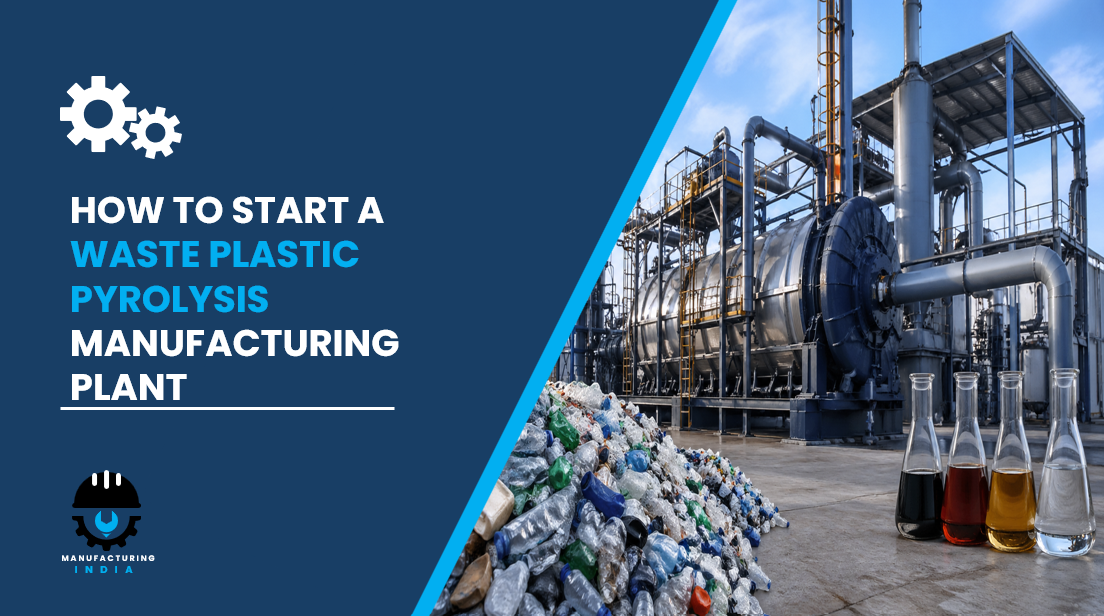
Waste plastic pyrolysis is a thermal decomposition process that converts plastic waste into valuable by-products such as pyrolysis oil, syngas, and carbon char in an oxygen-free environment. The process operates at high temperatures to break down long polymer chains into smaller hydrocarbon fractions. Pyrolysis oil serves as an alternative fuel source that can be refined into diesel-like products, syngas provides an additional energy source for the plant’s own operations, and carbon char finds applications in construction materials, pigments, and industrial fillers.
Waste plastic pyrolysis provides an effective solution for managing non-recyclable plastics, reducing landfill dependency, lowering environmental pollution, and supporting energy recovery initiatives. The technology transforms plastic waste into usable energy and industrial resources, directly supporting sustainability goals and circular economy objectives. The primary production method spans waste plastic collection and segregation, shredding and drying, continuous or batch pyrolysis, vapour condensation, oil collection, gas recovery, char handling, and product storage. The product serves end-use industries including the energy and fuel sector, industrial boilers and furnaces, chemical processing industry, construction materials, and waste management services.
Cost of Setting Up a Waste Plastic Pyrolysis Manufacturing Plant in India
The total cost of establishing a waste plastic pyrolysis manufacturing plant in India depends on production capacity, pyrolysis reactor technology (continuous vs. batch), plant location, degree of automation, and regulatory compliance requirements.
1. Capital Expenditure (CapEx)
The capital investment required to set up this facility covers several major cost heads. Land and site development — including land registration, boundary development, fire-resistant site infrastructure, plastic waste receiving and storage yard, and related site works — forms a substantial portion of total CapEx. Investors should consider locating the unit within industrial estates or waste processing zones in Maharashtra (Pune, Nagpur), Gujarat (Surat, Vadodara), Tamil Nadu, or Uttar Pradesh, where proximity to established plastic waste aggregation networks, fuel and energy sector buyers, and chemical processing infrastructure creates a commercially favourable operating environment.
Civil works and construction costs cover the plastic waste receiving and sorting yard, shredding and drying hall, pyrolysis reactor building with explosion-proof and fire safety provisions, condensation and oil collection section, gas recovery and scrubbing area, carbon char handling and storage zone, product storage for pyrolysis oil, quality control laboratory, effluent and emission treatment systems, and administrative block.
Machinery and equipment represent the largest component of total capital expenditure for this waste plastic pyrolysis manufacturing plant. Key machinery required includes:
- Shredders
- Dryers
- Pyrolysis reactors (continuous or batch)
- Condensers
- Gas scrubbing systems
- Storage tanks
- Pollution control units
Other capital costs include effluent treatment plant (ETP) installation, advanced flue gas and emissions control systems for pyrolysis reactor stack gases, pre-operative and commissioning expenses, and any applicable import duties on specialised continuous pyrolysis reactor and condensation equipment.
Request a Sample Report for In-Depth Market Insights: https://www.imarcgroup.com/waste-plastic-pyrolysis-manufacturing-plant-project-report/requestsample
2. Operational Expenditure (OpEx)
The operating cost structure of a waste plastic pyrolysis manufacturing plant is primarily driven by raw material procurement. Raw material cost — covering mixed plastic waste as the primary feedstock, along with catalyst and fuel for startup operations and gas cleaning systems — accounts for approximately 40–50% of total OpEx. Unlike most manufacturing segments where raw material is the dominant cost, pyrolysis benefits from the relatively low cost of plastic waste feedstock — and in some markets processors are paid a tipping fee to accept certain plastic waste streams, further improving feedstock economics. Investors should establish long-term supply agreements with municipal waste management authorities, plastic recycling aggregators, packaging manufacturers, and industrial waste generators to stabilise feedstock volumes and costs year-round.
Utility costs, covering electricity, water, and fuel for continuous reactor operation, pyrolysis heating, and gas scrubbing systems, account for 20–25% of OpEx — a notably higher share than most manufacturing segments, reflecting the energy-intensive nature of the high-temperature pyrolysis thermal decomposition process. Syngas generated in the process can be recirculated as fuel for reactor heating, reducing net utility purchase requirements and improving overall plant energy economics. Other operating costs include transportation for plastic waste collection and finished product dispatch to fuel buyers, packaging, salaries and wages, maintenance and calibration of reactor and condensation equipment, depreciation of fixed assets, and applicable taxes. By the fifth year of operations, total operational costs are projected to increase substantially due to inflation, plastic waste collection cost escalation, market fluctuations, supply chain disruptions, and rising demand for alternative energy sources.
3. Plant Capacity
The proposed manufacturing facility is designed with an annual production capacity ranging between 10,000–20,000 MT of plastic waste processed, enabling economies of scale while maintaining operational flexibility. Capacity can be customised based on specific investor requirements, available plastic waste feedstock volumes in the target catchment area, and capital availability. Modular plant designs enable capacity expansion while managing capital expenses incrementally as feedstock supply and market demand grow. Profitability improves meaningfully with higher capacity utilisation given the significant fixed cost base of reactor and emissions control infrastructure.
4. Profit Margins and Financial Projections
The waste plastic pyrolysis manufacturing plant demonstrates healthy profitability potential under normal operating conditions. Gross profit margins typically range between 30–40%, supported by the multi-output revenue model — pyrolysis oil, syngas, and carbon char — the relatively low cost of mixed plastic waste feedstock, and stable demand from energy, industrial, and construction material buyer segments. Net profit margins are projected in the range of 12–18%. Key financial indicators including NPV, IRR, payback period, liquidity analysis, and sensitivity analysis are covered comprehensively in the full project report.
Why Set Up a Waste Plastic Pyrolysis Manufacturing Plant in India?
Rising Plastic Waste Volumes Creating Abundant Feedstock Supply. The ongoing urban development and rising public consumption patterns in India generate significant plastic waste volumes, which increase the requirement for advanced waste management technologies. India’s large and rapidly urbanising population, combined with growing packaged goods consumption, is producing mixed plastic waste streams at a scale that far exceeds the capacity of mechanical recycling infrastructure — directly creating the feedstock abundance on which pyrolysis plants depend.
Circular Economy Adoption and Energy Recovery Potential. Pyrolysis enables resource recovery by transforming waste plastics into usable fuels and industrial materials — precisely the circular economy model that both government policy and corporate ESG commitments are actively promoting. The process generates multiple energy-rich outputs — pyrolysis oil, syngas, and carbon char — which together improve the economic performance of the entire facility and provide revenue diversification across energy, chemical, and construction material buyer segments.
Regulatory Support Phasing Out Landfilling and Incineration. Environmental regulations and landfill restrictions are creating favourable conditions for businesses to invest in waste-to-energy technology. India’s Extended Producer Responsibility (EPR) framework for plastic packaging, combined with State Pollution Control Board restrictions on open burning and landfilling of mixed plastic waste, is creating strong institutional and commercial demand for compliant pyrolysis-based plastic waste management solutions.
Scalable and Technology-Driven Operations. Modular plant designs enable capacity expansion while managing capital expenses, making the investment accessible at multiple entry scales. Continuous pyrolysis reactor technology — as opposed to older batch systems — delivers higher throughput, better product quality consistency, and lower per-unit operating costs, giving investors access to a proven and commercially mature technology platform.
Active Global Industry Investment Confirming Market Momentum. In March 2025, Dow secured an equity stake in Xycle alongside ING, Invest-NL, Polestar Capital, and Vopak, supporting the development of Xycle’s first commercial-scale waste plastic pyrolysis plant at the Port of Rotterdam — expected to be operational by Q4 2026 and designed to process 21 kilotons of plastic waste annually, producing circular feedstock for packaging, medical, and automotive applications. In March 2025, BASF Corporation and Braven Environmental signed a supply deal for Braven PyChem — an ISCC PLUS certified advanced recycled feedstock from mixed plastic waste — to partially replace fossil resources at BASF’s TotalEnergies Petrochemical facility in Port Arthur, Texas, supporting BASF’s ChemCycling process for construction and automotive applications. Both developments confirm powerful global corporate investment confidence in commercial-scale waste plastic pyrolysis.
Industrial and Power Generation Demand for Alternative Fuels. The market growth of waste plastic pyrolysis has received additional support from industrial and power generation sectors that require alternative fuel sources. Pyrolysis oil — which can substitute for heavy fuel oil in industrial boilers and furnaces, or be refined into diesel-grade product — offers industrial buyers a cost-competitive and sustainability-credentialed alternative to conventional fossil fuels, creating a stable and growing institutional demand channel for Indian pyrolysis oil producers.
Manufacturing Process — Step by Step
The waste plastic pyrolysis manufacturing process uses waste plastic collection and segregation, shredding and drying, continuous or batch pyrolysis, vapour condensation, oil collection, gas recovery, char handling, and product storage as the primary production method. The process involves multiple unit operations, material handling stages, and safety and quality verification checkpoints throughout.
- Plastic Waste Collection and Segregation: Mixed plastic waste is collected from municipal waste streams, industrial waste generators, packaging manufacturers, and plastic aggregators. Incoming waste is segregated by polymer type and contamination level to optimise reactor performance and output product quality.
- Shredding: Segregated plastic waste is fed into shredders to reduce particle size and create uniform feedstock suitable for reactor loading, improving heat transfer efficiency and throughput consistency.
- Drying: Shredded plastic is passed through dryers to reduce moisture content, improving thermal efficiency in the reactor and preventing steam formation that can affect product quality and reactor pressure control.
- Pyrolysis (Thermal Decomposition): Dried, shredded plastic enters the pyrolysis reactor — either continuous or batch — where it is heated to high temperatures in an oxygen-free environment. Thermal cracking breaks polymer chains into shorter hydrocarbon vapour fractions, syngas, and solid carbon char residue.
- Vapour Condensation: Hydrocarbon vapours exiting the reactor are cooled and condensed in condensers into liquid pyrolysis oil. Condensation system design determines oil yield, quality, and fraction distribution between light and heavy oil grades.
- Oil Collection and Storage: Condensed pyrolysis oil is collected in storage tanks, tested for quality parameters, and stored before dispatch to industrial fuel buyers or further refining operations.
- Gas Recovery and Scrubbing: Non-condensable syngas — primarily methane, ethane, and hydrogen — is recovered from the condensation system and passed through gas scrubbing systems to remove hydrogen sulphide and other contaminants before being recirculated as fuel gas for reactor heating or safely flared.
- Carbon Char Handling: Solid carbon char residue from the reactor is discharged, cooled, and processed for dispatch to construction material manufacturers, pigment producers, and industrial filler users.
- Quality Control and Testing: Finished pyrolysis oil is tested for calorific value, viscosity, flash point, sulphur content, and density against applicable fuel oil specifications. Carbon char is tested for carbon black content, particle size, and ash content for construction and industrial filler applications.
- Product Storage and Dispatch: Approved pyrolysis oil is dispatched via tanker trucks to industrial boiler and furnace operators, fuel blenders, and chemical refining buyers. Carbon char is packaged and dispatched to construction and industrial material manufacturers.
Key Applications
The waste plastic pyrolysis manufacturing plant serves multiple industrial end-use segments with growing demand for alternative fuels and circular economy-derived industrial materials:
- Energy and Fuel Industry: Pyrolysis oil serves as a substitute fuel in industrial boilers and furnaces, reducing operational dependency on conventional fossil fuels — the largest volume application for pyrolysis oil output.
- Chemical and Refining Sector: Recovered hydrocarbons enable secondary refining and conversion to chemical feedstock, with ISCC PLUS certified pyrolysis oil increasingly replacing fossil naphtha in petrochemical production as demonstrated by the March 2025 BASF-Braven Environmental supply deal.
- Waste Management Industry: The technology enables operators to safely dispose of non-recyclable plastic waste streams while recovering valuable materials, providing a compliant and commercially viable alternative to landfilling and incineration.
- Construction and Industrial Materials: Carbon char generated in the process is used by manufacturers in filler products, pigment materials, and building construction items — a direct and commercially established outlet for the solid by-product of the pyrolysis reaction.
Leading Manufacturers
The global waste plastic pyrolysis industry is served by several companies with extensive production capabilities and diverse application portfolios. Key players include:
- Nexus Circular
- OMV Aktiengesellschaft
- Niutech Environment Technology Corporation
- Klean Industries
- Fortum OyJ
Timeline to Start the Plant
- Feasibility study and project report preparation
- Land acquisition and site development
- Regulatory approvals and environmental clearances
- Factory licence and fire safety compliance
- Machinery procurement and installation
- Raw material supplier agreements and supply chain setup
- Trial production and quality testing
- Commercial production launch
Licences and Regulatory Requirements
Starting a waste plastic pyrolysis manufacturing unit in India requires several approvals:
- Business registration (Proprietorship, LLP, or Pvt Ltd)
- Factory Licence under the Factories Act
- Environmental Clearance from State Pollution Control Board
- GST Registration
- Fire Safety NOC
- Hazardous Waste Management authorisation under the Hazardous and Other Wastes (Management and Transboundary Movement) Rules
- Consent to Establish and Consent to Operate from State Pollution Control Board covering air emissions from pyrolysis reactor stacks and gas scrubbing systems
- Extended Producer Responsibility (EPR) compliance where applicable for plastic waste procurement
- Effluent Treatment Plant (ETP) operational clearance
- Occupational Health and Safety compliance
Key Challenges to Consider
High Capital Requirements and Emissions Control Investment. Pyrolysis reactors, condensers, gas scrubbing systems, and pollution control units — along with explosion-proof civil construction for reactor buildings — constitute significant CapEx commitments. The mandatory nature of advanced emissions control infrastructure for stack gas treatment adds substantially to the upfront investment requirement.
Plastic Waste Feedstock Quality and Supply Consistency. Mixed plastic waste is heterogeneous in composition — varying in polymer type, contamination level, moisture content, and calorific value — which directly affects reactor performance, product yields, and output oil quality. Building reliable feedstock supply agreements with consistent-quality industrial and packaging waste generators is preferable to reliance on variable municipal solid waste streams.
Regulatory Compliance for Hazardous Waste Processing. Waste plastic pyrolysis operations are classified as hazardous waste processing under Indian environmental regulations, requiring multi-layered approvals from State Pollution Control Boards, compliance with air emission standards for pyrolysis stack gases, and proper management of carbon char under applicable waste rules.
Technology Selection — Continuous vs. Batch Pyrolysis. The choice between continuous and batch pyrolysis reactor technology has significant implications for throughput capacity, product quality consistency, operating cost, and capital investment. Continuous systems deliver higher throughput and better quality control but require larger upfront investment, while batch systems are lower-cost but less suitable for large-scale commercial operations.
Competition. Global players such as OMV Aktiengesellschaft, Nexus Circular, Klean Industries, and Niutech Environment Technology Corporation bring established reactor technology and certified product credentials. Indian producers must develop stable, long-term fuel supply relationships with industrial boiler operators and chemical refiners requiring consistent oil specifications.
Skilled Manpower for Hazardous Process Operations. Operating high-temperature pyrolysis reactors, gas scrubbing systems, and pollution control units to State Pollution Control Board compliance standards requires chemical process engineers with hazardous material handling experience — a workforce category requiring targeted recruitment and continuous safety training investment.
Frequently Asked Questions
1. How much does it cost to set up a waste plastic pyrolysis manufacturing plant in India? Total investment depends on production capacity (10,000–20,000 MT annually), reactor technology, location, and automation level. Key cost components include land and fire-resistant site infrastructure, civil construction, machinery (shredders, dryers, pyrolysis reactors, condensers, gas scrubbing systems, storage tanks, pollution control units), ETP, and working capital. A detailed project report provides capacity-specific CapEx and OpEx estimates.
2. Is waste plastic pyrolysis manufacturing profitable in India in 2026? Yes. The facility demonstrates gross profit margins of 30–40% and net profit margins of 12–18% under normal operating conditions. The multi-output revenue model — pyrolysis oil, syngas, and carbon char — combined with relatively low mixed plastic waste feedstock costs, supports strong profitability. Profitability improves with higher capacity utilisation and stable industrial fuel buyer relationships.
3. What machinery is required for a waste plastic pyrolysis manufacturing plant in India? Key equipment includes shredders, dryers, pyrolysis reactors (continuous or batch), condensers, gas scrubbing systems, storage tanks, and pollution control units.
4. What licences and approvals are required to start a waste plastic pyrolysis manufacturing plant in India? Required approvals include business registration, Factory Licence under the Factories Act, Environmental Clearance from the State Pollution Control Board, GST registration, Hazardous Waste Management authorisation, Consent to Establish and Operate from the State Pollution Control Board, EPR compliance where applicable, ETP operational clearance, Fire Safety NOC, and Occupational Health and Safety certification.
5. What raw materials are needed for waste plastic pyrolysis manufacturing? The primary raw material is mixed plastic waste sourced from municipal waste streams, industrial waste generators, and packaging manufacturers. Supporting process inputs include catalyst for certain pyrolysis configurations, fuel for startup operations, and gas cleaning chemicals for scrubbing systems.
6. What are the environmental compliance requirements for a waste plastic pyrolysis manufacturing plant in India? Operators must obtain Environmental Clearance, Hazardous Waste Management authorisation, install and operate gas scrubbing and pollution control systems to meet State Pollution Control Board stack emission standards, maintain an operational ETP, and comply with applicable air quality monitoring and reporting requirements for hazardous waste processing facilities.
7. What is the best location to set up a waste plastic pyrolysis manufacturing plant in India? Ideal locations offer access to established plastic waste aggregation networks, proximity to industrial fuel buyers, reliable power supply, and compliance with State Pollution Control Board siting norms for hazardous waste processing. Maharashtra (Pune, Nagpur), Gujarat (Surat, Vadodara), Tamil Nadu, Rajasthan, and Uttar Pradesh are strong options combining plastic waste availability, industrial buyer proximity, and chemical processing infrastructure.
8. What is the break-even period for this type of plant in India? Break-even depends on production scale, plastic waste feedstock procurement costs, capacity utilisation, pyrolysis oil pricing, and the revenue contribution from carbon char and syngas. The combination of gross margins of 30–40% and the triple-output revenue model supports a commercially competitive payback timeline. A detailed feasibility study provides project-specific break-even, NPV, and IRR projections.
9. What government incentives are available for manufacturers in India? Waste plastic pyrolysis manufacturers in India can benefit from capital subsidies under state-level waste-to-energy and clean technology investment schemes, tax exemptions under state industrial promotion policies, reduced utility tariffs in industrial estates, and incentives under national circular economy and plastic waste management policy frameworks. Central and state government waste processing infrastructure support programmes may provide additional investment facilitation for compliant pyrolysis plants.
Key Takeaways for Investors
The waste plastic pyrolysis manufacturing plant opportunity in India is underpinned by the convergence of rapidly escalating plastic waste generation — with 19 to 23 million tons entering aquatic ecosystems globally each year according to UNEP 2025 data — mounting regulatory pressure on landfilling and incineration, and growing industrial demand for alternative fuels and circular economy-derived chemical feedstocks across energy, refining, and construction material sectors. The financial profile is highly attractive, with gross margins of 30–40% and net margins of 12–18%, supported by the multi-output revenue model across pyrolysis oil, syngas, and carbon char, and the relatively competitive cost of mixed plastic waste feedstock. The global waste plastic pyrolysis market, valued at USD 710.54 million in 2025, is projected to reach USD 1,150.44 million by 2034 at a CAGR of 5.5%, confirming sustained demand growth. As global majors including Dow, BASF, and OMV commit capital to commercial-scale pyrolysis plants and certified circular feedstock supply chains in March 2025 — and as India’s EPR framework for plastic packaging tightens compliance obligations on plastic waste generators — domestic pyrolysis operators in India are positioned to capture a structurally growing and policy-reinforced market for the decade ahead.
About the Author