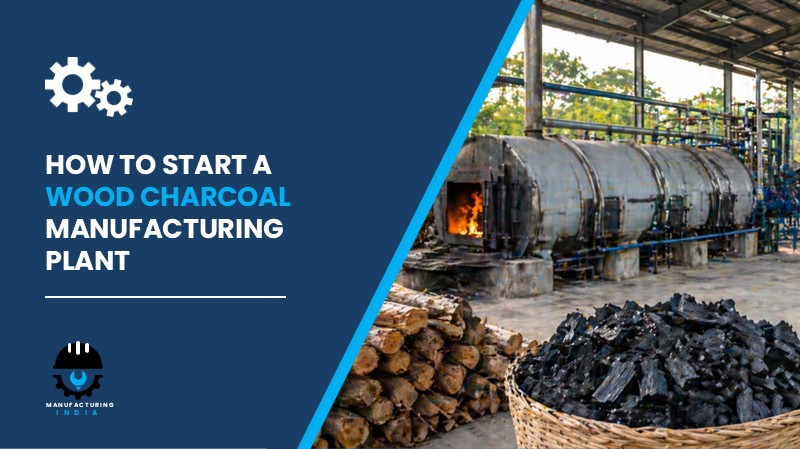
Setting up a wood charcoal manufacturing plant in India presents a compelling investment case, driven by sustained demand from metallurgy and metal processing, foodservice and hospitality, residential and commercial heating, water and air purification, and agriculture. Wood charcoal is a critical input material for small-scale iron smelting, grilling and barbecuing, filtration systems, and soil enhancement applications, making it indispensable across both industrial and domestic consumption segments. As India accelerates its manufacturing base and energy diversification agenda, biomass-derived solid fuels such as wood charcoal stand at the intersection of renewable energy and multi-sector industrial demand.
India’s natural advantages – abundant forestry biomass, low-cost labour, expanding infrastructure, and the Government of India’s Make in India initiative – make it a strategically sound location for establishing this production. States such as Gujarat, Maharashtra, Madhya Pradesh, and Chhattisgarh offer proximity to raw material sources, well-developed industrial estates, and road and rail connectivity to key demand markets. With the global wood charcoal industry valued at USD 22.52 Billion in 2025 and projected to reach USD 27.63 Billion by 2034, domestic producers are positioned to capitalise on both import substitution and export opportunities.
Setting up a wood charcoal manufacturing plant in India is financially viable and strategically sound, supported by Make in India policy tailwinds, low land and labour costs, and diversified demand from metallurgy, foodservice, agriculture, and water purification sectors. With gross profit margins ranging between 35-45% and net margins of 15-20%, this investment offers strong returns and a clearly defined break-even pathway.
What is Wood Charcoal?
Wood charcoal is a lightweight, black, porous, carbon-rich solid produced by heating wood in a low-oxygen environment – a process known as pyrolysis – which removes water and volatile compounds, yielding a fuel that burns hotter and cleaner than raw wood. The resulting material is widely preferred due to its renewable origin, relatively clean combustion, and versatility across industrial, domestic, and environmental applications. Key properties include high fixed carbon content, low sulfur emissions compared to coal, and strong adsorptive capacity, making it suitable as both a fuel and a functional industrial material.
Depending on the production method and feedstock used, wood charcoal can be manufactured in lump, powdered, or briquetted form. The production process involves wood selection and sizing, drying and moisture reduction, pyrolysis and carbonization in kilns or retorts, cooling and quenching, and finally crushing, grading, and packaging. End-use industries served include metallurgy and metal processing, foodservice and hospitality, residential and commercial heating, water and air purification, and agriculture – ensuring broad and diversified market absorption across the value chain.
Cost of Setting Up a Wood Charcoal Manufacturing Plant in India
The total cost of establishing a wood charcoal manufacturing plant in India depends on capacity, technology, site location, degree of automation, and regulatory compliance requirements.
1. Capital Expenditure (CapEx)
Capital investment in a wood charcoal manufacturing facility covers several major heads. Land and site development forms a substantial part of total CapEx, including land registration charges, boundary development, and site levelling. Investors may consider SEZ locations or notified industrial estates in states such as Gujarat or Madhya Pradesh to reduce land acquisition costs and benefit from fiscal incentives.
Civil works and construction costs encompass the production shed, kiln housing structures, laboratory and quality control area, raw material storage yard, finished goods warehouse, and the administrative block. Proper civil design is essential given the high-temperature and particulate-emission nature of carbonization operations.
Key machinery required for the wood charcoal manufacturing plant includes:
- Charcoal kilns (earth kilns, brick kilns, metal kilns, or retort kilns)
- Carbonization retorts
- Wood chippers and crushers
- Dryers
- Screening and grading systems
- Packaging machines
Other capital costs include effluent treatment plant (ETP) installation, pre-operative expenses, commissioning charges, and any applicable import duties on specialized kiln or retort equipment.
Request a Sample Report for In-Depth Market Insights: https://www.imarcgroup.com/wood-charcoal-manufacturing-plant-project-report/requestsample
2. Operational Expenditure (OpEx)
Raw material cost is the dominant operating expense for this facility. The primary raw material is hardwood/biomass, which accounts for approximately 50-60% of total OpEx. Investors should prioritize long-term procurement contracts with forestry estates, sawmills, and plantation residue suppliers to stabilize input pricing and ensure supply continuity.
Utility costs – covering electricity, water, and steam – represent 20-25% of total OpEx. Power consumption is significant during the drying and kiln-firing phases, making location within an industrial zone with reliable grid connectivity an operational priority. Other operating costs include transportation and logistics, primary and secondary packaging materials, salaries and wages for skilled and unskilled manpower, routine maintenance, depreciation on plant and machinery, and applicable taxes. By the fifth year of operations, total operational costs are projected to increase substantially due to inflation, market fluctuations, potential rises in the cost of hardwood/biomass, supply chain disruptions, and shifts in demand patterns.
3. Plant Capacity
The proposed manufacturing facility is designed with an annual production capacity ranging between 10,000 and 20,000 MT, enabling economies of scale while maintaining operational flexibility. Capacity can be customized based on individual investor requirements and target market size. Profitability improves meaningfully with higher capacity utilization, as fixed costs – including land, civil infrastructure, and kiln equipment – are distributed over a larger production volume.
4. Profit Margins and Financial Projections
The wood charcoal manufacturing plant demonstrates healthy profitability potential under normal operating conditions. Gross profit margins typically range between 35-45%, supported by stable multi-sector demand and value-added applications. Net profit margins are projected at 15-20% on an average basis across years. Financial projections encompass NPV (net present value), IRR (internal rate of return), payback period analysis, gross and net margin tracking, and a full profit and loss account – all detailed in the IMARC Group feasibility report.
Why Set Up a Wood Charcoal Plant in India?
Sustained Foodservice and Domestic Fuel Demand: The foodservice sector remains one of the most consistent demand drivers for wood charcoal globally, especially in emerging economies where charcoal is the preferred cooking and grilling fuel. In India, the hospitality, restaurant, and catering segment uses charcoal extensively, creating reliable year-round off-take volumes for domestic producers.
Industrial Metallurgy and Metal Processing: Wood charcoal is used as a reductant in small-scale iron smelting and non-ferrous metal processing due to its high fixed carbon content and low impurity profile. India’s large base of small and medium foundries, forges, and metal workshops sustains consistent industrial demand for this facility’s output.
Rising Agricultural Adoption of Biochar: Agriculture is an expanding demand segment, with biochar – derived from wood charcoal – being adopted to enhance soil fertility, moisture retention, and carbon sequestration. This application is gaining traction in the Asia-Pacific region, where awareness of biochar’s soil health benefits is growing steadily, opening a significant incremental market for Indian producers.
Water and Air Purification Growth: Wood charcoal serves as a precursor material for activated carbon used in water filtration and air adsorption systems. As India’s water treatment infrastructure expands under urban and industrial development programmes, demand for charcoal-derived purification materials is set to rise.
Renewable Energy and Sustainability Tailwinds: Wood charcoal is derived from biomass, making it a renewable alternative to fossil-based solid fuels when sourced from sustainably managed forests. India’s push toward renewable energy and low-sulfur combustion supports charcoal adoption across sectors, and the lower sulfur emissions of wood charcoal compared to coal align with tightening emission norms.
Active Industry Investment: In January 2026, Tandoor Morni – a prominent supplier of premium tandoors – reported a surge in demand for traditional charcoal tandoor models, with eco-conscious kitchens embracing the rise of charcoal wood tandoors for sustainable cooking. This signals growing consumer preference for charcoal-based systems, reinforcing demand growth across the hospitality and residential segments.
Manufacturing Process – Step by Step
The wood charcoal manufacturing process uses pyrolysis and carbonization as the primary production method. The complete process flow is outlined below:
- Wood Selection and Sizing: Hardwood/biomass feedstock is selected based on moisture content, species type, and density, then cut and sized for consistent feed to the kiln system.
- Drying and Moisture Reduction: Sized wood is passed through dryers to reduce moisture content to the optimal level required for efficient carbonization, improving final product quality.
- Pyrolysis and Carbonization in Kilns or Retorts: Wood is loaded into charcoal kilns (earth, brick, metal, or retort kilns) or carbonization retorts and heated in a low-oxygen environment, driving off water and volatile compounds to yield carbon-rich charcoal.
- Cooling and Quenching: Carbonized material is cooled under controlled conditions to prevent combustion and preserve product integrity before handling.
- Crushing and Grading: Cooled charcoal is passed through screening and grading systems to separate product by size grade – lump, powder, or briquette-grade material – as per market specifications.
- Packaging and Dispatch: Graded product is packed using packaging machines into appropriate packaging formats for dispatch to end-use industries including metallurgy, foodservice, agriculture, and water purification sectors.
Key Applications
Wood charcoal serves a diverse range of industries, each with distinct application requirements:
- Metallurgy and Metal Processing: Used as a reductant in small-scale iron smelting and non-ferrous metal processing due to high fixed carbon content and low impurity levels.
- Foodservice and Hospitality: Widely used for grilling, barbecuing, and traditional cooking because of its stable heat output and minimal smoke generation.
- Residential and Commercial Heating: Applied as a domestic heating fuel in regions lacking access to modern energy infrastructure.
- Water and Air Purification: Serves as a precursor material for activated carbon used in filtration and adsorption systems.
- Agriculture: Utilized as biochar to enhance soil fertility, moisture retention, and carbon sequestration.
Leading Manufacturers
The global wood charcoal market is served by a range of multinational producers with extensive production capacities and diverse application portfolios. Key players operating in this industry include:
- The Clorox Company
- Royal Oak Company
- Duraflame Inc.
- Fire & Flavor Grilling Company
- Fogo Charcoal
- Cooks International LLC
- Southern Fuelwood
- Kingsford Products Company
- K.P. BIOCOAL
Timeline to Start the Plant
Investors should plan for the following sequential development phases before reaching commercial production:
- Feasibility study and project report preparation
- Land acquisition and site development
- Regulatory approvals and environmental clearances
- Factory licence and fire safety compliance
- Machinery procurement and installation
- Raw material supplier agreements and supply chain setup
- Trial production and quality testing
- Commercial production launch
Licences and Regulatory Requirements
Starting a wood charcoal manufacturing unit in India requires several approvals:
- Business registration (Proprietorship, LLP, or Pvt Ltd) under the Ministry of Corporate Affairs
- Factory Licence under the Factories Act, 1948
- Environmental Clearance from the State Pollution Control Board
- GST Registration under the Goods and Services Tax framework
- Fire Safety NOC from the local Fire Services Authority
- Hazardous and chemical compliance for kiln gases and combustion by-products
- Effluent Treatment Plant (ETP) operational clearance
- Occupational Health and Safety compliance for kiln operators and floor staff
Key Challenges to Consider
High Capital Requirements: Establishing a wood charcoal manufacturing plant with the necessary kiln infrastructure, carbonization retorts, and ETP systems involves significant upfront capital outlay, which may require structured debt financing or equity partnership.
Raw Material Price Volatility: Hardwood and biomass input costs are subject to seasonal availability, forestry regulations, and transportation cost fluctuations. Price volatility in this primary raw material – which constitutes 50-60% of OpEx – directly impacts margin stability.
Regulatory Compliance: Wood charcoal production involves open or closed kiln carbonization, generating particulate matter and combustion gases. Maintaining continuous environmental clearance, ETP compliance, and emission monitoring requires dedicated resources and management attention.
Technology and Innovation Pressure: The industry is increasingly shaped by sustainability pressures, driving adoption of improved kiln technologies, traceable wood sourcing, and higher-efficiency carbonization methods. Producers using outdated kiln designs face cost and compliance disadvantages.
Competition from Established Players: Multinational players including The Clorox Company, Royal Oak Company, Kingsford Products Company, and Duraflame Inc. operate with large-scale production advantages. Indian entrants must differentiate on pricing, proximity to domestic markets, and product quality.
Skilled Manpower: Operating carbonization kilns and retorts requires trained technicians capable of managing temperature profiles, moisture control, and quality assurance. Developing and retaining this skill base represents an ongoing operational challenge.
Frequently Asked Questions
1. How much does it cost to set up a wood charcoal manufacturing plant in India?
Total investment depends on plant capacity, technology selected, site location, and automation level. The IMARC Group project report provides a detailed CapEx and OpEx breakdown covering land, civil works, machinery, and operating costs for this unit.
2. Is wood charcoal manufacturing profitable in India in 2026?
Yes. Gross profit margins for a wood charcoal manufacturing plant typically range between 35-45%, with net profit margins of 15-20%, supported by diversified demand across metallurgy, foodservice, agriculture, and purification sectors.
3. What machinery is required for a wood charcoal plant in India?
Key equipment includes charcoal kilns (earth, brick, metal, or retort kilns), carbonization retorts, wood chippers and crushers, dryers, screening and grading systems, and packaging machines.
4. What licences and approvals are required to start a wood charcoal plant in India?
Required approvals include business registration, Factory Licence, Environmental Clearance from the State Pollution Control Board, GST Registration, Fire Safety NOC, ETP operational clearance, and Occupational Health and Safety compliance.
5. What raw materials are needed for wood charcoal manufacturing?
The primary raw material is hardwood/biomass, which accounts for 50-60% of total operating expenses. Consistent sourcing through long-term supplier contracts is essential for cost stability.
6. What are the environmental compliance requirements for a wood charcoal plant in India?
Operators must obtain Environmental Clearance from the State Pollution Control Board, install and operate an Effluent Treatment Plant, and implement advanced monitoring systems to manage kiln emissions and combustion by-products in line with emission norms.
7. What is the best location to set up a wood charcoal plant in India?
Ideal locations offer proximity to hardwood/biomass supply sources, access to reliable utilities and transportation infrastructure, and compliance with local zoning laws. States with large plantation and forestry bases, such as Madhya Pradesh, Chhattisgarh, and Maharashtra, are strategically advantageous.
8. What is the break-even period for this type of plant in India?
The IMARC Group feasibility report includes a detailed payback period, NPV, and IRR analysis specific to plant capacity and operating conditions. Request the sample report for project-specific financial projections.
9. What government incentives are available for manufacturers in India?
Indian manufacturers may access benefits under the Make in India initiative, state industrial policy incentive schemes, SEZ fiscal benefits, and capital subsidy programmes available through state investment promotion boards. Eligibility depends on plant location, capacity, and sector classification.
Key Takeaways for Investors
A wood charcoal manufacturing plant in India represents a well-rounded investment opportunity, backed by diversified demand from metallurgy, foodservice, agriculture, and water purification – sectors that collectively ensure stable and growing off-take across economic cycles. The financial profile is compelling across plant capacities, with gross margins of 35-45% and net margins of 15-20% demonstrating strong viability even at conservative capacity utilisation levels. The global wood charcoal market, valued at USD 22.52 Billion in 2025, is projected to reach USD 27.63 Billion by 2034 at a CAGR of 2.3%, providing a sustained demand growth backdrop for domestic Indian producers. With biochar adoption accelerating in agriculture, activated carbon demand rising in water treatment, and foodservice charcoal consumption continuing to grow, the long-term demand sustainability of this investment is well-established.
About the Author