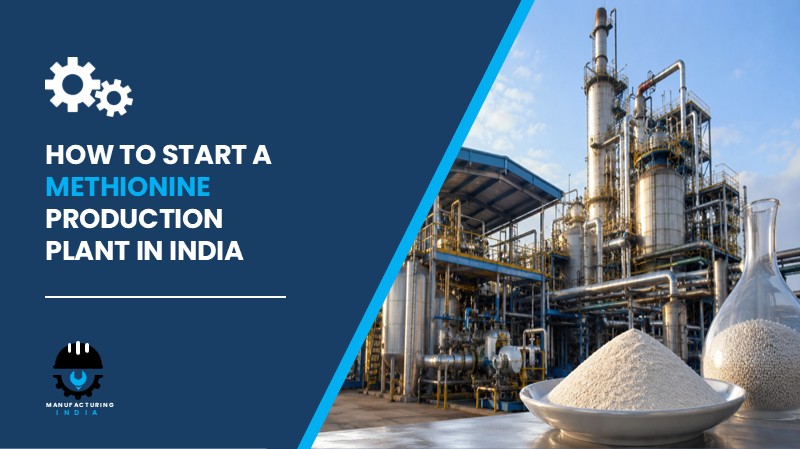
Setting up a methionine production plant in India presents a compelling investment case at a time when the country’s poultry, aquaculture, and livestock sectors are expanding at an exceptional pace, its pharmaceutical and nutraceutical industries are scaling rapidly, and its growing focus on food security and agricultural productivity is driving systematic adoption of amino acid supplementation in animal nutrition programmes. Methionine — the essential, sulfur-containing amino acid that the human body and most animals cannot synthesise independently, making dietary or supplementary intake mandatory — is the most widely used amino acid additive in global animal feed formulations, consumed in millions of tonnes annually by poultry, swine, and aquaculture producers seeking to improve growth performance, feed conversion efficiency, immunity, and overall livestock productivity. As India’s protein consumption rises with urbanisation, its organised poultry and aquaculture sectors deepen, and its government supports feed quality and self-sufficiency through agricultural modernisation programmes, the domestic requirement for reliably produced, high-purity methionine is growing into a commercially significant and multi-sector investment opportunity.
India’s positioning for methionine production is strongly supported by both demand fundamentals and policy momentum. According to UN-Habitat, by 2030, nearly 60% of the world’s population will live in urban areas — a demographic transition that in India translates directly into rising per-capita protein consumption, expanding poultry and aquaculture industries, and growing institutional demand for methionine-fortified feed products that improve animal production economics. India’s pharmaceutical sector — targeting USD 130 Billion by 2030 — creates an additional and growing demand layer for pharmaceutical-grade methionine in liver health, detoxification, and metabolic support formulations. Specialty chemical and petrochemical industrial estates in Gujarat, Maharashtra, and Andhra Pradesh offer the methyl mercaptan and acrolein supply chain proximity, corrosion-resistant reactor infrastructure, and regulatory frameworks that a methionine production facility requires. The Make in India initiative and government support for agricultural input self-sufficiency collectively create a policy environment that indirectly but meaningfully favours domestic methionine production over continued import dependence.
Investing in a methionine production plant in India today aligns the country’s expanding poultry, aquaculture, and livestock sectors with rising pharmaceutical and nutraceutical demand, megatrend alignment across sustainable animal nutrition and food security, and a global methionine market growing from USD 7.0 Billion in 2025 to USD 11.9 Billion by 2034 at a CAGR of 5.8%. With gross profit margins of 22–30% and net profit margins of 12–18% at an annual production capacity of 30,000 MT, the unit economics are commercially sound, and the investment’s diversified multi-sector demand base supports long-term revenue resilience across India’s agricultural and health industry growth cycle.
What is Methionine?
Methionine is an essential, sulfur-containing amino acid that the human body cannot produce on its own, making it necessary to obtain through diet. Rich in sulfur, it acts as a building block for proteins and plays a key role in initiating protein synthesis via the start codon AUG. Methionine is vital for metabolism, acting as a precursor for SAMe (S-adenosylmethionine), which is essential for DNA methylation, detoxification, and producing antioxidants like glutathione. It also aids in tissue repair and metabolism. Rich dietary sources include eggs, meat, fish, and dairy products.
In industrial animal nutrition, methionine is the most limiting essential amino acid in poultry diets, and synthetic DL-methionine is the industry-standard supplemental form used to balance feed protein quality and maximise growth performance and feed efficiency. Aquaculture and swine production similarly depend on methionine supplementation to meet the specific amino acid requirements of high-productivity production systems that cannot rely entirely on natural feed ingredient methionine content. The gradual shift toward sustainable and bio-based methionine production through fermentation processes — alongside the established chemical synthesis route via methyl mercaptan, acrolein, and hydrogen cyanide chemistry — is expanding both the technology options and sustainability credentials available to new methionine producers.
The primary production process covers fermentation or chemical synthesis, extraction, crystallisation, and drying. End-use industries served include animal feed, pharmaceuticals, food and beverages, personal care, agricultural chemicals, and nutraceuticals. Applications span methionine-enriched feed supplements for poultry, swine, and aquaculture, IV nutrition formulations, protein fortification, amino acid blends, and cosmetic and haircare ingredient formulations.
Cost of Setting Up a Methionine Production Plant in India
The cost of establishing a methionine production plant in India depends on production capacity, technology pathway selection between chemical synthesis and fermentation, product grade between feed-grade DL-methionine and pharmaceutical-grade L-methionine, geographic location — particularly proximity to methyl mercaptan, acrolein, and hydrogen cyanide supply chains — degree of automation, and the environmental, safety, and quality compliance requirements applicable to a highly toxic and chemically complex industrial amino acid manufacturing facility.
1. Capital Expenditure (CapEx)
Land and Site Development forms a foundational component of total capital investment, covering land acquisition charges, site registration, boundary development, chemical containment and bund wall infrastructure, drainage, and site utilities. The location must offer easy access to key raw materials such as methyl mercaptan, acrolein, hydrogen cyanide, ammonia, and CO₂. Proximity to target markets — particularly the large integrated poultry operations in Andhra Pradesh, Telangana, and Maharashtra and the pharmaceutical manufacturing clusters in Hyderabad and Ahmedabad — minimises distribution costs. The site must have robust infrastructure including reliable transportation, utilities, and waste management systems, with compliance with local zoning laws and environmental regulations ensured from the outset. Chemical industrial estates in Ankleshwar and Dahej in Gujarat and Hyderabad in Telangana are among the most strategically relevant locations.
Plant Layout Optimisation is critical for a methionine production facility given the multiple hazardous chemical streams processed simultaneously. The layout must be optimised to enhance workflow efficiency, safety, and minimise material handling distances between synthesis reactors, crystallisation units, and drying systems. Separate areas for raw material storage for methyl mercaptan, acrolein, hydrogen cyanide, and ammonia — with appropriate segregated containment — production, quality control, and finished goods storage must be designated. Space for future capacity expansion should be incorporated to accommodate business growth as animal feed customer contracts and pharmaceutical market access are secured.
Machinery and Equipment represent the largest single component of total CapEx for a methionine production plant. Essential equipment includes:
- Gas reformers
- Methanol synthesisers
- Sulfur burners
- Reaction towers
- Crystallisation units
- Distillation columns
- Drying systems
- Packaging machines
Other Capital Costs include an effluent treatment plant (ETP) to minimise environmental impact and ensure compliance with emission standards for the multiple toxic chemical streams processed, advanced monitoring systems to detect leaks or deviations in the synthesis process, fume scrubbing systems for methyl mercaptan and hydrogen cyanide emissions, pre-operative expenses, environmental clearance and MSIHC safety assessment costs, commissioning charges, and import duties on specialised reaction tower internals or crystallisation equipment not available domestically.
Request a Sample Report for In-Depth Market Insights: https://www.imarcgroup.com/methionine-manufacturing-plant-project-report/requestsample
2. Operational Expenditure (OpEx)
Raw Material Cost is the overwhelmingly dominant operational expense, accounting for approximately 58–68% of total OpEx. The primary raw materials are methyl mercaptan, acrolein, hydrogen cyanide, ammonia, and CO₂. Methyl mercaptan — as the primary sulfur-containing feedstock that provides the sulfur atom central to methionine’s chemistry — drives the majority of raw material cost in the chemical synthesis route and is a petrochemical derivative whose pricing is tied to natural gas and refining economics. Acrolein, produced from propylene, and hydrogen cyanide are critical synthesis intermediates consumed in stoichiometric quantities. Long-term contracts with reliable suppliers for all synthesis feedstocks are essential for production cost stability and supply continuity, given the concurrent hazardous nature and supply sensitivity of multiple key inputs.
Utility Cost is the second-largest OpEx component, representing approximately 9–13% of total operating expenses, covering electricity, steam, water, and cooling for gas reformers, reaction towers, crystallisation systems, distillation columns, and drying equipment. The chemical synthesis route’s energy requirements are concentrated in the reactor and distillation stages, where thermal management is critical for both reaction selectivity and product purity.
Other Operating Costs include transportation and distribution to animal feed manufacturers, integrated poultry and aquaculture producers, pharmaceutical ingredient formulators, and nutraceutical supplement producers, specialised packaging materials for feed-grade methionine in 25 kg bags and bulk containers, salaries and wages for chemical process engineers and quality control analysts, routine machinery maintenance including reaction tower lining inspection and crystalliser cleaning, depreciation on production equipment, and applicable taxes. By the fifth year, the total operational cost is expected to increase substantially due to factors such as inflation, market fluctuations, and potential rises in the cost of key materials. Additional factors, including supply chain disruptions, rising consumer demand, and shifts in the global economy, are expected to contribute to this increase.
3. Plant Capacity
The proposed production facility is designed with an annual production capacity of 30,000 MT, enabling economies of scale while maintaining the operational flexibility to serve a diversified customer base across animal feed, pharmaceutical, food and beverage, personal care, and nutraceutical market segments. Plant capacity can be customised per investor requirements and scaled through additional synthesis train and crystallisation capacity as customer volumes and market penetration grow. Profitability improves with higher capacity utilisation, making secured supply agreements with large integrated poultry operations, feed compounders, and pharmaceutical ingredient distributors a strategic commercial foundation for the investment from the outset.
4. Profit Margins and Financial Projections
The financial projections for a methionine production plant demonstrate commercially sound profitability potential under normal operating conditions. Gross profit margins typically range between 22–30%, supported by stable multi-sector demand from animal feed, pharmaceutical, nutraceutical, and personal care customers and the moderate entry barriers that favour reliable, quality-consistent producers. Net profit margins are projected at 12–18%. A comprehensive financial analysis covering NPV (net present value), IRR (internal rate of return), payback period, gross margin progression, and net margin development across a five-year horizon is essential before committing capital, with projections developed based on realistic assumptions related to capital investment, operating costs, production capacity utilisation, pricing trends, and demand outlook.
Why Set Up a Methionine Production Plant in India?
Essential Amino Acid for Animal Nutrition and India’s Food Security. Methionine is a critical sulfur-containing amino acid widely used in poultry, swine, and aquaculture feed to support growth, immunity, and feed efficiency — positioning it as an indispensable input for India’s food security and agricultural productivity agenda. As India’s poultry sector expands — with organised broiler production growing at over 8% annually — and aquaculture output increases to meet rising domestic and export demand for seafood protein, the methionine requirement in compounded feed formulations grows commensurately, creating a large and structurally expanding domestic market.
Megatrend Alignment Across Sustainable Livestock Farming and Protein Consumption. Rising global protein consumption, expanding poultry and aquaculture industries, increasing focus on feed efficiency and sustainable livestock farming are driving steady demand growth for methionine. According to UN-Habitat, by 2030, nearly 60% of the world’s population will live in urban areas — a transition that in India directly translates into rising per-capita protein consumption, growing organised food service and retail protein demand, and the commercial expansion of intensive livestock production systems that depend on precisely formulated, methionine-balanced feed to achieve competitive growth rates and feed conversion ratios.
Moderate but Defensible Entry Barriers Creating Long-Term Competitive Positioning. Methionine production requires significant technical expertise in chemical synthesis or fermentation processes, strict quality control, environmental compliance, and consistent raw material management. Long customer qualification cycles with feed manufacturers and integrated poultry producers — who require supplier audits, production facility inspections, and multi-batch quality consistency evidence before awarding supply contracts — create meaningful barriers that favour reliable and process-efficient manufacturers over new entrants pursuing purely price-based competition.
Policy and Food Security Push Supporting Agricultural Input Localisation. Government initiatives supporting domestic food production, livestock productivity, feed self-sufficiency, and agricultural modernisation are indirectly boosting methionine demand. Policies promoting animal nutrition, export-oriented agri-processing, and sustainable farming practices further strengthen industry prospects. India’s current dependence on imported methionine — primarily from established producers in Europe and China — creates a direct policy motivation for domestic production capacity development that the Make in India initiative and Atmanirbhar Bharat agenda collectively support.
Active Pricing Momentum Confirming Market Strength. In March 2026, Evonik announced a net price increase of 10% for MetAMINO (DL-methionine 99%, feed grade), effective immediately for all markets — a commercial signal that reflects tight global supply conditions and strong end-market demand that benefits domestic Indian producers who can supply the growing domestic poultry and aquaculture sector without the import cost, delivery time, and currency exposure disadvantages of foreign-sourced methionine.
Sustainability Innovation Expanding Market and Application Range. In February 2026, a study published in MDPI showed that reducing total dietary protein while supplementing with specific levels of methionine maintains animal growth and fur quality in species like blue foxes, while significantly decreasing nitrogen (N) emissions — a finding that positions precision methionine supplementation as an environmental sustainability tool for reducing the nitrogen pollution footprint of intensive livestock production. This emerging sustainability role for methionine creates new institutional demand from environmentally regulated livestock operations seeking to demonstrate reduced environmental impact without compromising production performance.
Production Process — Step by Step
The methionine production process uses fermentation, extraction, crystallisation, and drying — or for chemical synthesis routes, gas reforming, methanol synthesis, sulfur burning, reaction tower processing, crystallisation, and drying — as the primary production method. Each stage requires precisely controlled process parameters, reaction selectivity management, and quality verification to deliver methionine of the target purity, crystal form, and specification required by feed-grade, pharmaceutical-grade, or nutraceutical-grade customers.
- Raw Material Preparation: Methyl mercaptan, acrolein, hydrogen cyanide, ammonia, and CO₂ are received from certified suppliers, quality-checked for purity and composition specification compliance, and prepared in metered quantities for controlled feed into the synthesis reactor system. Hazardous chemical handling protocols are implemented throughout receipt, storage, and preparation operations.
- Sulfur Chemistry — Sulfur Burning and Methyl Mercaptan Production: Sulfur is burned in sulfur burners to produce sulfur dioxide, which is subsequently reduced and reacted with methanol in methanol synthesisers to produce methyl mercaptan — the primary sulfur-containing feedstock for methionine synthesis — where methyl mercaptan is not directly sourced from external suppliers.
- Gas Reforming: Hydrocarbon feedstocks are processed through gas reformers to produce synthesis gas streams — hydrogen, carbon monoxide, and methane — required for downstream methionine synthesis chemistry, with precise composition control ensuring optimal reaction conditions in subsequent synthesis steps.
- Reaction Tower Synthesis: Methyl mercaptan is reacted with acrolein in reaction towers to produce 3-methylthiopropanal (MMP), which is subsequently reacted with hydrogen cyanide and ammonia in a Strecker synthesis reaction to produce the methionine nitrile intermediate (HMTBA-nitrile), which undergoes controlled hydrolysis to yield DL-methionine as the primary product.
- Neutralisation and pH Control: The crude methionine synthesis mixture undergoes controlled neutralisation with ammonia and CO₂ addition to adjust pH to the optimal range for methionine crystallisation while minimising losses of product to the aqueous phase.
- Crystallisation: Neutralised methionine solution is processed through crystallisation units under controlled cooling and seeding conditions to produce DL-methionine crystals of the specified purity, crystal size, and bulk density required for feed-grade or pharmaceutical-grade product specifications.
- Filtration and Washing: Crystallised methionine is separated from the mother liquor through filtration and washed with water to remove residual impurities, with mother liquor recycled to recover methionine values and minimise product loss.
- Drying: Washed methionine crystals are processed through drying systems at controlled temperature to achieve the target moisture content specified for feed-grade and pharmaceutical-grade products while maintaining crystal integrity.
- Quality Control and Testing: Finished methionine undergoes comprehensive quality testing covering amino acid assay purity, moisture content, specific optical rotation for L-methionine grades, heavy metal content, sulphate ash, and microbiological compliance against customer or standard product specifications before packaging.
- Packaging and Dispatch: Specification-compliant methionine is filled into 25 kg multi-wall paper bags or bulk containers using packaging machines and dispatched to animal feed manufacturers, integrated poultry and aquaculture producers, pharmaceutical ingredient formulators, food and beverage fortification producers, and nutraceutical supplement companies.
Key Applications
Methionine produced in India serves a commercially broad and structurally growing range of nutritional, pharmaceutical, and personal care applications:
- Animal Feed Industry: Used as a nutritional additive to improve growth, metabolism, and feed efficiency in poultry, swine, and aquaculture livestock — the dominant application consuming the largest share of global methionine production.
- Pharmaceuticals: Used in formulations for liver health, detoxification, and metabolic support, and as an IV nutrition component for patients requiring parenteral amino acid nutrition.
- Food and Beverages: Applied as a fortification ingredient in dietary supplements, functional foods, sports nutrition products, and clinical nutrition formulations targeting protein sufficiency.
- Cosmetics and Personal Care: Used as an ingredient in skincare and haircare products for its antioxidant and conditioning properties, particularly in premium formulations targeting anti-aging and hair strengthening claims.
Leading Producers
The global methionine industry is served by a group of large multinational chemical and life science companies with extensive production capacities and diversified application portfolios across animal feed, pharmaceutical, and specialty chemical segments. Key players in the global market include:
- Sumitomo Chemical
- CJ Cheiljedang Corp
- Chongqing Unisplendour Chemical
- Sichuan Hebang
- Dow Chemical Company
Timeline to Start the Plant
Establishing a methionine production plant in India involves a structured multi-phase development sequence. Investors should plan for the following phases:
- Feasibility study and project report preparation
- Land acquisition and site development
- Regulatory approvals and environmental clearances
- Factory licence and fire safety compliance
- Machinery procurement and installation
- Raw material supplier agreements and supply chain setup
- Trial production and quality testing
- Commercial production launch
Licences and Regulatory Requirements
Starting a methionine production unit in India requires comprehensive approvals spanning business registration, hazardous chemical safety, animal feed quality regulation, pharmaceutical compliance, environmental, and industrial safety domains:
- Business registration (Proprietorship, LLP, or Pvt Ltd)
- Factory Licence under the Factories Act
- Environmental Clearance from the State Pollution Control Board
- GST Registration
- Fire Safety NOC
- Hazardous/Chemical compliance under the Manufacture, Storage and Import of Hazardous Chemical (MSIHC) Rules, applicable to methyl mercaptan, acrolein, and hydrogen cyanide as Schedule 1 toxic chemicals
- Feed Supplement or Feed Additive registration under the Feed and Fodder Rules applicable to methionine sold as an animal feed additive in India
- Effluent Treatment Plant (ETP) operational clearance with capability to manage toxic chemical-containing process effluents
- Occupational Health and Safety compliance including On-Site Emergency Plan mandatory for major hazard installations involving hydrogen cyanide and methyl mercaptan
Key Challenges to Consider
Highly Toxic Raw Material Hazard Management. Methyl mercaptan, acrolein, and hydrogen cyanide — the three primary synthesis feedstocks for the chemical synthesis route — are all acutely toxic chemicals with very low occupational exposure limits, flammable properties, and severe environmental hazard classifications. Managing these concurrent toxic hazards across receipt, storage, metering, and reaction stages requires the most sophisticated chemical safety management systems, continuous gas monitoring, emergency response infrastructure, and rigorous operational protocols — demands that go substantially beyond conventional chemical plant safety management.
Raw Material Supply Chain Complexity and Import Dependence. Methyl mercaptan accounts for approximately 58–68% of total OpEx as the primary raw feedstock, and India’s domestic methyl mercaptan production capacity is limited, creating import dependence on suppliers in Europe and the United States. Acrolein and hydrogen cyanide similarly require specialised procurement from petrochemical producers. Managing this multi-hazardous-chemical import supply chain requires expert logistics management, MSIHC Rules import compliance, and strategic inventory management to avoid production disruptions.
MSIHC Rules Compliance and Major Hazard Installation Obligations. Methionine production using the chemical synthesis route is classified as a major hazard installation under India’s MSIHC Rules given the inventories of hydrogen cyanide, methyl mercaptan, and acrolein involved. This classification requires preparation of a detailed safety case, On-Site and Off-Site Emergency Plans, mandatory reporting to the District Emergency Authority, and periodic safety audits — regulatory obligations that add both capital cost and ongoing management complexity unique to major hazard chemical manufacturing.
Competition from Established Global Scale Producers. The competitive landscape is dominated by large multinational producers including Evonik Industries, Sumitomo Chemical, Novus International, Adisseo, and CJ Cheiljedang, which collectively control the vast majority of global methionine production capacity and hold long-standing supply relationships with major integrated poultry and feed manufacturing companies. New Indian producers must compete through domestic supply chain advantages, import cost elimination, delivery reliability, and feed customer qualification to establish commercial positions against established international suppliers.
Technology Selection Between Chemical Synthesis and Fermentation. The established chemical synthesis route through methyl mercaptan and acrolein chemistry delivers the lowest production cost at commercial scale but involves the highest hazard chemical profile. Emerging fermentation-based bio-methionine routes — using glucose and sulfur sources with engineered microbial strains — offer a lower-hazard, more sustainable production pathway but are currently at higher cost than the chemical synthesis route. New investors must evaluate this technology selection decision carefully against long-term sustainability requirements, capital cost implications, and feedstock availability.
Customer Qualification Cycles for Feed and Pharmaceutical Markets. Supplying methionine to integrated poultry operations, feed compounders, and pharmaceutical manufacturers requires passage through supplier qualification and product approval processes that verify amino acid assay purity, batch consistency, and safety data. Pharmaceutical-grade L-methionine additionally requires GMP certification, pharmacopoeial specification compliance, and drug master file preparation — qualification cycles that can extend 12–24 months before commercial revenue is confirmed.
Frequently Asked Questions
1. How much does it cost to set up a methionine production plant in India?
The total setup cost depends on plant capacity, technology pathway between chemical synthesis and fermentation, product grade, location, and safety infrastructure scale. CapEx covers land and site development with major hazard installation safety infrastructure, core machinery including gas reformers, methanol synthesisers, sulfur burners, reaction towers, crystallisation units, distillation columns, drying systems, and packaging machines, along with ETP, toxic gas scrubbing systems, and other capital costs. A detailed project report with full CapEx and OpEx breakdowns is available on request.
2. Is methionine production profitable in India in 2026?
Yes. The project demonstrates gross profit margins of 22–30% and net profit margins of 12–18% under normal operating conditions, supported by stable and growing demand from the animal feed, pharmaceutical, food and beverage, and nutraceutical sectors. Evonik’s March 2026 announcement of a 10% MetAMINO price increase for all markets confirms the tight supply and strong demand conditions that benefit domestic Indian producers with cost and delivery advantages over import-dependent buyers.
3. What machinery is required for a methionine production plant in India?
Key machinery includes gas reformers, methanol synthesisers, sulfur burners, reaction towers, crystallisation units, distillation columns, drying systems, and packaging machines. Reaction towers are the most technically critical equipment, determining the yield, selectivity, and purity of the DL-methionine synthesis and defining the core production economics of the facility.
4. What licences and approvals are required to start a methionine production plant in India?
Required approvals include business registration, a Factory Licence under the Factories Act, Environmental Clearance from the State Pollution Control Board, GST registration, a Fire Safety NOC, MSIHC Rules compliance for methyl mercaptan, acrolein, and hydrogen cyanide as Schedule 1 toxic chemicals, Feed Supplement registration under the Feed and Fodder Rules, ETP operational clearance for toxic chemical-containing effluents, and Occupational Health and Safety compliance including mandatory On-Site and Off-Site Emergency Plans.
5. What raw materials are needed for methionine production?
The primary raw materials are methyl mercaptan, acrolein, hydrogen cyanide, ammonia, and CO₂. Methyl mercaptan accounts for approximately 58–68% of total operating expenses as the dominant synthesis feedstock, making methyl mercaptan procurement strategy, import logistics management, and synthesis feedstock price risk management the most critical cost management levers for the investment.
6. What are the environmental compliance requirements for a methionine production plant in India?
The unit must obtain Environmental Clearance from the State Pollution Control Board, operate a certified ETP for managing toxic chemical-containing process effluents, install fume scrubbing systems for methyl mercaptan and hydrogen cyanide emissions, comply with MSIHC Rules major hazard installation requirements including mandatory safety reporting and emergency planning, and maintain continuous monitoring systems for air emissions and wastewater discharge in line with state pollution control standards.
7. What is the best location to set up a methionine production plant in India?
Optimal locations offer proximity to methyl mercaptan, acrolein, and hydrogen cyanide supply chains or import logistics hubs, established hazardous chemical manufacturing infrastructure, reliable utilities, and access to large poultry, aquaculture, and pharmaceutical customer clusters. Chemical industrial estates in Ankleshwar and Dahej in Gujarat and Hyderabad’s Pharma City in Telangana are among the most strategically relevant options.
8. What is the break-even period for this type of plant in India?
The break-even period depends on plant capacity, customer qualification timelines with feed manufacturers and pharmaceutical producers, capacity utilisation rate, methyl mercaptan pricing trends, and demand conditions across animal feed and pharmaceutical segments. A detailed financial analysis including payback period, NPV, and IRR projections is included in the full project report, available via the sample request link.
9. What government incentives are available for manufacturers in India?
The Make in India initiative, agricultural input manufacturing support programmes, government initiatives promoting feed self-sufficiency and livestock productivity, and state-level chemical industry promotion policies in Gujarat and Telangana provide financial and regulatory support for methionine production investments. Export promotion benefits for specialty amino acid products and capital subsidy schemes under state investment promotion boards may be applicable depending on the chosen plant location and production profile.
Key Takeaways for Investors
A methionine production plant in India represents a commercially well-grounded investment in an essential nutritional amino acid positioned at the intersection of India’s most structurally robust growth industries — poultry, aquaculture, pharmaceuticals, and nutraceuticals — that together constitute a diverse, multi-sector demand base with different procurement cycles, pricing dynamics, and growth drivers that provide revenue resilience across economic cycles. The project demonstrates financial viability at an annual production capacity of 30,000 MT, with gross profit margins of 22–30% and net profit margins of 12–18% confirming commercially sound unit economics supported by the moderate entry barriers and long customer qualification cycles that protect established, quality-consistent producers from commodity competition pressure. The global methionine market, valued at USD 7.0 Billion in 2025, is projected to reach USD 11.9 Billion by 2034, growing at a CAGR of 5.8%, with India’s urbanisation trajectory, expanding livestock protein demand, and pharmaceutical sector growth placing the country among the most dynamically growing domestic methionine markets globally. With Evonik’s March 2026 price increase confirming strong supply-demand tightness, the February 2026 MDPI study validating precision methionine supplementation as an environmental sustainability tool for nitrogen reduction in livestock operations, and India’s poultry sector growing at over 8% annually, demand sustainability for India-based methionine production is structurally robust, food security-anchored, and commercially compelling across the full investment horizon.
About the Author