Setting up a lead acid battery manufacturing plant in India presents a compelling investment case, given rising demand from automotive, industrial, renewable energy, telecommunications, and electric vehicle sectors. These batteries remain central to backup power systems in essential infrastructure and to starting, lighting, and ignition (SLI) applications in automobiles.
India’s expanding automotive and telecommunications base positions the country as a strategically sound location for this production, with Exide Industries Ltd. already among the global leaders and Assurance International recently opening a new battery facility in Haryana. This established domestic ecosystem supports both component sourcing and market access for new entrants.
Backed by a global market valued at USD 36.8 Billion in 2025, gross margins of 20–30%, and an established domestic manufacturing base including Exide Industries, this investment offers a cost-competitive route into proven energy-storage technology, with steady demand from automotive and backup-power sectors supporting sound break-even viability.
What is Lead Acid Battery?
Lead-acid batteries are rechargeable batteries that contain lead oxide and sulphuric acid to store and release electrical energy. They are widely known in three kinds: flooded (wet-cell), sealed (AGM and Gel), and deep-cycle batteries. These batteries are frequently employed in automotive sectors, energy storage, backup power systems, and other applications.
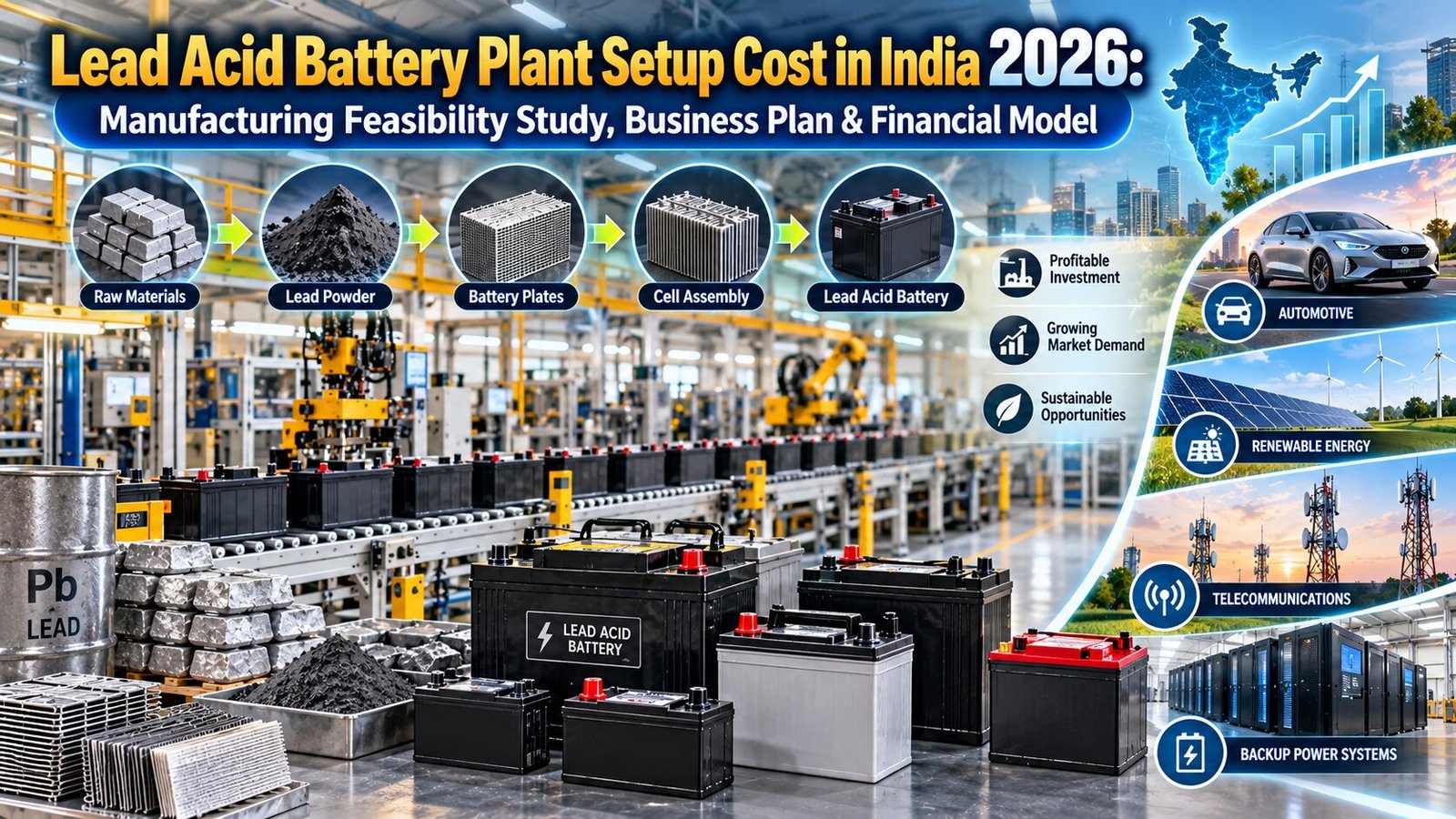
The lead acid battery manufacturing process uses lead preparation, lead oxide production, cell assembly, electrolyte filling, formation, and final sealing and testing. This method serves end-use industries such as automotive, industrial, renewable energy, telecommunications, and electric vehicles.
Cost of Setting Up a Lead Acid Battery Manufacturing Plant in India
The cost of a lead acid battery manufacturing plant depends on capacity, technology, location, automation, and regulatory compliance.
1. Capital Expenditure (CapEx)
Capital investment covers land acquisition, site preparation, and infrastructure, optimized through industrial estates or SEZ-linked plots with developed utilities and faster approvals. Civil works cover the production shed, laboratory, storage areas, and administrative block.
Machinery is the largest portion of capital expenditure for a lead acid battery manufacturing plant, since equipment costs scale with automation level and capacity. Land and site development, civil works for the production shed and administrative block, and effluent treatment infrastructure round out the capital plan, since lead and acid handling call for higher safety and containment specifications than many general manufacturing facilities. Key machinery required includes:
- Lead smelting and casting machines
- Battery formation machines
- Electrolyte filling systems
- Assembly lines
- Charging stations
- Testing and quality control systems
Other capital costs include effluent treatment systems, monitoring systems to detect leaks or process deviations, pre-operative and commissioning expenses, and import duties on machinery.
Request a Sample Report for In-Depth Market Insights: https://www.imarcgroup.com/lead-acid-battery-manufacturing-plant-project-report/requestsample
2. Operational Expenditure (OpEx)
Raw material cost dominates the operating structure at approximately 75–80% of OpEx, driven primarily by lead, along with polypropylene for casing and sulfuric acid. This unusually high share makes long-term supplier contracts essential to stabilize pricing against lead volatility and secure consistent supply.
Utility cost, covering electricity, water, and steam, accounts for approximately 10–15% of OpEx. Other costs include transportation, packaging, salaries, depreciation, taxes, and maintenance. By the fifth year, operational cost is expected to rise on inflation, market fluctuations, and supply chain disruptions.
3. Plant Capacity
The proposed facility is designed with an annual production capacity of 2 million units, enabling economies of scale while maintaining flexibility. Capacity can be customized to investor requirements, and profitability improves with higher capacity utilisation as fixed costs spread across greater output.
4. Profit Margins and Financial Projections
Financial projections cover net present value (NPV), internal rate of return (IRR), payback period, liquidity, and profitability analysis. Under normal conditions, a lead acid battery manufacturing plant typically shows gross margins of 20–30% and net margins of 10–18%, reflecting profitability supported by stable demand and value-added applications.
Why Set Up a Lead Acid Battery Plant in India?
Cost-Effectiveness: These batteries remain one of the most cost-effective energy storage solutions for automotive and backup-power applications, offering a low initial investment and an established supply chain for both manufacturing and recycling.
Energy Density and Efficiency: Good energy density for their cost makes this technology well-suited for automotive applications and industrial backup power.
Proven Technology and Reliability: Over a century of use has made this mature, reliable technology the go-to choice for SLI in vehicles, UPS, and telecommunications backup.
Recyclability: With over 95% of battery materials recyclable, this is among the most recycled products globally, an environmentally favourable trait compared with other battery types.
Advancements in Manufacturing and Recycling: Innovations in battery design and closed-loop lead recovery are making the category more sustainable and efficient.
Rising Electric Vehicle and Renewable Adoption: According to the International Energy Agency, more than 17 million electric cars were sold worldwide in 2024, a trend that continues to support demand for lead-acid batteries in EV auxiliary systems and renewable storage applications.
Active Industry Investment: In December 2024, Assurance International opened a new battery production facility in Haryana, serving major brands including STP, Goodyear, ACDelco, and Duracell, and offering SLA, AGM, VRLA, lithium-ion, tubular, and gel battery technologies — signalling continued domestic investment in India’s battery manufacturing base. In the same month, Xupai Power Vietnam Co., Ltd. began construction on a facility designed to manufacture 2.7 million kVAh of lead-acid batteries annually, underscoring the pace of global capacity expansion in this category.
Manufacturing Process — Step by Step
The lead acid battery manufacturing process uses lead preparation as the primary production method, followed by a series of unit operations, material handling steps, and quality checks.
- Lead Preparation: Lead smelting and casting machines prepare lead grids and oxide for battery construction.
- Lead Oxide Production: Lead oxide is produced to the required specification for plate manufacture.
- Cell Assembly: Assembly lines combine plates, separators, and casing components into complete cells.
- Electrolyte Filling: Electrolyte filling systems introduce sulfuric acid electrolyte into each cell.
- Formation: Charging stations electrically form the plates to activate the battery.
- Final Sealing and Testing: Testing and quality control systems verify performance before dispatch to automotive, industrial, and telecommunications end-users.
Key Applications
These batteries serve a broad set of end-use industries centered on energy storage:
- Automotive Industry: Starting, lighting, and ignition (SLI) in cars, trucks, and motorcycles.
- Industrial and Backup Power: Uninterruptible power supplies (UPS), backup systems, and grid stabilization.
- Renewable Energy Storage: Deep-cycle variants in off-grid solar and wind installations.
- Telecommunications: Backup power for telecom towers and data centers.
Leading Manufacturers
Leading manufacturers in this global industry include several companies with extensive manufacturing capacities and diverse application portfolios. Key players include:
- Brookfield Business Partners
- GS Yuasa
- EnerSys
- Exide Industries Ltd.
- East Penn Manufacturing
- FENGFAN
Timeline to Start the Plant
- Feasibility study and project report preparation
- Land acquisition and site development
- Regulatory approvals and environmental clearances
- Factory licence and fire safety compliance
- Machinery procurement and installation
- Raw material supplier agreements and supply chain setup
- Trial production and quality testing
- Commercial production launch
Licences and Regulatory Requirements
Starting a lead acid battery manufacturing unit in India requires several approvals:
- Business registration (Proprietorship, LLP, or Pvt Ltd)
- Factory Licence under the Factories Act
- Environmental Clearance from State Pollution Control Board
- GST Registration
- Fire Safety NOC
- Hazardous chemical compliance for lead and sulfuric acid handling
- Effluent Treatment Plant (ETP) operational clearance
- Occupational Health and Safety compliance
Key Challenges to Consider
High Capital Requirements: Machinery is the largest share of capital expenditure, with smelting and formation equipment demanding heavy investment.
Raw Material Price Volatility: With lead at 75–80% of OpEx, margins are unusually exposed to lead price movements, making procurement strategy decisive.
Regulatory Compliance: Hazardous-material handling, SOPs, documentation protocols, traceability, and regular audits govern each stage given the lead and acid content.
Competition from Established Players: Brookfield Business Partners, GS Yuasa, EnerSys, Exide Industries Ltd., East Penn Manufacturing, and FENGFAN hold extensive manufacturing capacities.
Technology Pressure from Alternatives: Rising use of lithium-ion and other advanced battery types requires continued innovation in design, manufacturing, and recycling to stay competitive.
Skilled Manpower: Smelting, formation, and quality control require trained personnel to maintain consistent standards.
Frequently Asked Questions
1. How much does it cost to set up a lead acid battery manufacturing plant in India?
Cost depends on capacity, automation level, land and site development, and civil works; a detailed CapEx and OpEx breakdown is covered in the full feasibility report.
2. Is lead acid battery manufacturing profitable in India in 2026?
The facility demonstrates healthy profitability potential, with gross margins of 20–30% and net margins of 10–18% under normal operating conditions.
3. What machinery is required for a lead acid battery plant in India?
Key machinery includes lead smelting and casting machines, battery formation machines, electrolyte filling systems, assembly lines, charging stations, and testing and quality control systems.
4. What licences and approvals are required to start a lead acid battery plant in India?
Requirements include business registration, a Factory Licence, Environmental Clearance, GST Registration, Fire Safety NOC, hazardous chemical compliance, ETP clearance, and occupational health and safety compliance.
5. What raw materials are needed for lead acid battery manufacturing?
Lead (grids, oxide), polypropylene for casing, and sulfuric acid are the primary raw materials.
6. What are the environmental compliance requirements for a lead acid battery plant in India?
Plants require Environmental Clearance from the State Pollution Control Board, an operational Effluent Treatment Plant, and adherence to emission and safety monitoring standards.
7. What is the best location to set up a lead acid battery plant in India?
Sites should offer access to raw materials, proximity to target markets, robust transportation and utility infrastructure, and compliance with zoning and environmental regulations.
8. What is the break-even period for this type of plant in India?
Break-even timing depends on capacity utilisation, pricing, and cost structure, assessed through payback period and net present value analysis.
9. What government incentives are available for manufacturers in India?
Incentives vary by state and are typically tied to industrial estate or SEZ location, land and infrastructure support, and regulatory compliance.
Key Takeaways for Investors
A lead acid battery manufacturing plant offers a compelling opportunity supported by demand from automotive, industrial, renewable energy, telecommunications, and electric vehicle sectors. Financial projections indicate sound viability at a capacity of 2 million units annually, with gross margins of 20–30% and net margins of 10–18%. The global market, valued at USD 36.8 Billion in 2025 and projected to reach USD 50.3 Billion by 2034 at a 3.41% CAGR, alongside India’s own base of established manufacturers and recent facility investment in Haryana, points to sustained demand for proven, highly recyclable energy-storage technology — a category in which over 95% of battery materials can be recovered and reused.
About the Author