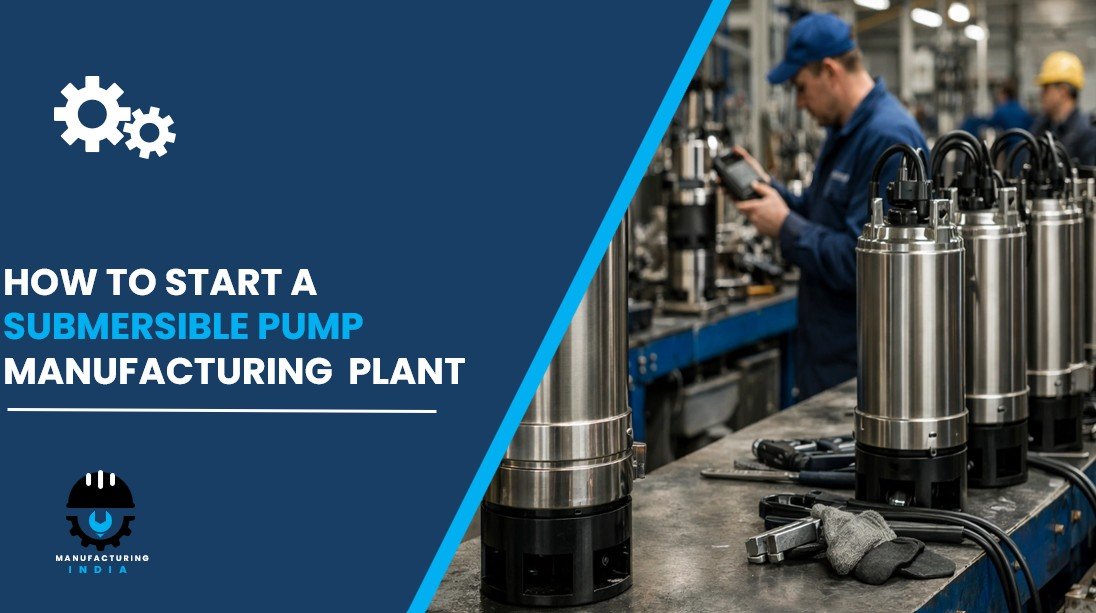
Setting up a submersible pump manufacturing plant cost in india represents an attractive investment proposition underpinned by India’s dependence on groundwater for irrigation and drinking water, expanding urban water and sewerage infrastructure, government-backed solar pumping programmes, and growing demand for energy-efficient pumping solutions in construction, mining, and industry. With established manufacturing clusters in Coimbatore, Gujarat, and Maharashtra, a deep supplier base for castings and motors, and strong export linkages, India offers a favourable environment for new entrants with efficient casting, machining, motor winding, and testing capabilities, provided they can meet the BIS and energy-labelling requirements that now shape the market.
What is a Submersible Pump?
A submersible pump is designed to operate fully submerged in the fluid being pumped. The pump and motor form a single assembly sealed inside a waterproof casing, so the unit pushes fluid to the surface under pressure rather than drawing it by suction. This avoids cavitation problems at depth and makes submersibles quiet, robust, and efficient at greater depths.
Submersible pumps are used for groundwater abstraction from borewells and open wells, sewage and wastewater handling, drainage and flood control, irrigation, construction dewatering, and industrial and mining slurry applications. Main product families include borewell (vertical) submersibles, open-well submersibles, sewage and dewatering pumps, and solar-powered submersibles. The core components are the motor (stator with copper windings, rotor, and shaft), pump stages (impellers and diffusers), casing, mechanical seals, power cable, and control panel or starter.
The global submersible pump market was valued at approximately USD 14.09 Billion in 2025 and, according to IMARC Group estimates, is expected to reach USD 20.77 Billion by 2034, exhibiting a CAGR of 4.4% from 2026 to 2034, supported by demand for efficient water and wastewater management in urban, industrial, and agricultural settings.
Minimum Cost Required to Set Up a Submersible Pump Plant:
Submersible pump manufacturing is an assembly-and-machining business whose capital need depends mainly on how much of the value chain is brought in-house. A plant that buys castings, laminations, and winding wire and focuses on machining, motor winding, assembly, and testing needs considerably less capital than one with a captive foundry, stamping and lamination unit, and wire drawing. Indian consultancy estimates for typical submersible pump projects, covering capacities from roughly 5,000 to 2 lakh pumps per year, place indicative investment at around INR 1–25 crore.
The 100,000–300,000 unit capacity band used in the IMARC Group report sits at or above the upper end of that consultancy range, so a project of this scale should expect investment toward the upper end and potentially beyond it, particularly with in-house casting or motor component manufacture. For scale reference, large Indian incumbents are much bigger: Aqua Group (Texmo) reports sales of over 780,000 pumps a year, and La-Gajjar Machineries (Varuna) cites annual capacity of half a million pumps.
Submersible Pump Plant Setup Cost in India
The total capital investment required to establish a submersible pump manufacturing plant in India is shaped by several key parameters: annual production capacity (typically 100,000 to 300,000 units), the product range (borewell, open-well, sewage, or solar submersibles), the degree of backward integration into casting and motor components, the level of automation in machining and assembly, testing and certification infrastructure, site and utility availability, and applicable regulatory and environmental compliance requirements. Below is a structured breakdown of the major cost components.
1. Capital Expenditure (CapEx)
Total capital investment in a submersible pump manufacturing plant covers the following major heads:
Land and Site Development
This encompasses land acquisition or lease, site preparation, boundary development, and utilities connectivity. Site selection should prioritise easy access to key inputs such as stainless steel and cast iron castings, copper winding wire, laminations, impellers, seals, cables, and controls, and proximity to dealers, irrigation-heavy markets, and ports. Reliable three-phase power, water for testing, strong road logistics, and access to a skilled machining and winding workforce are critical, which is why most units sit within or near established pump clusters. Compliance with zoning laws and environmental regulations, particularly for any foundry or heat-treatment operations, must be confirmed from project initiation, and space for expansion should be reserved.
Civil Works and Construction
Building costs cover the machining shop, motor winding and assembly hall, foundry or casting store where applicable, heat treatment area, pump assembly and testing bay with a water test tank, quality control and metrology laboratory, raw material and finished goods warehouses, administrative block, and utilities. Layouts should provide separate zones for raw material storage, manufacturing, quality control, and finished goods, with heavy equipment foundations for machining centres and presses. Construction must comply with factory act requirements and fire safety codes.
Machinery and Equipment
Machinery represents the largest CapEx component. Key equipment required for a submersible pump manufacturing plant includes:
- Casting Equipment: Melting furnaces, moulding and core-making equipment, and fettling units for casings, impellers, and diffusers, required where castings are produced in-house
- CBC Machining Centres: CNC and conventional machining centres for turning, boring, and milling of casings, impellers, shafts, and end covers to tight tolerances
- Motor Winding Machines: Automatic and semi-automatic winding machines that lay copper windings into stators, together with insulation, varnishing, and curing equipment
- Rotor Balancing Machines: Dynamic balancing equipment that ensures smooth, low-vibration operation and long bearing life
- Heat Treatment Furnaces: Furnaces for hardening and stress-relieving shafts and critical components
- Seal Assembly Equipment: Fixtures and presses for fitting mechanical seals and sealing arrangements that keep the motor watertight
- Assembly Lines: Stage assembly, motor coupling, oil filling, and cable gland fitting stations
- Pressure and Leak Testing Equipment: Test benches that verify the integrity of motor housings and sealed assemblies
- Performance Testing Rigs: Instrumented test tanks and rigs that measure head, discharge, power input, and efficiency against rated curves
- Quality Inspection Tools: Coordinate measuring machines, gauges, insulation and high-voltage testers, and material analysis instruments
- Utilities and Surface Treatment: Compressed air, power distribution, cranes and material handling, and painting or surface treatment systems
Other Capital Costs
These include pre-operative expenses, patterns, dies, and tooling, installation and commissioning charges, costs of BIS licensing and BEE star-labelling testing, staff training, initial working capital, regulatory compliance setup, and ISO quality system establishment. Tooling and patterns for multiple pump sizes can be a significant item for a product range with many models.
Request a Sample Report for In-Depth Market Insights: https://www.imarcgroup.com/submersible-pump-manufacturing-plant-project-report/requestsample
2. Operational Expenditure (OpEx)
Raw materials, principally stainless steel and cast iron casings, copper windings, impellers, seals, cables, and controls, constitute the dominant operating cost, typically representing 65–75% of total OpEx. Utility costs, driven by electricity for machining, melting and heat treatment, winding and curing, and test rigs, account for 10–15% of OpEx. Labour, maintenance, quality control, depreciation, taxes, packaging, and transportation make up the remainder. Because copper and steel are such large cost items, supplier contracts, price-linked selling terms, and tight scrap and rejection control are the most effective levers for protecting margins.
3. Plant Capacity
The proposed submersible pump manufacturing facility is designed with an annual production capacity ranging between 100,000 and 300,000 units, enabling economies of scale while maintaining operational flexibility. This capacity supports a diversified portfolio across borewell, open-well, sewage, and solar submersible pumps, sold through dealer networks, institutional and government tenders, OEM supply, and exports.
4. Profit Margins and Financial Projections
The project demonstrates healthy profitability potential under normal operating conditions. Financial projections encompass capital investment, operating costs, capacity utilisation ramp-up, pricing trends, and the demand outlook. A comprehensive feasibility analysis includes sensitivity analysis, Net Present Value (NPV), Internal Rate of Return (IRR), and Payback Period calculations. Gross profit margins for submersible pump manufacturing typically range from 30–40%, supported by stable demand and value-added applications. Net profit margins of 12–18% are achievable with disciplined cost management, efficient capacity utilisation, and effective procurement of copper and steel.
Why Set Up a Submersible Pump Manufacturing Plant?
Essential for Water and Infrastructure Applications
Submersible pumps are critical for groundwater extraction, wastewater management, irrigation, and industrial fluid handling, making their manufacture vital to municipal, agricultural, and industrial infrastructure. Industry commentary notes that farmer demand for submersibles is rising as groundwater levels continue to fall, because deeper borewells require pumps designed to work at greater depth.
Rising Demand from Agriculture and Urbanisation
Irrigation accounts for roughly 70% of global freshwater withdrawals according to the UN World Water Development Report, and in India borewell irrigation depends heavily on submersible pumps. Rapid urban growth, increasing water scarcity, and investment in water supply, sewage treatment, and drainage add municipal demand on top of agricultural needs.
Government-Backed Solar Pumping Programmes
Under PM-KUSUM, the Government supports standalone solar-powered agricultural pumps and solarisation of existing grid-connected pumps. As of October 2025, over 12.72 lakh off-grid solar pumps had been sanctioned under Component B, of which 9.03 lakh were installed. In April 2026, the Ministry of New and Renewable Energy extended the completion deadline for eligible projects to 31 March 2027, and an upgraded PM-KUSUM 2.0 with battery storage has been proposed. Solar pump tenders create a steady institutional demand channel for manufacturers with the required approvals, although implementation has been slower than targeted.
Established Cluster Ecosystem and Supply Chain
India’s pump industry is concentrated in clusters such as Coimbatore, Rajkot, Ahmedabad, Kolhapur, Belagavi, Batala and Jalandhar, and Hyderabad, where foundries, motor component makers, tooling suppliers, and skilled labour are readily available. Castings are commonly sourced from foundries in Coimbatore and Rajkot, and Coimbatore has historically supplied a very large share of the country’s domestic and agricultural pumpsets. New entrants benefit from this ready supplier and talent base.
Energy-Efficiency Push and Premium Positioning
Modern submersible pumps are designed for high efficiency and reduced energy use, helping optimise water use and support sustainable resource management. BEE star labelling and efficiency-linked tenders reward manufacturers who invest in better hydraulics and motors; one Ahmedabad manufacturer alone cites about 200 five-star-rated submersible models, and efficient designs can command a premium and stronger tender eligibility.
Growth in Construction, Mining, and Industrial Activity
Expansion of construction, mining, oil and gas, and industrial activity creates demand for dewatering, slurry, and process-water pumps. Infrastructure projects need dewatering for foundations, tunnels, and basements, while mining and industrial plants need robust pumps for slurry handling and groundwater removal, supporting demand beyond the agricultural cycle.
Export Opportunity and Technology Upgrades
Indian manufacturers already export widely, with Aqua Group reporting exports to 38 countries and La-Gajjar to over 50 countries. Technology advances such as efficient motors, corrosion-resistant materials, and smart pumps with performance monitoring improve performance and reduce lifecycle costs, supporting upgrade demand and higher-value product lines.
Major States Driving Submersible Pump Manufacturing Plant Demand in India
Submersible pump manufacturing in India is concentrated in states with established pump clusters, foundry and component supply chains, and large groundwater-irrigated or industrial demand. State incentive packages differ and change frequently, so current policy should be confirmed during site selection.
Tamil Nadu
Tamil Nadu, centred on Coimbatore, is the heart of India’s pump and motor industry. The first electric motor in India was made in Coimbatore in 1930, and the city has supplied a major share of the country’s domestic and agricultural pumpsets. A dense network of foundries, laminations and winding suppliers, and testing infrastructure makes it the most complete ecosystem for new entrants, though competition is intense.
Gujarat
Gujarat, with pump clusters in Ahmedabad (including GIDC Naroda) and Rajkot, is home to major submersible pump brands and a strong foundry base. The state’s industrial infrastructure, ports at Mundra and Kandla for exports, and proximity to large irrigation markets in western India make it a leading manufacturing location.
Maharashtra
Maharashtra, with Kolhapur’s engineering cluster and a large engineering and industrial base around Pune and Mumbai, combines component supply with strong domestic demand from irrigated agriculture, urban water supply, and industry.
Karnataka
Karnataka, with the Belagavi engineering cluster and Bengaluru’s engineering and electronics ecosystem, offers castings supply, skilled manpower, and a base for smart-pump and controller development.
Punjab and Telangana
Batala and Jalandhar in Punjab form a long-standing pump and engineering cluster serving northern India’s groundwater-irrigated agriculture, while Hyderabad in Telangana offers manufacturing and component supply for the southern and central markets.
Ask An Analyst – Submersible Pump Manufacturing Plant Cost and DPR 2026
Manufacturing Process Overview
Submersible pump manufacturing combines metal casting and machining, electric motor production, and precision assembly and testing. The key stages are:
- Casting or Procurement of Components: Casings, impellers, and diffusers are cast in cast iron or stainless steel, or procured from foundries, and then fettled and inspected.
- Machining: CBC machining centres bring casings, impellers, shafts, and end covers to final dimensions and tolerances; shafts may undergo heat treatment for strength and wear resistance.
- Motor Manufacturing: Laminations are stacked into stators and rotors, copper windings are inserted, and the stator is insulated, varnished, and cured; rotors are assembled and dynamically balanced.
- Assembly and Sealing: Pump stages are assembled on the shaft, coupled to the motor, fitted with mechanical seals, filled with oil or water as the design requires, and fitted with the power cable and gland.
- Lubrication and Electrical Insulation: Oil or water filling and insulation checks ensure the motor remains protected during submerged operation.
- Pressure and Leak Testing: Assembled units are pressure tested to confirm that seals and housings prevent water ingress.
- Performance Testing: Pumps are run on instrumented rigs to verify head, discharge, power consumption, and efficiency against rated performance.
- Quality Inspection and Finishing: Final electrical safety tests, visual inspection, painting or surface treatment, and labelling are completed before release.
- Packaging and Dispatch: Pumps are packed with cables and accessories and dispatched to dealers, institutional buyers, and export customers.
Key Applications of Submersible Pumps
The submersible pump market serves several major end-use segments:
- Water Supply and Borewell Pumping: Extraction of groundwater from borewells and wells for residential, municipal, and commercial water supply.
- Wastewater and Sewage Management: Transfer of sewage, sludge, and contaminated water in treatment plants, drainage systems, and wastewater handling.
- Agriculture and Irrigation: Supplying water for crop fields, drip irrigation, and sprinkler systems, including solar-powered pumping.
- Construction and Infrastructure: Dewatering of flooded sites, foundations, tunnels, and basements.
- Industrial and Mining Applications: Slurry handling, process water circulation, and removal of groundwater from mines and pits.
Global Submersible Pump Market Outlook
The global submersible pump market was valued at approximately USD 14.09 Billion in 2025. According to IMARC Group estimates, the market is expected to reach USD 20.77 Billion by 2034, exhibiting a CAGR of 4.4% from 2026 to 2034. Key demand drivers include:
- Rising demand for efficient and reliable water management systems in residential, agricultural, industrial, and municipal sectors
- Rapid urban population growth and water scarcity increasing groundwater extraction and constant-supply needs
- Heavy reliance of agriculture on irrigation, which accounts for approximately 70% of global freshwater withdrawals
- Rising investment in water treatment and sewage systems driven by environmental concerns
- Growth in construction, mining, and industrial projects creating dewatering and slurry-pump demand
- Technological advances in efficient motors, corrosion-resistant materials, and smart pumps with performance monitoring, which encourage upgrades
Leading producers in the global submersible pump industry include Xylem, Sulzer, KSB Group, Grundfos, Atlas Copco, and Tsurumi Manufacturing, serving water and wastewater management, agriculture and irrigation, oil and gas, construction and infrastructure, and mining and industrial processing.
Latest Industry Developments
- April 2026: The Ministry of New and Renewable Energy extended the completion deadline for eligible PM-KUSUM projects to 31 March 2027, for projects whose power purchase agreements were issued on or before 31 December 2025, while an upgraded PM-KUSUM 2.0 incorporating battery storage has been proposed.
- May 2025: Grundfos announced an expansion of its Brookshire, Texas, facilities, a new production facility that significantly enlarges the existing site and is the result of years of planning.
- March 2025: KSB reported that order intake exceeded EUR 3 billion for the first time in fiscal 2024, rising 5.2% to EUR 3,114 million, with sales revenue and EBIT also well above the prior year.
Licenses and Regulatory Requirements
Establishing a submersible pump manufacturing unit requires a range of approvals and certifications, which vary by state and product, including:
- Business registration and company incorporation, along with GST and Udyam registration where applicable
- Factory License under applicable state Factories Act provisions
- Pollution Control Board Clearances – Consent to Establish (CTE) and Consent to Operate (CTO), including for foundry, heat treatment, and painting operations
- Authorisation for handling and disposal of hazardous wastes such as used oils, sludges, and paint residues, where applicable
- BIS certification for submersible pumpsets under IS 8034 (and related standards for open-well submersibles and submersible motors), which government and solar-pump tenders generally require
- BEE star-labelling registration for pumpsets, which many tenders and customers expect
- MNRE or state empanelment for supplying solar pumps under government schemes
- Fire Safety Certification (NOC) and Electrical Inspectorate approvals for installations
- ISO 9001:2015 Quality Management System, ISO 14001 Environmental Management, and ISO 45001 Occupational Health and Safety certifications
- CE marking and relevant standards for export to Europe and other regulated markets
- Export-Import Code (IEC) for international market access
Key Challenges to Consider
Intense Competition from Established Clusters
Coimbatore and Gujarat incumbents operate at very large scale, with national dealer networks and extensive service centres, and compete aggressively on price. New entrants must differentiate through quality, efficiency ratings, specialised products, or regional focus rather than competing only on price.
Raw Material Price Volatility
Raw materials account for roughly 65–75% of operating expenses, and copper and steel prices can move sharply. Margins can be squeezed quickly when input costs rise faster than selling prices, so procurement planning, supplier contracts, and price-linked terms with large customers are important.
Certification and Tender Requirements
Government and solar-pump tenders typically require BIS certification and BEE labels, and dealer-only sales are rarely enough to scale. Testing, licensing, and approval processes take time and cost, so they should be started early and built into the project schedule.
Institutional Demand Cyclicality and Payment Cycles
Reliance on government schemes exposes manufacturers to delays and changes in programme timelines. PM-KUSUM, for example, has needed repeated deadline extensions because key components were well short of their targets. Diversifying across retail, institutional, industrial, and export channels reduces dependence on any single programme.
Casting Quality, Backward Integration, and Skills
Casting defects, winding quality, and sealing integrity directly determine field failure rates and warranty costs. Operating a captive foundry or motor component line adds capital and compliance burden but gives more control over quality and cost. Skilled machinists, winders, and test technicians are essential and should be recruited and trained early.
After-Sales Service and Brand Building
Established brands support their products with large service networks and authorised service centres, which matter greatly to farmers and dealers. New entrants need to invest in dealer development, spare parts availability, and responsive service to build trust.
Break-Even Timelines
Break-even depends on plant size, capital investment, copper and steel costs, selling prices, certification timelines, and the pace of dealer and tender-channel development. Plants that secure certifications and distribution early reach break-even sooner, while those that take longer to build brand and channels can see extended timelines.
Frequently Asked Questions (FAQs)
1. How much does it cost to set up a submersible pump manufacturing plant in India?
The total investment depends on plant capacity (100,000–300,000 units per annum), product range, the extent of in-house casting and motor manufacture, automation level, testing infrastructure, and location. Costs cover land, civil construction, machining, winding, assembly and testing equipment, tooling, certification, and working capital. Indicative consultancy estimates for smaller Indian projects range from about INR 1–25 crore, and larger, more integrated plants would be expected to sit at or above the upper end. A comprehensive feasibility study from IMARC Group provides detailed, capacity-specific cost estimates covering all CapEx and OpEx components.
2. Is submersible pump manufacturing a profitable business in 2026?
It can be. Steady demand from irrigation, water supply, wastewater, construction, and industry, combined with gross margins of 30–40% and net profit margins of 12–18%, makes the business financially attractive, particularly for manufacturers with efficient operations, certified products, and strong distribution. Margins are sensitive to copper and steel prices, competition, and capacity utilisation.
3. What machinery and equipment are required for a submersible pump plant?
Key equipment includes casting equipment (where castings are made in-house), CBC machining centres, motor winding machines, rotor balancing machines, heat treatment furnaces, seal assembly equipment, assembly lines, pressure and leak testing equipment, performance testing rigs, and quality inspection tools. All machinery should comply with industry standards for safety, efficiency, and reliability.
4. What licenses and approvals are required?
Required approvals include company registration, Factory License, Pollution Control Board consents (CTE and CTO), fire safety certification, and electrical approvals. Product approvals include BIS certification under IS 8034 and BEE star labelling, and MNRE or state empanelment is needed to supply solar pumps under government schemes. ISO 9001, ISO 14001, and ISO 45001 certifications strengthen customer qualification.
5. How long does it take to commission a submersible pump plant?
As an indicative guide, 12–18 months from project initiation to commercial production, depending on the scale of the facility, equipment lead times, approvals, and tooling development. BIS and BEE certification can add time after commissioning, so testing and applications should be prepared in parallel.
6. What are the key raw materials for submersible pump manufacturing?
The primary inputs are stainless steel and cast iron casings, copper winding wire, laminations, impellers, seals, cables, and controls. Raw materials account for approximately 65–75% of operating expenses, making reliable sourcing and price management a priority.
7. What is the break-even period for a submersible pump plant?
The break-even period depends on plant size, capital investment, raw material costs, selling prices, and the speed of channel and certification development. Detailed payback, NPV, and IRR calculations are provided in the IMARC Group feasibility report. Early certification and a diversified sales channel mix support faster break-even.
8. Which Indian states are best for submersible pump manufacturing?
Tamil Nadu (Coimbatore), Gujarat (Ahmedabad and Rajkot), Maharashtra (Kolhapur), Karnataka (Belagavi and Bengaluru), Punjab (Batala and Jalandhar), and Telangana (Hyderabad) are the main clusters. Specific incentives vary by state and should be verified during site selection.
9. What government support is available?
PM-KUSUM supports solar-powered agricultural pumps and solarisation of grid-connected pumps, with the completion deadline for eligible projects extended to 31 March 2027 and a PM-KUSUM 2.0 proposed. State industrial policies and MSME schemes may offer capital or interest subsidies. Scheme terms change, so current eligibility should be confirmed with the relevant ministry and state authorities.
10. Should a new plant make its own castings and motors?
It depends on scale and capital. Buying castings and laminations lowers investment and lets a new plant focus on machining, winding, assembly, and testing, which is how many smaller makers operate. Captive casting and component manufacture raise capital and compliance needs but improve quality control and cost over time, and suit larger, established producers. Many entrants start with outsourced castings and integrate later.
Key Takeaways for Investors
Submersible pump manufacturing benefits from enduring demand tied to groundwater irrigation, urban water and sewerage infrastructure, construction and mining activity, and government solar-pumping programmes. The global market is projected to grow from USD 14.09 Billion in 2025 to USD 20.77 Billion by 2034 at a CAGR of 4.4%, while India’s large agricultural base and established cluster ecosystem support domestic and export opportunities.
At the same time, success depends on competing effectively against large incumbents: securing BIS and BEE approvals early, managing copper and steel cost exposure, building dealer and service networks, and diversifying across retail, institutional, industrial, and export channels. Investors are best positioned when they combine a focused product range, quality casting and winding capability, efficiency-led differentiation, and a phased approach to backward integration.
Contact Us:
IMARC Group
134 N 4th St. Brooklyn, NY 11249, USA
Email: sales@imarcgroup.com
Tel No: (D) +91 120 433 0800
United States: (+1-201-971-6302)
About the Author