Key takeaways
- A 3PL relationship that was well negotiated at signing often drifts over time, as rates creep up, service levels slip, and nobody on the manufacturer’s side is tracking the gap between the contract and actual performance.
- Freight cost and service level are not the same lever. A cheaper 3PL contract that comes with worse on-time delivery can cost more in downstream disruption than it saves on the invoice.
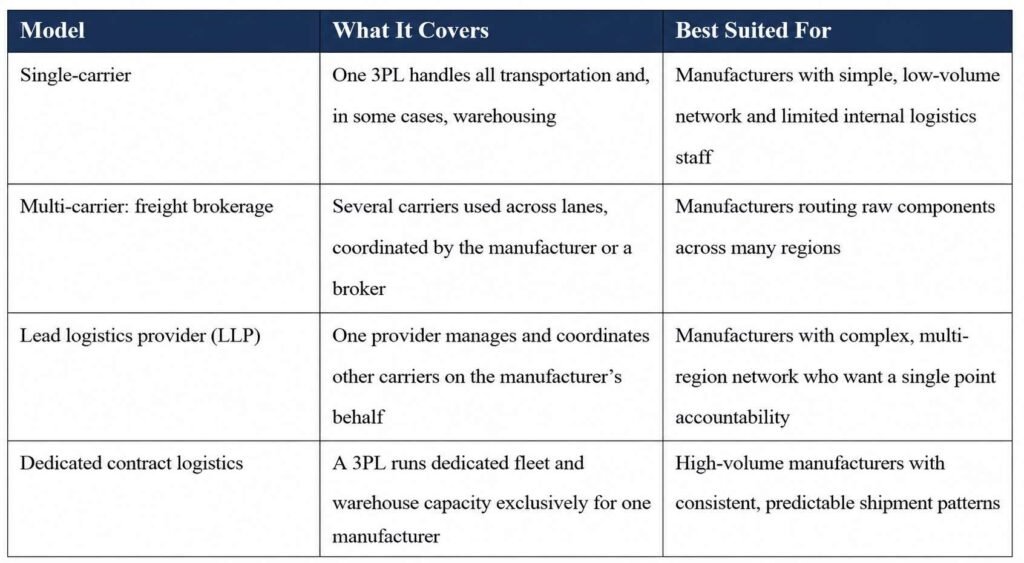
- Single-carrier, multi-carrier, and lead logistics provider models each shift risk, cost, and control in different directions, and the right choice depends on shipment volume and network complexity, not just on price.
- Most manufacturers do not have real-time visibility into whether their 3PL is meeting its contracted SLAs, because performance data sits with the 3PL rather than being tracked independently.
- Technology integration between a manufacturer’s systems and a 3PL’s tracking platform is what turns a service agreement into something that can actually be monitored, rather than taken on faith each month.
- 3PL contracts negotiated once and left unreviewed for years tend to fall behind market rates and evolving service expectations, which is why a periodic renegotiation cycle matters as much as the original contract terms.
Introduction
Most manufacturers do not build their own fleet or warehouse network. They rely on third-party logistics providers to move and store goods, and that relationship works well right up until it does not, usually surfacing as a slow, gradual drift rather than one obvious failure.
Rates creep upward between contract cycles. On-time delivery slips a few percentage points a quarter without anyone flagging it. A 3PL added for one region ends up handling volume well outside what it was originally scoped for. This is the specific gap Third-Party Logistics (3PL) Consulting is built to close: bringing structured evaluation, contract discipline, and ongoing performance tracking to a relationship that most manufacturers otherwise manage informally.
This guide covers what 3PL consulting actually involves, the engagement models available to manufacturers in India, and the levers that move cost and service level in opposite or aligned directions depending on how they are used.
Why 3pl Relationships Need Active Management
- Cost creep between contract cycles: Fuel surcharges, accessorial charges, and rate escalations tend to be reviewed individually by the 3PL and rarely by the manufacturer, which is how a competitively negotiated contract quietly becomes an uncompetitive one over two or three years.
- Service level drift: On-time delivery and order accuracy can decline gradually without triggering a formal review, especially when a manufacturer does not track 3PL performance independently of the 3PL’s own reporting.
- Scope mismatch: A 3PL brought on for a specific lane or region often ends up absorbing volume it was never scoped or priced for, which shows up as service strain rather than as a renegotiated rate.
- Limited visibility: Without integrated tracking, a manufacturer typically finds out about a delivery problem from a customer complaint rather than from its own logistics data.
3pl Engagement Models
Manufacturers structure their 3PL relationships differently depending on shipment volume, network complexity, and how much control they want to retain. The table below outlines the models most commonly used in India.
Partner with IMARC Engineering for efficient 3PL solutions: https://www.imarcengineering.com/contact?service=logistics-optimization
What 3pl Consulting Actually Involves
Bringing structure to a 3PL relationship follows a defined process, whether it is being set up for the first time or reset after years of informal management.
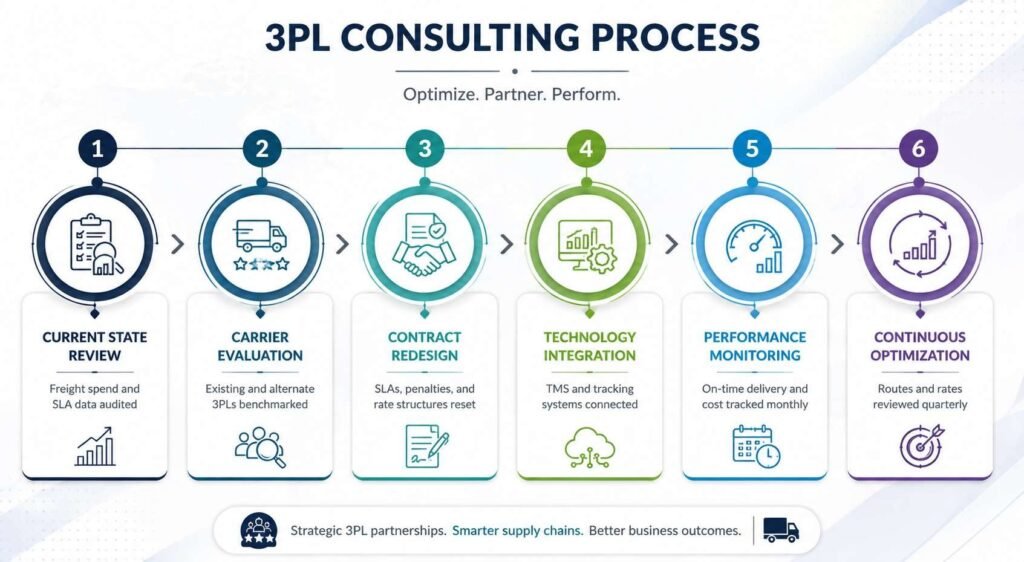
- Current state review: Existing freight spend, contract terms, and actual service level data are audited against what the contract originally promised, often surfacing a gap nobody had quantified before.
- Carrier and vendor evaluation: The incumbent 3PL is benchmarked against alternative providers on rate, network coverage, and service reliability, whether or not a change is ultimately made.
- Contract and SLA redesign: Service level agreements, penalty clauses, and rate structures are rebuilt around measurable, trackable terms rather than general commitments that are difficult to verify.
- Technology integration: The manufacturer’s systems are connected to the 3PL’s tracking and transportation management platform, so performance can be monitored directly rather than taken on the 3PL’s own reporting.
- Performance monitoring: On-time delivery, cost per shipment, and order accuracy are tracked on a defined cadence, typically monthly, against the SLA terms set in the contract.
- Continuous optimization: Routes, rates, and carrier mix are reviewed on a recurring cycle, so the relationship keeps pace with volume changes and market rate shifts instead of staying fixed at the terms set years earlier.
Cost and Service Levers That Actually Move the Needle
- Consolidating shipment volume across fewer carriers usually improves rate leverage, but can reduce redundancy if one carrier underperforms.
- Renegotiating on a fixed cycle, rather than only when a contract is up for renewal, keeps rates aligned with current market conditions instead of drifting upward unnoticed.
- Tying a meaningful share of 3PL compensation to measured SLA performance shifts incentives toward consistency, not just toward the lowest quoted rate.
- Real-time tracking integration reduces the lag between a delivery problem occurring and the manufacturer becoming aware of it, which is often the difference between a minor delay and a customer-facing failure.
Want to learn more about logistics cost optimization? Explore our latest insights: https://www.imarcengineering.com/blog/logistics-cost-optimization-in-india
Common Pitfalls in Unmanaged 3pl Relationships
- Treating the initial contract negotiation as a one-time event rather than the start of an ongoing performance relationship that needs periodic review.
- Selecting a 3PL primarily on quoted rate without weighting service level history and network fit for the specific product and region.
- Relying entirely on the 3PL’s own performance reporting, rather than tracking delivery and cost data independently.
- Allowing scope creep, where a 3PL absorbs volume or lanes it was never priced or scoped for, without revisiting the underlying contract terms.
Final Thoughts
A 3PL relationship rarely fails all at once. It drifts, in cost, in service level, in scope, until the gap between what was contracted and what is actually being delivered becomes large enough to notice on its own. Manufacturers that review their 3PL performance on a defined cycle, rather than only at contract renewal, catch that drift early enough to correct it cheaply.
The manufacturers getting the most out of their logistics spend are rarely the ones who negotiated the lowest rate at signing. They are the ones who kept the relationship under active, structured review long after the ink dried.
Contact Us:
IMARC Engineering
Phone: +91-120-433-0800
Email: sales@imarcengineering.com
India: C-130, Sector 2, Noida, Uttar Pradesh 201301
LinkedIn: https://www.linkedin.com/showcase/imarc-engineering/
About the Author