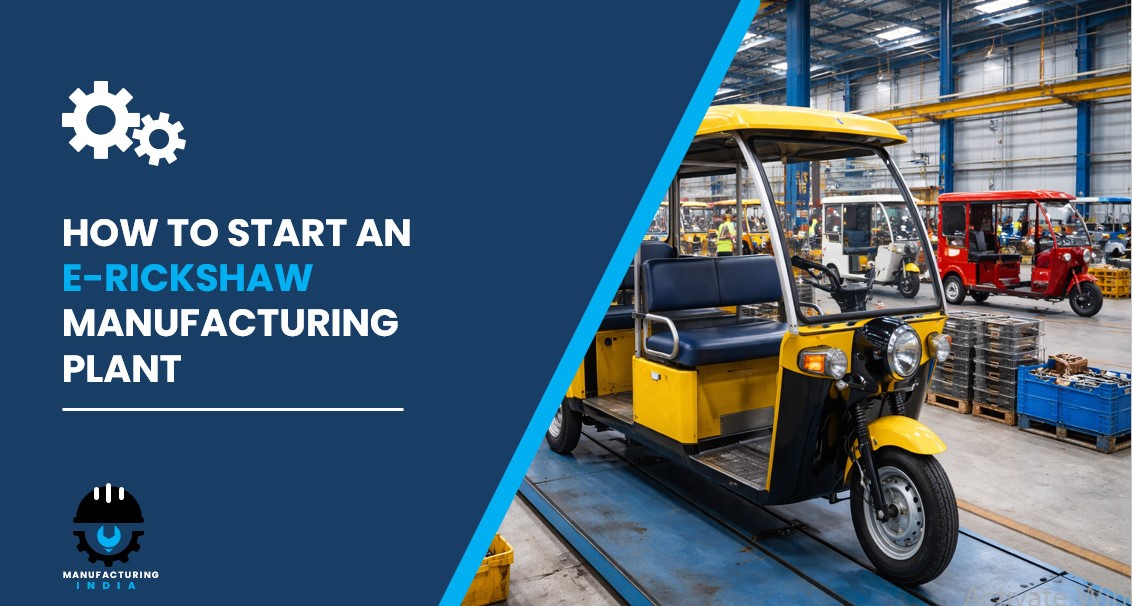
E-Rickshaw manufacturing plant cost in India has become one of the most compelling manufacturing investment opportunities in 2026, as the country accelerates its push toward sustainable, affordable urban mobility. India’s dense urban and semi-urban population, chronic traffic congestion, and the government’s aggressive push to decarbonize last-mile transport have converged to create a structural, long-term demand for electric rickshaws across the country.
India’s rapidly growing pharmaceutical and FMCG sectors are matched by an equally fast-growing electric vehicle ecosystem. The domestic e-rickshaw market is benefiting directly from the government’s FAME (Faster Adoption and Manufacturing of Hybrid and Electric Vehicles) scheme, which offers subsidies and incentives to both manufacturers and buyers. A large domestic consumer base, cost-competitive manufacturing infrastructure, and rising demand for eco-friendly short-distance commuting solutions make India a uniquely favorable destination for setting up an e-rickshaw production facility.
With over billion consumers, a rapidly urbanizing population, Make in India policy support, FAME scheme incentives, and growing demand for eco-friendly urban transport, India offers one of the most financially attractive environments for e-rickshaw manufacturing — with gross profit margins of 20–30% and a break-even window of 3–5 years.
What is an E-Rickshaw?
An e-rickshaw, also called an e-cart or electric rickshaw, is an eco-friendly, electrical-grade vehicle designed for urban transportation. It works with an electrical motor and a battery for its operation. Thus, they are environmentally friendly compared to the traditionally fuel-run rickshaws. E-rickshaws basically deal in short-distance travel, public transport, and cargo delivery within cities and towns. They are characterized by their low operational costs, lower carbon emissions, and low costs, making them an ideal choice for last-mile connectivity in heavily populated areas.
Cost of Setting Up an E-Rickshaw Manufacturing Plant in India
The cost of setting up an e-rickshaw manufacturing plant in India depends on several parameters including production capacity, technology used, plant location, level of automation, and regulatory compliance. Below is a structured breakdown of all major cost components.
1. Capital Expenditure (CapEx)
Machinery costs account for the largest portion of the total capital expenditure. The cost of land and site development, including charges for land registration, boundary development, and other related expenses, forms a substantial part of the overall investment. This allocation ensures a solid foundation for safe and efficient plant operations.
Request a Sample Report for In-Depth Market Insights: https://www.imarcgroup.com/e-rickshaw-manufacturing-plant-project-report/requestsample
Key machinery and equipment required for an e-rickshaw manufacturing plant includes:
• Laser cutters
• Bending and welding stations
• Painting booths
• Assembly lines with overhead conveyors
• Battery testing systems
• Motor calibration benches
• Quality control diagnostics
• Final inspection bays
2. Operational Expenditure (OpEx)
The operating cost structure of an e-rickshaw manufacturing plant is primarily driven by raw material consumption, particularly electric motors, which accounts for approximately 75–85% of total operating expenses (OpEx).
- Raw Material Cost: 75–85%
- Utility Cost: 5–10%
In the first year of operations, the operating cost for the e-rickshaw manufacturing plant is projected to be significant, covering raw materials, utilities, depreciation, taxes, packing, transportation, and repairs and maintenance. By the fifth year, the total operational cost is expected to increase substantially due to factors such as inflation, market fluctuations, and potential rises in the cost of key materials.
3. Plant Capacity
The proposed manufacturing facility is designed with an annual production capacity ranging between 20,000 to 50,000 vehicles, enabling economies of scale while maintaining operational flexibility. This range allows the plant to serve multiple end-use segments including passenger transportation, cargo delivery, and short-distance commuting in urban and semi-urban areas.
4. Profit Margins and Financial Projections
The project demonstrates healthy profitability potential under normal operating conditions:
- Gross Profit Margin: 20–30%
- Net Profit Margin: 8–12%
Financial projections must account for capital investment, operating costs, capacity utilization rates, pricing trends, and demand outlook. A thorough analysis should also include sensitivity analysis, Net Present Value (NPV), Internal Rate of Return (IRR), and Payback Period.
Why Set Up an E-Rickshaw Manufacturing Plant in India?
India presents a uniquely favorable environment for establishing an e-rickshaw manufacturing plant:
Eco-Friendly Transportation Solution: E-rickshaws serve as a sustainable transportation option by reducing reliance on fossil fuels and curbing emissions, aligning with the global push toward eco-friendly mobility.
Government Support and Incentives: Several governments, particularly in India and Southeast Asia, are offering subsidies and incentives to promote electric vehicles, making the e-rickshaw market an attractive investment opportunity.
Growing Demand for Affordable Mobility: With the rising cost of fuel and increasing urbanization, e-rickshaws provide an affordable and efficient solution for urban mobility, especially in developing countries.
Policy and Infrastructure Push: Government initiatives, such as the Faster Adoption and Manufacturing of Hybrid and Electric Vehicles (FAME) scheme in India, and infrastructure development for EV charging stations are supporting the growth of the e-rickshaw market.
Cost-Competitive Manufacturing: India offers competitive land costs, a large pool of trained labor, and a well-established raw material supply chain, making it one of the most cost-effective locations for e-rickshaw production in Asia.
Large Domestic Consumer Base: India’s dense urban and semi-urban population creates massive and sustained demand for last-mile commuting solutions, directly driving volume off-take for domestic manufacturers.
Manufacturing Process — Step by Step
The e-rickshaw manufacturing process is a multi-step operation that involves several unit operations, material handling, and quality checks. The main stages involved in the e-rickshaw manufacturing process flow are as follows:
- Frame Fabrication and Welding — Steel or aluminum chassis is cut, bent, and welded to form the structural frame of the vehicle.
- Battery Installation and Wiring — Lead-acid or lithium-ion battery packs are installed and connected to the vehicle’s electrical system.
- Motor and Controller Assembly — Electric motors and controllers are mounted and calibrated to the vehicle’s drive system.
- Body Panel Molding and Assembly — FRP or metal body panels are molded and assembled onto the frame.
- Seat Assembly and Upholstery — Passenger seating is fitted and upholstered as per product specifications.
- Electrical Wiring and System Integration — Full electrical wiring including lighting, dashboard, and auxiliary systems is integrated.
- Painting and Finishing — Vehicles pass through painting booths for surface coating and finishing.
- Testing for Performance, Safety, and Quality — Each unit undergoes rigorous performance, safety, and quality checks before clearance.
- Packaging and Dispatch — Approved units are packaged and dispatched to distribution channels.
Key Applications of E-Rickshaws
E-rickshaws manufactured in India serve a wide variety of end-use segments:
• Electrical Power Systems: Battery interconnects, power distribution cables, and grounding straps.
• Motor & Controller Systems: Flexible connections for traction motors, controllers, and inverters.
• Charging Systems: Charging cables, connectors, and onboard charging interfaces.
• Vehicle Wiring Harness: Flexible conductors for lighting, dashboard, and auxiliary electrical systems.
• Passenger Transportation: Short-distance urban and semi-urban commuting.
• Cargo Delivery: Last-mile cargo and logistics delivery within city limits.
Leading E-Rickshaw Manufacturers
Leading manufacturers in the global e-rickshaw industry include several multinational companies with extensive production capacities and diverse application portfolios. Key players include:
• Kohler Electric
• Greaves Cotton Ltd.
• Saera Electric Auto Pvt Ltd.
• Mahindra Electric
• Lohia Auto Industries
Timeline to Start the Plant
Setting up an e-rickshaw manufacturing plant from ideation to commissioning typically requires 12 to 18 months. This covers the following key phases:
- Feasibility study and project report preparation
- Land acquisition and site development
- Regulatory approvals and environmental clearances
- Factory license and fire safety compliance
- Machinery procurement and installation (laser cutters, welding stations, painting booths, assembly lines, battery and motor testing units)
- Trial production and quality testing
- Commercial production launch
Licences and Regulatory Requirements
Starting an e-rickshaw manufacturing unit in India requires several approvals, including:
• Business registration (Proprietorship, LLP, or Private Limited Company)
• Factory Licence under the Factories Act
• Environmental Clearance from the State Pollution Control Board
• GST Registration
• Fire Safety NOC
• Industry-specific permits as applicable under national and state EV manufacturing regulations
• FAME Scheme registration for government subsidy benefits
Key Challenges
Before investing, entrepreneurs should be aware of the common challenges in this business:
High Capital Requirements: Initial CapEx for machinery and infrastructure is significant, especially for mid to large-scale plants.
Raw Material Price Volatility: Key inputs such as electric motors, lead-acid and lithium-ion batteries, and steel are subject to price fluctuations that directly impact margins.
Regulatory Compliance: Meeting environmental standards and vehicle safety norms requires continuous investment in quality systems and compliance monitoring.
Competition: The market includes both organized large players and unorganized local manufacturers, requiring a clear differentiation strategy.
Skilled Manpower: Operating precision assembly, welding, and motor calibration equipment requires trained technical staff.
Securing Regulatory Approvals: Ensuring all applicable licenses and EV-specific certifications are obtained can extend the project timeline if not planned in advance.
Frequently Asked Questions
The following questions are answered in the report:
1. How much does it cost to set up an e-rickshaw manufacturing plant in India?
2. Is e-rickshaw manufacturing profitable in India in 2026?
3. What machinery is required for an e-rickshaw plant in India?
4. What licences and approvals are required to start an e-rickshaw plant in India?
5. How long does it take to commission an e-rickshaw manufacturing plant in India?
6. What raw materials are required for e-rickshaw production in India?
7. What is the break-even period for an e-rickshaw manufacturing plant in India?
8. Are there government subsidies available for e-rickshaw manufacturers in India?
9. What is the annual production capacity of an e-rickshaw plant?
Key Takeaways for Investors
The e-rickshaw manufacturing plant cost in India remains highly competitive and financially viable, with gross margins of 20–30%, net margins of 8–12%, and a break-even window of 3–5 years across plant capacities of 20,000 to 50,000 vehicles per year. Backed by the FAME scheme, rising urban demand, and a cost-effective manufacturing ecosystem, this is one of the most strategically sound EV investments available in India today.
About the Author