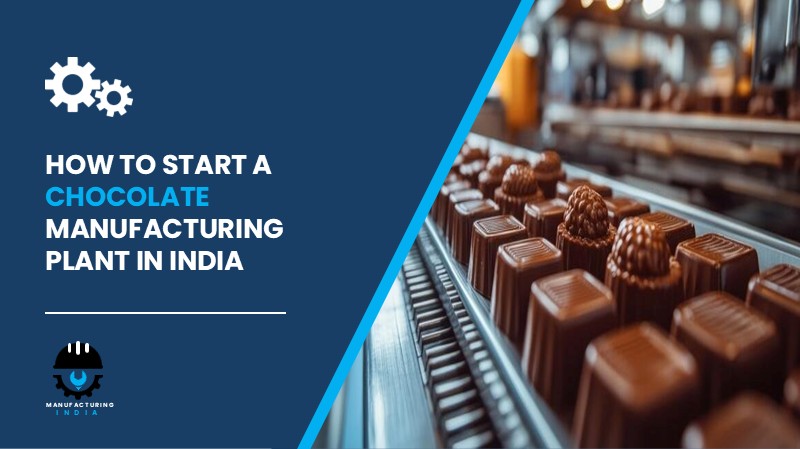
Setting up a chocolate manufacturing plant in India presents a compelling investment case as the country rapidly emerges as one of the most cost-competitive and high-demand destinations for food processing and confectionery manufacturing. Driven by booming demand from the confectionery, bakery, retail gifting, and food service industries, chocolate has become an indispensable part of India’s growing consumer economy.
“With over 1.4 billion consumers, a rapidly urbanizing population, Make in India policy support, and a booming FMCG and gifting sector, India offers one of the most financially attractive environments for chocolate manufacturing — with gross margins of 35-45% and a break-even window of 3-5 years.”
What is Chocolate?
Chocolate refers to a processed food that is made from cocoa beans and is produced through the controlled use of heat, mechanical, and formulation processes. It is made from cocoa solids, cocoa butter, sugar, and other types that may consist of milk solids and other emulsifiers. Chocolate is known for its smooth texture, rich cocoa flavour, and ability to melt at body temperature.
On the basis of its constitution, chocolate is categorized into dark chocolate, milk chocolate, and white chocolate. The production of chocolate requires strict control over particle size, viscosity, and crystallization in order to produce consistent quality. It is produced on both a mass production scale and a small artisanal level and is applied in a wide range of confectionery, bakery, and gifting uses.
Request for a Sample Report: https://www.imarcgroup.com/chocolate-manufacturing-plant-project-report/requestsample
Market Overview and Growth Potential
The global chocolate market demonstrates strong growth trajectory, valued at USD 167.0 Billion in 2025. According to IMARC Group’s comprehensive market analysis, the market is projected to reach USD 219.9 Billion by 2034, exhibiting a robust CAGR of 2.8% from 2026 to 2034. This sustained expansion is driven by increasing global consumption of confectionery products, rising disposable incomes, growing demand for premium and artisanal chocolates, innovation in health-focused formulations, and expansion of organized retail and e-commerce channels.
The chocolate market is witnessing robust demand due to the rising need for quality confectionery products across urban and semi-urban markets. Premiumization trends, demand for organic and functional chocolates, and the growing gifting culture are driving large-scale adoption. India’s organized food services segment is expected to grow at a CAGR of 13.2%, achieving a market share of 52.9% by 2028 (IBEF), reinforcing the long-term case for domestic chocolate manufacturing.
| Metric | Value |
| Market Size (2025) | USD 167.0 Billion |
| Projected Market Size (2034) | USD 219.9 Billion |
| CAGR (2026–2034) | 2.8% |
| Plant Capacity | 5,000 – 10,000 MT/Year |
| Gross Profit Margin | 35–45% |
| Net Profit Margin | 15–20% |
| Raw Material Share of OpEx | 70–80% |
| Utility Share of OpEx | 5–10% |
| Break-Even Period | 3–5 Years |
Cost of Setting Up a Chocolate Manufacturing Plant in India
The chocolate manufacturing plant cost in India depends on several parameters including production capacity, technology used, plant location, level of automation, and regulatory compliance. Here is a structured breakdown of all major cost components:
1. Capital Expenditure (CapEx)
The total capital investment in a chocolate manufacturing plant typically covers the following:
Land and Site Development
This includes land acquisition, boundary development, land registration charges, and basic site preparation. Cost varies significantly depending on whether the land is in an industrial estate, Special Economic Zone (SEZ), or a privately purchased plot. The location must offer easy access to key raw materials such as cocoa beans/mass, sugar, milk powder, cocoa butter, lecithin, and flavors, and proximity to target markets to minimize distribution costs.
Civil Works and Construction
Building costs cover the main manufacturing shed, utility area, raw material storage, quality control laboratory, administrative block, and worker amenities. The layout must be optimized with separate areas for raw material storage, production, tempering, molding, packaging, and finished goods storage. Construction specifications depend on plant scale, food safety requirements (HACCP, FSSAI), and local compliance norms.
Machinery and Equipment
This is the single largest component of CapEx. Key machinery required for a chocolate manufacturing plant includes:
- Bean cleaners and roasters for cocoa bean processing
- Winnowers for shell separation
- Grinders and refiners for particle size reduction
- Conches for flavour development and texture refinement
- Tempering machines for controlled cocoa butter crystallization
- Molding lines for solid bars, filled chocolates, and decorative shapes
- Enrobing machines for uniform chocolate coating
- Cooling tunnels and demoulding systems
- Packaging systems for wrapping, labeling, and cartoning
Machinery costs represent the largest share of overall capital expenditure, reflecting the precision engineering and food-grade standards required in chocolate production.
Other Capital Costs
These include pre-operative expenses, commissioning charges, import duties (if machinery is sourced internationally), utilities installation, cold storage systems, fire safety compliance, and Effluent Treatment Plant (ETP) setup.
2. Operational Expenditure (OpEx)
Once the plant is commissioned, the ongoing cost structure is dominated by a few key components:
Raw Material Cost (Cocoa Beans/Mass, Sugar, Milk Powder, Cocoa Butter, Lecithin, Flavors): 70–80% of Total OpEx — Cocoa beans and derived ingredients are the primary cost drivers, accounting for the largest share of operating expenses. Cocoa price volatility, driven by West African supply dynamics, represents the most significant cost risk in chocolate manufacturing.
Utility Cost: 5–10% of Total OpEx — Utilities include electricity (consumed by conches, tempering machines, refrigeration, and cooling tunnels), water (used in cleaning and cooling), and compressed air supply.
Other Operating Costs — The remaining budget covers transportation, secondary packaging, salaries and wages, maintenance, depreciation, taxes, and miscellaneous overhead.
3. Plant Capacity
The proposed manufacturing facility is designed with an annual production capacity ranging between 5,000 to 10,000 MT. This range allows the plant to achieve economies of scale while maintaining flexibility to serve multiple end-use segments including retail confectionery, bakery coatings, food service, and specialty gifting products.
Smaller artisanal setups with limited automation may start at lower capacities, but profitability significantly improves with higher capacity utilization.
4. Profit Margins and Financial Projections
- Gross Profit Margin: 35–45%
- Net Profit Margin: 15–20%
- Break-Even Period: 3 to 5 years, depending on production scale, market demand, cocoa price management, and sales efficiency.
Financial projections must account for capital investment, operating costs, capacity utilization rates, pricing trends, and demand outlook. A thorough analysis should also include sensitivity analysis, Net Present Value (NPV), Internal Rate of Return (IRR), and Payback Period.
Capital Expenditure Breakdown
| Particulars | Cost (in US$) |
| Land and Site Development Costs | XX |
| Civil Works Costs | XX |
| Machinery Costs | XX |
| Other Capital Costs | XX |
Operational Expenditure Breakdown
| Particulars | In % |
| Raw Material Cost | 70–80% |
| Utility Cost | 5–10% |
| Transportation Cost | XX |
| Packaging Cost | XX |
| Salaries and Wages | XX |
| Depreciation | XX |
| Taxes | XX |
| Other Expenses | XX |
Why Set Up a Chocolate Plant in India?
India presents a uniquely favorable environment for establishing a chocolate manufacturing plant:
Surging Domestic Demand: India’s confectionery, bakery, gifting, and food service industries are growing rapidly. Rising disposable incomes, urbanization, and a growing middle class are driving chocolate consumption across mass, premium, and artisanal segments.
Policy and Regulatory Tailwinds: The Government of India’s Production Linked Incentive (PLI) scheme for food processing, Make in India initiative, and cold-chain infrastructure development are creating a policy-friendly environment for chocolate manufacturers.
Cost-Competitive Manufacturing: India offers competitive land costs, a large pool of trained food-processing labor, and a well-established FMCG supply chain, making it one of the most cost-effective locations for chocolate production in Asia.
Export Opportunities: India-based manufacturers can tap into growing export demand from the Middle East, Southeast Asia, and Africa, where local chocolate manufacturing capacity remains limited.
Premiumization and Gifting Culture: Growing demand for premium, dark, organic, and sugar-free chocolates, combined with India’s expanding gifting culture, creates strong value-added product opportunities for quality-focused manufacturers.
Manufacturing Process Overview
The chocolate manufacturing process primarily uses three core technologies: tempering, molding, and enrobing. The complete process flow involves:
- Raw Material Sourcing and Quality Testing: Procurement and inspection of cocoa beans/mass, cocoa butter, sugar, milk powder, lecithin, and flavors
- Cocoa Bean Processing: Cleaning, roasting, winnowing, and grinding of cocoa beans to produce cocoa mass/liquor
- Mixing and Refining: Blending of ingredients and refining to achieve target particle size (typically <25 microns for smooth texture)
- Conching: Extended mechanical and thermal treatment to develop flavor, reduce moisture, and achieve desired viscosity
- Tempering: Controlled cooling and shearing to produce stable Form V cocoa butter crystals — essential for gloss, snap, and shelf life
- Molding: Depositing tempered chocolate into molds for bars, filled chocolates, and decorative shapes
- Enrobing: Applying uniform chocolate coatings over confectionery centers using enrobing machines
- Cooling and Demoulding: Controlled cooling tunnels for solidification, followed by demoulding and quality inspection
- Packaging: Wrapping, labeling, cartoning, and palletizing for dispatch
Key Applications of Chocolate
Chocolate manufactured in India serves a wide variety of end-use industries:
- Confectionery Manufacturing: Chocolate bars, filled bonbons, pralines, truffles, and seasonal gift items
- Bakery and Patisserie: Chocolate coatings, fillings, decorations, and inclusions for cakes, pastries, and cookies
- Retail Gourmet: Premium and artisanal chocolate brands targeting gifting and specialty retail channels
- Food Service: Desserts, hot chocolate beverages, fondue, and chocolate garnishes in restaurants and cafes
- Dairy and Ice Cream: Chocolate coatings, inclusions, and flavored products for the dairy industry
- Specialty Gifting: Branded boxed chocolates, seasonal gift sets, and corporate gifting products
Global Market Outlook
The global chocolate market was valued at USD 167.0 Billion in 2025 and is projected to reach USD 219.9 Billion by 2034, growing at a CAGR of 2.8% from 2026 to 2034. This sustained growth is driven by rising global confectionery consumption, increasing premiumization of food products, growth in gifting culture, innovation in sugar-reduced and functional chocolates, and expansion of organized retail and e-commerce channels.
Leading global players in this industry include:
- Mars Incorporated — One of the world’s largest chocolate and confectionery manufacturers
- Ferrero Group — Global leader in premium chocolate and confectionery gifting
- Mondelez International — Major multinational with iconic chocolate brands across global markets
- Nestlé S.A. — Diversified food giant with extensive chocolate and cocoa product portfolios
- Barry Callebaut — World’s largest cocoa processor and B2B chocolate manufacturer
- Lindt & Sprüngli — Premium Swiss chocolate manufacturer with strong global retail presence
Latest Industry Development
January 2024: Mars declared that it had completed the acquisition of Hotel Chocolat, one of the UK’s leading premium chocolate brands, introducing a much-loved artisanal brand into its global portfolio — signaling continued consolidation and premiumization in the global chocolate industry.
Timeline to Start a Chocolate Manufacturing Plant
Setting up a chocolate manufacturing plant from ideation to commissioning typically requires 12 to 18 months. This covers:
- Feasibility study and project report (DPR) preparation
- Land acquisition and site development
- Regulatory approvals, FSSAI license, and environmental clearances
- Factory license and fire safety compliance
- Machinery procurement, installation, and commissioning
- Trial production and quality testing (HACCP validation)
- Commercial production launch
Licenses and Regulatory Requirements
Starting a chocolate manufacturing unit in India requires several approvals, including:
- Business registration (Proprietorship, LLP, or Private Limited Company)
- FSSAI License (mandatory for food manufacturing)
- Factory License under the Factories Act
- Environmental Clearance from the State Pollution Control Board
- GST Registration
- Fire Safety NOC
- AGMARK certification (for export-oriented manufacturing)
- BIS certification for applicable product standards
Key Challenges to Consider
Before investing, entrepreneurs should be aware of the common challenges in this business:
Cocoa Price Volatility: Cocoa bean prices are driven by West African supply conditions and global commodity markets. Price fluctuations directly impact gross margins and require active procurement risk management.
Temperature-Sensitive Manufacturing: Chocolate requires precise temperature control throughout production, storage, and distribution — adding infrastructure complexity and cost for cold-chain facilities.
Strict Food Safety Standards: Meeting HACCP, FSSAI, and export market food safety requirements (FDA, EU) demands continuous investment in quality systems and documentation.
Competition from Established Brands: The market includes both multinational chocolate brands and organized domestic players, requiring strong product differentiation and branding strategy.
Skilled Technical Manpower: Operating conches, tempering machines, and molding lines requires trained chocolate technologists and food engineers — a specialized talent pool.
Frequently Asked Questions
The following questions are answered in the IMARC report:
- How much does it cost to set up a chocolate manufacturing plant in India?
- Is chocolate manufacturing profitable in India in 2026?
- What machinery is required for a chocolate plant in India?
- What licenses and approvals are required to start a chocolate plant in India?
- How long does it take to commission a chocolate manufacturing plant in India?
- What is the best state or location to set up a chocolate plant in India?
- What government incentives are available for chocolate manufacturers in India?
- What is the break-even period for a chocolate plant in India?
- What are the FSSAI and HACCP compliance requirements for chocolate manufacturing in India?
Key Takeaways for Investors
The chocolate manufacturing industry in India represents a strong and scalable investment opportunity backed by growing domestic demand, rising premiumization trends, and supportive government policy. With gross margins of 35–45% and a break-even window of 3–5 years, a well-planned chocolate manufacturing plant in India remains competitive and financially viable across production capacities.
The combination of rising consumer aspirations, expanding gifting culture, growth in bakery and food service channels, and India’s strategic position as a cost-competitive food processing hub creates an attractive value proposition for investors committed to quality manufacturing and operational excellence.
How IMARC Can Help?
IMARC Group is a global management consulting firm that helps the world’s most ambitious changemakers to create a lasting impact. The company provides a comprehensive suite of market entry and expansion services. IMARC offerings include thorough market assessment, feasibility studies, company incorporation assistance, factory setup support, regulatory approvals and licensing navigation, branding, marketing and sales strategies, competitive landscape and benchmarking analyses, pricing and cost research, and procurement research.
About the Author