Setting up a precast concrete manufacturing plant in India presents a highly compelling investment opportunity as the precast concrete industry is driven by rapid urbanization, rising infrastructure investments, increasing adoption of modular construction techniques, and the growing need for time-efficient and cost-effective building solutions. Demand from residential, commercial, industrial, and public infrastructure projects continues to support market expansion.
“With a rapidly expanding global market projected to grow at a CAGR of 4.2% from 2026 to 2034, rising from USD 139.99 Billion in 2025 to USD 202.03 Billion by 2034, and gross margins of 30-40%, precast concrete manufacturing in India offers one of the most financially attractive opportunities in the construction and infrastructure sector.”
What is Precast Concrete?
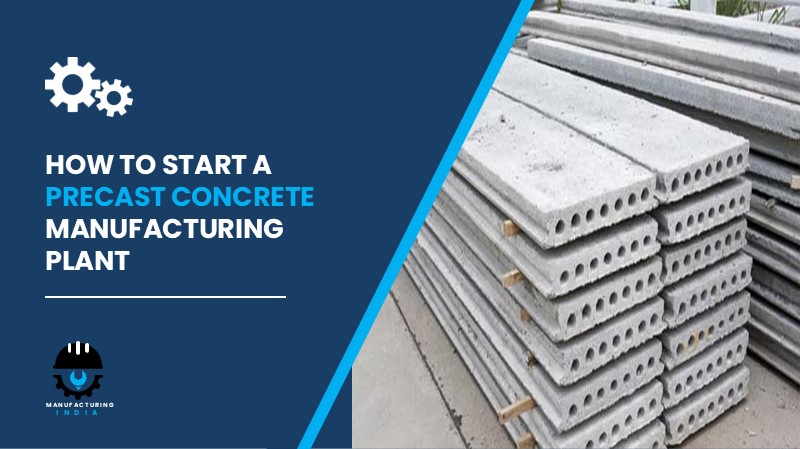
Precast concrete or precasting is a process that involves making concrete parts in a factory under controlled conditions and then moving them to the site for assembly. The precast components consist of beams, columns, slabs, walls, pipes, culverts, staircases, and structural panels. The given process allows control of the quality of the materials, curing conditions, and the accuracy of dimensions, which results in the same strength and durability. Working with precast concrete is not only faster but also less dependent on labor, generates limited waste on site, and is very predictable and safe while allowing capacity increase and production to be standardized. Therefore, making use of precast concrete is a growing trend in the construction of residential buildings, commercial complexes, industrial facilities, transportation infrastructure, and urban development due to its design flexibility, structural reliability, and speed of project execution.
- Process Used: Concrete batching and mixing, mold preparation, casting, vibration and compaction, curing, demolding, surface finishing, inspection, and storage.
- End-use Industries: Construction and infrastructure sector, residential housing, commercial real estate, industrial facilities, transportation, and utilities.
- Applications: Structural components, building panels, drainage products, road and bridge elements, and modular construction systems.
Cost of Setting Up a Precast Concrete Manufacturing Plant in India
The precast concrete manufacturing plant setup cost is provided in detail covering project economics, capital investments (CapEx), project funding, operating expenses (OpEx), income and expenditure projections, fixed costs vs. variable costs, direct and indirect costs, expected ROI and net present value (NPV), profit and loss account, financial analysis, and more. Here is a structured breakdown of all major cost components:
1. Capital Expenditure (CapEx)
The total capital investment in a precast concrete manufacturing plant in India typically covers the following:
Land and Site Development The cost of land and site development, including charges for land registration, boundary development, and other related expenses, forms a substantial part of the overall investment. The location must offer easy access to key raw materials such as cement and aggregates. Proximity to target markets will help minimize distribution costs. The site must have robust infrastructure, including reliable transportation, utilities, and waste management systems. Compliance with local zoning laws and environmental regulations must also be ensured.
Request a Sample Report for In-Depth Market Insights: https://www.imarcgroup.com/precast-concrete-manufacturing-plant-project-report/requestsample
Civil Works and Construction Building costs cover the main production facility and supporting infrastructure. The layout should be optimized to enhance workflow efficiency, safety, and minimize material handling. Separate areas for raw material storage, production, quality control, and finished goods storage must be designated. Space for future expansion should be incorporated to accommodate business growth.
Machinery and Equipment Machinery costs account for the largest portion of the total capital expenditure. High-quality, corrosion-resistant machinery tailored for precast concrete production must be selected. Essential equipment includes:
- Batching Plants
- Molds
- Vibration Systems
- Curing Chambers
- Cranes
- Finishing Equipment
The scale of production and automation level will determine the total cost of machinery. All machinery must comply with industry standards for safety, efficiency, and reliability.
Other Capital Costs These include pre-operative expenses and other related costs. This allocation ensures a solid foundation for safe and efficient plant operations.
2. Operational Expenditure (OpEx)
In the first year of operations, the operating cost for the precast concrete manufacturing plant in India is projected to be significant, covering raw materials, utilities, depreciation, taxes, packing, transportation, and repairs and maintenance. By the fifth year, the total operational cost is expected to increase substantially due to factors such as inflation, market fluctuations, and potential rises in the cost of key materials. Additional factors, including supply chain disruptions, rising consumer demand, and shifts in the global economy, are expected to contribute to this increase.
Raw Material Cost (Cement): 60-70% of Total OpEx Raw materials, including cement and aggregates, are a major part of operating costs. Long-term contracts with reliable suppliers will help mitigate price volatility and ensure a consistent supply of materials.
Utility Cost: 10-15% of Total OpEx Costs associated with utilities including electricity, water, and steam must be considered in the financial plan.
Other Operating Costs The remaining budget covers transportation, packaging, salaries and wages, depreciation, taxes, repairs and maintenance, and other expenses.
3. Plant Capacity
The proposed precast concrete manufacturing facility in India is designed with an annual production capacity ranging between 50,000 – 100,000 cubic meters, enabling economies of scale while maintaining operational flexibility.
4. Profit Margins and Financial Projections
The project demonstrates healthy profitability potential under normal operating conditions:
- Gross Profit Margin: 30-40%
- Net Profit Margin: 12-18%
The financial projections for the proposed project have been developed based on realistic assumptions related to capital investment, operating costs, production capacity utilization, pricing trends, and demand outlook. These projections provide a comprehensive view of the project’s financial viability, ROI, profitability, and long-term sustainability. A detailed financial analysis including income projections, expenditures, and break-even points must be conducted, as this aids in securing funding and formulating a clear financial strategy.
Why Set Up a Precast Concrete Manufacturing Plant in India?
The global market environment presents a uniquely favorable opportunity for establishing a precast concrete manufacturing facility in India:
Rising Infrastructure Investments The influx of government and private sector spending on roads, railways, housing, and urban development is the main reason behind the increasing precast demand. As per the data reported by the World Bank Group, private participation in infrastructure (PPI) projects reached about USD 100.7 billion in 2024, up nearly 16% from USD 87.1 billion in 2023, accelerating demand for precast concrete as developers prioritize faster construction, quality consistency, and cost-efficient project delivery.
Time and Cost Efficiency Factory-based production leads to shorter construction cycles and, at the same time, minimizes material wastage and labor costs. Working with precast concrete is not only faster but also less dependent on labor, generates limited waste on site, and is very predictable and safe while allowing capacity increase and production to be standardized.
Quality Consistency The controlled conditions in manufacturing lead to uniform strength, finish, and full compliance with structural standards. The process allows control of the quality of the materials, curing conditions, and the accuracy of dimensions, which results in the same strength and durability across all precast components.
Sustainability Benefits Less waste produced on-site, efficient material usage, and lower emissions are steps taken to meet green construction goals. New technologies in mold design, concrete mixing, and curing methods are contributing to the improvement in product quality and widening the application area.
Scalable Production Model The capacity of the plants can be increased or decreased depending on the project pipeline and demand within the region. Governments across major economies continue to invest heavily in transportation networks, affordable housing, and smart city projects, creating sustained demand for precast structural components.
Manufacturing Process Overview
Setting up a precast concrete manufacturing plant in India requires evaluating several key factors, including technological requirements and quality assurance. The manufacturing process is a multi-step operation that involves several unit operations, material handling, and quality checks. The main stages involved in the precast concrete manufacturing process flow include:
- Unit Operations Involved
- Mass Balance and Raw Material Requirements
- Quality Assurance Criteria
- Technical Tests
Key considerations in the manufacturing setup include:
- Raw Material Sourcing: Reliable suppliers must be secured for raw materials like cement and aggregates to ensure consistent production quality. Minimizing transportation costs by selecting nearby suppliers is essential. Sustainability and supply chain risks must be assessed, and long-term contracts should be negotiated to stabilize pricing and ensure a steady supply.
- Safety and Environmental Compliance: Safety protocols must be implemented throughout the manufacturing process of precast concrete. Advanced monitoring systems should be installed to detect leaks or deviations in the process. Effluent treatment systems are necessary to minimize environmental impact and ensure compliance with emission standards.
- Quality Assurance Systems: A comprehensive quality control system should be established throughout production. Analytical instruments must be used to monitor product concentration, purity, and stability. Documentation for traceability and regulatory compliance must be maintained.
Key Applications of Precast Concrete
Precast concrete serves a wide variety of end-use industries and applications:
- Residential Construction: Precast elements enable faster housing development with consistent quality, reduced site labor, and improved project timelines.
- Commercial and Industrial Buildings: High load-bearing capacity and rapid structural assembly are advantages for factories, warehouses, offices, and malls.
- Infrastructure Projects: Due to the benefits of durability and precision, precast concrete is used for bridges, metro systems, drainage networks, and highways.
- Urban Development and Smart Cities: Modular precast systems can carry out large-scale urban projects while controlling quality and reducing environmental impact.
Global Market Outlook
The global precast concrete market size was valued at USD 139.99 Billion in 2025. According to IMARC Group estimates, the market is expected to reach USD 202.03 Billion by 2034, exhibiting a CAGR of 4.2% from 2026 to 2034. The precast concrete sector is experiencing continuous development, which is mainly attributed to the infrastructure building, urbanization, and industrial construction practices adoption that are all fast-paced. As per the data reported by the World Bank Group, private participation in infrastructure (PPI) projects reached about USD 100.7 billion in 2024, up nearly 16% from USD 87.1 billion in 2023.
Leading manufacturers in the global precast concrete industry include:
- Balfour Beatty plc
- Boral Limited
- CEMEX S.A.B. de C.V.
- Elementbau Osthessen GmbH & Co. ELO KG
- Forterra Inc.
All of which serve end-use sectors such as construction, infrastructure, industrial, and urban development projects.
Latest Industry Developments
- May 2025: Elematic and Carbonaide jointly introduced a production-ready CO2-curing system for precast concrete, targeting industrial and infrastructure construction. The breakthrough offers stronger material performance and lowers emissions by mineralizing carbon into concrete. Initial rollout across Elematic manufacturing lines supports faster, greener, scalable precast concrete production.
- February 2025: MIG Holding launched a 700,000 m3-per-year precast concrete factory in the Middle East, through a partnership with National Industries Park. The facility supports the UAE Operation 300Bn strategy, strengthening innovative manufacturing while accelerating infrastructure delivery and expanding building materials capacity across regional construction value chains and investment momentum.
Licenses and Regulatory Requirements in India
Starting a precast concrete manufacturing unit in India requires several regulatory approvals and certifications. The report covers regulatory procedures, financial assistance, and necessary certifications, ensuring all legal and compliance requirements are met, including:
- Business registration and incorporation
- Factory License under applicable labor and manufacturing laws
- Environmental Clearance from relevant pollution control authorities
- Industrial permits and business licenses
- Industry-specific regulatory licensing
- Intellectual property rights (IPR) registrations and licensing
Frequently Asked Questions
The following questions are answered in the report:
- How has the precast concrete market performed so far and how will it perform in the coming years in India?
- What is the market segmentation of the global precast concrete market?
- What is the regional breakup of the global precast concrete market?
- What are the price trends of various feedstocks in the precast concrete industry in India?
- What is the structure of the precast concrete industry and who are the key players?
- What are the various unit operations involved in a precast concrete manufacturing plant in India?
- What is the total size of land required for setting up a precast concrete manufacturing plant in India?
- What is the layout of a precast concrete manufacturing plant in India?
- What are the machinery requirements for setting up a precast concrete manufacturing plant in India?
- What are the raw material requirements for setting up a precast concrete manufacturing plant in India?
- What are the packaging requirements for setting up a precast concrete manufacturing plant in India?
- What are the transportation requirements for setting up a precast concrete manufacturing plant in India?
- What are the utility requirements for setting up a precast concrete manufacturing plant in India?
- What are the human resource requirements for setting up a precast concrete manufacturing plant in India?
- What are the infrastructure costs for setting up a precast concrete manufacturing plant in India?
- What are the capital costs for setting up a precast concrete manufacturing plant in India?
- What are the operating costs for setting up a precast concrete manufacturing plant in India?
- What should be the pricing mechanism of the final product?
- What will be the income and expenditures for a precast concrete manufacturing plant in India?
- What is the time required to break even?
- What are the profit projections for setting up a precast concrete manufacturing plant in India?
- What are the key success and risk factors in the precast concrete industry in India?
- What are the key regulatory procedures and requirements for setting up a precast concrete manufacturing plant in India?
- What are the key certifications required for setting up a precast concrete manufacturing plant in India?
Key Takeaways for Investors
The precast concrete manufacturing industry in India represents a strong and scalable investment opportunity backed by growing global demand across residential housing, commercial real estate, industrial facilities, transportation, and urban development sectors. This report provides the comprehensive blueprint needed to transform your precast concrete manufacturing plant cost in India vision into a technologically advanced and highly profitable reality. With gross margins of 30-40% and net margins of 12-18%, a well-planned precast concrete manufacturing plant remains competitive and financially viable. The convergence of rapid urbanization, rising infrastructure investments, increasing adoption of modular construction techniques, and the growing need for time-efficient and cost-effective building solutions creates a robust and diversified revenue base for precast concrete manufacturers entering or expanding in this market.
About the Author