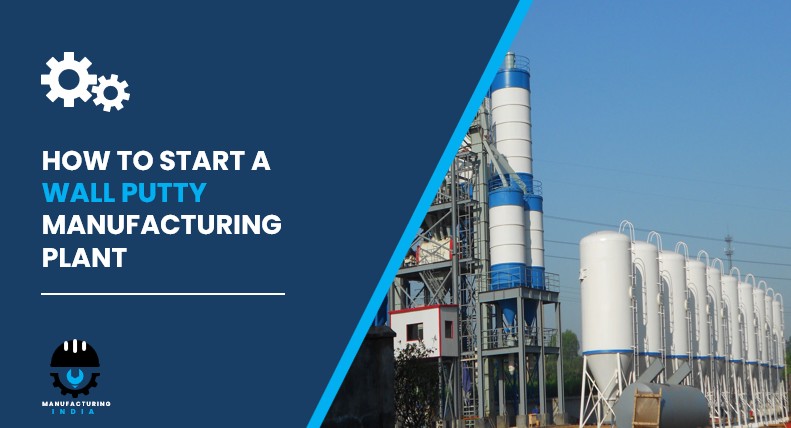
Setting up a wall putty manufacturing plant in India presents a highly compelling investment opportunity as demand for premium surface finishing materials continues to rise across residential, commercial, infrastructure, and renovation construction sectors. Wall putty has become an indispensable part of the modern construction finishing process — providing smooth, crack-resistant, and paint-ready surfaces that significantly enhance the longevity and aesthetics of painted walls.
“With the India wall putty market projected to grow at a CAGR of 5.0% through 2034, driven by rapid urbanization, government housing missions, and rising consumer awareness about surface preparation, wall putty manufacturing offers gross margins of 30–40% and a break-even window of 3–5 years — making it one of the most financially rewarding opportunities in the construction chemicals sector.”
What is Wall Putty?
Wall putty is a finishing material made from white cement, calcium carbonate, polymers, and functional additives that builders apply to interior and exterior walls before painting. The product functions as a protective and levelling layer that creates a smooth surface by filling small cracks, gaps, pin holes, and surface defects. Wall putty improves paint adhesion, enhances paint coverage, and extends the life of decorative coatings by preventing moisture ingress and stopping peeling and flaking.
Wall putty is available in two primary forms: powder wall putty — the more widely used dry-mix variant requiring on-site mixing with water — and ready-mix acrylic putty, which offers superior flexibility and water resistance. Both variants are valued for their exceptional whiteness, high compressive strength, dampness resistance, and ability to create a consistent, smooth surface finish across different climatic conditions.
The product finds extensive application throughout residential homes, commercial office buildings, institutional facilities, hotels, hospitals, educational institutions, and industrial plants. Its standardized formulation ensures consistent performance and reliable quality across varying temperature, humidity, and substrate conditions, making it the preferred choice of builders, painters, architects, and contractors worldwide.
Cost of Setting Up a Wall Putty Manufacturing Plant in India
The wall putty manufacturing plant cost depends on several parameters including production capacity, technology configuration, plant location, level of automation, raw material sourcing strategy, and regulatory compliance requirements. Here is a structured breakdown of all major cost components:
1. Capital Expenditure (CapEx)
The total capital investment in a wall putty manufacturing plant typically covers the following:
Land and Site Development
This includes land acquisition, boundary development, land registration charges, and basic site preparation. Cost varies significantly depending on whether the land is located in a designated industrial zone, construction materials cluster, Special Economic Zone (SEZ), or a privately purchased plot. Proximity to raw material suppliers — particularly white cement and calcium carbonate sources — and key transportation routes is a critical factor in site selection.
Request a Sample Report for In-Depth Market Insights: https://www.imarcgroup.com/wall-putty-manufacturing-plant-project-report/requestsample
Civil Works and Construction
Building costs cover the main production facility, raw material storage silos and warehouses, quality control laboratory, blending and packaging hall, administrative block, utility area, dust collection infrastructure, and worker amenities. Construction must comply with industrial safety norms including dust containment, ventilation systems, fire resistance, and environmental management standards appropriate for a dry-powder manufacturing environment.
Machinery and Equipment
This is the single largest component of CapEx. Key machinery required for a wall putty manufacturing plant includes:
- Jaw Crushers and Impact Crushers (for limestone and mineral processing)
- Pulverizers and Grinding Mills (for white cement and calcium carbonate)
- Vibrating Screens and Classifiers
- Ribbon Blenders and Paddle Mixers (for dry-mix homogenization)
- Dust Collection Systems and Bag Filters
- Raw Material Storage Silos (cement, calcium carbonate, polymer powder)
- Pneumatic Conveying Systems and Screw Conveyors
- Automated Weighing and Batching Systems
- Automated Packaging Machines (25 kg / 40 kg bag filling and sealing)
- Pallet Wrappers and Stretch Film Machines
- Quality Control Laboratory Equipment (whiteness meter, compressive strength tester, fineness tester)
- Process Control and Automation Systems (PLC/SCADA)
Machinery costs represent the largest share of overall capital expenditure, reflecting the precision engineering, dust-handling requirements, and process automation standards involved in dry-mix wall putty production.
Other Capital Costs
These include pre-operative expenses, commissioning charges, import duties (if machinery is sourced internationally), utilities installation, fire safety systems, dust suppression infrastructure, Effluent Treatment Plant (ETP) setup, and environmental management infrastructure.
2. Operational Expenditure (OpEx)
Once the plant is commissioned, the ongoing cost structure is dominated by a few key components:
Raw Material Cost (White Cement, Calcium Carbonate, Polymers): 60–70% of Total OpEx
White cement is the primary raw material and the largest cost driver, accounting for the majority of raw material expense. Other key materials include calcium carbonate (ground limestone), Redispersible Polymer Powder (RDP), cellulose ether (HPMC), titanium dioxide (for whiteness enhancement), and anti-efflorescence additives, depending on the product grade and performance specification.
Utility Cost: 5–10% of Total OpEx
Utilities include electricity (consumed by grinding mills, blenders, conveyors, packaging lines, and process control equipment), compressed air supply, and water (used in quality control testing and facility maintenance). The relatively low utility cost compared to other manufacturing sectors reflects the dry-processing nature of wall putty production, with no significant thermal or chemical energy requirements.
Other Operating Costs
The remaining budget covers transportation and logistics (bulk inbound raw materials and outbound finished goods), packaging materials (multi-layer kraft paper bags, BOPP woven bags), salaries and wages, maintenance, depreciation, insurance, quality certification costs, and miscellaneous overhead.
3. Plant Capacity
The proposed manufacturing facility can be designed across a range of production scales:
- Small-Scale Operations: 5,000–15,000 metric tons annually — suitable for regional markets, local builders, and small contractor networks with batch production and semi-automated equipment.
- Mid-Scale Plants: 20,000–50,000 metric tons annually — designed for state-level or multi-regional markets with continuous blending lines, moderate automation, and diversified product portfolio spanning interior, exterior, and premium grades.
- Large-Scale Plants: 1,00,000+ metric tons annually — built for national distribution with high-speed automated packaging, multiple parallel blending lines, and comprehensive product portfolio including standard, premium, and waterproof wall putty variants.
Profitability significantly improves with higher capacity utilization. Larger plants benefit from economies of scale in white cement procurement, logistics, and distribution network reach.
4. Profit Margins and Financial Projections
- Gross Profit Margin: 30–40%
- Net Profit Margin: 15–22%
- Break-Even Period: 3 to 5 years, depending on production scale, market positioning, raw material cost management, product mix, and sales channel efficiency.
Financial projections must account for capital investment, operating costs, capacity utilization rates, pricing trends, and demand outlook. A thorough analysis should also include sensitivity analysis, Net Present Value (NPV), Internal Rate of Return (IRR), and Payback Period.
Why Set Up a Wall Putty Manufacturing Plant in India?
The Indian market and global construction environment present a uniquely favorable opportunity for establishing a wall putty manufacturing facility:
Rapid Urbanization and Housing Demand
India’s urbanization rate continues to accelerate, with the government’s Pradhan Mantri Awas Yojana (PMAY) and Smart Cities Mission driving massive investments in affordable and mid-segment housing construction. Each new housing unit represents direct demand for wall putty in the finishing and pre-painting stages, creating a structural and sustained consumption base for manufacturers.
Infrastructure and Public Works Growth
India’s Union Budget 2025-26 outlined ambitious infrastructure expansion plans including airport development, road and highway construction, metro rail projects, and public buildings. Government infrastructure projects extensively use wall putty in building and institutional construction, generating large-scale demand from public sector procurement channels.
Rising Consumer Awareness About Surface Finishing
Consumer awareness about the role of surface preparation in paint longevity and aesthetics has transformed wall putty from an optional to an essential pre-painting step. Architects, interior designers, and contractors now specify wall putty as a standard component of the finishing specification, significantly expanding the addressable market beyond premium segments into mass-market residential construction.
Renovation and Repainting Recurring Demand
Unlike many construction materials consumed only during new construction, wall putty generates consistent recurring demand from maintenance, renovation, and repainting activities. With India’s large existing housing stock requiring periodic repainting every 3–5 years, the renovation segment provides a stable, cycle-resistant revenue base for wall putty manufacturers.
Commercial Real Estate Expansion
The expanding commercial real estate sector — offices, retail spaces, hotels, hospitals, and educational institutions — generates significant demand for premium-grade wall putty with superior whiteness, smoothness, and moisture resistance. Rising investment in organized retail and hospitality infrastructure is creating new high-value market segments for wall putty producers.
Highly Scalable and Low-Complexity Process
Wall putty manufacturing is a relatively low-complexity dry-mixing process compared to other construction chemicals. It requires modest capital investment, does not involve hazardous chemical reactions, and can be scaled up incrementally. This makes it particularly attractive for first-time investors and regional manufacturers seeking a capital-efficient entry into the construction materials sector.
Manufacturing Process Overview
The wall putty manufacturing process primarily involves the sourcing and blending of white cement, calcium carbonate, polymer powders, and functional additives in precise formulation ratios to produce a consistent, high-performance dry-mix product. The production is divided into several key stages:
- Raw Material Sourcing and Incoming Quality Inspection — white cement, calcium carbonate, RDP, HPMC, titanium dioxide, and additives are received, sampled, and tested against specifications before acceptance into storage.
- Crushing and grinding — mineral raw materials are size-reduced using jaw crushers and grinding mills to achieve the required particle size distribution for product fineness and workability.
- Precise Weighing and Batching — all ingredients are weighed using automated batch weighing systems to ensure formulation accuracy and batch-to-batch consistency.
- Homogeneous Blending — the weighed raw materials are blended in ribbon blenders or paddle mixers for a controlled mixing duration to achieve complete homogenization.
- Quality Testing and Inspection — each batch is sampled and tested for whiteness, fineness, consistency, compressive strength, and setting time before release.
- Automated Packaging — approved product is conveyed to packaging lines for filling into 25 kg or 40 kg multi-layer kraft paper bags, sealed, stacked on pallets, and wrapped for dispatch.
Key Applications of Wall Putty
Wall putty serves a wide variety of construction and finishing applications:
- Residential Construction: Interior and exterior wall levelling, surface smoothing, crack filling, and pre-painting preparation for all types of residential buildings.
- Commercial and Institutional Buildings: High-quality smooth wall finishes for offices, hospitals, educational institutions, and retail spaces requiring superior aesthetics and durability.
- Infrastructure and Public Works: Surface finishing for government buildings, metro stations, airports, railway stations, and public infrastructure projects.
- Renovation and Refurbishment: Surface restoration, crack repair, and re-levelling of existing wall surfaces in maintenance, repainting, and building upgrade projects.
- Decorative and Premium Finishes: Premium white cement putty providing exceptional whiteness and ultra-smooth surfaces for luxury residential and hospitality applications.
Global and India Market Outlook
The India wall putty market size was valued at USD 41.18 Million in 2025. According to IMARC Group estimates, the market is expected to reach USD 63.89 Million by 2034, exhibiting a CAGR of 5.0% from 2026 to 2034. This sustained growth is driven by expanding residential and commercial construction activity, government housing and infrastructure missions, increasing consumer awareness of surface preparation, renovation and repainting demand, and rising adoption of premium and waterproof wall putty grades.
The Asia Pacific region dominates global wall putty consumption, led by India, China, and Southeast Asian markets, due to their large construction activity base, rapid urbanization, and growing middle-class housing demand. India represents one of the fastest-growing individual country markets within the global wall putty industry.
Leading players in the India and global wall putty industry include:
- Aditya Birla Management Corp. Pvt. Ltd. (UltraTech)
- Asian Paints Ltd.
- Akzo Nobel NV
- Walplast Products Pvt. Ltd.
- Birla White
- JK Cement Ltd.
- ABC Phil Inc.
- Arkema Group
Timeline to Start a Wall Putty Manufacturing Plant
Setting up a wall putty manufacturing plant from ideation to commissioning typically requires 12 to 24 months. This covers:
- Feasibility study and detailed project report (DPR) preparation
- Land acquisition and site development
- Environmental impact assessment and regulatory approvals
- Plant design, layout engineering, and civil construction
- Machinery procurement, installation, and commissioning
- Utility setup and infrastructure commissioning
- Raw material trials, product development, and quality testing
- Product certification and regulatory compliance verification
- Distribution channel setup and commercial production launch
Licenses and Regulatory Requirements
Starting a wall putty manufacturing unit requires several approvals, which may vary by state and jurisdiction in India, including:
- Business registration and incorporation (Ministry of Corporate Affairs)
- Factory License under the Factories Act
- Consent to Establish and Consent to Operate from State Pollution Control Board
- Environmental Clearance for applicable plant capacity
- GST Registration
- Fire Safety NOC from local Fire Department
- BIS Certification (IS 6452 for white cement-based wall putty, where applicable)
- Weights and Measures Registration (for packed commodity net weight compliance)
- ISO 9001 Quality Management System Certification
- ISO 14001 Environmental Management System Certification
- MSME/Udyam Registration (if applicable for smaller plants)
Key Challenges to Consider
Before investing, entrepreneurs and investors should be aware of the common challenges in this business:
White Cement and Raw Material Price Volatility: White cement prices — the primary cost driver — are influenced by energy costs, clinker availability, and cement market dynamics. Fluctuations in white cement pricing directly impact production costs and profit margins, requiring manufacturers to develop robust procurement strategies including long-term supply agreements and strategic inventory management.
Competition from Established Brands: The wall putty market features dominant national brands such as Birla White, JK White Cement, and Asian Paints with significant distribution networks, brand equity, and consumer trust. New entrants must invest in distribution infrastructure, contractor and painter engagement programs, and product quality differentiation to compete effectively against established players.
Dust and Environmental Management: Dry-mix manufacturing generates significant airborne dust from grinding, conveying, blending, and packaging operations. Compliance with air quality standards requires investment in bag filter dust collection systems, enclosed material handling, and regular environmental monitoring to meet Pollution Control Board requirements.
Logistics and Distribution Challenges: Wall putty is a relatively low unit-value, high-weight construction material. Efficient distribution logistics — particularly for last-mile delivery to construction sites and retail dealers — is critical to maintaining cost competitiveness and service levels. Freight cost management is essential for profitability, especially for plants serving distant markets.
Product Quality Consistency: Maintaining consistent whiteness, fineness, compressive strength, and setting time across every batch is critical to maintaining contractor and dealer confidence. This requires rigorous incoming raw material quality control, precise batching systems, and thorough finished product testing before dispatch.
Frequently Asked Questions
The following questions are answered in the report:
- How much does it cost to set up a wall putty manufacturing plant?
- Is wall putty manufacturing a profitable business in 2026?
- What machinery and equipment are required for a wall putty plant?
- What licenses and approvals are required to start a wall putty manufacturing facility in India?
- How long does it take to commission a wall putty manufacturing plant?
- What is the best location to set up a wall putty manufacturing plant in India?
- What government incentives and subsidies are available for wall putty manufacturers?
- What is the break-even period for a wall putty manufacturing plant?
- What is the BIS certification requirement for wall putty production in India?
- What are the key raw materials and their sourcing strategies for wall putty manufacturing?
Key Takeaways for Investors
The wall putty manufacturing industry represents a strong, scalable, and capital-efficient investment opportunity backed by structural demand growth across India’s booming construction sector. With gross margins of 30–40%, net margins of 15–22%, and a break-even window of 3–5 years, a well-planned wall putty manufacturing plant cost remains highly competitive and financially viable across all production scales. The convergence of government housing missions, infrastructure expansion, rising consumer awareness of quality surface finishing, and consistent renovation and repainting demand creates a robust, diversified, and recession-resistant revenue base for wall putty manufacturers entering or expanding in this market.
About the Author