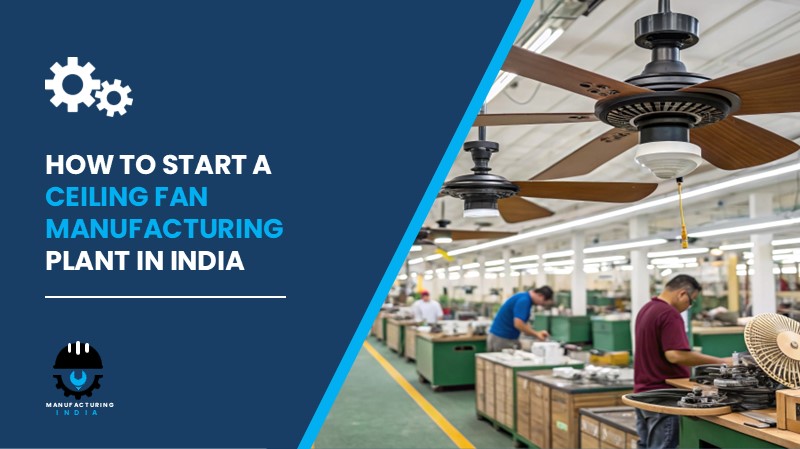
Setting up a ceiling fan manufacturing plant in India presents a compelling investment case backed by surging residential construction activity, rapid urbanisation across Tier 2 and Tier 3 cities, expanding commercial real estate, and the growing national focus on energy-efficient appliances. Ceiling fans remain one of the most essential electrical household items in both developed and developing economies, serving residential housing, commercial buildings, hospitality properties, industrial facilities, and public infrastructure. As electrification deepens across India’s semi-urban and rural regions, demand for ceiling fans continues to grow at a stable, predictable pace — making this manufacturing vertical particularly attractive for first-time investors and seasoned industrialists alike.
India’s structural advantages make it a strategically sound location for this investment. The country offers cost-competitive land in dedicated industrial estates and Special Economic Zones, an abundant skilled and semi-skilled labour pool, and a robust domestic component supply chain for motors, capacitors, steel sheets, and plastic parts. Key manufacturing states such as Gujarat, Maharashtra, Uttar Pradesh, and Tamil Nadu provide reliable power, well-developed logistics corridors, and government-backed investment incentives under the Make in India initiative. With a large installed base of legacy fans driving a consistent replacement market and new construction driving fresh demand, India represents one of the most viable destinations globally for ceiling fan production.
A ceiling fan manufacturing plant in India combines policy support, cost-competitive operations, and multi-sector demand — from residential housing to industrial warehousing — to deliver gross profit margins of 25–35% and net margins of 10–15%, with break-even typically achievable within two to four years of commercial production.
What is a Ceiling Fan?
Ceiling fans are electric air-circulation devices installed on the ceiling of indoor spaces to promote airflow and thermal comfort. Beyond the electric motor at their core, a ceiling fan comprises blades, a mounting assembly, a down rod, and electronic or mechanical control systems. By promoting continuous air circulation, ceiling fans reduce dependence on air conditioning, making them significantly more energy-efficient and lowering electricity costs for end users.
Modern ceiling fans span a wide range of designs, blade materials, motor technologies, and surface finishes to meet the needs of residential, commercial, and industrial spaces. Advanced variants now incorporate brushless DC (BLDC) motors, smart connectivity features, remote operation, and energy-saving performance aligned with efficiency labelling programmes. Their long-lasting, low-maintenance, and cost-effective characteristics have made ceiling fans one of the most widely used electrical appliances across both developed and developing economies.
The primary production method is a multi-stage process involving sheet metal cutting and forming, motor winding and assembly, blade manufacturing and balancing, surface finishing and coating, final assembly, quality testing, and packaging. End-use industries served include residential housing, commercial buildings, the hospitality sector, industrial facilities, and public infrastructure — spanning applications from homes and offices to retail spaces, factories, educational institutions, and healthcare facilities.
Cost of Setting Up a Ceiling Fan Manufacturing Plant in India
The cost of establishing a ceiling fan manufacturing plant depends on capacity, technology selection, plant location, automation level, and regulatory compliance requirements. Below is a structured breakdown of the major cost components investors must plan for.
1. Capital Expenditure (CapEx)
Land and Site Development costs form a substantial part of the overall investment, covering land registration charges, boundary development, and related site preparation expenses. Locating the facility within a recognised industrial estate or Special Economic Zone can significantly reduce land acquisition costs and provide access to pre-built infrastructure and streamlined regulatory clearances.
Civil Works and Construction costs cover the manufacturing shed, quality control laboratory, raw material and finished goods storage areas, effluent treatment infrastructure, and the administrative block. Well-designed civil works also incorporate future expansion space — an important consideration given the scalable nature of ceiling fan manufacturing.
Machinery and Equipment represent the single largest component of capital expenditure. Key machinery required includes:
- Sheet metal cutting machines
- Stamping presses (for fan blades and body)
- Motor winding machines
- Blade moulding machines
- Balancing machines for fan blades
- Painting booths
- Assembly lines
- Quality inspection and testing equipment
- Packaging machines
Other Capital Costs include the effluent treatment plant, pre-operative and commissioning expenses, and applicable import duties on specialised machinery not available domestically.
Request a Sample Report for In-Depth Market Insights: https://www.imarcgroup.com/ceiling-fan-manufacturing-plant-project-report/requestsample
2. Operational Expenditure (OpEx)
Raw Material Cost constitutes the dominant share of operating expenses, accounting for 70–80% of total OpEx. The primary raw materials include steel blades, motors, capacitors, plastic parts, electrical components such as wires and bearings, fasteners, and paint. Securing long-term supply contracts with reliable domestic and international suppliers is critical to controlling price volatility and maintaining consistent production quality.
Utility Cost — covering electricity, water, and ancillary energy requirements — accounts for 5–10% of total operating expenditure. Locating the plant in a region with dependable grid supply or investing in captive renewable power can meaningfully reduce this cost over time.
Other Operating Costs include transportation and logistics, packaging materials, salaries and wages for production and management staff, machinery maintenance, depreciation on fixed assets, and applicable taxes. By the fifth year of operations, total operational costs are expected to increase substantially due to inflation, market fluctuations, and potential rises in the cost of key raw materials, compounded by supply chain shifts and rising consumer demand.
3. Plant Capacity
The proposed manufacturing facility is designed with an annual production capacity ranging between 2 and 5 million units, enabling economies of scale while maintaining operational flexibility. Capacity can be customised based on individual investor requirements, market strategy, and available capital. As with most manufacturing verticals, profitability improves meaningfully with higher capacity utilisation, making ramp-up planning a critical part of the financial model.
4. Profit Margins and Financial Projections
The ceiling fan manufacturing plant project demonstrates healthy profitability under normal operating conditions. Gross profit margins typically range between 25–35%, supported by stable demand and value-added product applications. Net profit margins average 10–15% over a five-year horizon. A comprehensive financial analysis — covering Net Present Value (NPV), Internal Rate of Return (IRR), payback period, sensitivity analysis, and profit and loss projections — is essential before committing capital. Break-even is typically achievable within two to four years, depending on plant size, raw material costs, market demand, and operational efficiency.
Why Set Up a Ceiling Fan Plant in India?
Growing Construction and Housing Demand: The rapid expansion of residential and commercial construction across India continues to drive steady, region-wide demand for ceiling fans. Rapid urbanisation and apartment construction in Tier 1 and Tier 2 cities generate consistent large-volume procurement requirements from developers and contractors.
Energy Efficiency as a Core Demand Driver: Rising electricity costs and government-mandated appliance labelling programmes are accelerating the shift towards high-efficiency and BLDC-based ceiling fans. Manufacturers offering energy-rated products are positioned to capture premium pricing and government procurement contracts.
Replacement and Upgrade Market: A large installed base of legacy ceiling fans across India drives reliable replacement demand, particularly for modern smart variants. This recurring demand stream provides revenue predictability that is independent of new construction cycles.
Design and Product Differentiation: Manufacturers who invest in premium surface finishes, smart controls, decorative designs, and multi-colour options are accessing higher-value market segments with better margin profiles, as demonstrated by Orient Electric’s July 2025 launch of its Next-Gen BLDC ceiling fan range with 40+ colour options and smart voice control.
Active Industry Investment: The ceiling fan industry continues to attract significant product development capital. In June 2025, SKYX Platforms Corp. confirmed production start for its patented All-In-One Smart Turbo Heater and Ceiling Fan, targeting both residential and commercial markets — demonstrating the growing convergence of ceiling fan technology with smart indoor climate control.
Local Supply Chain Preference: India’s well-established components ecosystem — for motors, capacitors, steel sheets, and plastic parts — enables manufacturers to source locally, reduce import dependency, and build cost-competitive, India-first supply chains that serve both domestic and export markets.
Manufacturing Process Step by Step
The ceiling fan manufacturing process uses sheet metal cutting and forming as the primary production entry point, followed by a multi-stage assembly and quality assurance sequence.
- Sheet Metal Cutting and Forming: Steel sheets are cut and pressed into the required blade profiles and fan body components using stamping machines and sheet metal cutting equipment.
- Motor Winding and Assembly: Copper windings are applied to motor cores using motor winding machines, followed by assembly of the complete motor unit including capacitors, bearings, and wiring.
- Blade Manufacturing and Balancing: Blades are moulded or stamped to specification and passed through balancing machines to ensure vibration-free rotation in service.
- Surface Finishing and Coating: All metal and plastic components are processed through painting booths for surface finishing, coating, and aesthetic treatment across the specified colour range.
- Final Assembly: Motors, blades, mounting assemblies, down rods, and control systems are brought together on dedicated assembly lines to produce complete ceiling fan units.
- Testing and Quality Inspection: Every unit undergoes quality inspection and technical testing covering airflow performance, motor function, electrical safety, and noise levels.
- Packaging and Dispatch: Finished, inspected fans are packaged and dispatched to residential, commercial, hospitality, and industrial end-use sectors.
Key Applications
Ceiling fans serve a broad cross-section of end-use industries driven by the universal need for cost-effective air circulation and thermal comfort:
- Residential Sector: Delivering smooth, energy-efficient airflow across apartments and independent housing units throughout the day.
- Commercial Buildings: Providing indoor air circulation in offices, retail stores, and shopping malls while reducing HVAC operating costs.
- Hospitality and Institutional Facilities: Supplying reliable cooling with low maintenance requirements to hotels, hospitals, schools, and colleges.
- Industrial and Warehousing Spaces: Enhancing ventilation and thermal comfort in factories and storage facilities using large-diameter ceiling fan units.
Leading Manufacturers
The global ceiling fan industry is served by several multinational and domestic companies with extensive production capacities and diversified application portfolios. Key players operating in this space include:
- Crompton Greaves Consumer Electricals Limited
- Orient Electric
- Havells
- Hunter Fan Company
- The Henley Fan Company Ltd
- Mega Home Appliances
Timeline to Start the Plant
Establishing a ceiling fan manufacturing plant in India typically takes 12 to 18 months from project initiation to commercial production:
- Feasibility study and project report preparation
- Land acquisition and site development
- Regulatory approvals and environmental clearances
- Factory licence and fire safety compliance
- Machinery procurement and installation
- Raw material supplier agreements and supply chain setup
- Trial production and quality testing
- Commercial production launch
Licences and Regulatory Requirements
Starting a ceiling fan manufacturing unit in India requires several approvals:
- Business registration (Proprietorship, LLP, or Private Limited Company)
- Factory Licence under the Factories Act
- Environmental Clearance from the State Pollution Control Board
- GST Registration
- Fire Safety NOC
- Effluent Treatment Plant (ETP) operational clearance
- Occupational Health and Safety compliance
Key Challenges to Consider
High Capital Requirements: Land, civil construction, machinery procurement, and working capital together represent a significant upfront investment that requires careful financial planning and funding arrangement.
Raw Material Price Volatility: Steel blades, motors, capacitors, and plastic parts — which together account for 70–80% of operating expenditure — are subject to global commodity price swings that can compress margins if not managed through long-term supplier contracts.
Regulatory Compliance: Navigating environmental clearances, factory licencing, and ETP compliance across Indian states requires dedicated legal and technical resources, particularly for first-time manufacturers.
Technology and Innovation Pressure: The rapid adoption of BLDC motors, smart connectivity, and energy-labelled products means manufacturers must continuously invest in product development to remain competitive against established brands.
Competition: The market includes well-capitalised players such as Crompton Greaves Consumer Electricals Limited, Orient Electric, and Havells, requiring new entrants to differentiate through pricing, design, or regional focus.
Skilled Manpower: Motor winding, precision balancing, and quality inspection require trained technicians whose recruitment and retention can present operational challenges, particularly outside major industrial clusters.
Frequently Asked Questions
1. How much does it cost to set up a ceiling fan manufacturing plant in India?
Total investment depends on plant capacity, location, technology level, and automation. It covers land, civil construction, machinery, utilities, and working capital. IMARC Group’s detailed project report provides a full CapEx and OpEx breakdown.
2. Is ceiling fan manufacturing profitable in India in 2026?
Yes. With gross margins of 25–35% and net margins of 10–15%, and supported by stable multi-sector demand, ceiling fan manufacturing is a financially viable investment in India.
3. What machinery is required for a ceiling fan plant in India?
Essential equipment includes sheet metal cutting machines, stamping presses, motor winding machines, blade moulding machines, balancing machines, painting booths, assembly lines, quality inspection equipment, and packaging machines.
4. What licences and approvals are required to start a ceiling fan plant in India?
Required approvals include business registration, Factory Licence, Environmental Clearance, GST Registration, Fire Safety NOC, ETP clearance, and Occupational Health and Safety compliance.
5. What raw materials are needed for ceiling fan manufacturing?
Key raw materials include steel blades, motors, capacitors, plastic parts, electrical components (wires, bearings), fasteners, and paint.
6. What are the environmental compliance requirements for a ceiling fan plant in India?
Plants must obtain Environmental Clearance from the State Pollution Control Board, install and operate a compliant Effluent Treatment Plant, and meet all emission and waste management standards applicable to light engineering manufacturing.
7. What is the best location to set up a ceiling fan plant in India?
Industrial estates and SEZs in Gujarat, Maharashtra, Uttar Pradesh, and Tamil Nadu offer advantages including reliable power, established logistics infrastructure, local component supply chains, and investment incentives.
8. What is the break-even period for this type of plant in India?
Break-even typically ranges from two to four years, depending on plant capacity, raw material cost management, market demand, and operational efficiency.
9. What government incentives are available for manufacturers in India?
Manufacturers may access capital subsidies, tax exemptions, reduced utility tariffs, export benefits, and interest subsidies under national and state industrial policies, including schemes under the Make in India initiative.
Key Takeaways for Investors
A ceiling fan manufacturing plant in India addresses deep, diversified demand from residential housing, commercial buildings, the hospitality sector, industrial facilities, and public infrastructure — making this one of the more demand-resilient manufacturing investments available to mid-market investors. The plant’s financial profile is compelling across capacity ranges, with gross margins of 25–35% and net margins of 10–15% achievable under normal operating conditions. The global ceiling fan market was valued at USD 11.54 billion in 2025 and is projected to reach USD 15.05 billion by 2034 at a CAGR of 3.0%, underpinning the long-term demand sustainability of this investment. India’s combination of growing electrification, urbanisation momentum, and energy-efficiency mandates positions domestic ceiling fan producers to serve a market that will continue to expand for the foreseeable future.
About the Author