Setting up an onion powder manufacturing plant in India presents a compelling investment case driven by the rapid expansion of the processed food sector, rising demand for shelf-stable ingredients, and accelerating consumption of ready-to-eat meals, snacks, and instant food products where onion powder serves as a key flavoring component. India’s food processing industry is a powerful demand engine for dehydrated ingredients such as onion powder, which delivers consistent onion flavor, superior shelf stability, and ease of handling compared to fresh onions – making it indispensable across food manufacturing, seasoning blends, and foodservice operations.
India’s strategic advantages for onion powder production are considerable. The country is among the world’s largest onion-producing nations, enabling proximity to raw material supply chains and significantly reducing input costs. The Make in India initiative and agro-industrial park schemes actively support domestic food processing investment, while urbanisation and busy modern lifestyles continue to fuel demand for convenience foods across the country’s rapidly growing consumer base. States such as Gujarat and Maharashtra, which sit at the heart of India’s onion cultivation and food export corridors, offer particular locational advantages for this type of facility. As exports of Gujarat’s dehydrated white onions surged 67% in FY 2023–2024 to 83,452 tons – the highest in four years – the export opportunity for Indian producers has never been stronger.
Setting up an onion powder manufacturing plant in India is a financially compelling and strategically sound investment, supported by Make in India policy tailwinds, cost-competitive domestic raw material sourcing, and robust demand from the food processing, foodservice, and convenience foods sectors. With gross profit margins of 30–40% and a clear demand growth trajectory, this plant offers strong ROI and proven break-even viability.
What is Onion Powder?
Onion powder is essentially fresh onion in a dehydrated and extremely fine powder form. The production process involves the removal of moisture while characteristic flavors, aroma, and functional properties are held intact. The finished product typically appears as an off-white to pale yellow free-flowing powder with a very strong onion profile, delivering freshness of flavour, great shelf stability, and ease of flavour delivery – qualities that are superior to fresh onions in large-scale manufacturing contexts.
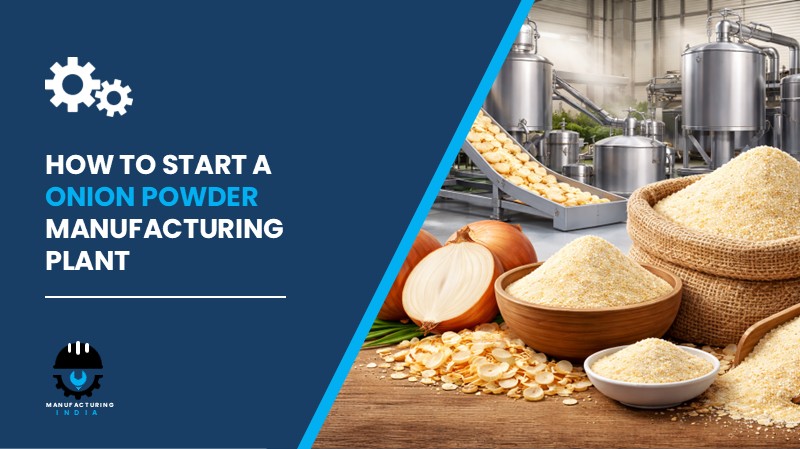
The product’s composition includes naturally occurring sulfur compounds responsible for its taste and aroma, alongside carbohydrates, trace minerals, and dietary fiber. Its low moisture content results in a very long shelf life with minimal risk of microbial contamination, which is why onion powder is the preferred ingredient in large-scale food manufacturing and seasoning applications. The production process – washing, peeling, slicing, drying (using hot air or freeze drying), grinding, sieving, and packaging – transforms raw onions into a high-value, shelf-stable ingredient. End-use industries served include food processing, spice blends, ready-to-eat meals, snacks, and culinary products.
Cost of Setting Up an Onion Powder Manufacturing Plant in India
The overall cost of establishing an onion powder manufacturing plant in India depends on several variables including production capacity, technology selection, plant location, level of automation, and regulatory compliance requirements. Investors should plan for both capital expenditure (CapEx) to construct and equip the facility and operational expenditure (OpEx) to sustain ongoing production efficiently.
1. Capital Expenditure (CapEx)
The total capital investment required for this facility encompasses multiple cost heads. Land and site development costs – including land registration charges, boundary development, and related site preparation expenses – form a substantial portion of the overall capital outlay, and investors should evaluate options such as Special Economic Zones (SEZs) and dedicated industrial estates in onion-growing regions to optimise land acquisition costs.
Civil works and construction expenditure covers the erection of the production shed, quality control laboratory, raw material and finished goods storage areas, and an administrative block. These structures must comply with food-grade safety and hygiene norms given the edible nature of the end product.
Machinery and equipment costs represent the largest single component of capital expenditure for an onion powder manufacturing plant. Key machinery required includes:
- Peelers
- Slicers
- Dryers (hot air or freeze dryers)
- Grinders
- Sieves
- Blenders
- Packaging machines
Other capital costs to be accounted for include effluent treatment plant (ETP) installation, pre-operative and commissioning expenses, and import duties on specialised machinery where applicable.
Request a Sample Report for In-Depth Market Insights: https://www.imarcgroup.com/onion-powder-manufacturing-plant-project-report/requestsample
2. Operational Expenditure (OpEx)
The operating cost structure of an onion powder manufacturing plant is primarily driven by raw material consumption. Onions account for approximately 70–80% of total operating expenses, making supplier contract strategy and proximity to onion-growing belts a critical factor in long-term cost management. Long-term contracts with reliable suppliers help mitigate price volatility and ensure a consistent supply of quality raw material.
Utility costs – covering electricity for drying and grinding operations, water consumption, and steam – represent 10–15% of total OpEx. Other operating costs include transportation and logistics, packaging materials, salaries and wages, maintenance and repairs, depreciation on plant and machinery, and applicable taxes. By the fifth year of operations, total operational costs are projected to increase substantially due to inflation, market fluctuations, rising input costs, supply chain disruptions, and shifts in the global economy.
3. Plant Capacity
The proposed manufacturing facility is designed with an annual production capacity ranging between 1,000 and 3,000 MT, enabling economies of scale while maintaining operational flexibility. Capacity can be customized per investor requirements based on target market size and capital availability. It is worth noting that profitability improves significantly with higher capacity utilisation, as fixed costs are spread over a larger production volume, improving per-unit margins.
4. Profit Margins and Financial Projections
The onion powder manufacturing plant project demonstrates healthy profitability potential under normal operating conditions. Gross profit margins typically range between 30–40%, supported by stable demand and value-added applications. Net profit margins are projected at 12–18% on an average basis across the operational period. The financial analysis framework covers NPV (Net Present Value), IRR (Internal Rate of Return), payback period, income and expenditure projections, liquidity analysis, sensitivity analysis, and uncertainty analysis – providing investors with a complete picture of financial viability before committing capital.
Why Set Up an Onion Powder Plant in India?
High and Growing Culinary Demand: Onion powder remains a core ingredient in food processing, seasoning, and ready-meal supply chains, prized for its excellent flavor consistency, long shelf life, and easy handling. Rising urbanisation and busy lifestyles have accelerated demand for ready-to-eat meals, snacks, and instant food products where onion powder serves as a critical flavoring component.
Expanding Food Processing and Foodservice Sectors: Growth in the foodservice industry drives consistent demand for powdered ingredients that reduce preparation time and storage complexity. Restaurants, catering units, and large-scale food manufacturers across India increasingly prefer onion powder for its ease of storage and consistent taste in high-volume cooking.
Policy and Regulatory Tailwinds: The Make in India initiative and agro-industrial park schemes actively support domestic food processing investment and international trade in dehydrated agri-products. These policy initiatives reduce barriers to entry, improve infrastructure access for processing facilities, and enhance the competitiveness of Indian manufacturers in global export markets.
Cost-Competitive Manufacturing: India’s position as a major onion-producing country enables manufacturers to source raw materials at competitive prices close to the plant, reducing transportation costs and ensuring supply reliability. Affordable land, labour, and a deep domestic supply chain further strengthen the cost competitiveness of Indian production.
Active Industry Investment and Export Growth: In February 2025, Dryon Food Pvt Ltd commenced commercial dehydration of onions at its advanced processing facility, sourcing fresh, pesticide-free onions directly from farmers and preserving natural flavor, aroma, and nutrients for culinary and industrial use. At the global level, in May 2024, McCormick launched new seasoning blends featuring onion as a high-quality primary ingredient, signaling continued product innovation and demand expansion for dehydrated onion ingredients.
Record Export Performance Validates Demand: Gujarat’s dehydrated white onions witnessed unprecedented overseas demand, driving exports up 67% in FY 2023–2024 to 83,452 tons – the highest in four years. This record export performance validates the global demand trajectory for Indian-manufactured dehydrated onion products and strengthens the business case for new capacity investment.
Manufacturing Process – Step by Step
The onion powder manufacturing process uses washing, peeling, slicing, drying, grinding, sieving, and packaging as the primary production method. Each stage involves specific equipment and quality assurance checks to ensure the final product meets food-grade standards for flavor intensity, moisture content, and microbial safety.
- Washing: Raw onions received from farmers or procurement agents are thoroughly washed to remove surface dirt, pesticide residues, and field debris before processing begins.
- Peeling: Peelers are used to remove the outer skin of onions, exposing the fresh, flavour-rich inner layers for further processing.
- Slicing: Industrial slicers cut the peeled onions into uniform thin slices to ensure consistent drying and even moisture removal across the entire batch.
- Drying: Dryers – either hot air dryers or freeze dryers – are used to remove moisture from the sliced onions while preserving the characteristic flavors, aroma, sulfur compounds, and functional properties of the raw material.
- Grinding: Grinders reduce the dried onion slices into fine powder form, achieving the characteristic off-white to pale yellow free-flowing consistency required by food manufacturers.
- Sieving: Sieves ensure particle size uniformity, removing any coarse particles that do not meet specification to produce a consistently fine powder product.
- Blending: Blenders are used where required to homogenise the powder batch and ensure uniform flavor profile across the entire production run.
- Packaging and Dispatch: Packaging machines seal the finished onion powder in food-grade packaging for dispatch to food processing companies, spice blend manufacturers, foodservice operators, and ready-to-eat meal producers.
Key Applications
Onion powder serves a wide range of industries within the food and beverage value chain, with applications spanning retail, foodservice, industrial processing, and convenience foods.
- Food and Beverage Industry: Used in sauces, soups, dressings, frozen foods, and bakery formulations to provide uniform onion flavor without moisture addition.
- Foodservice and Catering Industry: Restaurants and catering units use onion powder for ease of storage, faster preparation, and consistent taste in large-scale cooking.
- Seasoning and Spice Blends Industry: Acts as a core base ingredient in spice mixes, dry rubs, and instant seasoning blends.
- Ready-to-Eat and Convenience Foods: Enhances taste in instant noodles, snacks, extruded products, and meal kits.
Leading Manufacturers
The global onion powder industry is served by a competitive set of multinational and regional players with extensive production capacities and diverse application portfolios. Key players in the global market include:
- Sensient
- Vegenat
- STL
- JISL
- Sodeleg
- Qingdao Lulin Dehydrated Vegetables Co.
- Olam International Inc.
- Giza National Dehydration
- New Benisuef
- Natural Dehydrated Vegetables Pvt. Ltd.
- Xinghua Hengsheng Food Co. Ltd.
Timeline to Start the Plant
- Feasibility study and project report preparation
- Land acquisition and site development
- Regulatory approvals and environmental clearances
- Factory licence and fire safety compliance
- Machinery procurement and installation
- Raw material supplier agreements and supply chain setup
- Trial production and quality testing
- Commercial production launch
Licences and Regulatory Requirements
Starting an onion powder manufacturing unit in India requires several approvals:
- Business registration (Proprietorship, LLP, or Private Limited Company)
- Factory Licence under the Factories Act
- Environmental Clearance from the State Pollution Control Board
- GST Registration
- Fire Safety NOC
- Effluent Treatment Plant (ETP) operational clearance
- Occupational Health and Safety compliance
- FSSAI (Food Safety and Standards Authority of India) licence for food-grade manufacturing
Key Challenges to Consider
High Capital Requirements: Establishing an onion powder manufacturing facility with appropriate drying, grinding, and packaging infrastructure involves significant upfront investment in land, civil works, and specialised machinery including dryers, grinders, and sieves.
Raw Material Price Volatility: Onions – the primary raw material accounting for 70–80% of OpEx – are subject to seasonal price fluctuations and supply disruptions. Long-term procurement contracts and proximity to onion-growing regions are essential to manage this exposure.
Regulatory Compliance: Food-grade manufacturing in India requires adherence to FSSAI standards, State Pollution Control Board environmental norms, ETP operational requirements, and Factory Act provisions – all of which demand continuous compliance investment.
Technology and Innovation Pressure: Established producers with consistent quality, hygiene standards, and advanced drying processes (including freeze drying) hold a competitive advantage that new entrants must match through appropriate technology investment.
Competition from Established Players: The global market features strong players including Sensient, Olam International Inc., JISL, Natural Dehydrated Vegetables Pvt. Ltd., and others with established supply chains and buyer relationships across food processing and seasoning industries.
Skilled Manpower: Operating drying, grinding, and quality assurance systems for a food-grade manufacturing facility requires trained technical and quality control staff, which may be challenging to recruit and retain in smaller industrial locations.
Frequently Asked Questions
1. How much does it cost to set up an onion powder manufacturing plant in India?
The total cost depends on plant capacity, technology (hot air vs. freeze drying), location, and automation level. Capital costs include land and site development, civil works, machinery (peelers, slicers, dryers, grinders, sieves, blenders, and packaging machines), and pre-operative expenses. Request the full project report for detailed CapEx figures.
2. Is onion powder manufacturing profitable in India in 2026?
Yes. The project demonstrates gross profit margins of 30–40% and net profit margins of 12–18% under normal operating conditions, supported by stable demand from the food processing, foodservice, and convenience foods sectors.
3. What machinery is required for an onion powder plant in India?
Key equipment includes peelers, slicers, dryers (hot air or freeze dryers), grinders, sieves, blenders, and packaging machines.
4. What licences and approvals are required to start an onion powder plant in India?
approvals include business registration, Factory Licence, Environmental Clearance, GST Registration, Fire Safety NOC, ETP operational clearance, FSSAI licence, and Occupational Health and Safety compliance.
5. What raw materials are needed for onion powder manufacturing?
The primary raw material is onions, which account for 70–80% of total operating expenses. A reliable procurement strategy with long-term supplier contracts is essential to manage cost and supply continuity.
6. What are the environmental compliance requirements for an onion powder plant in India?
Operators must obtain Environmental Clearance from the State Pollution Control Board and maintain an operational Effluent Treatment Plant (ETP). Advanced monitoring systems should be installed to detect deviations in the process and ensure compliance with emission standards.
7. What is the best location to set up an onion powder plant in India?
Locations close to major onion-producing regions – particularly Gujarat and Maharashtra – are strategically advantageous, reducing raw material transportation costs and ensuring supply reliability. Sites within SEZs or agro-industrial parks also offer regulatory and infrastructure benefits.
8. What is the break-even period for this type of plant in India?
The break-even period is determined through detailed financial analysis including NPV, IRR, and payback period modelling as part of the project’s feasibility report. This varies by plant capacity, capacity utilisation, and market pricing.
9. What government incentives are available for manufacturers in India?
The Make in India initiative and agro-industrial park schemes actively support domestic food processing investment and exports of dehydrated agricultural products, providing policy, infrastructure, and financial support for eligible manufacturers.
Key Takeaways for Investors
The onion powder manufacturing plant in India offers a strong investment opportunity backed by robust demand from the food processing, foodservice, seasoning, and ready-to-eat convenience foods sectors – all of which are growing rapidly in line with India’s urbanisation and changing consumption patterns. The project demonstrates financial viability across a range of plant capacities (1,000–3,000 MT per annum), with gross margins of 30–40% and net margins of 12–18% providing a compelling return profile for investors at various scales. The global onion powder market was valued at 75,585.40 tons in 2025 and is projected to reach 1,02,122.81 tons by 2034 at a CAGR of 3.4% from 2026 to 2034, reflecting a long-duration demand growth cycle that supports sustained capacity investment. With India’s export performance at record levels, domestic policy support under Make in India, and supply chain localisation advantages rooted in the country’s position as a major onion-producing nation, the forward demand sustainability case for this investment is exceptionally strong.
About the Author