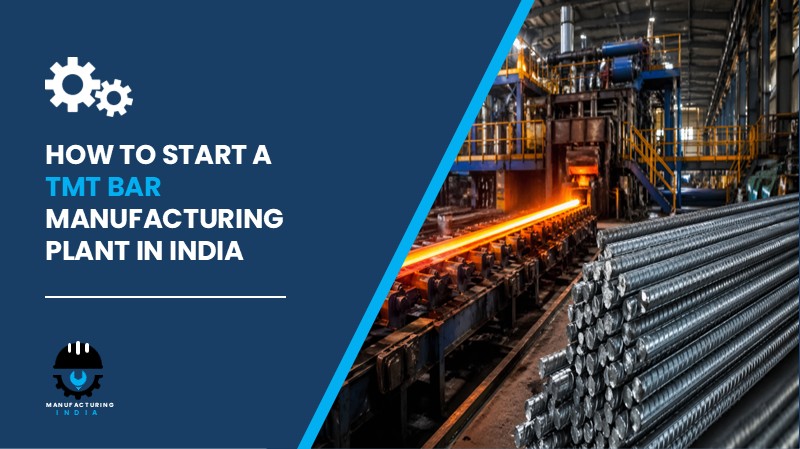
Setting up a TMT bar manufacturing plant in India presents a compelling investment case at a time when the country’s construction sector is experiencing one of its most sustained growth phases in history — driven by rapid urbanisation, ambitious government infrastructure programmes, expanding smart city initiatives, and a housing demand pipeline that spans affordable housing under the PM Awas Yojana through to premium real estate and large-scale commercial development. Thermo-Mechanically Treated (TMT) bars — the highest-strength steel reinforcement bars used in modern construction, produced through a combination of rapid quenching of hot-rolled steel followed by controlled cooling — are the foundational structural material for every concrete-framed building, bridge, highway, dam, metro rail system, and industrial structure being built across India today. As India’s construction activity accelerates across residential, commercial, and government infrastructure segments, the domestic requirement for high-quality, BIS-certified TMT bars in grades Fe 415, Fe 500, and Fe 550 is growing at a pace that makes new manufacturing capacity commercially necessary and financially viable across a wide range of production scales.
India’s structural positioning for TMT bar manufacturing is among the strongest globally. The country is one of the world’s largest consumers of steel reinforcement, with a domestic construction market that provides immediate, large-volume, geographically distributed customer demand within reach of plants located in any major state. The Make in India initiative and government investments in housing, roads, bridges, metro rail, and industrial infrastructure are creating sustained public sector procurement volumes that provide a demand floor for producers. Industrial estates in Jharkhand, Chhattisgarh, Odisha, West Bengal, Gujarat, Maharashtra, and other states offer proximity to steel billet suppliers, established logistics infrastructure, and the industrial utilities required for rolling mill operations. The market is further expanding through the preference for specialised products such as corrosion-resistant and high-ductility TMT bars alongside conventional grades, continuously broadening the addressable application and customer base for domestic producers.
Investing in a TMT bar manufacturing plant in India today aligns India’s powerful construction-driven demand cycle — anchored by government infrastructure spending, urbanisation, and housing development — with a global TMT bar market projected to grow from USD 12.25 Billion in 2025 to USD 26.83 Billion by 2034 at an exceptional CAGR of 9.1%. With gross profit margins of 10–15% and net profit margins of 3–7% supported by stable, recurring demand and volume-driven economics, the facility’s large-scale production model — designed for 300,000 to 500,000 tons annually — supports commercially viable and long-term reliable returns.
What are TMT Bars?
TMT bars are a type of high-strength steel bar, and the Thermo-Mechanically Treated (TMT) process is the most important element of their production. The production process involves a combination of rapid quenching of hot-rolled steel followed by controlled cooling, resulting in superior mechanical properties including high tensile strength, ductility, and corrosion resistance. TMT bars are the preferred choice for general construction use and particularly for earthquake-prone areas, where they guarantee the structural stability and safety of reinforced concrete structures.
TMT bars are available in different grades — including Fe 415, Fe 500, and Fe 550 — each calibrated to meet different load-bearing and structural design requirements across building types and engineering applications. The bars possess consistent quality, convenient transport dimensions, ease of installation, and compatibility with different construction methods, making them one of the essential materials for both large infrastructure projects and smaller housing or commercial constructions. The availability of specialised products such as corrosion-resistant and high-ductility TMT bars alongside conventional grades ensures the market continues to expand into demanding structural applications.
The primary production process covers melting of steel, casting of billets, rolling, tempering, cutting, surface treatment, and quality control. End-use industries served include housing construction, industry and commerce infrastructure projects, and government and real estate infrastructure developments. Applications span reinforcement of concrete-made structures including bridges, highways, dams, industrial buildings, and constructed housing across all structural categories.
Cost of Setting Up a TMT Bar Manufacturing Plant in India
The cost of establishing a TMT bar manufacturing plant in India depends on plant capacity, integration level between steel melting and rolling operations, the grade range from Fe 415 through Fe 550 and specialised corrosion-resistant variants, geographic location — particularly proximity to steel billet suppliers and construction market clusters — and the BIS quality certification requirements applicable to TMT reinforcement bars sold for structural applications in India.
1. Capital Expenditure (CapEx)
Land and Site Development forms a foundational component of total capital investment, covering land acquisition charges, site registration, boundary development, heavy-duty industrial drainage infrastructure, and site utilities including high-capacity electrical supply for rolling mill motors and reheating furnaces. TMT bar plants require large land parcels to accommodate billet storage yards, rolling mill buildings, finished bar cooling beds, bundling and dispatch areas, and potential future expansion space. Investors may explore steel industry estates in Jharkhand, Odisha, Chhattisgarh, and West Bengal — states with established steel manufacturing ecosystems and proximity to iron ore and scrap steel supply chains — alongside industrial zones in Gujarat and Maharashtra where large construction market demand is immediately accessible.
Civil Works and Construction cover the main rolling mill building — a large-span steel structure housing reheating furnaces, rolling stands, the quenching and tempering system, and cooling beds — steel billet storage yards with crane infrastructure, a quality control laboratory, finished TMT bar bundling and storage areas, an administrative block, utilities infrastructure including transformer substations, water supply and recycling systems for quenching operations, and effluent treatment infrastructure.
Machinery and Equipment represent the largest single component of total CapEx for a TMT bar manufacturing plant. Key machinery required includes:
- Rolling mills
- Reheating furnaces
- Quenching tanks
- Tempering systems
- Cutting machines
- Inspection equipment
Other Capital Costs include an effluent treatment plant (ETP) for managing mill scale-contaminated cooling water and quenching water recycling, dust collection and air pollution control systems for reheating furnace emissions, pre-operative expenses, BIS licence application and testing costs, commissioning charges, and any import duties on specialised rolling mill stands or automated quenching system components not available from domestic machinery suppliers.
Request a Sample Report for In-Depth Market Insights: https://www.imarcgroup.com/tmt-bar-manufacturing-plant-project-report/requestsample
2. Operational Expenditure (OpEx)
Raw Material Cost is the overwhelmingly dominant operational expense, accounting for approximately 85–90% of total OpEx. The primary raw materials are steel billets, water for quenching, and alloys. Steel billets — the primary steel feedstock that is reheated and rolled into TMT bars — constitute the vast majority of raw material cost and are priced in correlation with global steel markets, scrap metal prices, and domestic iron ore and coking coal economics. Billet procurement strategy — whether purchasing from integrated steel producers, secondary sponge iron-based producers, or operating an in-house steel melting shop — is the single most important commercial and cost decision for a TMT bar investment. Alloys including silicon, manganese, and vanadium are added in controlled quantities to achieve grade-specific mechanical properties. Long-term supply agreements with reliable billet suppliers are strongly advisable to stabilise production economics.
Utility Cost is the second-largest OpEx component, representing 5–8% of total operating expenses — covering electricity for rolling mill motors, reheating furnace fuel (typically gas, coal, or heavy fuel oil depending on location and infrastructure), water for quenching and cooling operations, and general plant utilities. Reheating furnace fuel cost is the primary variable, and fuel selection significantly affects both operating cost and environmental compliance obligations.
Other Operating Costs include transportation and distribution to construction contractors, real estate developers, government infrastructure projects, hardware dealers, and distribution networks, bundling and packaging materials for TMT bar bundles, salaries and wages for rolling mill operators and quality engineers, routine machinery maintenance including rolling stand roll replacement and reheating furnace refractory maintenance, depreciation on capital equipment, and applicable taxes. By the fifth year of operations, total operational costs are projected to increase substantially due to inflation, steel billet price movements, fuel cost changes, supply chain disruptions, and shifts in the global steel and construction economy.
3. Plant Capacity
The proposed manufacturing facility for a TMT bar plant is designed with an annual production capacity ranging between 300,000 and 500,000 tons, enabling economies of scale while maintaining the operational flexibility to serve diverse customer segments across residential construction, commercial infrastructure, and government projects across different bar grades, diameters, and surface profiles. Plant capacity can be customised per investor requirements, with smaller regional plants and larger integrated steel-to-bar complexes both representing viable investment configurations depending on market access, raw material sourcing, and capital availability. Profitability improves with higher capacity utilisation, and the volume-driven economics of rolling mill operations place strong commercial emphasis on securing sustained supply agreements and building robust distribution networks from the outset of commercial production.
4. Profit Margins and Financial Projections
The financial projections for a TMT bar manufacturing plant reflect the volume-intensive, infrastructure-grade nature of this product category. Gross profit margins typically range between 10–15%, and net profit margins are projected at 3–7% — reflecting the high raw material cost concentration of 85–90% of OpEx in steel billets and the competitive, price-sensitive nature of the construction materials market. These margins are commercially viable at the large production volumes — 300,000 to 500,000 tons — that the investment is designed for, where the combination of stable recurring demand, reliable revenue streams from long-term construction project supply, and operational efficiency from rolling mill utilisation provide a financially sound and defensible investment case. A comprehensive financial analysis covering NPV, IRR, payback period, and five-year financial projections is essential before committing capital.
Why Set Up a TMT Bar Plant in India?
Rising Construction Activities and Urbanisation-Driven Demand. Urbanisation, smart city projects, and infrastructure development are primary demand drivers for TMT bars. India’s rapid urban expansion is creating massive residential, commercial, and public infrastructure construction pipelines that require TMT bar as the foundational steel reinforcement material. The market is going through an impressive growth phase driven by urbanisation, industrialisation, and infrastructure investments — a structural demand environment that is both immediate in its current scale and durable in its decade-long growth trajectory.
Government Infrastructure Investment Across Highways, Metro, and Housing. Public sector investment in the development of roads, bridges, and housing projects is directly increasing the need for TMT bar reinforcement across every major government construction programme. India’s capital expenditure on infrastructure — including the Bharatmala highway programme, smart cities, Jal Jeevan Mission, PM Awas Yojana, and metro rail expansion across tier-2 cities — creates guaranteed, large-volume, sustained procurement demand for domestic TMT bar producers with BIS certification and the production scale to supply project-scale quantities reliably.
Global Market Growth at 9.1% CAGR. The global TMT bar market, valued at USD 12.25 Billion in 2025, is expected to reach USD 26.83 Billion by 2034, exhibiting a CAGR of 9.1% — among the highest growth rates of any construction materials product category. Africa’s infrastructure investment alone averaged around USD 83 Billion annually at roughly 3% of GDP during 2016–2020, as reported by OECD, illustrating the global scale of construction-driven TMT bar demand that extends beyond India’s domestic market to export opportunities in developing regions.
High-Strength and Earthquake-Resistant Construction Preference. Growing preference for earthquake-resistant construction materials across India’s seismic zones is systematically driving the specification of higher-grade TMT bars — Fe 500 and Fe 550 — over conventional mild steel reinforcement. Structural engineers and building codes are increasingly mandating high-ductility TMT bars for critical structures, expanding both the volume demand and the average grade mix toward higher-specification and marginally better-priced products.
Active Industry Investment and Product Innovation. In June 2025, SRMB Steel strengthened its market presence with Fe:500 and Fe:550D TMT bars offering corrosion resistance and high ductility, using advanced German Tempcore technology and rigorous quality control while expanding across India and global markets. In April 2025, Blue Gold Steel Industries earned the “Emerging TMT Bar Manufacturer of the Year” award at the Karnataka Business Awards 2025 held in Bengaluru, reflecting the active investment momentum and recognition being accorded to new entrants in India’s TMT bar manufacturing sector.
Scalable Production Opportunities and Long-Term Profitability. Plants can operate at multiple capacities — from regional to large-scale production — allowing investment flexibility suited to different capital availability levels, market access strategies, and operational integration approaches. Stable demand and recurring usage across infrastructure ensures a reliable revenue stream that extends across economic cycles, making TMT bar manufacturing one of India’s most commercially durable construction materials investments.
Manufacturing Process — Step by Step
The TMT bar manufacturing process uses melting of steel, casting of billets, rolling, tempering, cutting, surface treatment, and quality control as the primary production method. Each stage requires controlled temperature profiles, rolling speed, and quenching parameters to achieve the combination of high tensile strength outer layer and ductile inner core that defines the superior mechanical properties of thermo-mechanically treated reinforcement bars.
- Steel Melting: Steel scrap, sponge iron, or pig iron is charged into electric arc furnaces or induction furnaces, melted at temperatures above 1,600°C, and refined to achieve the steel chemistry specification for the target TMT bar grade, with alloy additions of silicon, manganese, and other elements to achieve the required mechanical properties.
- Billet Casting: Refined liquid steel is continuously cast through a continuous casting machine to produce steel billets of specified cross-section — typically 100 x 100 mm to 130 x 130 mm square — with controlled cooling rates during solidification to achieve the required grain structure and billet internal quality.
- Billet Reheating: Steel billets are charged into reheating furnaces and heated to the rolling temperature of approximately 1,050–1,150°C through a controlled heating profile that achieves temperature uniformity across the billet cross-section required for consistent rolling reduction.
- Rolling: Heated billets are progressively reduced in cross-section through a series of rolling mill stands — comprising roughing, intermediate, and finishing stands — to achieve the final bar diameter and the twisted rib surface profile that provides mechanical bonding with concrete in reinforced structures.
- Quenching: Immediately on exiting the finishing rolling stand, the hot-rolled bar passes through quenching tanks — a controlled water jet system — that rapidly quenches the bar’s outer surface, transforming it into a hard martensitic rim while the bar core remains hot and austenitic.
- Tempering: The hot bar core conducts heat back to the quenched rim in the tempering system, tempering the martensitic surface into tempered martensite with the combination of high tensile strength and adequate ductility that defines the TMT bar’s superior performance over conventional reinforcement bars.
- Cutting: The continuously produced bar is cut to standard commercial lengths — typically 6 m, 9 m, or 12 m — by cutting machines calibrated to the rolling line speed.
- Surface Treatment and Cooling: Cut bars pass along cooling beds where controlled ambient air cooling completes the thermal treatment, developing the final mechanical property profile of the ductile ferrite-pearlite core microstructure characteristic of high-quality TMT bars.
- Quality Control and Inspection: Finished bars are inspected by inspection equipment covering dimensional measurement including diameter, rib height and spacing, weight per metre, and visual surface inspection, with mechanical testing of yield strength, tensile strength, elongation, and bend/rebend performance against BIS IS:1786 specification requirements.
- Bundling, Marking, and Dispatch: Specification-compliant bars are bundled, labelled with grade, heat number, and producer identification markings, and dispatched to residential construction contractors, commercial and industrial infrastructure projects, government highway and bridge programmes, and real estate development customers.
Key Applications
TMT bars manufactured in India serve the complete spectrum of reinforced concrete construction across all structural categories:
- Residential Construction: TMT bars provide the primary reinforcement for the safety and durability of homes and apartments across affordable housing, mid-income, and premium residential developments.
- Commercial and Industrial Infrastructure: High-strength reinforcement for factories, office buildings, warehouses, shopping malls, and industrial facilities that require reliable, code-compliant structural steel reinforcement.
- Government Infrastructure Projects: TMT bars constitute the structural reinforcement material for highways, bridges, dams, metro rail systems, ports, and other earthquake-resistant public infrastructure across India’s massive public capital expenditure programme.
- Real Estate Development: Essential component in high-rise constructions and mixed-use developments for safety and structural integrity across India’s rapidly expanding organised real estate sector.
Leading Manufacturers
The global TMT bar industry is served by a group of large integrated steel producers and specialist rolling mill operators with extensive production capacities and diversified market portfolios across residential, commercial, and infrastructure construction segments. Key players in the global market include:
- Nucor Corporation
- EVRAZ North America
- Tata Steel Limited
- JSW Steel Limited
- Balkan Steel Engineering Ltd.
Timeline to Start the Plant
Establishing a TMT bar manufacturing plant in India involves a structured multi-phase development sequence. Investors should plan for the following phases:
- Feasibility study and project report preparation
- Land acquisition and site development
- Regulatory approvals and environmental clearances
- Factory licence and fire safety compliance
- Machinery procurement and installation
- Raw material supplier agreements and supply chain setup
- Trial production and quality testing
- Commercial production launch
Licences and Regulatory Requirements
Starting a TMT bar manufacturing unit in India requires several approvals spanning business registration, BIS product certification, environmental, and industrial safety compliance domains:
- Business registration (Proprietorship, LLP, or Pvt Ltd)
- Factory Licence under the Factories Act
- Environmental Clearance from the State Pollution Control Board
- GST Registration
- Fire Safety NOC
- BIS licence under IS:1786 mandatory for TMT bars sold for structural use in India, administered under the BIS Compulsory Certification scheme for steel reinforcement bars
- Consent to Establish and Consent to Operate from the State Pollution Control Board for a large industrial installation with reheating furnace emissions
- Effluent Treatment Plant (ETP) operational clearance for managing mill scale-contaminated cooling water and quenching water recycling
- Occupational Health and Safety compliance
Key Challenges to Consider
Steel Billet Cost Concentration and Price Volatility. Steel billets account for approximately 85–90% of total OpEx, with pricing tied to global steel markets, domestic scrap and sponge iron pricing, iron ore availability, and coking coal costs. Steel market price cycles — which can move 15–25% or more within a year — create significant margin pressure during downturns, making billet procurement strategy, forward purchasing discipline, and customer contract price adjustment mechanisms essential tools for protecting financial performance across the investment cycle.
Intense Market Competition and Price Sensitivity. The TMT bar market is one of India’s most competitive construction materials segments, with a large number of established producers including major integrated steel companies (Tata Steel, JSW Steel) and hundreds of independent rolling mills competing on price, grade availability, and distribution reach. New entrants must build BIS certification, distribution network depth, and brand recognition to compete effectively — a market development process that requires sustained investment alongside plant commissioning.
BIS Certification and Ongoing Compliance. TMT bars sold for structural use in India must carry BIS certification under IS:1786, which requires initial product qualification, factory assessment, and ongoing surveillance audits. Maintaining BIS certification while producing consistently across grades Fe 415, Fe 500, and Fe 550 demands robust quality management systems, calibrated testing equipment, and well-documented process control records across every production batch.
Environmental Compliance for Reheating Furnace Emissions. Reheating furnace operations generate particulate matter and combustion gas emissions that must comply with state pollution control board air quality standards. Installing and maintaining stack emission monitoring, bag filter or electrostatic precipitator systems, and meeting the Consent to Operate conditions requires ongoing investment in environmental compliance infrastructure and management.
Capital Intensity and Working Capital Requirements. Establishing a 300,000 to 500,000 ton per year rolling mill requires substantial capital investment in land, civil works, machinery, and utilities infrastructure. Additionally, the high raw material cost of steel billets creates significant working capital requirements for maintaining adequate billet inventory, managing the payment cycle with billet suppliers, and financing the receivables from construction project customers — all requiring careful financial planning and banking relationship management.
Skilled Manpower for Rolling Mill Operations. Maintaining consistent rolling reduction, bar dimensions, rib profile, and quenching parameters across high-speed continuous rolling operations requires experienced rolling mill technicians, metallurgical engineers, and quality control personnel — a specialised industrial workforce that requires ongoing investment in recruitment, technical training, and retention.
Frequently Asked Questions
1. How much does it cost to set up a TMT bar manufacturing plant in India?
The total setup cost depends on plant capacity, integration level between melting and rolling, grade range, location, and machinery configuration. CapEx covers land and site development, large-span rolling mill civil construction, core machinery including rolling mills, reheating furnaces, quenching tanks, tempering systems, cutting machines, and inspection equipment, along with BIS certification infrastructure, ETP, air pollution control systems, and other capital costs. A detailed project report with full CapEx and OpEx breakdowns is available on request.
2. Is TMT bar manufacturing profitable in India in 2026?
Yes. The project demonstrates gross profit margins of 10–15% and net profit margins of 3–7% under normal operating conditions — margins that are commercially viable at the large production volumes of 300,000 to 500,000 tons annually supported by stable and growing demand from India’s accelerating residential, commercial, and government infrastructure construction programmes, and a global TMT bar market growing at an exceptional 9.1% CAGR.
3. What machinery is required for a TMT bar plant in India?
Key machinery includes rolling mills, reheating furnaces, quenching tanks, tempering systems, cutting machines, and inspection equipment. Rolling mills — comprising roughing, intermediate, and finishing stands — and the quenching and tempering system are the most technically critical capital items, as they determine production capacity, bar grade capability, and the mechanical properties that define TMT bar quality.
4. What licences and approvals are required to start a TMT bar plant in India? Required approvals include business registration, a Factory Licence under the Factories Act, Environmental Clearance and Consent to Operate from the State Pollution Control Board, GST registration, a Fire Safety NOC, BIS licence under IS:1786 for structural TMT bars, ETP operational clearance, and Occupational Health and Safety compliance.
5. What raw materials are needed for TMT bar manufacturing?
The primary raw materials are steel billets, water for quenching, and alloys including silicon, manganese, and vanadium. Steel billets account for approximately 85–90% of total operating expenses, making billet procurement strategy, supplier relationships, and steel price risk management the most critical cost management levers for the investment.
6. What are the environmental compliance requirements for a TMT bar plant in India?
The unit must obtain Environmental Clearance from the State Pollution Control Board, hold a Consent to Operate with emission standards compliance for reheating furnace stack emissions, operate a certified ETP for mill scale-contaminated cooling and quenching water management, install air pollution control equipment including bag filters or electrostatic precipitators, and maintain stack emission monitoring in line with applicable state pollution control standards.
7. What is the best location to set up a TMT bar plant in India?
Optimal locations offer proximity to steel billet suppliers or integrated steel producers, competitive industrial electricity tariffs for rolling mill motors, reliable water supply for quenching operations, logistics connectivity to large construction market demand zones, and regulatory environments experienced with large-scale steel processing facilities. Steel industry estates in Jharkhand, Odisha, Chhattisgarh, and West Bengal, and industrial zones in Gujarat and Maharashtra, are among the most strategically relevant options.
8. What is the break-even period for this type of plant in India?
The break-even period depends on plant capacity, capacity utilisation rate, steel billet pricing trends, and demand conditions across residential, commercial, and government construction segments. A detailed financial analysis including payback period, NPV, and IRR projections is included in the full project report, available via the sample request link.
9. What government incentives are available for manufacturers in India?
The Make in India initiative, state-level industrial promotion policies in steel-producing states, capital subsidy schemes for manufacturing in designated industrial areas, and preferential procurement policies for domestically manufactured TMT bars in government projects provide financial and regulatory support for TMT bar manufacturing investments. State investment promotion boards in Jharkhand, Odisha, and Chhattisgarh may offer additional incentives including power tariff concessions and land cost benefits for large-scale steel processing facilities.
Key Takeaways for Investors
A TMT bar manufacturing plant in India represents one of the most volume-scalable and demand-stable manufacturing investments in the country’s construction materials sector — anchored by the structural, government-supported demand generated by India’s housing programmes, highway expansion, metro rail projects, bridge construction, and the broader urbanisation wave that is fundamentally reshaping the country’s built environment. The project demonstrates commercial viability across annual production capacities of 300,000 to 500,000 tons, with gross profit margins of 10–15% and net profit margins of 3–7% confirming financially sound unit economics at volume scale that reflect the high raw material cost concentration and competitive but stable market dynamics of structural steel reinforcement. The global TMT bar market, valued at USD 12.25 Billion in 2025, is projected to reach USD 26.83 Billion by 2034, growing at a CAGR of 9.1% — one of the highest growth rates across all construction material product categories — with India’s domestic market representing a disproportionate share of this global growth given the country’s construction investment trajectory. With domestic producers like SRMB Steel expanding across India and global markets with advanced Tempcore technology, and new entrants like Blue Gold Steel Industries earning national recognition for innovation and quality in 2025, the competitive and commercial landscape for India-based TMT bar manufacturing is active, growth-oriented, and structured to reward producers who combine large-scale production efficiency with BIS-certified quality, reliable distribution, and strong customer relationships across India’s construction sector.
About the Author