Efficient inventory management is the backbone of successful manufacturing operations. Without a structured approach, businesses often face challenges such as overstocking, stockouts, increased holding costs, and disrupted production schedules. Implementing inventory optimization in manufacturing helps companies strike the right balance between demand and supply while improving overall operational efficiency.
Understanding Inventory Optimization in Manufacturing
Inventory optimization is the process of maintaining the ideal stock levels to meet production and customer demand without excess or shortage. In manufacturing units, this involves aligning inventory planning, procurement, and production schedules with real-time demand insights.
A well-executed inventory management for manufacturing units ensures that raw materials, work-in-progress, and finished goods are always available when needed without tying up unnecessary capital.
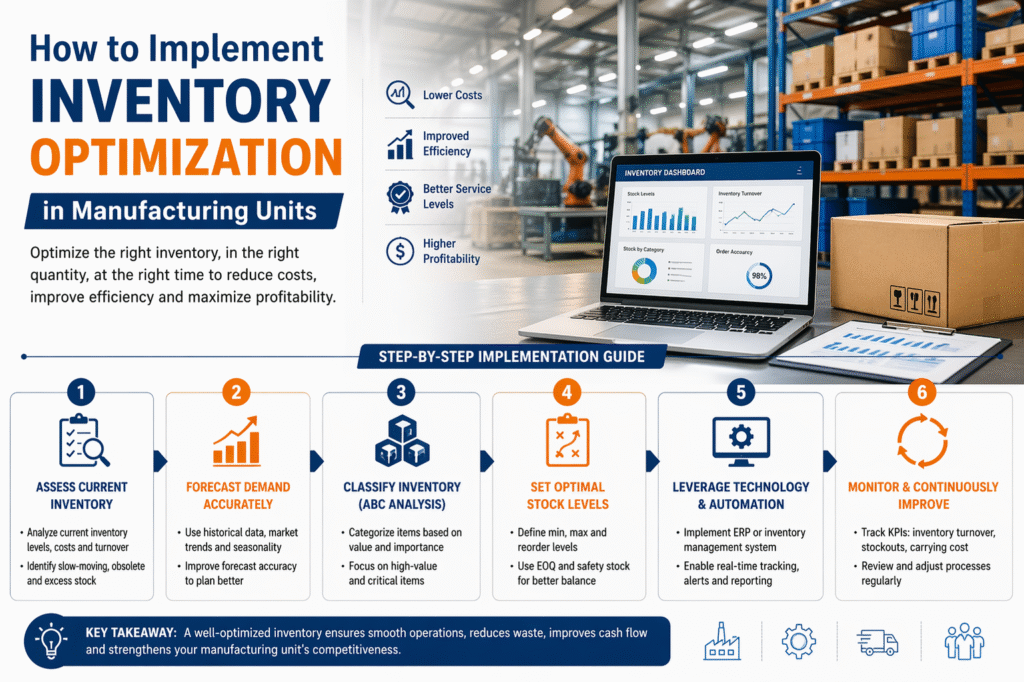
Step 1: Analyse Current Inventory Performance
The first step toward manufacturing inventory control is to assess your existing inventory system. Identify:
- Slow-moving and obsolete stock
- Frequent stockouts
- Excess inventory carrying costs
Tracking key metrics such as inventory turnover ratio and order fulfillment rates helps in understanding inefficiencies. This analysis lays the foundation for building effective stock optimization strategies.
Step 2: Implement Demand Forecasting
Accurate demand forecasting in manufacturing is critical for optimizing inventory levels. By analyzing historical sales data, seasonal trends, and market demand, manufacturers can predict future requirements more precisely.
Advanced tools and software can enhance forecasting accuracy, enabling better production inventory planning and reducing uncertainty in supply chain operations.
Unlock Smarter Inventory Management: https://www.imarcengineering.com/services/inventory-optimization-and-stock-planning
Step 3: Optimize Safety Stock Levels
Maintaining the right level of safety stock is essential to avoid disruptions. Too much safety stock increases holding costs, while too little can lead to production delays.
Using techniques like statistical analysis and variability tracking helps in safety stock optimization. This ensures business continuity without unnecessary capital investment.
Step 4: Adopt Lean Inventory Management
Lean inventory management focuses on minimizing waste while ensuring smooth production flow. Techniques such as just-in-time inventory manufacturing allow businesses to receive materials only when they are needed in the production process.
This approach reduces storage costs and improves efficiency, making it a key component of modern inventory optimization strategies for industrial businesses.
Step 5: Use Inventory Optimization Models
Applying proven models like economic order quantity (EOQ) and material requirement planning (MRP) can significantly improve inventory decisions.
- EOQ helps determine the optimal order quantity to minimize ordering and holding costs
- MRP aligns material procurement with production schedules
These models enhance inventory control methods for manufacturing companies, ensuring better resource utilization.
Step 6: Leverage Technology and Automation
Modern manufacturing units increasingly rely on digital tools such as:
- Warehouse management systems (WMS)
- Inventory tracking systems
- ERP software
These technologies provide real-time visibility into stock levels, automate reordering, and improve warehouse inventory optimization. Automation reduces human errors and enhances decision-making capabilities.
Step 7: Align Inventory with Supply Chain Operations
Effective supply chain inventory management ensures seamless coordination between suppliers, warehouses, and production units. Strong supplier relationships and reliable logistics networks help maintain consistent material flow.
Integrating inventory planning with supply chain strategies improves responsiveness and supports inventory optimization in manufacturing at every stage.
Step 8: Reduce Inventory Costs Strategically
One of the primary goals of inventory optimization is cost reduction. Businesses can achieve this by:
- Eliminating obsolete stock
- Consolidating suppliers
- Optimizing order quantities
These steps help reduce inventory costs in manufacturing units while maintaining operational efficiency.
Step 9: Improve Inventory Turnover
A high inventory turnover ratio indicates efficient inventory utilization. Manufacturers can improve this by:
- Enhancing demand forecasting accuracy
- Reducing excess stock
- Streamlining production cycles
Focusing on improving inventory turnover in manufacturing ensures better cash flow and reduced holding costs.
Step 10: Monitor and Continuously Improve
Inventory optimization is not a one-time process. Continuous monitoring of performance metrics, regular audits, and process improvements are essential.
Tracking KPIs such as:
- Inventory turnover
- Order accuracy
- Stockout frequency
helps in refining inventory optimization techniques for factories over time.
Conclusion
Implementing inventory optimization in manufacturing units requires a strategic combination of data analysis, forecasting, technology adoption, and process improvement. By focusing on efficient stock planning and control, manufacturers can enhance productivity, reduce costs, and improve customer satisfaction.
In an increasingly competitive industrial landscape, businesses that invest in advanced inventory planning in manufacturing gain a significant edge. With the right approach, inventory can transform from a cost center into a strategic asset that drives sustainable growth.
View Related Insights:
- Recruitment Services:https://www.imarcengineering.com/services/recruitment
- Post Commissioning Performance Validation Service: https://www.imarcengineering.com/services/post-commissioning-performance-validation
Contact Us:
IMARC Engineering
Phone: +91-120-433-0800
Email: sales@imarcengineering.com
India: C-130, Sector 2, Noida, Uttar Pradesh 201301
LinkedIn: https://www.linkedin.com/showcase/imarc-engineering/
About the Author