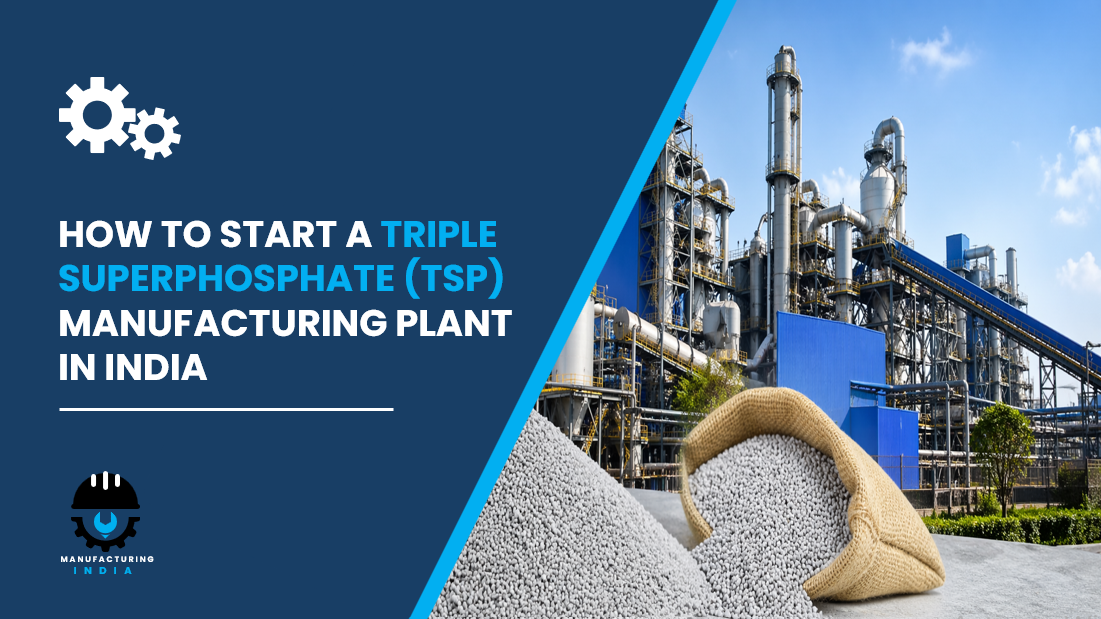
Triple Superphosphate (TSP) Manufacturing Plant
Setting up a triple superphosphate manufacturing plant in India presents a compelling investment case anchored in the country’s position as one of the world’s largest agricultural economies, persistent and documented soil phosphorus deficiency across millions of hectares of farmland, a large and growing fertilizer consumption base, and strong government policy support for domestic fertilizer manufacturing and balanced nutrient management in commercial agriculture. Triple superphosphate (TSP) — a high-analysis phosphate fertilizer containing 44 to 46% phosphorus as water-soluble monocalcium phosphate — delivers significantly higher nutrient density than conventional phosphate fertilizers, reducing transportation and storage costs per unit of nutrient delivered while improving application efficiency for farmers. As India’s food demand continues to grow and soil nutrient depletion intensifies, the demand for high-quality phosphate fertilizers such as TSP is structurally supported by both agronomic necessity and government-driven nutrient management programmes.
India’s strategic advantages for this investment are robust. The country’s Soil Health Card programme under the Ministry of Agriculture and Farmers Welfare reported persistent nutrient depletion from 2023 to 2025, with 64% of soils low in nitrogen and 48.5% low in organic carbon — conditions that directly support the rising demand for TSP to restore soil fertility and sustain agricultural productivity. Rajasthan holds India’s primary phosphate rock deposits, providing a domestic raw material sourcing option that reduces import dependency relative to globally competing TSP producers. Key manufacturing states including Gujarat, Rajasthan, Andhra Pradesh, and Tamil Nadu offer established chemical industry infrastructure, port access for phosphoric acid and sulfuric acid procurement, and proximity to agricultural distribution networks. The Make in India initiative and government fertilizer sector investment incentives provide additional policy momentum.
A triple superphosphate manufacturing plant in India combines structural agricultural demand driven by documented soil phosphorus deficiency, strong government support for domestic fertilizer production, and a scalable industrial process with gross margins of 20–30% and net margins of 8–15%. With the global TSP market projected to reach USD 18.50 billion by 2034 at a CAGR of 4.9%, this investment delivers stable financial returns and essential positioning within India’s agricultural supply chain.
What is Triple Superphosphate (TSP)?
Triple superphosphate (TSP) is a high-phosphorus agricultural fertilizer used to enhance plant growth and root development. The manufacturing process involves treating phosphate rock with phosphoric acid to generate a product that contains 44 to 46% phosphorus in the form of water-soluble monocalcium phosphate. TSP provides a highly efficient source of phosphorus, making it suitable for soils with low phosphorus availability and crops with high nutrient demand.
The fertilizer exists in two physical forms — granular and powdered — enabling easy handling, storage, and application across diverse farm-scale operations. TSP’s high nutrient density decreases transportation and storage expenses compared to standard phosphate fertilizers, making it particularly cost-effective for large-scale commercial farming and blended fertilizer manufacturing. Triple superphosphate functions effectively across multiple crop types including cereals, oilseeds, fruits and vegetables, and plantation crops, enhancing crop yield, early root establishment, and overall plant growth. The primary production method spans phosphate rock grinding, phosphoric acid reaction, curing and solidification, granulation, drying and cooling, screening, and packaging. The product serves end-use industries including the agriculture sector, commercial farming operations, horticulture and plantation crops, and the fertilizer blending industry.
Cost of Setting Up a Triple Superphosphate Manufacturing Plant in India
The total cost of establishing a triple superphosphate manufacturing plant in India depends on production capacity, granulation technology, plant location, degree of automation, and regulatory compliance requirements.
1. Capital Expenditure (CapEx)
The capital investment required to set up this facility covers several major cost heads. Land and site development — including land registration, boundary development, acid-resistant site infrastructure, storage facilities for raw materials, and related site works — forms a substantial portion of total CapEx. Investors should consider locating the unit within chemical or fertilizer industrial estates in Gujarat (Dahej, Kandla), Rajasthan (for proximity to domestic phosphate rock sources), or Andhra Pradesh and Tamil Nadu (for port access to imported phosphoric acid and sulfuric acid). Proximity to agricultural distribution hubs and fertilizer dealer networks also reduces last-mile logistics costs.
Civil works and construction costs cover the phosphate rock receiving and storage yard, grinding hall, reaction and curing building, granulation and drying area, cooling and screening zone, quality control laboratory, finished goods warehouse, dust control and emission treatment systems, effluent treatment area, and administrative block. All process areas handling phosphoric acid and sulfuric acid must be constructed with acid-resistant materials and drainage infrastructure throughout the facility.
Machinery and equipment represent the largest component of total capital expenditure for this triple superphosphate manufacturing plant. Key machinery required includes:
- Rock grinders
- Reactors
- Granulators
- Dryers
- Coolers
- Screening units
- Dust control systems
- Packaging machinery
- Quality inspection systems
Other capital costs include effluent treatment plant (ETP) installation, fluoride emission control systems (fluorine is released during the phosphoric acid reaction with phosphate rock and must be captured and treated), pre-operative and commissioning expenses, and any applicable import duties on specialised granulation and reaction equipment.
Request a Sample Report for In-Depth Market Insights: https://www.imarcgroup.com/triple-superphosphate-manufacturing-plant-project-report/requestsample
2. Operational Expenditure (OpEx)
The operating cost structure of a triple superphosphate manufacturing plant is primarily driven by raw material procurement. Raw material cost — covering phosphate rock as the dominant feedstock input, along with phosphoric acid and sulfuric acid as the primary process reagents — accounts for approximately 60–70% of total OpEx. Phosphate rock pricing is tied to global phosphate commodity markets, while phosphoric acid prices are linked to both phosphate rock and sulfur costs. Investors should establish long-term supply contracts with phosphate rock suppliers — sourcing from Rajasthan domestic deposits where possible and supplementing with imports through Gujarat ports — alongside agreements with phosphoric acid and sulfuric acid producers to stabilise input costs across production planning cycles.
Utility costs, covering electricity, water, and steam required for grinding, reaction, drying, and granulation operations, account for 10–15% of OpEx — reflecting the moderate thermal and mechanical energy demands of the TSP production process. Other operating costs include transportation and logistics for raw material procurement and finished TSP dispatch to farmers, fertilizer dealers, and blending industry buyers, packaging materials for granular and powdered product formats, salaries and wages, maintenance and repairs of process equipment, depreciation of fixed assets, and applicable taxes. By the fifth year of operations, total operational costs are projected to increase substantially due to inflation, phosphate rock price escalation, phosphoric acid market fluctuations, supply chain disruptions, and rising agricultural demand dynamics.
3. Plant Capacity
The proposed manufacturing facility is designed with an annual production capacity ranging between 50,000–200,000 MT, enabling economies of scale while maintaining operational flexibility. Capacity can be customised based on specific investor requirements, target market geography, and available capital. The process supports large-scale continuous manufacturing, providing predictable operating economics, and profitability improves meaningfully with higher capacity utilisation.
4. Profit Margins and Financial Projections
The triple superphosphate manufacturing plant demonstrates healthy profitability potential under normal operating conditions. Gross profit margins typically range between 20–30%, supported by stable multi-sector agricultural demand, the high nutrient density premium of TSP versus conventional phosphate fertilizers, and its value as a blending ingredient in the fertilizer industry. Net profit margins are projected in the range of 8–15%. Key financial indicators including NPV, IRR, payback period, liquidity analysis, and sensitivity analysis are covered comprehensively in the full project report.
Why Set Up a Triple Superphosphate Manufacturing Plant in India?
Documented Soil Phosphorus Deficiency Creating Structural Demand. India’s Soil Health Card programme under the Ministry of Agriculture and Farmers Welfare reported persistent nutrient depletion from 2023 to 2025, with 64% of soils low in nitrogen and 48.5% low in organic carbon. These widespread nutrient deficiencies directly support the rising demand for TSP to restore soil fertility and maintain sustainable agricultural productivity across India’s vast cultivated land area.
Consistent Agricultural Demand Anchored in Phosphorus as an Essential Macronutrient. Phosphorus remains an essential macronutrient with steady global consumption. Food demand keeps growing as the global population expands, farmers increase crop production intensity, and soil nutrient levels decrease — creating a durable, non-discretionary demand base for phosphate fertilizers that is independent of economic cycle fluctuations.
High Nutrient Concentration Delivering Logistics and Application Efficiency. TSP offers a higher phosphorus content — 44 to 46% — compared to conventional phosphate fertilizers, resulting in better application efficiency per unit of product. High-analysis fertilizers reduce transportation and storage costs per unit of nutrient delivered, making TSP increasingly preferred by commercial farmers managing input costs and fertilizer dealers seeking to optimise their handling and storage operations.
Growing Adoption by Fertilizer Blending Industry. TSP integrates easily into blended fertilizer formulations for diverse crop needs. The fertilizer blending industry uses TSP as the primary phosphorus ingredient for creating tailored NPK blends — creating a stable, high-volume institutional buyer base for TSP producers beyond direct-to-farmer sales channels.
Active Major Global Market Commitments Confirming Demand Strength. In July 2025, six Indian importers signed a fresh agreement with Moroccan producer OCP for the supply of DAP and triple superphosphate through the end of 2026, increasing total commitments to 1.5 million tons of DAP and 1 million tons of TSP. This demonstrates the scale of India’s TSP import requirement — a market that domestically located producers can directly substitute with cost and supply reliability advantages. In July 2025, OCP Nutricrops surpassed 5 million tons of triple superphosphate capacity through its TSP Hub programme, reflecting major global investment confidence in TSP’s sustained demand trajectory.
Developing Economies and Government Agricultural Initiatives Supporting Adoption. Developing economies are experiencing higher fertilizer usage as government agricultural initiatives support increased farm productivity and food security. India’s direct subsidy and soil health programmes are encouraging farmers to adopt balanced nutrient management practices that include phosphate fertilizer application as a core component of crop nutrition programmes.
Manufacturing Process — Step by Step
The triple superphosphate manufacturing process uses phosphate rock grinding, phosphoric acid reaction, curing and solidification, granulation, drying and cooling, screening, and packaging as the primary production method. The process involves multiple unit operations, material handling stages, and quality verification checkpoints throughout.
- Phosphate Rock Receipt and Storage: Phosphate rock is received from domestic (Rajasthan) or imported sources, inspected for BPL (bone phosphate of lime) grade, and stockpiled in covered storage areas before entering the grinding stage.
- Phosphate Rock Grinding: Rock grinders reduce phosphate rock to a fine powder with the particle size required for complete reaction with phosphoric acid. Grinding fineness directly affects reaction completeness and product phosphorus availability.
- Phosphoric Acid Reaction: Ground phosphate rock is mixed with phosphoric acid in reactors under controlled conditions to produce a wet slurry of monocalcium phosphate — the primary active ingredient in TSP. The reaction is exothermic and releases fluorine gas, which must be captured by scrubbing systems for environmental compliance.
- Curing and Solidification: The wet TSP slurry is transferred to curing areas where it solidifies and dries over a controlled period, completing the chemical reaction and developing the product’s physical structure.
- Granulation: Cured TSP material is processed through granulators to produce uniform, free-flowing granules of the required size range for agricultural application. Granulation parameters are controlled to achieve consistent granule size distribution, hardness, and dust content.
- Drying: Granulated TSP is dried in dryers to reduce moisture content to the specified product standard, improving storage stability and flowability.
- Cooling: Dried granules are cooled through coolers to reduce product temperature before screening and packaging, preventing caking and degradation during storage.
- Screening: Cooled granules are passed through screening units to separate on-size product from oversized and undersized fractions. Oversized and undersized material is recycled back into the granulation circuit to maintain product uniformity.
- Quality Control and Testing: Finished TSP is tested for total phosphorus content, water-soluble phosphorus, moisture, granule size distribution, and physical quality against applicable fertilizer control order specifications and export quality standards.
- Packaging and Dispatch: Approved TSP — in granular or powdered form — is packaged in bags or bulk containers and dispatched to agricultural input dealers, cooperative societies, direct farm buyers, fertilizer blending facilities, and export markets.
Key Applications
The triple superphosphate manufacturing plant serves multiple agricultural and industrial end-use segments with consistent, large-volume demand:
- Field Crop Agriculture: Enhances root growth in crops while making phosphorus accessible to cereals, pulses, and oilseeds, resulting in better crop establishment and higher harvests across India’s primary grain-producing belts.
- Horticulture and Plantation Crops: Used extensively in fruit, vegetable, sugarcane, and plantation crop cultivation to improve flowering and fruiting, nutrient absorption, and overall plant productivity.
- Fertilizer Blending Industry: Serves as the primary phosphorus ingredient for creating tailored NPK and phosphate fertilizer blends used across commercial farming operations, compound fertilizer manufacturers, and specialty crop nutrition programmes.
- Soil Nutrient Management Programmes: Addresses phosphorus-deficient soil conditions while enhancing soil fertility for extended periods, supporting government-mandated and farmer-driven soil health restoration initiatives.
Leading Manufacturers
The global triple superphosphate industry is served by several major multinational companies with extensive production capacities and diverse application portfolios. Key players include:
- OCP Group
- The Mosaic Company
- Yara International
- PhosAgro
- EuroChem Group
Timeline to Start the Plant
- Feasibility study and project report preparation
- Land acquisition and site development
- Regulatory approvals and environmental clearances
- Factory licence and fire safety compliance
- Machinery procurement and installation
- Raw material supplier agreements and supply chain setup
- Trial production and quality testing
- Commercial production launch
Licences and Regulatory Requirements
Starting a triple superphosphate manufacturing unit in India requires several approvals:
- Business registration (Proprietorship, LLP, or Pvt Ltd)
- Factory Licence under the Factories Act
- Environmental Clearance from State Pollution Control Board
- GST Registration
- Fire Safety NOC
- Fertilizer registration under the Fertiliser (Control) Order — mandatory for manufacture and sale of fertilizers in India
- Hazardous chemical compliance for phosphoric acid and sulfuric acid storage and handling under applicable rules
- Fluoride emission control compliance — mandatory for phosphoric acid reaction operations that release fluorine gas
- Effluent Treatment Plant (ETP) operational clearance for acid and process wastewater management
- Occupational Health and Safety compliance
Key Challenges to Consider
Raw Material Price Volatility. Phosphate rock and phosphoric acid — together accounting for 60–70% of total OpEx — are global commodity-priced inputs subject to significant market cycles. India’s July 2025 agreements with OCP for 1 million tons of TSP imports illustrate the scale of India’s dependence on imported phosphate supply chains. Domestic Rajasthan phosphate rock sourcing, where available at adequate grade, can partially offset import exposure, but long-term supply contracts with multiple sourcing channels are essential cost risk management tools.
High Capital Requirements. Acid-resistant reactors, industrial granulators, rotary dryers, coolers, dust control systems, fluoride scrubbing equipment, and ETP infrastructure constitute a significant CapEx commitment requiring careful financial structuring and access to institutional or government-backed fertilizer sector investment support.
Regulatory Compliance. Meeting the Fertiliser (Control) Order registration requirements, phosphoric acid and sulfuric acid hazardous chemical handling norms, fluoride emission control standards for stack gas from the reaction stage, and State Pollution Control Board effluent quality requirements involves multi-layered compliance obligations that require dedicated management and documentation investment.
Technology and Innovation Pressure. Commercial farmers are increasingly adopting precision nutrient management and blended fertilizer programmes, requiring TSP producers to offer consistent product quality across both granular and powdered forms and to maintain supply reliability for blending industry customers with tight production scheduling requirements.
Competition. Global players such as OCP Group, The Mosaic Company, Yara International, PhosAgro, and EuroChem Group maintain dominant market positions with large-scale production capacity and established Indian import distribution networks — as demonstrated by the July 2025 OCP India supply agreements. Domestic producers must compete on supply reliability, logistics cost advantage, and consistent product specification to displace imports and build stable institutional buyer relationships.
Skilled Manpower. Operating phosphoric acid reaction systems, granulation lines, fluoride scrubbing infrastructure, and analytical quality control laboratories to fertilizer control order specifications requires chemical engineers and process operators with specialised experience — a workforce category that presents sourcing challenges outside established chemical manufacturing clusters.
Frequently Asked Questions
1. How much does it cost to set up a triple superphosphate manufacturing plant in India? Total investment depends on production capacity (50,000–200,000 MT annually), granulation technology, location, and degree of automation. Key cost components include land and acid-resistant site infrastructure, civil construction, machinery (rock grinders, reactors, granulators, dryers, coolers, screening units, dust control systems, packaging machinery), fluoride emission control systems, ETP, and working capital for phosphate rock and acid procurement. A detailed project report provides capacity-specific CapEx and OpEx estimates.
2. Is triple superphosphate manufacturing profitable in India in 2026? Yes. The facility demonstrates gross profit margins of 20–30% and net profit margins of 8–15% under normal operating conditions. Profitability is supported by structural soil phosphorus deficiency driving farmer demand, the high nutrient density premium of TSP versus conventional phosphate fertilizers, and the scale economics achievable across the 50,000–200,000 MT annual capacity range.
3. What machinery is required for a triple superphosphate manufacturing plant in India? Key equipment includes rock grinders, reactors, granulators, dryers, coolers, screening units, dust control systems, packaging machinery, and quality inspection systems.
4. What licences and approvals are required to start a triple superphosphate manufacturing plant in India? Required approvals include business registration, Factory Licence under the Factories Act, Environmental Clearance from the State Pollution Control Board, GST registration, fertilizer registration under the Fertiliser (Control) Order, hazardous chemical compliance for acid handling, fluoride emission control compliance, ETP operational clearance, Fire Safety NOC, and Occupational Health and Safety certification.
5. What raw materials are needed for triple superphosphate manufacturing? Key raw materials are phosphate rock as the primary feedstock, phosphoric acid as the primary process reagent used to treat the phosphate rock and generate monocalcium phosphate, and sulfuric acid used in certain process configurations.
6. What are the environmental compliance requirements for a triple superphosphate manufacturing plant in India? Operators must obtain Environmental Clearance, install and operate fluoride scrubbing systems to capture fluorine gas released during the phosphoric acid reaction stage, maintain an operational ETP for acid and process wastewater management, and comply with State Pollution Control Board guidelines on stack gas emissions, effluent quality, and hazardous chemical storage under applicable rules.
7. What is the best location to set up a triple superphosphate manufacturing plant in India? Ideal locations offer access to phosphate rock supply — either from Rajasthan deposits or through port-adjacent import logistics — reliable phosphoric acid and sulfuric acid supply chains, proximity to agricultural distribution networks, and established chemical industry infrastructure. Gujarat (Dahej, Kandla), Rajasthan, Andhra Pradesh, and Tamil Nadu are well-positioned options combining raw material access, chemical industry ecosystem support, and agricultural market proximity.
8. What is the break-even period for this type of plant in India? Break-even depends on production scale, phosphate rock and phosphoric acid procurement costs, capacity utilisation, and prevailing domestic TSP market pricing. The combination of gross margins of 20–30% and the scale economics of the 50,000–200,000 MT capacity range supports a commercially viable payback timeline. A detailed feasibility study provides project-specific break-even, NPV, and IRR projections.
9. What government incentives are available for manufacturers in India? TSP manufacturers in India can benefit from fertilizer sector investment subsidies under national and state-level agricultural input industry promotion schemes, capital subsidies for fertilizer plant establishment under state industrial promotion policies in Gujarat and Rajasthan, tax exemptions, concessional utility tariffs in chemical industrial estates, and export-linked benefits for TSP supplied to international buyers. The national Soil Health Card programme and nutrient-based subsidy framework may provide additional demand-side support for domestically manufactured phosphate fertilizers.
Key Takeaways for Investors
The triple superphosphate manufacturing plant opportunity in India is underpinned by structural, agronomically-driven demand from a vast agricultural sector with documented soil phosphorus deficiency — with 64% of Indian soils low in nitrogen and 48.5% low in organic carbon as reported by the Soil Health Card programme — alongside strong institutional demand from the fertilizer blending industry, horticulture sector, and plantation crop agriculture. The financial profile is commercially sound across the 50,000–200,000 MT capacity range, with gross margins of 20–30% and net margins of 8–15%, supported by the high nutrient density premium of TSP and its essential role in both direct application and blended fertilizer formulations. The global triple superphosphate market, valued at USD 11.84 billion in 2025, is projected to reach USD 18.50 billion by 2034 at a CAGR of 4.9%, confirming a durable and growing demand runway. As India’s July 2025 agreements for 1 million tons of TSP imports from OCP illustrate, the domestic TSP demand base is substantial and currently import-dependent — creating a directly addressable opportunity for India-based producers to substitute imports with cost-advantaged, domestically manufactured product backed by reliable supply and reduced logistics costs.
About the Author