Setting up an automotive oil filter manufacturing plant in India presents a compelling investment case, driven by the country’s rapidly expanding vehicle parc, growing awareness about engine maintenance, and the rising demand from original equipment manufacturers and aftermarket automotive services alike. These filters are a critical component in every vehicle’s engine lubrication system, making this a non-discretionary, high-volume product category insulated from demand volatility — precisely the kind of investment profile suited to India’s scale-driven manufacturing model.
India’s automotive sector ambitions further strengthen the case. NITI Aayog’s blueprint for India’s automotive sector by 2030 envisions automotive component production growing to USD 145 Billion, with exports tripling from USD 20 Billion to USD 60 Billion. Manufacturing corridors in Maharashtra, Tamil Nadu, Gujarat, and Haryana — home to major OEM clusters — offer an automotive oil filter plant in India immediate proximity to its largest customers, reducing logistics costs and supporting margin performance from day one.
The global automotive oil filter market was valued at USD 28.67 Billion in 2025 and is projected to reach USD 77.61 Billion by 2034, growing at a CAGR of 11.7%. India’s OEM growth trajectory, expanding aftermarket, Make in India policy support, and gross margins of 30–40% make this a financially compelling and strategically timely investment.
What is an Automotive Oil Filter?
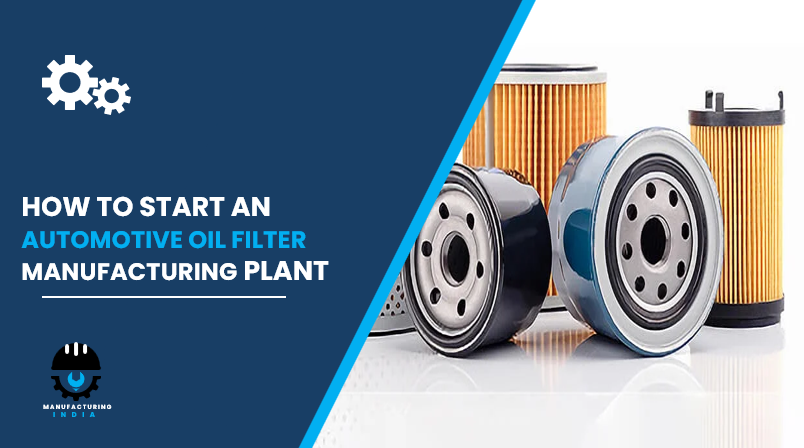
Automotive oil filters play an important role in the engine lubrication system of vehicles. Their purpose is to filter contaminants from the engine oil, preventing unwanted particles from entering the engine and causing wear, malfunction, or breakdown. These filters are made from a blend of pleated paper or synthetic filter media, spring-loaded bypass valves, and casings that enable the filter to be correctly positioned within the lubrication system.
Various types of automotive oil filters include spin-on filters, cartridge-type oil filters, and magnetic oil filters. High-performance variants have accelerated segment growth, responding to demand for enhanced filtration in modern engines. The manufacturing process covers raw material procurement, filter element design and manufacturing, assembly, testing, quality inspection, packaging, and labelling. End-use industries include the automotive sector, aftermarket automotive services, vehicle maintenance shops, and original equipment manufacturers (OEMs). Applications span passenger cars, commercial vehicles, and heavy-duty trucks.
Cost of Setting Up an Automotive Oil Filter Manufacturing Plant in India
The cost of establishing an automotive oil filter manufacturing plant in India depends on plant capacity, technology level, degree of automation, geographic location, and applicable regulatory compliance requirements.
1. Capital Expenditure (CapEx)
Capital investment is structured across four components. Land and site development — covering land registration, boundary development, and site preparation — forms a substantial share of the initial outlay. Investors can reduce this component by selecting industrial estates or Special Economic Zones (SEZs) in established automotive corridors such as Pune, Chennai, or Sanand, where plug-and-play infrastructure is available.
Civil works cover the manufacturing shed, quality-control laboratory, raw material storage, finished goods warehouse, and administrative block. All facility areas must be designed to meet automotive-grade cleanliness and safety standards.
Machinery and equipment costs represent the largest single component of CapEx. Key machinery required includes:
- Raw material handling systems
- Pleating machines
- Filter assembly units
- Quality control and testing systems
- Packaging and labelling machines
- Automated inspection equipment
Other capital costs include effluent treatment plant (ETP) setup, pre-operative and commissioning expenses, and any applicable import duties on specialised machinery not produced domestically.
Request a Sample Report for In-Depth Market Insights: https://www.imarcgroup.com/automotive-oil-filter-manufacturing-plant-project-report/requestsample
2. Operational Expenditure (OpEx)
Raw material costs are the dominant driver of operational expenditure for this facility, accounting for approximately 55–65% of total OpEx. The primary inputs are filter media (cellulose/glass), steel end caps/casing, rubber gaskets, anti-drain back valves, and adhesives. Establishing long-term supply contracts with domestic suppliers for these materials is essential to mitigate price volatility and ensure uninterrupted production.
Utility costs — electricity, water, and steam — account for 10–15% of OpEx, reflecting the relatively moderate energy intensity of the filter assembly process compared with chemical or metallurgical manufacturing. Other operating costs include transportation, packaging, salaries and wages, maintenance, depreciation, and taxes. By the fifth year, total operational expenditure is expected to increase substantially due to inflation, market fluctuations, rising input material costs, supply chain disruptions, and the impact of growing consumer demand on logistics pricing.
3. Plant Capacity
The proposed facility is designed with an annual production capacity of 4–6 million units, enabling economies of scale while maintaining the operational flexibility to serve both OEM supply contracts and the broader aftermarket. Capacity can be customised to match investor requirements and target market size. Profitability improves with higher capacity utilisation, making ramp-up sequencing and order book development a critical early-stage priority.
4. Profit Margins and Financial Projections
The automotive oil filter manufacturing plant demonstrates healthy profitability under normal operating conditions. Gross profit margins typically range between 30–40%, supported by stable demand from OEMs and aftermarket channels. Net profit margins average 10–15% over a five-year projection horizon. Full financial viability is assessed through net present value (NPV), internal rate of return (IRR), payback period, sensitivity analysis, and uncertainty modelling based on realistic capacity utilisation, pricing trends, and demand outlook assumptions.
Why Set Up an Automotive Oil Filter Plant in India?
Rising Vehicle Sales and Maintenance Demand. With the rising number of vehicles in use and increasing demand for oil change services, the requirement for automotive oil filters is growing in both the OEM and aftermarket segments. India’s rapidly expanding vehicle parc — spanning passenger cars, two-wheelers, commercial vehicles, and heavy-duty trucks — creates a structurally growing domestic demand base that a well-positioned manufacturing facility can serve at low distribution cost.
Engine Protection and Fuel Efficiency Imperatives. Car oil filters are necessary for the protection of engines from harmful particles that cause engine wear, thereby achieving improved fuel efficiency. As Indian consumers and fleet operators increasingly prioritise total cost of ownership over upfront price, demand for high-performance oil filters — including synthetic and extended-life variants — is accelerating, offering manufacturers higher-margin product opportunities.
NITI Aayog’s Automotive Vision 2030. NITI Aayog’s blueprint for India’s automotive sector envisions component production growing to USD 145 Billion and exports tripling to USD 60 Billion by 2030. This policy-backed growth trajectory creates large forward demand for automotive oil filters and related components, signalling a favourable regulatory and incentive environment for component manufacturers investing in the market today.
Technological Advancement and Product Innovation. Manufacturers are focusing on innovations such as enhanced filtration efficiency, extended oil change intervals, and improved durability. Technological advancements in filter technologies are increasing the market for premium products, as consumers and fleet operators seek higher-performance filters. Indian manufacturers entering the market now can adopt current-generation filter technology from the outset, competing on quality rather than only price.
Active Industry Investment. In December 2025, Penrite launched a premium oil filter and air filter range at Supercheap Auto stores across Australia and New Zealand, designed to complement engine oils and support long-term engine performance. In March 2025, Purolator unveiled a new 20,000-mile premium oil filter through an exclusive Walmart partnership, targeting long-lasting engine protection. These global launches signal growing consumer willingness to pay for premium filter products — a trend that Indian manufacturers can leverage through branded aftermarket positioning.
E-Commerce and Aftermarket Accessibility. The rise of e-commerce and online automotive parts sales is increasing accessibility to high-quality oil filters for both consumers and businesses. Indian B2C platforms and automotive aftermarket e-tailers are expanding distribution reach significantly, reducing the barrier for new domestic manufacturers to access end consumers directly without large traditional distribution infrastructure.
Manufacturing Process – Step by Step
The automotive oil filter manufacturing plant uses a multi-step production process covering raw material procurement through to packaged product dispatch, with quality assurance integrated at each stage.
- Raw Material Procurement: Filter media (cellulose/glass), steel end caps/casing, rubber gaskets, anti-drain back valves, and adhesives are sourced from approved suppliers and inspected upon receipt.
- Filter Element Design and Manufacturing: Filter media is cut, shaped, and configured according to filter type (spin-on, cartridge, or magnetic). Pleating machines form the characteristic accordion-fold structure that maximises filtration surface area within a compact housing.
- Assembly: Filter elements, bypass valves, end caps, rubber gaskets, and anti-drain back valves are assembled into the steel casing using precision filter assembly units, ensuring correct seating and leak-free construction.
- Testing: Assembled filters are subjected to pressure testing, flow-rate testing, and bypass valve calibration through quality control and testing systems to verify performance under simulated operating conditions.
- Quality Inspection: Automated inspection equipment conducts dimensional checks, surface quality verification, and compliance testing against applicable automotive standards.
- Packaging and Labelling: Approved units are packaged using packaging and labelling machines, with batch coding and traceability documentation for OEM and aftermarket channels.
- Dispatch: Finished goods are dispatched to automotive OEMs, aftermarket automotive services, vehicle maintenance shops, and commercial and heavy truck operators.
Key Applications
Oil filters serve a range of vehicle categories and service channels, each with distinct performance and volume requirements:
- Automotive Sector (OEMs): Incorporated during vehicle manufacture to ensure proper engine performance and long vehicle lifespan.
- Aftermarket Automotive Services: Used during routine oil changes to maintain engine durability and efficiency over a vehicle’s service life.
- Vehicle Maintenance Shops: A vital engine maintenance consumable used in car repair shops to prevent engine wear and contamination.
- Commercial and Heavy Trucks: Heavy-duty oil filters used in commercial trucks operating under high-load conditions where filtration quality directly impacts operational uptime.
Leading Manufacturers
The global automotive oil filter industry is served by several multinational companies with extensive production capacities and diverse application portfolios. Key players include:
- FRAM Group IP LLC
- Sogefi S.p.A
- Hengst SE & Co. KG
- Robert Bosch GmbH
- K & N Engineering, Inc.
These global manufacturers serve the automotive sector, aftermarket services, vehicle maintenance shops, and OEMs — setting the quality and performance benchmarks that new Indian entrants must meet or exceed to win and retain customer contracts.
Timeline to Start the Plant
- Feasibility study and project report preparation
- Land acquisition and site development
- Regulatory approvals and environmental clearances
- Factory licence and fire safety compliance
- Machinery procurement and installation
- Raw material supplier agreements and supply chain setup
- Trial production and quality testing
- Commercial production launch
Licences and Regulatory Requirements
Starting an automotive oil filter manufacturing plant or unit in India requires several approvals:
- Business registration (Proprietorship, LLP, or Pvt Ltd)
- Factory Licence under the Factories Act
- Environmental Clearance from State Pollution Control Board
- GST Registration
- Fire Safety NOC
- Effluent Treatment Plant (ETP) operational clearance
- Occupational Health and Safety compliance
- BIS certification and applicable automotive quality standards compliance (relevant for OEM supply)
Key Challenges to Consider
High Capital Requirements. Significant investment in pleating machines, filter assembly units, automated inspection equipment, and quality testing infrastructure can be a barrier for smaller investors, requiring careful financial structuring and access to term lending or government scheme support.
Raw Material Price Volatility. Key raw material inputs — filter media (cellulose/glass), steel end caps/casing, rubber gaskets, anti-drain back valves, and adhesives — are exposed to commodity price fluctuations and supply chain disruptions, making long-term procurement contracts and supplier diversification essential.
Regulatory Compliance. Meeting automotive-grade quality standards, environmental norms, and OEM supplier qualification requirements demands sustained investment in testing infrastructure, quality systems, and documentation management.
Technology and Innovation Pressure. Technological advancements in filter technology — including enhanced filtration efficiency, extended oil change intervals, and high-temperature performance — require manufacturers to invest in R&D or licensing arrangements to stay competitive as OEM specifications evolve.
Competition from Established Players. The presence of global leaders such as FRAM Group IP LLC, Sogefi S.p.A, Hengst SE & Co. KG, Robert Bosch GmbH, and K & N Engineering means that domestic new entrants must differentiate on quality, delivery reliability, and pricing to win OEM and aftermarket volume.
Skilled Manpower. Operating precision assembly lines, maintaining quality assurance protocols, and managing testing systems requires trained technicians and quality engineers who must be proactively recruited, trained, and retained.
Frequently Asked Questions
1. How much does it cost to set up this type of manufacturing plant in India? The total investment depends on plant capacity, technology, location, and automation level, covering land, civil works, machinery, and other capital costs. A detailed feasibility study is the recommended starting point for site-specific cost estimation.
2. Is oil filter manufacturing profitable in India in 2026? Yes. The investment delivers gross profit margins of 30–40% and net profit margins of 10–15% over a five-year horizon, supported by stable OEM demand and growing aftermarket consumption.
3. What machinery is required for an oil filter plant in India? Key equipment includes raw material handling systems, pleating machines, filter assembly units, quality control and testing systems, packaging and labelling machines, and automated inspection equipment.
4. What licences are required to start an automotive oil filter manufacturing unit in India? Required approvals include business registration, Factory Licence, Environmental Clearance, GST registration, Fire Safety NOC, ETP operational clearance, Occupational Health and Safety compliance, and applicable BIS and automotive quality certifications for OEM supply.
5. What raw materials are needed for automotive oil filter manufacturing? The primary inputs are filter media (cellulose/glass), steel end caps/casing, rubber gaskets, anti-drain back valves, and adhesives. Raw materials account for 55–65% of total OpEx.
6. What are the environmental compliance requirements for an automotive oil filter plant in India? The facility must obtain Environmental Clearance from the State Pollution Control Board, install and operate an ETP, and ensure compliance with waste disposal and effluent treatment standards applicable to light manufacturing operations.
7. What is the best location to set up an automotive oil filter plant in India? Locations within or proximate to established automotive OEM clusters — such as Pune (Maharashtra), Chennai (Tamil Nadu), Sanand (Gujarat), or Manesar (Haryana) — offer the best access to raw material suppliers, OEM customers, skilled labour, and logistics infrastructure.
8. What is the break-even period for this type of plant in India? The break-even timeline is determined through detailed financial analysis covering payback period, NPV, and IRR calculations based on capacity utilisation rates, pricing trends, and demand outlook assumptions specific to the investment scenario.
9. What government incentives are available for automotive component manufacturers in India? Manufacturers can explore incentives under the Make in India initiative, state industrial policies, SEZ benefits, PLI schemes for automotive components, capital subsidy programmes, and export promotion schemes aligned with NITI Aayog’s automotive sector vision.
Key Takeaways for Investors
This automotive oil filter manufacturing plant investment is a high-conviction proposal anchored by structural demand from OEMs, aftermarket automotive services, vehicle maintenance shops, and commercial vehicle operators — all of which are growing in scale and sophistication within the domestic market. The facility offers financial viability across plant capacities, with gross margins of 30–40% and net margins of 10–15%, providing a credible return profile for both first-time manufacturers and experienced auto-component investors. With the global market for oil filters valued at USD 28.67 Billion in 2025 and projected to reach USD 77.61 Billion by 2034 at a CAGR of 11.7%, the demand trajectory is among the strongest in the automotive components segment. NITI Aayog’s vision for India’s automotive component exports to triple by 2030 adds an export dimension that further enhances the long-term revenue and growth sustainability of this investment.
About the Author