Setting up a drill bits set manufacturing plant in India presents a highly compelling investment opportunity, driven by accelerating infrastructure development, expanding construction and real estate activity, rising automotive and metal fabrication output, sustained mining and oil and gas exploration, and the growing penetration of precision drilling tools across DIY, professional, and industrial end-use segments. As one of the most strategically important segments of the global cutting tools and industrial hardware industry, drill bits set manufacturing combines precision metal forming, controlled heat treatment, advanced surface coating, automated grinding, and laser marking operations to serve a broad range of construction, automotive, aerospace, mining, oil and gas, electronics, and consumer end-use markets.
The global drill bits set market is propelled by sustained construction sector growth, accelerating urban infrastructure expansion in emerging economies, rising consumer preference for power tools and DIY applications, and the increasing penetration of advanced cutting tool variants across industrial, automotive, and oilfield applications North America accounts for approximately 35.6% of the overall market share, supported by mature oil and gas drilling activity, strong automotive and aerospace manufacturing, and well-developed home improvement retail networks.
Expanding adoption of carbide-tipped, cobalt steel, and polycrystalline diamond compact (PDC) drill bits, growing demand for value-added coated variants such as titanium nitride (TiN), titanium aluminium nitride (TiAlN), and black oxide finishes, and the increasing use of drill bits sets across automotive; aerospace, electronics, and renewable energy applications continue to elevate demand for high-quality precision drill bits. The shift from conventional plain steel bits toward dimensionally precise, long-life, and application-specific drill bits set formats integrates drill bits manufacturing as a core operation in modern construction, industrial, and consumer hardware supply chains.
Drill bits set manufacturing sits at the intersection of precision metallurgy, automated CNC machining, surface engineering, and downstream construction, automotive, and oilfield value chains, supported by a structurally growing global cutting tools industry. With gross profit margins typically ranging between 30 to 45% and a well-defined break-even trajectory at scale, a dedicated drill bits set manufacturing plant represents both a financially sound and strategically well-timed investment for industrial groups, hardware brands, and institutional investors targeting the evolving global construction, automotive, mining, and consumer hardware markets.
What is Drill Bits Set?
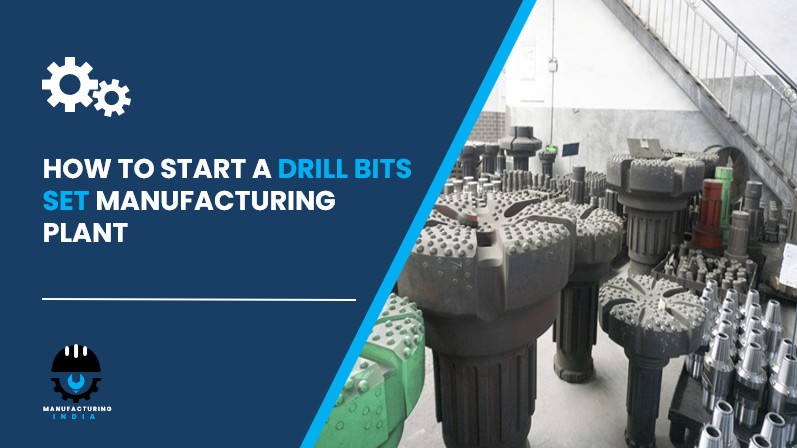
A drill bits set is an organised assortment of drill bits packaged together in a single case or kit, designed to perform a wide range of drilling operations across diverse materials such as wood, metal, masonry, concrete, plastic, glass, ceramic, and composite substrates. Each set typically combines bits of varying diameters, lengths, geometries, and material grades to address common drilling requirements encountered in construction, manufacturing, automotive servicing, woodworking, electrical installation, and household applications. Drill bits are produced primarily from high-speed steel (HSS), cobalt steel, tungsten carbide, and polycrystalline diamond compact (PDC) substrates, supplemented by surface coatings such as titanium nitride (TiN), titanium aluminium nitride (TiAlN), titanium carbon nitride (TiCN), and black oxide finishes that enhance hardness, wear resistance, heat tolerance, and corrosion protection.
Standard drill bits set product types include twist drill bits, masonry bits, brad point wood bits, spade bits, hole saws, step drill bits, countersink bits, forstner bits, auger bits, cobalt drill bits, carbide-tipped bits, PDC bits, and specialty bits targeted at metalworking, woodworking, masonry, glass and tile, and oilfield drilling end-use segments. Sets are typically packaged in plastic, metal, or fabric organiser cases with index markings for size identification and protective storage.
The drill bits set manufacturing sequence broadly involves raw material reception and quality inspection, bar cutting to length, CNC turning and shaping, fluting and pointing on dedicated grinding machines, heat treatment in controlled atmosphere furnaces, surface coating via physical vapour deposition (PVD) or chemical vapour deposition (CVD), laser engraving for size and brand marking, final inspection, set assembly into organiser cases, and retail packaging. End-use segments served include residential and commercial construction, automotive original equipment and aftermarket, aerospace and defence, mining and oil and gas exploration, metalworking and fabrication, electronics and precision engineering, woodworking and furniture, and consumer DIY and home improvement.
Cost of Setting Up a Drill Bits Set Manufacturing Plant
The total cost of establishing a drill bits set manufacturing plant depends on several variables including plant capacity, level of automation, chosen manufacturing technology (CNC turning versus traditional machining, integrated versus stand-alone heat treatment, in-house versus outsourced coating capability), geographic location, raw material sourcing strategy, and applicable regulatory compliance requirements. A thorough feasibility assessment covering all CapEx and OpEx components is essential before committing capital, given the precision-driven and quality-sensitive nature of drill bits set manufacturing.
1. Capital Expenditure (CapEx)
Capital investment for a drill bits set manufacturing plant covers several broad cost heads. Land and site development forms a meaningful part of the overall investment, encompassing land registration charges, boundary development, drainage, site grading, and related civil infrastructure expenses. A typical drill bits set facility requires a land parcel sized to accommodate the production shop floor, raw material storage, heat treatment area, coating section, finished goods warehousing, and on-site utility installations. Investors may consider locating the facility in proximity to steel and tungsten carbide suppliers, automotive and engineering industrial clusters, hardware retail distribution hubs, or port-connected logistics centres for export-oriented strategies.
Civil works and construction costs cover the production shed, raw material storage, CNC machining bay, heat treatment area, coating room, laser engraving and inspection zone, finished goods warehousing, quality control laboratory, effluent treatment plant, and the administrative block. Machinery and equipment costs represent the largest single portion of total capital expenditure, with CNC turning centres, precision grinding machines, heat treatment furnaces, and PVD coating systems together accounting for most of the equipment investment. Key machinery and equipment required includes:
- Raw material handling and storage systems (bar cutting saws, automated bar feeders, magnetic conveyors, raw material racks, and intermediate storage bins for HSS, cobalt steel, and tungsten carbide rods)
- CNC turning centres (multi-axis CNC lathes, Swiss-type sliding head machines, automated bar-fed turning units, and precision tool-room lathes for shaping the drill bit blank to specified shank, body, and flute geometries)
- Flute grinding machines (CNC tool and cutter grinders, helical flute grinders, and dedicated drill flute grinding centres equipped with diamond and CBN wheels for producing precision spiral flutes with consistent helix angle and rake)
- Pointing and tip grinding machines (automatic point grinders, four-facet and split-point grinding machines, and rotary indexing pointers for forming the cutting tip geometry to standards such as 118-degree, 135 degree, and split-point designs)
- Heat treatment furnaces (vacuum hardening furnaces, salt bath furnaces, atmosphere-controlled hardening and tempering furnaces, induction hardening units, and cryogenic treatment chambers for achieving target hardness, toughness, and red-hardness properties)
- Surface coating systems (PVD coating chambers for TiN, TiAlN, TiCN, and AlCrN deposition; CVD reactors for diamond and carbide coating; black oxide and bronze oxide treatment lines; and pre-coating cleaning and degreasing units)
- Tungsten carbide tip brazing stations (induction brazing units, silver solder feeders, flux applicators, and post-braze cleaning systems for masonry and carbide-tipped drill bits)
- Laser marking and engraving systems (fibre laser markers, CO2 laser engravers, and rotary indexing tables for permanent marking of size, brand logo, batch number, and standards compliance information on each drill bit)
- Inspection and quality control equipment (optical profile projectors, coordinate measuring machines, hardness testers, surface roughness testers, runout gauges, microscope-based geometry inspection stations, and metallurgical specimen preparation units)
- Automated assembly and packaging lines (robotic pick-and-place units, automated index case loading machines, blister packaging machines, shrink wrap units, carton sealing machines, and barcode labelling stations for organiser case assembly and retail packaging)
- Cleaning and degreasing systems (ultrasonic cleaning tanks, vapour degreasers, alkaline wash lines, and deionised water rinse stations for pre-coating and pre-packaging surface preparation)
- Utility systems (electrical substations and transformers, compressed air compressors and dryers, vacuum pump systems for PVD chambers, water cooling and chilling units, nitrogen and argon gas distribution networks, and process gas storage and regulation infrastructure)
- Effluent and emission control equipment (wastewater treatment plants, oil-water separators, mist collectors and fume extraction systems for grinding and machining operations, scrubbers for coating and brazing flue gases, and metal sludge collection systems)
- Quality control and testing equipment (Rockwell and Vickers hardness testers, drilling life test rigs, salt spray corrosion test chambers, coating thickness gauges using XRF or calo testers, and laboratory metallographic microscopes for routine product certification)
- Material handling and transport equipment (overhead cranes, forklifts, pallet trucks, tote bins, and on-site logistics infrastructure for movement of bars, work-in-progress, and finished goods)
Other capital costs include utility connections (electricity, water, compressed air, and process gas supply), pre-operative expenses, plant commissioning costs, product qualification and trial production runs, tooling and fixture costs for CNC machines, and applicable import duties on specialised CNC tool and cutter grinders, PVD coating systems, and quality measurement instruments not manufactured domestically.
Request a Sample Report for In-Depth Market Insights: https://www.imarcgroup.com/drill-bits-set-manufacturing-plant-project-report/requestsample
2. Operational Expenditure (OpEx)
The operating cost structure of a drill bits set manufacturing plant is heavily weighted toward raw materials. Raw material costs (encompassing high-speed steel rods, cobalt steel rods, tungsten carbide rods or tips, brazing alloys, coating target materials, packaging components, and minor consumables) account for approximately 60 to 70% of total OpEx, with HSS and cobalt steel rods typically representing the single largest raw material cost component due to their global commodity pricing exposure and the high precision quality grade required for cutting tool applications. Entering long-term supply agreements with reliable HSS bar producers, tungsten carbide suppliers, and coating target material vendors is essential to mitigate input price volatility and maintain production continuity.
Utility costs, particularly electricity for CNC machining, grinding, heat treatment, and PVD coating operations, along with compressed air, cooling water, and process gases, account for 15 to 20% of OpEx. Additional operating costs include packaging materials (plastic and metal organiser cases, blister packs, cartons, foam inserts, and retail labels), transportation and distribution logistics, salaries and wages for CNC operators, grinding technicians, heat treatment specialists, coating engineers, quality control inspectors, and sales personnel, periodic tooling replacement (grinding wheels, CNC inserts, and brazing consumables), maintenance of CNC machines and coating systems, effluent and emission control system servicing, quality testing consumables, and applicable regulatory and product certification costs. Operational expenditure is projected to increase substantially by year five of operations, driven by raw material cost inflation, electricity tariff escalation, and potential increases in labour and logistics costs.
3. Plant Capacity
The proposed drill bits set manufacturing facility is designed with an annual production capacity of 3 million drill bits, enabling meaningful economies of scale while preserving operational flexibility across the full product range, from standard HSS twist bits and brad point wood bits to cobalt steel, carbide-tipped masonry, step drills, hole saws, and PDC and TiAlN-coated premium variants. Plant capacity can be customised based on the investor’s specific capital availability, target market scale, and chosen product mix across end-use segments such as construction and masonry, automotive and metalworking, woodworking, oil and gas and mining, electronics, and consumer DIY. Profitability improves considerably at higher capacity utilisation levels, given the high fixed-cost component of CNC machining and coating operations, making early off-take agreements with hardware retailers, power tool OEMs, automotive after-market chains, and industrial distributors strategically important.
4. Profit Margins and Financial Projections
A drill bits set manufacturing plant demonstrates healthy profitability potential under normal operating conditions. Gross profit margins typically range between 30 to 45%, supported by stable and growing demand across construction, automotive, aerospace, mining, electronics, and consumer hardware markets; the structural shift toward coated and premium drill bits variants; growing infrastructure spending across emerging economies; and differentiation opportunities through carbide-tipped, cobalt, PDC, and specialty geometry product variants. Net profit margins range between 15 to 25%.
Financial projections incorporate NPV analysis, IRR calculations, payback period modelling, and sensitivity analysis across plant capacity utilisation, raw material pricing, electricity costs, and end-market demand scenarios. These projections are developed based on realistic assumptions related to capital investment, operating costs, capacity utilisation, and demand outlook, providing investors with a comprehensive view of long-term financial viability across the typical 8-to-12-year asset depreciation cycle of CNC and coating equipment.
Why Set Up a Drill Bits Set Manufacturing Plant?
- Essential Tool Across Industries: Drill bits are indispensable cutting tools used in nearly every industrial, construction, and household activity, making them a high-volume, recurring-demand product category with sustained replacement and consumption cycles across the global hardware ecosystem.
- Urbanisation and Infrastructure Megatrend: Rapid urban population expansion across India, Southeast Asia, the Middle East, and Africa is driving large-scale residential and commercial construction, public infrastructure projects, and metro and airport development, creating sustained demand for masonry, concrete, and metal drilling tools across emerging economies.
- Coated and Premium Bits Driving Margins: Tightening industrial productivity expectations and rising adoption of TiN, TiAlN, TiCN, and PDC coated drill bits are creating attractive value-added margin opportunities for drill bits manufacturers integrated with in-house coating and heat treatment capabilities.
- Power Tools and DIY Market Expansion: The accelerating global penetration of cordless power drills, impact drivers, and home improvement DIY culture is creating a structurally growing demand stream for retail-packaged drill bits sets, opening a fast-growing diversification channel for hardware brands and private label manufacturers.
- Automotive, Aerospace, and EV Off-Take: Continued growth in global vehicle production, including electric vehicles and aerospace components, supports stable industrial demand for precision drilling tools used in metal fabrication, body-in-white assembly, engine machining, battery housing, and structural component drilling.
- Mining and Oil and Gas Cycle: Sustained global investment in mining, oil and gas exploration, geothermal drilling, and infrastructure tunnelling supports steady demand for industrial-grade rotary drill bits, PDC bits, and tungsten carbide tipped masonry bits across heavy industrial channels.
- Specialised Manufacturing Moat: Drill bits set manufacturing requires precision CNC machining capability, controlled heat treatment expertise, and consistent coating quality, creating moderate but justifiable entry barriers and supporting structurally protected margins for established and well-capitalised producers operating at scale.
- Value-Addition and Premiumisation Opportunities: Drill bits manufacturers can capture meaningful margin uplift through advanced coating, specialty geometries, branded retail kits, and OEM private label arrangements, transforming a commodity cutting tool into engineered industrial and consumer hardware.
- Government Policy and Manufacturing Support: Public sector investment in housing, transport infrastructure, smart cities, defence indigenisation, and manufacturing incentive schemes such as India’s Production Linked Incentive (PLI) initiatives indirectly support sustained drill bits consumption growth.
- Import Substitution and Export Potential: Many emerging markets continue to rely on imported premium and specialty drill bits, creating attractive import substitution opportunities for new domestic capacity, while strategically located plants near port logistics can also serve regional export markets across Asia, Africa, and the Middle East.
- High-Volume Recurring Consumption Economics: Drill bits are consumable cutting tools with a finite operating life that depends on usage intensity, material being drilled, and bit specification. This drives a steady, predictable replacement cycle that supports long-term revenue visibility when paired with a stable distribution and OEM customer portfolio.
Manufacturing Process: How Drill Bits Sets are Manufactured
The drill bits set manufacturing sequence encompasses raw material reception and quality inspection, bar cutting and CNC turning, flute and point grinding, heat treatment, surface coating, laser marking, inspection, set assembly, and final packaging as the core stages of production. Each stage involves specific unit operations, quality assurance checkpoints, and process control protocols aligned to product specifications and applicable cutting tool, safety, and dimensional standards.
- Raw Material Reception and Quality Inspection: High-speed steel rods, cobalt steel rods, tungsten carbide rods, brazing alloys, coating targets, and packaging materials are received from suppliers, sampled, and tested for chemical composition, hardness, dimensional tolerance, and surface quality before being conveyed to dedicated storage racks. Strict raw material quality control is critical because variability in steel grade, decarburisation, or surface defects significantly impacts finished drill bit performance and life.
- Bar Cutting and Blank Preparation: Steel rods are cut to specified blank lengths using automated band saws or precision cold saws, with accurate length control and end facing to prepare the blank for downstream CNC turning. Cut blanks are inspected for length, straightness, and surface integrity before being transferred to the machining section.
- CNC Turning and Body Forming: Blanks are loaded onto CNC turning centres or Swiss-type sliding head machines, where they are precisely turned to form the shank, body taper, and overall geometry of the drill bit. Multi-axis CNC programming ensures dimensional consistency across long production runs and enables efficient changeovers between different drill bit sizes and designs.
- Flute Grinding: Turned blanks are transferred to CNC tool and cutter grinders or dedicated helical flute grinding machines, where diamond or CBN grinding wheels cut precision spiral flutes along the body of the bit. Helix angle, flute depth, web thickness, and rake angle are tightly controlled to deliver target chip evacuation, cutting performance, and bit strength.
- Pointing and Tip Geometry Forming: Fluted blanks are transferred to automatic point grinding machines, where the cutting tip geometry is formed to standard or specialty designs such as 118 degree conventional, 135 degree split point, four-facet, or self-centring tip configurations. Tip grinding accuracy directly governs drilling efficiency, hole quality, and bit life.
- Heat Treatment: Ground drill bits are processed through controlled-atmosphere or vacuum hardening furnaces, where they are heated to austenitising temperature, quenched in oil or gas, and subsequently tempered to achieve target hardness in the range of 62 to 65 HRC for HSS and cobalt grades. Cryogenic treatment may be applied for premium variants to enhance dimensional stability and tool life.
- Tungsten Carbide Tip Brazing (Where Applicable): For masonry and carbide-tipped variants, pre-formed tungsten carbide tips are brazed onto the steel body using induction brazing units with silver solder and flux application. Post-braze cleaning, inspection, and grinding ensure precise tip geometry and brazed joint integrity.
- Surface Coating: Heat-treated drill bits are loaded onto rotating fixtures inside PVD coating chambers, where titanium nitride (TiN), titanium aluminium nitride (TiAlN), titanium carbon nitride (TiCN), or aluminium chromium nitride (AlCrN) coatings are deposited under high vacuum and elevated temperature. Black oxide and bronze oxide treatments are applied to standard variants through alkaline immersion lines for surface stability and aesthetic appeal.
- Laser Marking and Engraving: Coated and finished drill bits pass through fibre laser marking stations, where size, brand logo, manufacturing batch number, and applicable certification marks are permanently engraved onto the shank for traceability, brand identification, and end-user reference.
- Inspection and Quality Testing: Finished bits undergo dimensional verification on optical profile projectors and coordinate measuring machines, hardness testing, runout and concentricity inspection, coating thickness measurement, surface finish evaluation, and sampling-based drilling life testing. Statistical process control charts are maintained for each lot to ensure compliance with applicable BIS, DIN, ANSI, and ISO drill bit standards.
- Set Assembly and Packaging: Inspected drill bits are assembled into pre-formed plastic, metal, or fabric organiser cases according to the target set composition (commonly 5-piece, 13-piece, 21-piece, 29-piece, and 99-piece configurations). Cases are sealed, blister wrapped or carton packed, barcode labelled, and palletised for dispatch to retail distributors, hardware chains, e-commerce fulfilment centres, OEM customers, and industrial supply networks.
- Final Quality Audit: Production samples from each lot undergo final dimensional verification, drilling performance testing, salt spray corrosion testing for coated variants, and packaging integrity assessment. Each production batch is released only upon passing all specified quality parameters and certification requirements.
Key Applications
Drill bits sets manufactured at a dedicated processing facility serve a broad range of end-use channels, each with specific product quality, geometry, and performance requirements.
- Construction and Masonry: Drill bits sets are widely used in residential, commercial, and infrastructure construction for drilling concrete, brick, stone, and masonry substrates during structural assembly, anchor installation, MEP fittings, formwork, and finishing operations, supplied through hardware retailers, professional contractors, and large construction supply chains.
- Metalworking and Fabrication: HSS, cobalt steel, and TiN-coated drill bits are extensively used in metal fabrication, sheet metal work, and structural steel processing for drilling precise holes in steel, aluminium, stainless steel, copper, and other metals across industrial components, machinery, and equipment manufacturing.
- Automotive and Machinery: Automotive original equipment and aftermarket channels use drill bits for engine parts, transmission housings, body-in-white assembly, frame fabrication, panel work, and mechanical assembly operations requiring accurate, repeatable, high-quality hole-making across ferrous and non-ferrous components.
- Aerospace and Defence: Aerospace and defence manufacturers use cobalt steel, carbide, and PCD drill bits for drilling titanium, stainless steel, aluminium alloys, and composite substrates used in airframe, engine, fuselage, and structural component manufacturing, where dimensional precision and hole integrity are mission-critical.
- Oil and Gas and Mining: Industrial-grade rotary drill bits, PDC bits, and tungsten carbide tipped bits are used in oilfield exploration and production, geothermal drilling, mining operations, and tunnelling projects, where high wear resistance, durability under extreme down-hole conditions, and cost per drilled metre are key performance criteria.
- Woodworking and Furniture: Brad point bits, spade bits, forstner bits, auger bits, and hole saws are used by furniture manufacturers, cabinetmakers, carpentry workshops, and DIY enthusiasts for wood drilling, joinery, hinge installation, dowel work, and decorative interior fitments.
- Electronics and Precision Engineering: Micro drill bits and high-precision HSS bits are used in printed circuit board (PCB) drilling, electronic enclosure machining, instrument fabrication, and precision component manufacturing where tight tolerances, fine surface finish, and burr-free hole quality are essential.
- Glass, Tile, and Ceramic: Specialty diamond-coated and tungsten carbide-tipped drill bits are used by tile installers, glass fabricators, sanitary fitting installers, and bathroom and kitchen renovation contractors for clean, chip-free hole drilling in fragile substrates.
- DIY and Home Improvement: Retail-packaged drill bits sets in 5-piece, 13-piece, 21-piece, and larger combinations are sold through hardware retailers, big-box home improvement stores, and e-commerce platforms to homeowners, hobbyists, and tradespeople for general repair, mounting, installation, and household maintenance tasks.
- Industrial Maintenance and MRO: Drill bits sets are used extensively across industrial maintenance, repair, and operations (MRO) functions in factories, warehouses, refineries, power plants, and process industries, supplied through industrial distributors and procurement networks for routine machine servicing and equipment installation.
Leading Drill Bits Set Manufacturers
The global drill bits set manufacturing industry is served by several multinational and large regional companies with extensive production capacities and diverse product portfolios across construction, industrial, automotive, oilfield, and consumer markets. Key players active across institutional supply, retail channels, and downstream OEM and distributor networks include:
- Robert Bosch GmbH
- Stanley Black & Decker, Inc. (DEWALT)
- Makita Corporation
- Snap-on Incorporated
- Techtronic Industries Co. Ltd. (Milwaukee Tool, Ryobi)
- Sandvik AB
- Atlas Copco AB (Epiroc)
- Hilti Corporation
- Kyocera Corporation
- Sumitomo Electric Industries, Ltd.
- Mitsubishi Materials Corporation
- Kennametal Inc.
- Schlumberger Limited (SLB)
- Halliburton Company
- National Oilwell Varco, Inc.
- Mincon Group plc
Recent Industry Developments
- December 2025: Epiroc unveiled its next-generation polycrystalline diamond compact (PCD) drill bits, designed to deliver exceptional wear resistance and longer service life, optimised for high-precision drilling in abrasive ground conditions across mining and construction applications. The launch reinforces Epiroc’s leadership in advanced rock drilling consumables and supports productivity gains for mining operators.
- November 2025: Robert Bosch expanded its EXPERT line of drill bit accessories with new HSS-Co cobalt drill bits and SDS plus-7 hammer drill bits, offering improved performance in stainless steel and reinforced concrete applications. The expansion targets professional tradespeople and industrial users seeking longer life and higher productivity.
- September 2025: Sandvik AB announced the launch of advanced CoroDrill DM 460 indexable insert drill bits with optimised geometry and Zertivo coating technology, delivering up to 50% longer tool life in steel machining applications. The launch underscores Sandvik’s continued investment in cutting tool innovation for industrial machining customers.
Timeline to Start the Plant
Investors planning a drill bits set manufacturing plant should anticipate the following phased development timeline, typically ranging from 12 to 18 months depending on site development requirements, regulatory approval timelines, and the lead time for specialised CNC tool grinders, PVD coating systems, and heat treatment furnaces:
- Feasibility study and detailed project report preparation
- Land acquisition, site assessment, and environmental impact review
- Regulatory approvals, factory licence, environmental clearances, and utility connections
- Civil construction: production shed, raw material warehouse, heat treatment area, coating room, finished goods warehousing, and quality laboratory
- Specialised machinery procurement, CNC turning and grinding equipment installation, and PVD coating system commissioning
- Raw material supplier agreements (HSS rods, cobalt steel, tungsten carbide tips, coating targets, brazing alloys) and electricity and process gas contracts
- Plant commissioning, trial production runs, and tool path optimisation
- Product qualification, BIS and DIN certification, and downstream OEM and retailer technical qualification
- Distribution channel development and key account relationships, commercial production ramp-up to design capacity
Licences and Regulatory Requirements
Starting a drill bits set manufacturing unit requires several approvals, which vary by country and jurisdiction:
- Business registration (Proprietorship, LLP, or Private Limited Company)
- Factory Licence under applicable factories legislation
- Industrial Entrepreneur Memorandum (IEM) filing with the Department for Promotion of Industry and Internal Trade (India)
- Environmental Clearance from the relevant national authority (where applicable based on project scale)
- Consent to Establish and Consent to Operate from the relevant State Pollution Control Board
- Air emission compliance and water consumption permits
- Hazardous waste authorisation for grinding swarf, coating residues, spent quenching oil, and process effluents
- Bureau of Indian Standards (BIS) certification under IS 5103 (twist drills) and applicable product standards
- DIN, ANSI, ISO 235, and ISO 5746 conformance for export-oriented production
- GST or VAT Registration
- Fire Safety NOC and explosives licence (for process gas storage, where applicable)
- Electricity Board approval and grid connectivity permits
- ISO 9001 Quality Management System certification (recommended for industrial OEM and institutional supply)
- ISO 14001 Environmental Management System certification
- ISO 45001 Occupational Health and Safety Management System certification
- Import or export code (for international trade in drill bits and cutting tools)
- MSME registration (where applicable, for access to government subsidy and incentive schemes in India)
- Energy efficiency compliance under the Bureau of Energy Efficiency, where designated
Key Challenges to Consider
- Raw Material Price Volatility: High-speed steel, cobalt steel, and tungsten carbide are subject to global commodity market fluctuations, currency movements, and supply concentration risks (notably for tungsten and cobalt, where supply is geographically concentrated). Managing raw material cost volatility through long-term procurement agreements, multi-source qualification, and inventory hedging is a critical commercial priority.
- Precision Quality and Process Discipline: Drill bits are precision cutting tools where minor deviations in flute geometry, tip angle, hardness, or coating uniformity directly impact drilling performance and bit life. Maintaining tight statistical process control across CNC machining, grinding, heat treatment, and coating operations is essential to deliver consistent product quality and protect brand reputation.
- Capital Intensity for Coated and Premium Variants: While a basic HSS drill bits plant has moderate capital requirements, expansion into TiN, TiAlN, TiCN, AlCrN, and PCD coated variants requires substantial investment in PVD or CVD coating systems, vacuum infrastructure, and specialised process gas handling. Phased capital deployment aligned with market demand and customer qualification is critical to managing financial risk.
- Competition from Established Global Brands: The global drill bits market includes established multinational brands such as Bosch, DEWALT, Makita, Milwaukee Tool, Hilti, Sandvik, and Kennametal, with strong distribution networks, brand recognition, and competitive cost structures. Differentiated products, value-added coatings, regional cost advantage, private label arrangements, and strong customer relationships are essential for new entrants to gain market share.
- Cyclical Industrial and Construction Demand: Drill bits demand is closely tied to construction cycles, automotive production, mining capex, and oil and gas exploration activity. Diversification across construction, automotive, aerospace, mining, electronics, and consumer DIY segments is essential to smooth demand volatility across economic cycles.
- Counterfeit and Low-Cost Imports: The drill bits market in many emerging economies is exposed to counterfeit branded products and low-cost unbranded imports of variable quality. Investing in brand building, anti-counterfeit packaging, retail trust, and OEM and institutional channel relationships is critical to defending market share and pricing power.
- Environmental Compliance and Effluent Management: Drill bits manufacturing generates grinding swarf, spent quenching oil, alkaline cleaning effluent, and coating chamber residues, requiring proper treatment and disposal. Investing in oil-water separators, mist collectors, wastewater treatment, hazardous waste management, and continuous monitoring is essential for regulatory compliance and community acceptance.
- Skilled Workforce Availability: CNC programming, precision grinding, heat treatment metallurgy, and coating process operation require skilled technical talent that is in limited supply in many emerging markets. Structured training programmes, partnerships with technical institutes, and competitive compensation are necessary to build and retain a capable workforce.
- Logistics and Distribution Reach: Drill bits are sold across diverse channels including hardware retailers, modern trade home improvement chains, industrial distributors, e-commerce platforms, and OEM accounts. Building a multi-channel distribution capability with appropriate trade margins, inventory positioning, and digital commerce readiness materially affects market reach and revenue scaling.
Project Economics
Capital Expenditure (CapEx) and Operational Expenditure (OpEx) Analysis
Capital Investment (CapEx)
Machinery costs account for the largest portion of the total capital expenditure, with CNC turning centres, precision flute and point grinding machines, heat treatment furnaces, and PVD coating systems together representing the most significant equipment investments. The cost of land and site development, including charges for land registration, boundary development, and other related expenses, forms a substantial part of the overall investment. This allocation ensures a solid foundation for safe, continuous, and efficient plant operations across the multi-year asset depreciation cycle.
Operating Expenditure (OpEx)
In the first year of operations, the operating cost for the drill bits set manufacturing plant is projected to be significant, covering raw materials (with HSS rods, cobalt steel, and tungsten carbide accounting for 60 to 70% of total OpEx), utilities (particularly electricity and process gases at 15 to 20% of OpEx), depreciation, taxes, packaging, transportation, and repairs and maintenance. By the fifth year, the total operational cost is expected to increase substantially due to factors such as inflation, market fluctuations, raw material and energy price escalation, and potential increases in labour and logistics costs.
Frequently Asked Questions
1. How much does it cost to set up a drill bits set manufacturing plant?
Total setup cost depends on plant capacity, level of automation, manufacturing technology configuration (basic HSS line versus integrated coated and premium variant capability), product range, geographic location, and applicable regulatory requirements. Capital investment covers land, civil works, raw material handling systems, CNC turning centres, flute and point grinding machines, heat treatment furnaces, PVD coating systems, laser marking units, inspection equipment, automated packaging lines, utility infrastructure, emission control equipment, quality testing instruments, and pre-operative costs. A detailed project report provides capacity-specific cost estimates.
2. Is drill bits set manufacturing profitable?
Yes. Gross profit margins typically range between 30 to 45% and net margins between 15 to 25%, supported by growing demand across construction, automotive, aerospace, mining, oil and gas, electronics, and consumer DIY markets; the structural shift toward coated and premium drill bits variants; rising infrastructure investment across emerging economies; and product differentiation opportunities through carbide-tipped, cobalt steel, PDC, TiN, TiAlN, and specialty geometry variants.
3. What machinery is required for a drill bits set manufacturing plant?
Essential machinery and equipment includes raw material handling systems and bar cutting saws, CNC turning centres or Swiss-type sliding head machines, CNC flute grinding machines, automatic point grinders, heat treatment furnaces (vacuum, atmosphere-controlled, or salt bath), tungsten carbide tip brazing stations, PVD or CVD coating systems, black oxide and bronze oxide treatment lines, laser marking and engraving units, optical profile projectors and coordinate measuring machines, hardness testers, automated assembly and packaging lines, ultrasonic cleaning systems, utility infrastructure (electricity, compressed air, vacuum, cooling water, process gases), and emission and effluent control equipment.
4. What licences and approvals are required to start a drill bits set manufacturing plant?
Required approvals include business registration, a Factory Licence, Industrial Entrepreneur Memorandum filing (India), Environmental Clearance from the relevant national authority where applicable, Consent to Establish and Operate from the State Pollution Control Board, Bureau of Indian Standards (BIS) certification under IS 5103, hazardous waste authorisation, fire safety NOC, GST or VAT registration, ISO 9001 quality management certification, ISO 14001 environmental management certification, and ISO 45001 occupational health and safety certification. Export-oriented producers should additionally pursue DIN, ANSI, and ISO 235 or ISO 5746 conformance.
5. What raw materials are needed for drill bits set manufacturing?
Primary raw materials include high-speed steel (HSS) rods (M2, M35, and M42 grades), cobalt steel rods, tungsten carbide rods or pre-formed tips, brazing alloys (silver solder), PVD coating target materials (titanium, aluminium, chromium, nitrogen and argon process gases), black oxide treatment chemicals, packaging materials (organiser cases, blister packs, cartons, foam inserts, labels), and minor consumables such as grinding wheels, cutting fluids, and quenching oils. Raw materials collectively account for approximately 60 to 70% of total operating costs, with HSS and cobalt steel rods typically representing the single largest cost component, making procurement strategy and supply chain management critical business priorities.
6. What are the environmental compliance requirements?
Operators must obtain Consent to Operate, install and maintain effective mist collection and fume extraction systems for grinding and machining operations, manage wastewater from cleaning and degreasing operations through dedicated treatment plants, ensure responsible handling and disposal of grinding swarf, spent quenching oil, alkaline cleaning effluent, and coating chamber residues as hazardous waste where applicable, and adhere to applicable air and water quality norms. Energy efficiency, recycling of process water, and recovery of metal swarf for resale are increasingly expected by regulators and customers.
7. What is the best location to set up a drill bits set manufacturing plant?
Ideal locations offer proximity to high-speed steel and cobalt steel suppliers and tungsten carbide tip vendors to minimise raw material procurement and logistics costs, access to a reliable and competitively priced electricity supply for CNC machining, heat treatment, and coating operations, compliance with industrial zoning and air quality regulations, availability of a skilled CNC machining and metallurgy workforce, robust road and rail logistics infrastructure for distribution, and access to construction, automotive, and engineering end-use clusters and port logistics for export markets.
8. How long does it take to start a drill bits set manufacturing plant?
The timeline typically ranges from 12 to 18 months, depending on site development requirements, regulatory approval timelines, specialised CNC tool grinder, PVD coating system, and heat treatment furnace procurement lead times, civil works completion, equipment installation and commissioning, trial production runs, and product qualification testing under applicable BIS, DIN, and ISO standards.
9. What government incentives are available for drill bits manufacturers?
In India, the Production Linked Incentive (PLI) scheme for select advanced materials and capital goods, MSME capital subsidy programmes, state-level industrial promotion policies, infrastructure development incentives, and export promotion schemes provide meaningful support to new drill bits manufacturers. State-level concessions on power tariffs, stamp duty, and GST reimbursement, along with priority allocation of land in industrial corridors, offer additional benefits. Bilateral free trade agreements and export incentive schemes also create favourable frameworks for export-oriented drill bits producers.
10. What is the break-even period for a drill bits set manufacturing plant?
Break-even typically ranges from 3 to 5 years, depending on scale, automation level, raw material and energy procurement strategy, product mix between standard HSS variants and premium coated and specialty bits, and customer off-take contract flow. Securing early supply agreements with hardware retailers, big-box home improvement chains, power tool OEMs, automotive aftermarket distributors, industrial supply networks, and private label customers can significantly support a smoother ramp-up and faster break-even achievement.
Key Takeaways for Investors
The drill bits set manufacturing plant opportunity is underpinned by sustained demand growth across construction and infrastructure, automotive and metal fabrication, aerospace and defence, mining and oil and gas, electronics and precision engineering, woodworking and furniture, and consumer DIY and home improvement markets, all aligned with global urbanisation, industrial productivity, and infrastructure investment megatrends, the cutting tools industry’s structural shift toward coated and premium drill bits variants, growing consumer preference for branded retail-packaged drill bits sets, and the long-term expansion of construction, manufacturing, and industrial activity across emerging and developed markets alike.
With a well-defined market demand base across multiple end-use segments, a rich landscape of product differentiation opportunities across HSS, cobalt, carbide-tipped, PDC, TiN, TiAlN, and specialty geometry formats, capital-efficient processing economics with multi-year asset life, and the fundamental role of drill bits in addressing global construction, automotive, aerospace, mining, and consumer hardware demand, drill bits set manufacturing offers both medium-term commercial viability and long-term demand sustainability for well-positioned producers.
About the Author