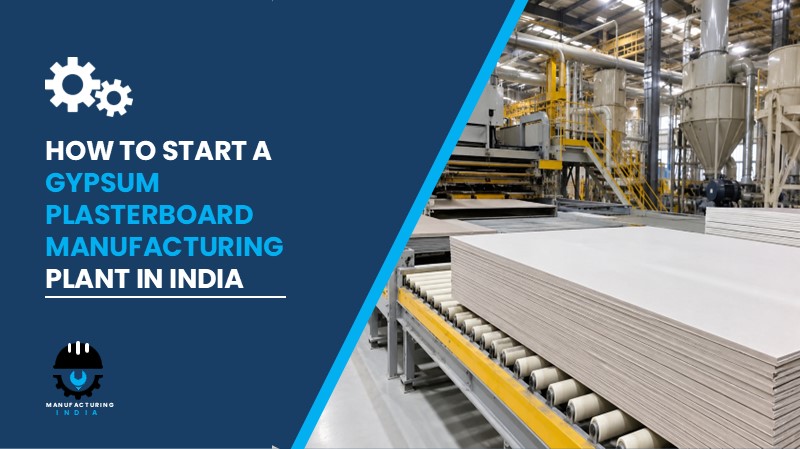
Setting up a gypsum plasterboard manufacturing plant in India presents a compelling investment case driven by the country’s rapid expansion across residential construction, commercial real estate, renovation projects, and interior design sectors. Gypsum plasterboard — commonly known as drywall — is a core structural and finishing material used in interior walls, ceilings, partitions, and fire-rated systems. As India’s urban population grows and large-scale infrastructure projects accelerate, demand for lightweight, fast-installation wall systems is rising steadily, making domestic production both timely and commercially sound.
India’s natural advantages — affordable land, a large skilled and semi-skilled workforce, robust raw material availability in the form of natural gypsum deposits, and strong policy support through the Make in India initiative — position the country as one of the most cost-competitive destinations for establishing this type of facility. Key manufacturing states such as Gujarat, Rajasthan, and Maharashtra offer excellent proximity to raw material sources, logistics connectivity, and access to growing urban markets. Together, these factors make India a strategically sound location for investors looking to enter or scale within the building materials sector.
Setting up a gypsum plasterboard manufacturing plant in India combines policy-driven demand, a cost-competitive supply chain, and healthy gross profit margins of 30–40% — making this a financially viable investment with strong long-term demand sustainability. With the global gypsum plasterboard market projected to more than double from USD 25,395.34 Million in 2025 to USD 50,765.39 Million by 2034, India-based producers are strategically placed to capture a significant share of this growth.
What is Gypsum Plasterboard?
Gypsum plasterboard, also known as drywall, is a building material used for interior walls and ceilings. It consists of a layer of gypsum — a naturally occurring mineral — sandwiched between two layers of paper. This construction gives the board a unique combination of properties: it is fire-resistant, offers soundproofing capabilities, and provides thermal insulation, making it indispensable in modern construction environments. The gypsum core is formed through the hydration of calcium sulfate, which gives the material its structural integrity and makes it ideal for a wide variety of construction applications. The plasterboard is lightweight, easy to handle, and can be readily cut, making it particularly suited for fast installation in both residential and commercial projects.
The primary production method is the gypsum plasterboard manufacturing process, which involves gypsum mining, crushing, calcining, mixing, pressing, and cutting. End-use industries served include construction, residential and commercial buildings, renovation projects, and interior design. Within these sectors, the material finds application in interior wall construction, ceilings, partitions, insulation systems, and fire-rated assemblies — making it a truly multi-application product with stable cross-sector demand.
Cost of Setting Up a Gypsum Plasterboard Manufacturing Plant in India
The cost of establishing a gypsum plasterboard manufacturing plant in India depends on several key variables including production capacity, technology selection, plant location, level of automation, and regulatory compliance requirements. Investors must account for both capital expenditure at the project inception stage and ongoing operational costs throughout the production lifecycle.
1. Capital Expenditure (CapEx)
The capital investment for a gypsum plasterboard plant covers several major cost heads. Land and site development constitute a significant portion of total CapEx, encompassing land registration charges, boundary development, and site preparation. Investors may consider locating the facility within an SEZ or notified industrial estate to benefit from reduced land costs, tax exemptions, and faster regulatory clearances.
Civil works and construction include the manufacturing shed, quality control laboratory, raw material storage areas, finished goods warehouse, and administrative block. These must be designed to accommodate continuous production lines and comply with industrial safety norms.
Machinery and equipment represent the largest share of capital expenditure for a gypsum plasterboard manufacturing facility. Key machinery required includes:
- Crushers
- Calciners
- Grinding mills
- Mixers
- Board formers
- Drying ovens
- Cutters
- Finishing and packaging lines
- Material conveying systems
- Forming tables
- Board handling equipment
- Kilns and dryers
- Temperature-controlled chambers
- Cutting units
- Stacking systems
- Palletizing lines
Other capital costs include effluent treatment plant (ETP) setup, pre-operative expenses, commissioning charges, and applicable import duties on specialized equipment not available domestically.
Request a Sample Report for In-Depth Market Insights: https://www.imarcgroup.com/gypsum-plasterboard-manufacturing-plant-project-report/requestsample
2. Operational Expenditure (OpEx)
The operating cost structure of a gypsum plasterboard plant is primarily driven by raw material consumption. Raw material costs account for approximately 50–60% of total operational expenditure. The key raw materials required are gypsum rock/stucco, paper (face and back), additives, and foaming agents. Investors should negotiate long-term supplier contracts to stabilize pricing and mitigate the risk of supply chain disruptions, particularly for gypsum rock procurement.
Utility costs — covering electricity, water, and steam — represent a further 20–25% of total OpEx. Energy-intensive stages such as calcining and drying require consistent power supply, making proximity to reliable grid infrastructure or investment in captive energy an important planning consideration.
Other operating costs include transportation and logistics, packaging materials, salaries and wages, routine machinery maintenance, annual depreciation, and applicable taxes. By the fifth year of operations, total operational costs are projected to increase substantially, driven by inflation, market price fluctuations, rising costs of key raw materials, and broader shifts in global supply chain dynamics.
3. Plant Capacity
The proposed gypsum plasterboard manufacturing facility is designed with an annual production capacity ranging between 20 and 40 million square meters, enabling economies of scale while maintaining operational flexibility. This capacity range can be customized per individual investor requirements, depending on market access, capital availability, and target customer segments. Profitability improves meaningfully with higher capacity utilisation, making early ramp-up planning a critical factor in project success.
4. Profit Margins and Financial Projections
A gypsum plasterboard plant demonstrates healthy profitability under normal operating conditions. Gross profit margins typically range between 30–40%, supported by stable demand across construction end-markets and the value-added properties of the product. Net profit margins are projected in the range of 12–18%. Financial projections incorporate assessments of net present value (NPV), internal rate of return (IRR), payback period, gross margin trajectory, and net margin evolution across five operating years, providing investors with a comprehensive view of the project’s long-term financial viability and return profile.
Why Set Up a Gypsum Plasterboard Plant in India?
Essential Demand from the Construction Sector. Gypsum plasterboard is a core component in residential, commercial, and industrial construction, widely used for walls, ceilings, partitions, and fire-rated systems. India’s residential construction industry grew at 6.8% during FY2024–25 and is projected to reach USD 350 billion by 2030, creating a massive sustained pipeline of demand for interior construction materials.
Rapid Urbanisation and Housing Missions. Rapid urbanisation across India’s tier-1 and tier-2 cities is driving fast-paced real estate development. Affordable housing initiatives and smart city programmes directly support long-term demand for lightweight, fast-installation wall systems — precisely the segment where gypsum plasterboard excels.
Policy and Regulatory Tailwinds. Government spending on housing, public infrastructure, transport hubs, and commercial buildings — combined with incentives for domestic manufacturing under Make in India — directly supports long-term demand growth for locally produced gypsum plasterboard. Policy alignment reduces market risk for new entrants.
Cost-Competitive Manufacturing. India offers a compelling cost base for setting up this type of plant, with access to affordable land in industrial corridors, a large trained workforce, and domestic availability of key raw materials such as gypsum rock. Reduced logistics costs through local sourcing and proximity to construction markets further strengthen the investment case.
Active Industry Investment and Innovation. In October 2024, Saint-Gobain unveiled CarbonLow — a new line of low-carbon gypsum wallboard offering up to 60% less embodied carbon cradle-to-gate compared with traditional alternatives. This development signals accelerating innovation in the sector and growing demand for sustainable building materials, an area where India-based manufacturers can build differentiated offerings.
Local Supply Chain Preference. Builders, developers, and contractors increasingly prefer local manufacturers to ensure timely delivery, stable pricing, and reduced logistics costs. This creates significant opportunities for regional producers in India with efficient raw material sourcing, strong distribution networks, and consistent product quality — reducing dependence on imports and building durable customer relationships.
Manufacturing Process – Step by Step
The gypsum plasterboard manufacturing process uses gypsum mining, crushing, calcining, mixing, pressing, and cutting as the primary production method. The following steps outline the complete process from raw material intake to finished product dispatch:
- Gypsum Mining and Raw Material Receipt: Natural gypsum rock is mined or procured and delivered to the plant site along with other raw materials including paper (face and back), additives, and foaming agents.
- Crushing: Gypsum rock is fed into crushers that reduce the material to smaller, manageable particle sizes suitable for further processing.
- Drying: Crushed gypsum is passed through drying systems to remove moisture and prepare it for the calcining stage.
- Calcining: The dried gypsum is fed into calciners where it is heated at controlled temperatures to produce calcium sulfate hemihydrate (stucco), the active binding compound in the finished board.
- Grinding and Milling: The calcined material is processed through grinding mills to achieve the precise particle fineness required for consistent board quality.
- Mixing: Stucco is combined with water, foaming agents, and additives in mixers to produce a uniform slurry that will form the plasterboard core.
- Board Forming: The slurry is deposited onto a continuous face paper layer on the forming table; the back paper is applied on top, and the sandwich is shaped into a continuous board.
- Drying and Curing: The formed board passes through temperature-controlled drying ovens, kilns, and dryers to cure the gypsum core and achieve final board strength and dimensional stability.
- Cutting: Continuous board is cut to standard commercial dimensions using cutting units.
- Finishing, Stacking, and Packaging: Cut boards are finished, stacked using stacking systems, and palletized via palletizing lines for dispatch to construction, residential, commercial, and renovation end-use markets.
Key Applications
Gypsum plasterboard serves a broad range of industries and applications across the construction and interior design value chain:
- Construction: Used extensively in the construction of interior wall systems, ceilings, fire-rated partitions, and insulation assemblies in residential, commercial, and industrial buildings.
- Residential Buildings: Provides lightweight, fast-install wall and ceiling solutions for housing projects ranging from affordable homes to premium residences.
- Commercial Buildings: Applied in office fit-outs, retail spaces, hotels, and institutional buildings requiring acoustic performance, fire resistance, and aesthetic versatility.
- Renovation Projects: A preferred material for renovation and refurbishment projects due to ease of installation, clean finish, and minimal structural disruption.
- Interior Design: Widely used by interior designers and fit-out contractors for creating partitions, feature walls, drop ceilings, and custom interior finishes.
Leading Manufacturers
The global gypsum plasterboard industry is dominated by several multinational companies with large-scale production capacities and diverse application portfolios. Key players in the market include:
- Saint-Gobain
- Knauf
- USG Corporation
- Gypsum India Limited
- Etex Group
Timeline to Start the Plant
Investors should plan for the following phases when setting up a gypsum plasterboard manufacturing unit in India:
- Feasibility study and project report preparation
- Land acquisition and site development
- Regulatory approvals and environmental clearances
- Factory licence and fire safety compliance
- Machinery procurement and installation
- Raw material supplier agreements and supply chain setup
- Trial production and quality testing
- Commercial production launch
Licences and Regulatory Requirements
Starting a gypsum plasterboard manufacturing unit in India requires several approvals:
- Business registration (Proprietorship, LLP, or Pvt Ltd)
- Factory Licence under the Factories Act
- Environmental Clearance from State Pollution Control Board
- GST Registration
- Fire Safety NOC
- Effluent Treatment Plant (ETP) operational clearance
- Occupational Health and Safety compliance
Key Challenges to Consider
High Capital Requirements. Establishing a gypsum plasterboard facility involves significant upfront investment in continuous production lines, calcining equipment, drying ovens, and board handling systems. Investors must plan carefully for both CapEx financing and adequate working capital to support initial production ramp-up.
Raw Material Price Volatility. Key raw materials — including gypsum rock/stucco, paper (face and back), additives, and foaming agents — are subject to price fluctuations driven by global supply-demand dynamics, energy costs, and logistics disruptions. Long-term procurement contracts are essential to stabilize input costs and protect margins.
Regulatory Compliance. Environmental clearances, ETP operational approvals, fire safety norms, and factory licensing requirements demand careful planning and dedicated compliance management throughout both the setup and operational phases.
Technology and Innovation Pressure. The October 2024 launch of Saint-Gobain’s CarbonLow low-carbon wallboard signals a clear industry trend toward sustainable, low-embodied-carbon products. Domestic manufacturers will need to stay aligned with evolving product standards and green building certification requirements.
Competition from Established Players. The presence of global leaders such as Saint-Gobain, Knauf, USG Corporation, Gypsum India Limited, and Etex Group creates a competitive market environment. New entrants must differentiate through quality consistency, regional distribution efficiency, and service responsiveness.
Skilled Manpower. Operating calcining systems, temperature-controlled drying chambers, and precision cutting equipment requires a trained technical workforce. Recruiting, training, and retaining skilled personnel in process control and quality assurance is an ongoing operational challenge.
Frequently Asked Questions
1. How much does it cost to set up a gypsum plasterboard manufacturing plant in India?
The total cost depends on plant capacity, technology selected, location, and automation level. Key cost heads include land and site development, civil construction, machinery (crushers, calciners, grinding mills, mixers, board formers, drying ovens, and packaging lines), raw materials, and utilities. A detailed feasibility study is recommended before committing capital.
2. Is gypsum plasterboard manufacturing profitable in India in 2026?
Yes. The gypsum plasterboard manufacturing process generates gross profit margins of 30–40% and net profit margins of 12–18% under normal operating conditions, supported by stable construction sector demand and India’s residential construction growth trajectory.
3. What machinery is required for a gypsum plasterboard plant in India?
Essential machinery includes crushers, calciners, grinding mills, mixers, board formers, drying ovens, cutters, finishing and packaging lines, material conveying systems, forming tables, board handling equipment, kilns, dryers, temperature-controlled chambers, stacking systems, and palletizing lines.
4. What licences and approvals are required to start a gypsum plasterboard plant in India?
Required approvals include business registration, Factory Licence under the Factories Act, Environmental Clearance from the State Pollution Control Board, GST Registration, Fire Safety NOC, ETP operational clearance, and Occupational Health and Safety compliance.
5. What raw materials are needed for gypsum plasterboard manufacturing?
The primary raw materials are gypsum rock/stucco, paper (face and back), additives, and foaming agents. Long-term supplier contracts are recommended to ensure consistent supply and stable input pricing.
6. What are the environmental compliance requirements for a gypsum plasterboard plant in India?
The facility must secure Environmental Clearance from the State Pollution Control Board, operate a compliant Effluent Treatment Plant (ETP), and adhere to emission norms applicable to thermal calcining and drying operations. Ongoing monitoring and documentation are required for continued compliance.
7. What is the best location to set up a gypsum plasterboard plant in India?
Ideal locations offer proximity to gypsum rock deposits (Rajasthan is India’s largest natural gypsum source), reliable power and water supply, strong logistics infrastructure, and access to growing construction markets. Industrial estates in Gujarat, Rajasthan, and Maharashtra are strong candidates.
8. What is the break-even period for this type of plant in India?
The break-even period depends on capacity utilization, pricing strategy, and operating cost management. A detailed financial analysis covering NPV, IRR, and payback period is included in IMARC Group’s full project report.
9. What government incentives are available for manufacturers in India?
Investors may benefit from Make in India incentives, state-level industrial subsidies, capital subsidy schemes for MSME-scale units, GST input tax credits, and accelerated depreciation benefits. Locating within an SEZ may provide additional tax and duty benefits.
Key Takeaways for Investors
A gypsum plasterboard manufacturing plant in India represents a well-rounded investment opportunity anchored by structural demand from construction, residential building, commercial real estate, and renovation sectors — all of which are in long-term expansion across the country. The investment is financially viable across a range of plant capacities, with gross margins of 30–40% and net margins of 12–18% confirming strong profitability potential even at moderate utilisation levels. The global gypsum plasterboard market, valued at USD 25,395.34 Million in 2025, is projected to reach USD 50,765.39 Million by 2034, growing at a CAGR of 8.0% — with the Asia-Pacific region, including India, identified as a primary volume growth driver. With urbanisation, housing missions, green building adoption, and infrastructure investment continuing to accelerate, demand for this essential construction material in India is set to remain robust for the foreseeable future.
About the Author