Setting up a wire mesh manufacturing plant in India presents a compelling investment case anchored in the country’s accelerating infrastructure construction, rapid urbanisation, expanding industrial manufacturing base, and the growing adoption of wire mesh across construction reinforcement, agricultural protection, mining screening, and industrial safety applications. Wire mesh a product made of metal created by weaving, welding, or interlacing metal wires into a uniform grid pattern from stainless steel, galvanised steel, mild steel, aluminium, or copper alloys forms the literal backbone of construction, industrial safety, mining operations, and agricultural protection globally, making it a steady, demand-driven product that keeps pace with infrastructure development across every Indian state. The global wire mesh market was valued at USD 235.63 billion in 2025 and is projected to reach USD 356.25 billion by 2034 at a CAGR of 4.7%, driven by growing infrastructure development, rising demand for reinforcement and filtration solutions, and increasing use of wire mesh in industrial safety and fencing applications.
India’s structural advantages make it an exceptionally well-positioned location for establishing a wire mesh manufacturing facility. India’s manufacturing sector is projected to have the potential to expand to nearly USD 1 trillion by 2025–26 according to IBEF, driven by policy support, rising investments, and increasing domestic and global demand directly translating into sustained procurement of wire mesh across construction reinforcement, industrial safety enclosures, and infrastructure fabrication applications at scale. The government’s investments in housing, roads, rail, industrial parks, and agri-infrastructure create a government-funded demand base for wire mesh that is geographically distributed across every Indian state and sustained across multi-year project timelines. Industrial clusters in Maharashtra, Gujarat, Haryana, and Tamil Nadu provide investors with direct access to GI wire and steel wire supply chains, fabrication engineering talent, and established distribution networks serving construction contractors, industrial plant operators, agricultural equipment suppliers, and mining companies.
A wire mesh manufacturing plant in India is positioned within a global market valued at USD 235.63 billion in 2025 growing at 4.7% CAGR toward USD 356.25 billion by 2034, driven by infrastructure expansion, construction reinforcement demand, industrial safety adoption, and agricultural fencing growth. With gross margins of 20–30% and net margins of 8–12% at 10,000–20,000 MT annual production capacity, and India’s manufacturing sector targeting USD 1 trillion by 2025–26, this investment delivers commercially stable, infrastructure-demand-anchored returns.
What is Wire Mesh?
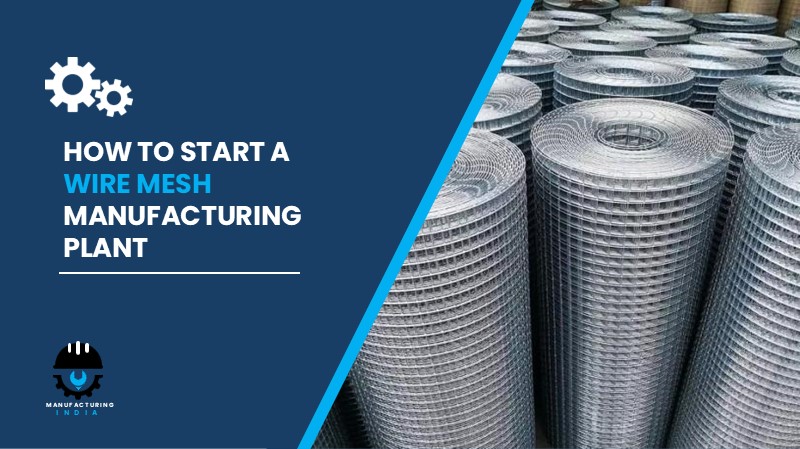
Wire mesh is a product made of metal that is created by weaving, welding, or interlacing metal wires into a grid pattern of uniform aperture size. Its production involves the use of materials including stainless steel, galvanised steel, mild steel, aluminium, or copper alloys, with the material choice determined by the application’s structural, corrosion resistance, and conductivity requirements. Wire mesh offers high mechanical strength, dimensional stability, good airflow permeability, and resistance to corrosion and wear. Depending on the production technique woven, welded, or expanded wire mesh can be fine-tuned regarding aperture size, wire diameter, and surface treatment to precisely match application requirements.
These attributes make wire mesh suitable for reinforcement, filtration, fencing, screening, safety barriers, and architectural designs across numerous industries. The primary production method involves wire drawing, straightening, weaving or welding, cutting, and surface finishing a multi-step manufacturing process integrating raw material preparation, wire processing, mechanical interlacing or fusion welding, and quality verification at each stage. End-use industries served include construction, industrial manufacturing, agriculture, mining, and infrastructure covering applications from concrete reinforcement and security fencing through to industrial filtration systems, sieving operations, agricultural enclosures, and architectural facades.
Cost of Setting Up a Wire Mesh Manufacturing Plant in India
The total investment required to establish a wire mesh manufacturing plant in India depends on plant capacity, wire mesh type focus, geographic location, level of automation, and compliance with BIS product standards and environmental regulatory requirements. Investors must account comprehensively for both one-time capital expenditure and recurring operational costs when preparing a feasibility study or detailed project report (DPR).
1. Capital Expenditure (CapEx)
Land and Site Development constitutes a substantial foundational investment. Costs for land registration, boundary construction, internal road layout, drainage infrastructure, and site levelling vary based on whether the facility is within a government-notified industrial estate, a steel products or metal fabrication manufacturing cluster, or on privately acquired industrial land. Locations in Maharashtra, Gujarat, Haryana, and Tamil Nadu with access to GI wire and steel wire supply chains and proximity to construction, mining, and industrial manufacturing buyer concentrations minimise procurement logistics costs and maximise distribution efficiency for heavy finished product delivery.
Civil Works and Construction encompasses the main wire drawing and straightening hall, weaving or automated welding production area, cutting and finishing zone, surface treatment facility for galvanising, PVC coating, or other surface finishes, quality control laboratory, finished goods warehouse with adequate floor load ratings for heavy coiled or panel mesh storage, and administrative block. The heavy structural loads associated with steel wire storage, wire drawing equipment, and welding machines require heavy-duty industrial floor construction standards and high-bay building height for large coil handling adding to civil construction costs relative to lighter manufacturing operations.
Machinery and Equipment represent the single largest component of capital expenditure. Key machinery required for a wire mesh manufacturing plant includes:
- Wire drawing machines
- Straightening units
- Weaving or welding machines
- Cutting systems
- Surface coating equipment
Other Capital Costs include the effluent treatment plant (ETP) for managing surface treatment and galvanising process wastewater, pre-operative expenses covering regulatory filings and feasibility study preparation, plant commissioning charges, utility connection fees, and import duties applicable to specialised automated welding machines or multi-layer surface coating equipment sourced internationally.
Request a Sample Report for In-Depth Market Insights: https://www.imarcgroup.com/wire-mesh-manufacturing-plant-project-report/requestsample
2. Operational Expenditure (OpEx)
Raw Material Cost is the overwhelmingly dominant driver of operating expenditure, accounting for approximately 80–85% of total OpEx one of the highest raw material cost concentrations across all metal products manufacturing categories. The primary inputs are GI wire and steel wire. Galvanised iron wire the dominant raw material for standard wire mesh is priced against domestic steel wire rod markets and zinc commodity prices, both of which are subject to global commodity cycle dynamics. Stainless steel wire, aluminium wire, and copper wire are used for speciality applications including food processing filters, chemical industry screens, and electrical shielding commanding premium prices relative to standard GI wire grades. Investors are advised to negotiate long-term supply contracts with domestic wire rod manufacturers and galvanising companies to stabilise the dominant input cost and ensure production continuity. Geographic proximity to wire rod and drawn wire processing operations in established steel product manufacturing states reduces inbound logistics costs materially for this high-volume, heavy-weight raw material.
Utility Costs – covering electricity for wire drawing machines, automated welding equipment, surface coating systems, and facility operations account for approximately 5–10% of total OpEx, reflecting the moderate energy intensity of wire mesh assembly operations relative to more energy-intensive manufacturing categories. Wire drawing machines represent the most energy-intensive process step within the production line. Investors in regions with competitive industrial electricity tariffs and reliable grid supply are better positioned to manage this cost component over the plant’s operational life.
Other Operating Costs include outbound transportation of finished wire mesh panels, rolls, and gabion units which require heavy goods vehicles for construction site, mining operation, and industrial facility delivery to construction contractors, fabrication shops, agricultural supply dealers, mining companies, and industrial plant maintenance operators; packaging materials for panels and coiled rolls; employee salaries and wages for wire drawing operators, weaving machine operators, welding technicians, surface treatment operators, and quality inspectors; equipment maintenance; quality assurance testing for tensile strength, aperture dimensions, and BIS product standards compliance; depreciation on civil and machinery assets; and applicable taxes including GST. By the fifth year of operations, total operational costs are expected to increase substantially due to inflation, market fluctuations, potential rises in GI wire and steel wire prices, supply chain disruptions, rising consumer demand, and shifts in the global economy.
3. Plant Capacity
The proposed wire mesh manufacturing facility is designed with an annual production capacity ranging between 10,000 and 20,000 MT, enabling significant economies of scale while maintaining operational flexibility across different wire mesh types welded mesh, woven mesh, hexagonal chicken wire mesh, expanded metal mesh, and gabion mesh aperture sizes, wire diameters, and surface treatment options. This capacity range is well-aligned with the procurement requirements of construction contractors, concrete reinforcement suppliers, agricultural dealers, mining operators, and industrial plant maintenance organisations across India’s active domestic market and regional export channels. Capacity can be customised based on investor requirements and GI wire procurement network scale. Profitability improves consistently with higher capacity utilisation, and wire mesh manufacturing plants support phased capacity expansion through additional weaving machines or welding lines with contained incremental CapEx.
4. Profit Margins and Financial Projections
The wire mesh manufacturing plant demonstrates stable profitability potential under normal operating conditions. Gross profit margins typically range between 20–30%, supported by stable multi-sector demand and the value-added, specification-differentiated nature of surface-treated, dimensionally certified wire mesh products relative to commodity GI wire inputs. Net profit margins range between 8–12%, reflecting the very high raw material cost intensity of the production model. A comprehensive financial analysis should include income projections, expenditure forecasts, gross and net margin tracking across Years 1 through 5, net present value (NPV), internal rate of return (IRR), payback period, and a full profit and loss account. Sensitivity analysis covering GI wire and steel wire commodity price movements and construction sector demand variability is recommended for investment-grade financial planning.
Why Set Up a Wire Mesh Manufacturing Plant in India?
India’s Manufacturing Sector Expansion Creating Structural Wire Mesh Demand. India’s manufacturing sector is projected to have the potential to expand to nearly USD 1 trillion by 2025–26 according to IBEF, driven by policy support, rising investments, and increasing domestic and global demand. This rapid industrial growth is expected to significantly boost demand for wire mesh, as it plays a critical role across construction, manufacturing, energy, and infrastructure applications from reinforcing concrete slabs and partitions in factories through to safety enclosures for industrial machinery and filtration systems for chemical processing units.
Urban Infrastructure and Smart City Development Driving Construction Reinforcement Demand. Rapid urbanisation, smart city projects, and industrial expansion are driving global consumption of wire mesh upwards and India’s own infrastructure investment pipeline is particularly robust, with government spending on housing, roads, rail, industrial parks, and agri-infrastructure providing a multi-year, government-funded demand base for wire mesh across construction reinforcement, perimeter security fencing, and urban drainage infrastructure applications. The increasing use of reinforced concrete in residential and commercial buildings has made welded and woven wire mesh an integral material in modern construction practices.
Gabion Technologies India’s BSE Debut Validating Domestic Market Confidence. In January 2026, Gabion Technologies India, a manufacturer of steel wire mesh gabions, made a strong debut on the Bombay Stock Exchange (BSE), with shares surging 5 percent on its first trading day, attracting significant institutional investment including Vorton Capital’s Vorton Opportunities Fund purchasing 4.97 lakh shares for Rs 4.42 crore. This successful market debut by an Indian wire mesh gabion manufacturer and the strong institutional buying interest it attracted on day one directly confirms domestic investor confidence in India’s wire mesh manufacturing sector and validates the commercial attractiveness of this product category for new market entrants.
KnitMesh and GKD Strategic Alliance Signalling Green Hydrogen and Advanced Application Growth. In March 2025, KnitMesh Technologies, a specialist in knitted wire mesh, announced a strategic alliance with woven wire mesh manufacturer GKD to broaden their combined product offerings and streamline the value chain, initially targeting Europe and North America. The partnership serves diverse industries with a strong focus on green hydrogen enabling integrated knitted and woven mesh solutions including complete electrolyser cell assemblies from a single source. This strategic alignment of wire mesh technology with green hydrogen electrolysis infrastructure directly signals the emergence of a new, high-value application segment for precision wire mesh that will grow in importance as India’s own green hydrogen and electrolyser manufacturing investment scales up.
Agricultural Sector Providing Stable and Geographically Distributed Demand. The agriculture sector is contributing to growth through sustained demand for fencing and protective mesh solutions across crop protection enclosures, animal containment, orchard protection, and poultry farming infrastructure. India’s vast and dispersed agricultural sector operating across every state provides wire mesh manufacturers with a large, recurring, and geographically broad buyer base that runs independently of construction project cycles, providing commercial revenue resilience alongside the infrastructure-dependent demand streams.
Localization Preference of Construction and Industrial Buyers Providing Proximity Advantage. Contractors and industrial buyers increasingly favour local manufacturers to reduce lead times, minimise transportation costs for heavy wire mesh products, and maintain supply chain reliability creating strong commercial opportunities for regional wire mesh producers who can offer consistent product quality, responsive service, and competitive delivered cost against distant alternatives. Wire mesh is a heavy, bulky product where transportation cost represents a meaningful share of total delivered cost a structural advantage for proximate domestic manufacturers over import-dependent supply chains.
Manufacturing Process – Step by Step
The wire mesh manufacturing process uses wire drawing, straightening, weaving or welding, cutting, and surface finishing as the primary production method. Below are the main stages involved in the wire mesh manufacturing process flow:
- Raw Material Receipt and Quality Testing: GI wire, steel wire, stainless steel wire, or other metal wire inputs are received, tested for dimensional conformance wire diameter, tensile strength, and galvanising coating weight and cleared for production scheduling following quality verification against raw material specifications.
- Wire Drawing: Wire drawing machines reduce the incoming wire rod or coil to the precise wire diameter specification required for the target wire mesh product using progressive drawing dies to achieve dimensional accuracy, surface finish, and mechanical properties while maintaining the ductility required for subsequent weaving or welding operations.
- Wire Straightening: Straightening units remove residual coil curvature from the drawn wire, producing straight, dimensionally consistent wire feed for the weaving or welding production line. Consistent wire straightness is critical for maintaining aperture uniformity and panel flatness in finished wire mesh products.
- Wire Cutting to Length: For welded wire mesh production, cut-to-length systems cut both longitudinal and transverse wires to the precise dimensions specified for the target panel width and aperture configuration, with dimensional accuracy maintained within the tolerance range required by BIS product standards.
- Weaving (for Woven Wire Mesh): Weaving machines interlace longitudinal warp wires and transverse weft wires in the specified over-under weave pattern plain weave, twill weave, or Dutch weave depending on the aperture size, wire diameter, and filtration performance requirement producing woven wire mesh in continuous roll format for subsequent cutting and finishing operations.
- Resistance Welding (for Welded Wire Mesh): Welding or welded mesh machines position longitudinal and transverse wires at the specified aperture spacing and join them at each intersection point using resistance spot welding applying precisely controlled electrical current and pressure that melts the wire at the contact point, forming a permanent, strong weld joint. Automated multi-spot welding heads simultaneously weld multiple intersections across the panel width, achieving high production rates with consistent weld quality across the finished mesh sheet.
- Cutting and Panel Sizing: Cutting systems cut woven rolls or welded mesh sheets to the specified panel dimensions or roll lengths and widths, with cut-edge quality and dimensional accuracy verified against product specification.
- Surface Finishing: Surface coating equipment applies the specified surface treatment to the finished wire mesh product including hot-dip galvanising for corrosion resistance in construction and outdoor fencing applications, PVC or polymer coating for agricultural and decorative fencing applications, or electrolytic zinc plating for light-duty indoor applications at the specified coating weight and uniformity.
- Quality Inspection and Testing: Quality control instruments verify the finished wire mesh against BIS and application specification acceptance criteria including wire diameter measurement, aperture size uniformity, mesh opening tolerance, weld shear strength for welded products, tensile strength and elongation of the base wire, galvanising coating weight per unit area, and panel or roll dimensions. Non-conforming products are segregated before despatch.
- Bundling, Rolling, and Packaging: Finished wire mesh panels are bundled in standard-size stacks for construction and industrial supply, or finished mesh is rolled onto cardboard cores or bundled as coils for agricultural and fencing applications with product labelling including wire diameter, aperture size, mesh dimensions, surface treatment specification, and batch reference for supply chain traceability.
- Dispatch to End-Use Industries: Finished wire mesh is dispatched to construction contractors for concrete reinforcement and safety barrier applications, agricultural supply dealers for fencing and crop protection, mining operators for screening and safety enclosures, industrial plant maintenance teams for filtration and safety applications, and fabrication workshops for architectural and general metal fabrication uses.
Key Applications
Wire mesh produced at this type of facility serves four primary end-use sectors with specific wire type, aperture specification, surface treatment, and quality requirements for each:
- Construction: Widely used for concrete reinforcement in slabs, walls, and columns, partition wall fabrication, safety barriers on construction sites, scaffolding enclosures, and structural support systems the largest single volume application for domestic wire mesh production in India.
- Industrial Processing: Applied in filtration systems, screening operations, material sorting, and separation processes in chemical plants, food processing facilities, water treatment operations, and pharmaceutical manufacturing requiring stainless steel or speciality wire mesh grades for corrosion-resistant performance.
- Agriculture: Utilised for animal enclosures, poultry farming infrastructure, crop protection netting, orchard bird exclusion fencing, and irrigation channel screening providing farmers and agri-businesses with durable, cost-effective protective solutions across diverse agricultural applications.
- Mining: Used in screening operations for mineral grading, ore sizing, and aggregate separation, and in safety reinforcement applications including tunnel mesh and slope stabilisation gabions requiring heavy-duty wire mesh specifications capable of withstanding abrasive loading and outdoor weathering conditions.
Leading Wire Mesh Manufacturers
The global wire mesh industry is served by several large-scale manufacturers with extensive production capacities and diversified end-use application portfolios. Key players include:
- Drahtzug Stein
- Klein Steel Service Inc.
- Wolverine Wire
- Gerdau S.A.
- Rochester Wire and Products
- Keystone Consolidated Industries
Timeline to Start the Plant
Investors planning to establish a wire mesh manufacturing plant in India should anticipate the following project development phases:
- Feasibility study and project report preparation
- Land acquisition and site development
- Regulatory approvals and environmental clearances
- Factory licence and fire safety compliance
- Machinery procurement and installation
- Raw material supplier agreements and supply chain setup
- Trial production and quality testing
- Commercial production launch
Licences and Regulatory Requirements
Starting a wire mesh manufacturing unit in India requires several approvals:
- Business registration (Proprietorship, LLP, or Private Limited Company)
- Factory Licence under the Factories Act
- Bureau of Indian Standards (BIS) certification under applicable IS standards for wire mesh including IS 4948 for welded steel wire fabric for general use and IS 1566 for hard-drawn steel wire fabric for concrete reinforcement mandatory for supply to government construction projects and qualified institutional procurement
- Environmental Clearance from the State Pollution Control Board including compliance with galvanising zinc emission and wastewater standards where hot-dip galvanising operations are conducted on-site
- GST Registration
- Fire Safety NOC
- Effluent Treatment Plant (ETP) operational clearance for galvanising process wastewater and surface treatment chemical waste stream management
- Occupational Health and Safety compliance covering wire drawing machinery safety, zinc fume monitoring in galvanising areas, and heavy material handling protocols
- Consent to Establish and Consent to Operate from the State Pollution Control Board
Key Challenges to Consider
GI Wire and Steel Wire Price Volatility as the Dominant Cost Variables. GI wire and steel wire together account for 80–85% of total OpEx — the second-highest raw material cost concentration across all manufacturing categories reviewed in this series. Any significant movement in domestic steel wire rod or zinc commodity prices directly and materially compresses gross margins. Long-term supply contracts with wire rod manufacturers and galvanising operations, multi-supplier procurement strategies, and strategic wire inventory management during price-advantageous procurement windows are essential operational risk management disciplines for wire mesh manufacturers.
High Competition in Commodity Wire Mesh Segments. The welded and woven wire mesh market for standard construction reinforcement and fencing applications is highly competitive, with numerous domestic producers and organised importers offering similar products at close price points. Building and maintaining a competitive position requires consistent product quality, reliable on-time delivery, responsive customer service, and competitive pricing capabilities that must be operationally embedded from day one rather than developed reactively after market entry.
BIS Certification and Quality Compliance Management. Supplying concrete reinforcement wire mesh for government infrastructure and institutional construction projects requires BIS IS 1566 certification compliance, ongoing batch testing, and dimensional quality documentation. Maintaining this certification currency across production volume variations and product range expansions requires dedicated quality management system investment and ongoing testing infrastructure operation.
Surface Treatment Environmental Compliance. On-site hot-dip galvanising operations generate zinc-containing fume emissions and acidic pickling wastewater requiring comprehensive environmental management including fume capture and scrubbing, acid pickling bath waste neutralisation, and ETP for rinse water treatment. State Pollution Control Board standards for galvanising operations are increasingly stringent, and ongoing environmental compliance adds meaningful overhead to manufacturing operations that cannot be avoided in this product category.
Skilled Workforce for Automated Welding and Wire Drawing Operations. Operating multi-electrode automatic welding machines, wire drawing production lines, and surface coating equipment requires technicians trained in resistance welding process control, wire drawing die maintenance, surface treatment chemistry, and quality inspection for metallic mesh products. Sourcing and retaining qualified personnel with this combination of skills in locations outside established metal fabrication industrial clusters presents a recurring operational challenge.
Logistics Intensity for Heavy Finished Product Delivery. Wire mesh particularly reinforcement mesh panels and gabion units is a heavy, bulky finished product requiring specialist heavy goods vehicle delivery to construction sites, mining operations, and industrial facilities that may be located on variable-quality access roads. Building and managing a reliable logistics network that covers the delivery geography required to serve the procurement clusters of target buyers is a meaningful operational capability requirement beyond the production plant investment.
Frequently Asked Questions
1. How much does it cost to set up a wire mesh manufacturing plant in India?
The total cost depends on plant capacity (10,000–20,000 MT per annum), wire mesh type focus, location, and automation level. CapEx covers land, heavy-duty industrial civil construction, and machinery including wire drawing machines, straightening units, weaving or welding machines, cutting systems, and surface coating equipment, along with pre-operative and regulatory costs including BIS certification.
2. Is wire mesh manufacturing profitable in India in 2026?
Yes. With gross margins of 20–30% and net margins of 8–12%, supported by stable multi-sector demand across construction reinforcement, industrial filtration, agriculture, and mining, a global market growing at 4.7% CAGR toward USD 356.25 billion by 2034, and India’s manufacturing sector targeting USD 1 trillion by 2025–26, the investment presents a commercially stable and infrastructure-demand-backed profitability case.
3. What machinery is required for a wire mesh manufacturing plant in India?
Key equipment includes wire drawing machines, straightening units, weaving or welding machines, cutting systems, and surface coating equipment. Supporting systems include wire cut-to-length lines, resistance welding power supply units, galvanising bath infrastructure where on-site surface treatment is planned, quality testing equipment including tensile testing rigs and aperture measurement gauges, and heavy material handling cranes.
4. What licences and approvals are required to start a wire mesh manufacturing plant in India?
Required approvals include business registration, BIS certification under IS 4948 and IS 1566 as applicable, Factory Licence, Environmental Clearance, GST Registration, Fire Safety NOC, ETP operational clearance, State Pollution Control Board Consent to Operate, and Occupational Health and Safety compliance.
5. What raw materials are needed for wire mesh manufacturing?
The primary raw materials are GI wire and steel wire. Additional raw material inputs include stainless steel wire, aluminium wire, or copper wire for speciality product grades, zinc ingots or pre-galvanised wire where surface treatment is conducted in-house, and packaging materials for panels, rolls, and coils.
6. What are the environmental compliance requirements for a wire mesh manufacturing plant in India?
Environmental Clearance from the State Pollution Control Board is required, along with an ETP for managing galvanising process wastewater and surface treatment chemical waste streams, compliance with zinc fume emission standards where hot-dip galvanising is conducted on-site, and adherence to solid waste management rules for metallic process waste disposal and recycling.
7. What is the best location to set up a wire mesh manufacturing plant in India?
States with established steel wire and GI wire supply chains, proximity to large construction and infrastructure project activity, and access to agricultural, mining, and industrial buyer markets — including Maharashtra, Gujarat, Haryana, and Tamil Nadu — offer the best combination of raw material access, logistics connectivity to buyer clusters, experienced metal fabrication workforce availability, and state-level industrial incentive support for wire mesh manufacturing investment.
8. What is the break-even period for this type of plant in India?
The break-even period depends on plant capacity utilisation, product mix between commodity construction reinforcement mesh and higher-margin speciality or coated wire mesh grades, GI wire procurement cost management, and distribution network development speed. A full NPV and IRR analysis incorporating sensitivity testing for steel wire commodity price movements and domestic construction demand variability is recommended for investment-grade financial planning.
9. What government incentives are available for wire mesh manufacturers in India?
Make in India manufacturing investment incentives, PLI scheme benefits for steel products and metal fabrication where applicable, state-level industrial zone incentive schemes in Maharashtra and Gujarat, BIS product certification support programmes, construction sector procurement preferences for domestically manufactured reinforcement mesh under government infrastructure projects, and general domestic manufacturing promotion policies all provide relevant financial and market access support for qualifying wire mesh manufacturing investments.
Key Takeaways for Investors
A wire mesh manufacturing plant in India represents a commercially stable, infrastructure-demand-driven investment backed by a global market valued at USD 235.63 billion in 2025 growing at 4.7% CAGR toward USD 356.25 billion by 2034, India’s manufacturing sector trajectory toward USD 1 trillion by 2025–26, and the fundamental, non-discretionary role of wire mesh as a backbone material in construction, industrial safety, mining operations, and agricultural protection across every segment of India’s growing economy. Financial viability is demonstrated across a production capacity range of 10,000 to 20,000 MT per annum, with gross margins of 20–30% and net margins of 8–12% achievable under competitive GI wire procurement and efficient weaving or welding production operations. Active domestic and international market developments including Gabion Technologies India’s strong BSE debut in January 2026 confirming domestic investor confidence, and KnitMesh Technologies’ March 2025 strategic alliance with GKD targeting green hydrogen electrolyser mesh applications signal both the near-term commercial momentum and the long-term technology-driven market expansion that will support India’s wire mesh manufacturing sector throughout the decade ahead. With India’s infrastructure investment pipeline sustained by government construction spending, agricultural and mining wire mesh demand geographically distributed and recurring, and localization preferences of construction and industrial buyers creating structural commercial advantage for domestic producers, the investment case for wire mesh manufacturing in India is comprehensively and durably well-supported.
About the Author