Eco-Friendly Water Bottles Manufacturing Plant in India
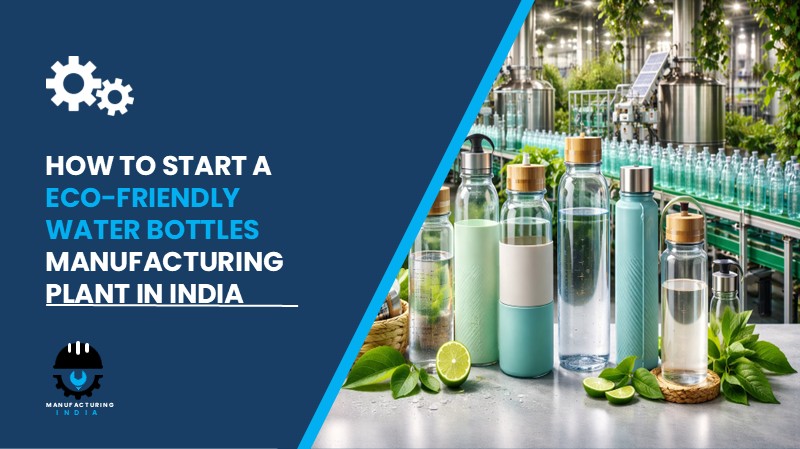
Setting up an eco-friendly water bottles manufacturing plant in India presents a compelling investment case backed by surging consumer demand across retail, outdoor and sports, corporate gifting, personal care, and hospitality sectors. As environmental awareness around single-use plastic intensifies across urban and semi-urban India, the shift toward reusable, biodegradable, and BPA-free hydration products is accelerating rapidly. The eco-friendly water bottles segment is no longer a niche it sits at the intersection of lifestyle, health consciousness, and sustainability, making it one of the most strategically timed manufacturing opportunities available to Indian investors today.
India’s advantages for this investment are structural and durable. A fast-expanding urban consumer base, supportive government policy under the Make in India initiative, an active single-use plastic ban driving institutional demand, and competitive land and labour costs in key manufacturing states such as Gujarat, Maharashtra, Uttar Pradesh, and Tamil Nadu all combine to create a production environment that is difficult to replicate elsewhere. With Asia-Pacific emerging as a significant growth market driven by rising disposable incomes and environmental awareness India is strategically positioned to serve both domestic consumption and export markets simultaneously.
India’s biodegradable plastic market is projected to reach USD 223 million by 2030, driven by the country’s escalating efforts under its single-use plastic ban. Combined with a globally growing eco-friendly water bottles market expected to reach USD 22.33 Billion by 2034 at a CAGR of 9.9%, this unit presents investors with strong policy tailwinds, cost-competitive production, and gross margins of 30–45% making break-even viability well within reach.
What Are Eco-Friendly Water Bottles?
Eco-friendly water bottles are consumer hydration products designed with sustainability as their defining principle. They are manufactured from environmentally responsible materials such as stainless steel, glass, biodegradable plastics, or plant-based polymers like PLA (Polylactic Acid) resin. Unlike conventional single-use plastic bottles, eco-friendly alternatives are reusable, recyclable, or biodegradable, significantly reducing the environmental footprint associated with disposable plastic products.
These bottles carry a range of functional properties that make them attractive to modern consumers. They are free from harmful chemicals such as BPA, making them suitable for health-conscious users. Many variants incorporate insulation technology to maintain beverage temperatures hot or cold for extended durations, and most feature leak-proof lid designs for everyday convenience and portability. The production process relies on injection molding, blow molding, welding, and assembly as its primary manufacturing methods. The end-use industries served include retail, personal care, outdoor and sports, and corporate gifting, with applications spanning personal hydration, fitness, corporate branding, and eco-conscious consumer goods.
Cost of Setting Up an Eco-Friendly Water Bottles Manufacturing Plant in India
The total cost of establishing this type of plant depends on a combination of factors: production capacity, technology selection, degree of automation, geographic location, and regulatory compliance requirements. Investors should approach cost planning through both a capital expenditure (CapEx) and an operational expenditure (OpEx) lens to build a financially sound project structure.
1. Capital Expenditure (CapEx)
The capital investment for an eco-friendly water bottles manufacturing plant covers several major heads. Land and site development including land registration charges, boundary development, and site preparation forms a substantial share of total CapEx. Investors may explore options within Special Economic Zones (SEZs) or state-designated industrial estates in Gujarat or Maharashtra to benefit from infrastructure subsidies and faster regulatory clearances.
Civil works and construction costs cover the manufacturing shed, quality control laboratory, raw material and finished goods storage facilities, and the administrative block. The layout must incorporate separate zones for production, quality testing, and packaging to maintain workflow efficiency and food-grade safety standards.
Machinery and equipment represent the largest single component of capital expenditure. Key machinery required includes:
- Material sorters
- Washing and flaking systems
- Vacuum dryers
- Injection molding machines
- Blow molders
- Quality control and leak-testing stations
- Labeling systems
- Automated packaging lines
Other capital costs include effluent treatment plant (ETP) installation, pre-operative expenses, plant commissioning costs, and import duties on specialised machinery components where applicable.
Request a Sample Report for In-Depth Market Insights: https://www.imarcgroup.com/eco-friendly-water-bottles-manufacturing-plant-project-report/requestsample
2. Operational Expenditure (OpEx)
Raw material cost is the dominant driver of operating expenses. PLA (Polylactic Acid) resin and other bioplastic resins account for approximately 60–70% of total OpEx. Securing long-term supplier contracts with domestic and international bioplastic resin suppliers is a critical strategy for managing price volatility and maintaining supply continuity. Utility costs covering electricity, water, and steam account for 15–20% of OpEx and should be factored into site selection decisions, particularly regarding proximity to reliable power infrastructure.
Other operating costs include transportation and logistics, product packaging materials, salaries and wages for production and administrative staff, maintenance and repairs, depreciation on machinery, and applicable taxes. By the fifth year of operations, total operational costs are expected to increase substantially due to inflation, market fluctuations, rising input material costs, supply chain shifts, and growing consumer demand pressures.
3. Plant Capacity
The proposed manufacturing facility is designed for an annual production capacity of up to 50 million bottles, enabling economies of scale while maintaining operational flexibility. Capacity can be customised based on individual investor requirements, whether targeting regional distribution or national-scale supply. As a general principle, profitability improves meaningfully with higher capacity utilisation, making scale planning a key lever in financial modelling.
4. Profit Margins and Financial Projections
The financial projections for this investment demonstrate healthy profitability potential under normal operating conditions. Gross profit margins typically range between 30–45%, supported by stable demand across multiple end-use sectors and the value-added nature of eco-certified, branded products. Net profit margins range between 15–25%. A complete financial analysis including NPV (Net Present Value), IRR (Internal Rate of Return), payback period, sensitivity analysis, and a profit and loss account is available through the detailed project report. These parameters collectively confirm the long-term financial viability of the plant across varying capacity utilisation scenarios.
Why Set Up an Eco-Friendly Water Bottles Plant in India?
Growing Environmental Awareness and Plastic Pollution Concerns. Consumer consciousness around single-use plastic waste is at an all-time high in India, with urban households and institutional buyers actively switching to reusable alternatives. This behavioural shift is creating a self-reinforcing demand cycle across retail, hospitality, and corporate channels, providing manufacturers with a durable and expanding customer base.
Single-Use Plastic Ban and Biodegradable Market Expansion. India has implemented a ban on single-use plastics, creating regulatory-driven displacement demand for reusable and biodegradable alternatives. According to IBEF, India’s biodegradable plastic market is projected to grow to USD 223 million by 2030, providing a quantified growth runway for producers of PLA-based eco-friendly products.
Policy and Regulatory Tailwinds. The Make in India initiative, combined with active government schemes promoting sustainable manufacturing and plastic waste reduction, provides a supportive policy environment for this facility. Producers aligned with the single-use plastic ban narrative also benefit from preferential procurement consideration from institutional buyers, government agencies, and large corporates pursuing ESG mandates.
Cost-Competitive Manufacturing Advantage. India’s competitive land acquisition costs, lower labour rates relative to developed markets, and an established petrochemical and polymer supply chain make it a cost-efficient production base. Proximity to bioplastic resin suppliers and end-user markets across retail and corporate gifting further reduces logistics costs and strengthens the unit economics of the plant.
Active Industry Investment and Innovation. In January 2025, Stasher launched its first Water Bottle, reinforcing the market’s direction toward endlessly reusable products integrated into everyday consumer life. In January 2024, S’well announced the S’well Explorer made from 91% recycled, post-consumer stainless steel demonstrating the premium innovation trajectory of the global market. These developments signal continued investment appetite and product evolution across the sector.
Local Supply Chain Preference Across Key Sectors. Retail chains, corporate gifting companies, hospitality brands, and outdoor sports distributors in India are increasingly prioritising locally sourced, certified eco-friendly alternatives to reduce import dependency and meet sustainability commitments. A domestic production facility is well-positioned to capture this preference.
Manufacturing Process Step by Step
The eco-friendly water bottles manufacturing process uses injection molding, blow molding, welding, and assembly as the primary production method. The process is a multi-step operation involving several unit operations, material handling stages, and quality checkpoints.
- Raw Material Preparation: PLA (Polylactic Acid) resin and other bioplastic resins are received, inspected for quality, and passed through material sorters to remove contaminants or foreign matter.
- Washing and Flaking: Raw bioplastic materials are processed through washing and flaking systems to ensure purity and consistency before entering the molding stage.
- Drying: Vacuum dryers remove residual moisture from the prepared resin, which is critical to preventing defects during the molding process.
- Injection Molding: Dried resin is fed into injection molding machines, where the bottle preforms or structural components are formed under controlled temperature and pressure.
- Blow Molding: Preforms are transferred to blow molders, where they are expanded into the final bottle shape using pressurised air within precision molds.
- Welding and Assembly: Component parts including lids, insulation layers, and handles are welded and assembled to complete the finished bottle unit.
- Quality Control and Leak Testing: Each bottle passes through quality control and leak-testing stations to verify structural integrity, seal performance, and dimensional accuracy.
- Labeling: Approved bottles move to labeling systems where brand, compliance, and consumer information labels are applied.
- Packaging and Dispatch: Finished products are processed through automated packaging lines and prepared for dispatch to retail, corporate gifting, hospitality, and outdoor sports end-use industries.
Key Applications
Eco-friendly water bottles serve a diverse range of industries and consumer segments across India and globally.
- Sustainable Packaging: Reusable, BPA-free water bottles for everyday consumer use, replacing single-use plastic alternatives at point-of-sale.
- Outdoor & Sports: Durable, lightweight bottles designed for hiking, fitness, and travel, where product performance and environmental credentials are equally valued.
- Corporate & Promotional Use: Custom-branded eco-friendly bottles for organisations and events, serving the corporate gifting market with sustainability-aligned merchandise.
- Hospitality & Retail: Refillable water bottles supplied to hotels, cafes, and eco-conscious retail outlets catering to sustainability-focused guests and shoppers.
Leading Manufacturers
The global eco-friendly water bottles market is served by several well-established multinational companies with extensive production capacities and diverse application portfolios. Key players in this industry include:
- Hydro Flask
- S’well
- Klean Kanteen
- Lifefactory
- Contigo
Timeline to Start the Plant
- Feasibility study and project report preparation
- Land acquisition and site development
- Regulatory approvals and environmental clearances
- Factory licence and fire safety compliance
- Machinery procurement and installation
- Raw material supplier agreements and supply chain setup
- Trial production and quality testing
- Commercial production launch
Licences and Regulatory Requirements
Starting an eco-friendly water bottles manufacturing unit in India requires several approvals:
- Business registration (Proprietorship, LLP, or Pvt Ltd)
- Factory Licence under the Factories Act
- Environmental Clearance from State Pollution Control Board
- GST Registration
- Fire Safety NOC
- Effluent Treatment Plant (ETP) operational clearance
- Occupational Health and Safety compliance
Key Challenges to Consider
High Capital Requirements. Establishing a facility at meaningful scale with injection molding machines, blow molders, and automated packaging lines demands significant upfront investment, which may require a combination of equity and debt financing.
Raw Material Price Volatility. PLA (Polylactic Acid) resin and other bioplastic resins are subject to global pricing fluctuations driven by feedstock costs and supply chain dynamics. Long-term supplier contracts and hedging strategies are essential for protecting margins.
Regulatory Compliance. Navigating India’s environmental clearances, ETP requirements, and factory licensing processes requires dedicated compliance management and may extend pre-production timelines if not planned carefully.
Technology and Innovation Pressure. The global market is seeing rapid product innovation from recycled stainless steel construction to plant-based polymers — which means production lines must be adaptable to evolving material and design specifications to stay competitive.
Competition from Global Players. Established global brands such as Hydro Flask, Klean Kanteen, S’well, Lifefactory, and Contigo maintain strong brand recognition and supply chain efficiencies that domestic entrants will need to counter with localisation, pricing, and speed-to-market advantages.
Skilled Manpower. Operating injection molding and blow molding equipment, maintaining quality control systems, and managing ETP infrastructure requires trained technical staff, which can be challenging to source and retain in some manufacturing locations.
Frequently Asked Questions
1. How much does it cost to set up an eco-friendly water bottles manufacturing plant in India? The total cost depends on plant capacity, technology, automation level, location, and regulatory compliance requirements. A detailed breakdown covering CapEx and OpEx is available through a project-specific feasibility report.
2. Is eco-friendly water bottles manufacturing profitable in India in 2026? Yes. Gross profit margins range between 30–45% and net profit margins between 15–25%, supported by stable demand across retail, corporate gifting, and hospitality sectors.
3. What machinery is required for an eco-friendly water bottles plant in India? Key equipment includes material sorters, washing and flaking systems, vacuum dryers, injection molding machines, blow molders, quality control and leak-testing stations, labeling systems, and automated packaging lines.
4. What licences and approvals are required to start an eco-friendly water bottles plant in India? Required approvals include business registration, Factory Licence under the Factories Act, Environmental Clearance, GST Registration, Fire Safety NOC, ETP operational clearance, and Occupational Health and Safety compliance.
5. What raw materials are needed for eco-friendly water bottles manufacturing? The primary raw material is PLA (Polylactic Acid) resin and other bioplastic resins, which account for 60–70% of total operating costs.
6. What are the environmental compliance requirements for an eco-friendly water bottles plant in India? The facility must obtain Environmental Clearance from the State Pollution Control Board, maintain an operational Effluent Treatment Plant, and comply with applicable emission standards and waste management regulations.
7. What is the best location to set up an eco-friendly water bottles plant in India? Locations with access to bioplastic resin suppliers, reliable power infrastructure, transportation connectivity, and proximity to retail and corporate end-user markets such as industrial zones in Gujarat, Maharashtra, or Uttar Pradesh are strategically advantageous.
8. What is the break-even period for this type of plant in India? Break-even timelines depend on installed capacity, utilisation rate, and operating cost management. A detailed payback period analysis is covered in the project’s financial projections.
9. What government incentives are available for manufacturers in India? Manufacturers may benefit from Make in India incentives, state-level industrial subsidies, capital subsidy schemes for sustainable manufacturing, and benefits available under SEZ or MSME frameworks depending on plant size and location.
Key Takeaways for Investors
An eco-friendly water bottles manufacturing plant in India represents a high-potential investment opportunity anchored by structural demand from retail, corporate gifting, outdoor and sports, personal care, and hospitality sectors all of which are actively transitioning away from single-use plastic alternatives. The financial profile is compelling across plant capacities, with gross margins of 30–45% and net margins of 15–25% demonstrating viability even at moderate production scales. The global eco-friendly water bottles market valued at USD 9.55 Billion in 2025 and projected to reach USD 22.33 Billion by 2034 at a CAGR of 9.9% provides a long-horizon growth backdrop, while India’s own biodegradable plastic market is targeted to reach USD 223 million by 2030. With regulatory tailwinds, a cost-competitive production environment, and deepening consumer preference for sustainable products, demand sustainability for this investment is strong and structurally supported well into the next decade.
About the Author