Setting up a garbage bag manufacturing plant in India presents a compelling investment case at a time when the country’s rapid urbanisation, expanding middle class, growing organised retail sector, healthcare infrastructure build-out, and the government’s Swachh Bharat Mission are collectively creating one of the world’s most dynamic and volume-driven demand environments for waste containment and sanitation products. Garbage bags — the disposable, lightweight bags made from flexible polyethylene materials including LDPE and LLDPE that hold, store, and dispose of solid waste across households, hospitals, hotels, commercial kitchens, offices, and municipalities — are among the most fundamental fast-moving consumable products in the modern urban economy. As India’s urban population grows, its organised hospitality, healthcare, food delivery, and retail sectors expand, and its solid waste management infrastructure is systematically upgraded under government initiatives, the domestic requirement for consistently produced, multi-specification garbage bags is growing at a commercially predictable and structurally durable pace that makes new manufacturing capacity both financially sound and commercially accessible.
India’s structural advantages for garbage bag manufacturing are well-aligned with the product’s supply chain and market requirements. The country’s large domestic polyethylene production base — with LDPE and LLDPE produced by Reliance Industries, GAIL, and ONGC Petro Additions across Gujarat and Maharashtra — provides cost-competitive, port-accessible raw material supply. The government’s single-use plastic regulation framework is simultaneously constraining unorganised producers and driving demand toward biodegradable and compostable variants — a regulatory transition that advantages organised, quality-focused manufacturers who can invest in product innovation and material compliance ahead of policy deadlines. According to the IBEF, the biodegradable plastic market in India is expected to grow to USD 223 Million in 2030, as India escalates efforts under the single-use plastic ban — a market growth trajectory that directly supports premium product positioning for Indian garbage bag producers who move early into certified compostable and recycled-content variants. Industrial polymer processing estates in Gujarat, Maharashtra, and Rajasthan offer the polyethylene supply chain access, blown film extrusion expertise, and logistics connectivity that a garbage bag manufacturing facility requires.
Investing in a garbage bag manufacturing plant in India today aligns rapid urbanisation, expanding healthcare and hospitality infrastructure, growing organised retail, government waste management mandates, and rising biodegradable product demand with a global garbage bag market growing from USD 13.80 Billion in 2025 to USD 23.40 Billion by 2034 at a CAGR of 5.89%. With gross profit margins of 20–30% and net profit margins of 10–15% at an annual production capacity of 10,000–30,000 MT, the unit economics are commercially sound, and the investment’s non-cyclical, necessity-product demand profile supports reliable, long-term returns.
What is a Garbage Bag?
A garbage bag, also known as a trash bag, bin liner, or refuse sack, is a disposable, lightweight bag designed to hold, store, and dispose of solid waste. Generally manufactured from flexible plastic materials like polyethylene — primarily LDPE (low-density polyethylene) and LLDPE (linear low-density polyethylene) — these bags are crucial for sanitation, keeping waste containers clean by acting as a liner. They are used in homes, offices, and industries to collect wet or dry rubbish, minimising odours and preventing leaks across a wide range of waste containment applications.
Available in various sizes, thicknesses, and colours, garbage bags allow for efficient waste sorting across domestic and commercial settings, with colour-coding increasingly mandated by municipal waste management authorities for segregated collection of dry, wet, and hazardous waste streams. Modern options include compostable and biodegradable materials for better environmental management — innovations gaining commercial traction as governments implement single-use plastic restrictions and consumers adopt sustainability preferences. The rising innovation in design, such as odour-control features, tear resistance, and compostable variants, is helping manufacturers differentiate products and meet stricter waste management standards across India’s evolving regulatory landscape.
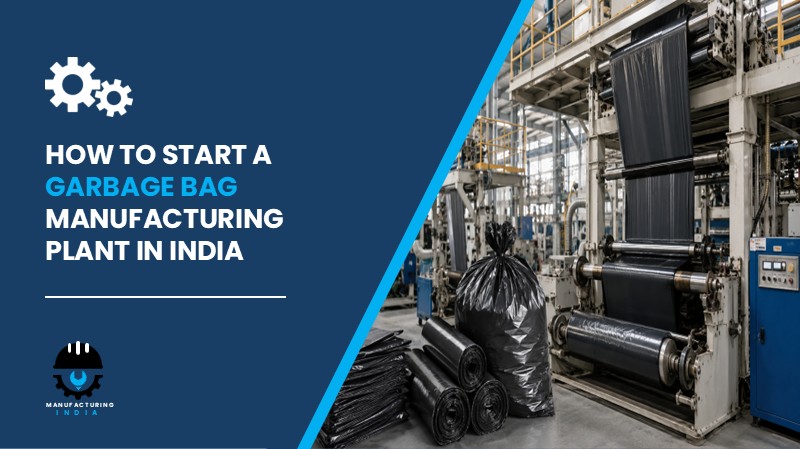
The primary production process covers blown film extrusion, surface printing, and star-sealing or heat sealing. End-use industries served include hospitality, healthcare, food service, retail, residential, waste management, and industrial manufacturing. Applications span waste containment in commercial kitchens, medical waste disposal in hospitals, household trash lining, retail shopping bags, industrial bin liners, and recycling collection programmes.
Cost of Setting Up a Garbage Bag Manufacturing Plant in India
The cost of establishing a garbage bag manufacturing plant in India depends on plant capacity, product mix across standard HDPE, LDPE, LLDPE, and compostable variants, the level of surface printing capability, geographic location — particularly proximity to polyethylene granule suppliers — degree of automation, and the BIS quality compliance requirements applicable to garbage bags sold to institutional and municipal customers in India.
1. Capital Expenditure (CapEx)
Land and Site Development forms a foundational component of total capital investment, covering land acquisition charges, site registration, boundary development, drainage infrastructure, and site utilities. The location must offer easy access to key raw materials such as LDPE/LLDPE granules and colour masterbatch. Proximity to target markets — particularly the large institutional buyers of garbage bags including hospital chains, hotel groups, municipal corporations, and facility management companies in metro and tier-1 cities — minimises distribution costs. The site must have robust infrastructure including reliable transportation, utilities, and waste management systems, with compliance with local zoning laws and environmental regulations ensured from the outset. Investors may explore polymer processing industrial estates in Ahmedabad, Surat, Silvassa, Noida, and Bhiwandi — locations with established LDPE/LLDPE granule supply chains and large institutional garbage bag demand in adjacent markets.
Plant Layout Optimisation is a critical civil investment for a garbage bag facility — the layout must be optimised to enhance workflow efficiency, safety, and minimise material handling between extrusion, printing, sealing, and packaging stages. Separate areas for raw material storage for LDPE/LLDPE granule silos and colour masterbatch, blown film extrusion bays, printing hall, sealing and cutting operations, quality control testing, finished goods storage, and dispatch must be designated. Space for future expansion should be incorporated to accommodate business growth as municipal, healthcare, and hospitality customer contracts are secured.
Machinery and Equipment represent the largest single component of total CapEx for a garbage bag manufacturing plant. Essential equipment includes:
- Shredders
- Extrusion lines
- Bag-making machines
- Sealing and cutting units
- Printing presses
- Quality control testers
- Automated packaging systems
Other Capital Costs include an effluent treatment plant (ETP) for managing process water and any polymer processing effluents, fume extraction systems for blown film extrusion operations, pre-operative expenses, BIS certification costs, commissioning charges, and import duties on high-speed automated bag-making and sealing equipment not available domestically at the required throughput specification.
Request a Sample Report for In-Depth Market Insights: https://www.imarcgroup.com/garbage-bag-manufacturing-plant-project-report/requestsample
2. Operational Expenditure (OpEx)
Raw Material Cost is the overwhelmingly dominant operational expense, accounting for approximately 75–85% of total OpEx. The primary raw materials are LDPE/LLDPE granules and colour masterbatch. LDPE and LLDPE granules — consumed in the largest volumes as the base polymer for blown film production — drive the vast majority of raw material cost and are priced in correlation with global polyethylene and naphtha markets. LLDPE is increasingly preferred for its superior tear resistance, puncture resistance, and stretch properties that enable thinner gauge films at equivalent strength — reducing raw material consumption per bag and improving overall material efficiency. Colour masterbatch is consumed in smaller volumes but is critical for producing the colour-coded bags required for municipal waste segregation compliance. Long-term contracts with reliable LDPE/LLDPE suppliers — including domestic resin producers and importers — must be negotiated to stabilise pricing and ensure a steady supply.
Utility Cost is the second-largest OpEx component, representing approximately 5–10% of total operating expenses — a low utility proportion reflecting the relatively energy-moderate nature of blown film extrusion and bag-making operations compared to energy-intensive chemical or metallurgical processes. Electricity for extrusion line drive motors, film blowing air systems, sealing and cutting equipment, printing presses, and automated packaging systems constitutes the primary utility input.
Other Operating Costs include transportation and distribution to institutional buyers including hospital chains, hotel groups, facility management companies, municipal corporations, retail chains, and food delivery aggregators, as well as through wholesale and retail distribution channels for household garbage bags, packaging materials for roll and flat-pack bag formats, salaries and wages for extrusion and bag-making machine operators, routine machinery maintenance including die head cleaning and sealing wire replacement, depreciation on production equipment, and applicable taxes. By the fifth year of operations, the total operational cost is expected to increase substantially due to factors such as inflation, market fluctuations, and potential rises in the cost of key materials. Supply chain disruptions, rising consumer demand, and shifts in the global economy are expected to contribute to this increase.
3. Plant Capacity
The proposed manufacturing facility is designed with an annual production capacity ranging between 10,000 and 30,000 MT, enabling economies of scale while maintaining operational flexibility across product grades including standard HDPE and LDPE household bags, heavy-duty LLDPE bags for industrial and healthcare applications, printed and branded bags for retail and hospitality clients, and compostable and biodegradable variants for premium and regulatory-aligned market segments. Plant capacity can be customised per investor requirements and scaled through additional extrusion lines and bag-making machines as institutional customer contracts and market penetration grow. Profitability improves with higher capacity utilisation, making secured supply agreements with large institutional buyers a strategic commercial foundation.
4. Profit Margins and Financial Projections
The financial projections for a garbage bag manufacturing plant demonstrate commercially sound profitability potential under normal operating conditions. Gross profit margins typically range between 20–30%, supported by stable and recurring necessity-product demand across residential, commercial, healthcare, hospitality, and municipal waste management customer segments. Net profit margins are projected at 10–15%. A comprehensive financial analysis covering NPV (net present value), IRR (internal rate of return), payback period, gross margin progression, and net margin development across a five-year horizon is essential before committing capital, with projections developed based on realistic assumptions related to capital investment, operating costs, production capacity utilisation, pricing trends, and demand outlook.
Why Set Up a Garbage Bag Manufacturing Plant in India?
Essential Daily-Use Product with Non-Cyclical Demand. Garbage bags are fundamental consumables for waste collection, hygiene maintenance, and sanitation across households, hospitals, hospitality, retail, municipalities, and industrial facilities — positioning them as a necessity product with recurring demand and non-cyclical consumption patterns. Unlike discretionary consumer products, garbage bag procurement is driven by waste generation volumes that grow directly with population, urbanisation, and economic activity — all of which are structurally expanding in India across a multi-decade horizon.
Rapid Urbanisation and Expanding Middle-Class Consumption. Rapid urbanisation, growing middle-class consumption, expansion of organised retail, healthcare infrastructure growth, food delivery ecosystems, and increasing hygiene awareness are driving sustained demand for reliable waste disposal solutions across India’s cities and towns. As more Indian households shift from unorganised waste disposal practices to purchased garbage bags — a transition that is accelerating with rising disposable incomes and urban apartment living — the residential market alone provides a large and growing demand base.
Policy and Waste Management Push Creating Regulatory Tailwinds. Government initiatives focused on urban cleanliness under the Swachh Bharat Mission, solid waste management reforms under the Solid Waste Management Rules 2016, municipal waste segregation mandates requiring colour-coded bins and liners, and sustainability targets are indirectly boosting demand for garbage bags — especially colour-coded and biodegradable variants aligned with environmental regulations. According to the IBEF, the biodegradable plastic market in India is expected to grow to USD 223 Million in 2030, as India escalates efforts under the single-use plastic ban — a growth trajectory that directly supports premium product positioning for organised garbage bag manufacturers who invest early in certified compostable and recycled-content variants.
Sustainable and Biodegradable Innovation Driving Market Expansion. In April 2024, Revolution launched Dailygood Bags — the most eco-friendly heavy-duty trash bags designed for everyday household use — made with as much as 97% post-consumer recycled plastic resin (PCR), resulting in lower environmental impacts compared to trash bags made without recycled content. This product launch demonstrates the commercial viability and consumer acceptance of sustainable garbage bag innovations that Indian producers can replicate and adapt for the domestic market as regulatory requirements for recycled content and biodegradable materials tighten progressively.
Megatrend Alignment Across Healthcare, Hospitality, and Food Delivery. The expansion of hospital capacity, hotel chains, quick-service restaurants, cloud kitchens, and food delivery aggregators across India’s cities is driving institutional demand for heavy-duty, specific-gauge, and often branded garbage bags that standard household-grade products cannot serve. These institutional channels command higher average selling prices, provide longer-term supply agreements, and offer better margin profiles than commodity retail distribution — making institutional customer development a key strategic priority for a new garbage bag manufacturing unit.
Localisation and Supply Chain Reliability Creating Commercial Opportunity. Institutional buyers, facility management companies, and municipal bodies prefer dependable regional manufacturers to ensure timely delivery, customisation including size, gauge, colour, and branding, and stable pricing amid polymer price volatility — creating commercial opportunities for efficient local producers with optimised sourcing and scalable production capacity. The moderate but defensible entry barriers of consistent film extrusion quality, thickness uniformity, load-bearing strength, leak resistance, printing capability, and large-volume supply commitments favour organised, process-driven producers focused on quality control and cost efficiency over unorganised small-scale competitors.
Manufacturing Process — Step by Step
The garbage bag manufacturing process uses blown film extrusion, surface printing, and star-sealing or heat sealing as the primary production method, covering raw material mixing and feeding, blown film extrusion, film printing, bag making including sealing and cutting, quality inspection, and automated packaging. Each stage requires controlled process parameters for film thickness uniformity, seal strength, and dimensional accuracy to deliver garbage bags meeting the load-bearing, leak resistance, and appearance specifications required by residential, institutional, and municipal customers.
- Raw Material Preparation and Mixing: LDPE/LLDPE granules are received from suppliers, quality-checked for melt flow index and density specification compliance, and blended with colour masterbatch in the required proportions for the target bag colour and specification. Recycled polymer content is blended where specified for PCR-content or compostable variant production.
- Blown Film Extrusion: The blended polymer granule mixture is fed into extrusion lines where it is melted and homogenised under controlled temperature and screw speed conditions, then extruded through an annular die where high-pressure air is introduced through the die centre to inflate the melt into a tubular film bubble of the specified diameter and lay-flat width. Controlled cooling of the film bubble by external air rings and internal bubble cooling achieves the target film thickness and mechanical properties.
- Film Winding and Slitting: The collapsed blown film tube is wound onto rolls or slit to the specified width dimensions required for the target bag size, with roll tension and winding speed controlled to prevent film distortion or blocking.
- Surface Printing: Where customer branding, regulatory markings, or product information printing is required, film rolls are processed through printing presses applying water-based or solvent-based inks in specified colours and designs to achieve consistent print registration and adhesion across the film surface.
- Bag Making — Sealing and Cutting: Printed or unprinted film is processed through bag-making machines where star-seal or heat-seal bottom seams are formed by impulse or continuous heat-sealing bars at controlled temperature and dwell time, and individual bags are cut from the continuous film at the specified length to produce the target bag dimensions.
- Perforation and Roll Conversion: Where roll-format dispensing is required for household or commercial roll bags, individual bags are perforated at specified intervals and wound onto cores using automated packaging systems for the consumer roll format.
- Quality Inspection: Finished garbage bags are tested at quality control testing stations covering film thickness gauge, seal strength, load-bearing capacity, leak resistance, dimensions, and print registration compliance against product specification requirements before release for packaging.
- Automated Packaging: Specification-compliant garbage bags — in flat-pack, roll, or bulk format — are counted, folded, and packed into retail cartons or institutional bulk packs using automated packaging systems, then labelled with product information, compliance markings, and customer branding before dispatch to residential, retail, healthcare, hospitality, food service, waste management, and industrial manufacturing customers.
Key Applications
Garbage bags manufactured in India serve a commercially broad and structurally growing range of waste containment and sanitation applications across all sectors of the economy:
- Waste Management: Household trash collection, commercial waste disposal, municipal bin lining, and sanitary containment across India’s expanding urban solid waste management infrastructure.
- Retail and Commercial: Packaging waste containment, in-store disposal systems, and bulk refuse handling across organised retail, shopping malls, and commercial complexes.
- Healthcare: Medical waste containment, sanitary liners, and biohazard segregation in hospitals, clinics, diagnostic centres, and pharmaceutical manufacturing facilities — a high-specification, premium-priced segment requiring specific gauge, colour-coding, and biohazard compliance.
- Hospitality and Food Service: Kitchen waste disposal, event cleanup, and high-volume trash collection across hotel chains, quick-service restaurants, cloud kitchens, catering operations, and food delivery infrastructure.
Leading Manufacturers
The global garbage bag industry is served by a group of large-scale multinational packaging companies with extensive production capacities and diverse application portfolios across residential, commercial, healthcare, and industrial waste containment segments. Key players in the global market include:
- Berry Global Group, Inc.
- Novolex Holdings, LLC
- The Clorox Company (Glad)
- Reynolds Consumer Products Inc.
- Mondi plc
Timeline to Start the Plant
Establishing a garbage bag manufacturing plant in India involves a structured multi-phase development sequence. Investors should plan for the following phases:
- Feasibility study and project report preparation
- Land acquisition and site development
- Regulatory approvals and environmental clearances
- Factory licence and fire safety compliance
- Machinery procurement and installation
- Raw material supplier agreements and supply chain setup
- Trial production and quality testing
- Commercial production launch
Licences and Regulatory Requirements
Starting a garbage bag manufacturing unit in India requires several approvals spanning business registration, plastic product compliance, environmental, and industrial safety domains:
- Business registration (Proprietorship, LLP, or Pvt Ltd)
- Factory Licence under the Factories Act
- Environmental Clearance from the State Pollution Control Board
- GST Registration
- Fire Safety NOC
- Plastic Waste Management Rules compliance under the Ministry of Environment, Forest and Climate Change — covering registration as a plastic producer/manufacturer, Extended Producer Responsibility (EPR) obligations, and compliance with thickness standards for plastic carry bags
- BIS certification where applicable for specific garbage bag product categories under relevant IS standards
- Effluent Treatment Plant (ETP) operational clearance for managing process water and polymer extrusion fume management
- Occupational Health and Safety compliance
Key Challenges to Consider
LDPE/LLDPE Price Volatility and Feedstock Cost Concentration. LDPE/LLDPE granules account for approximately 75–85% of total OpEx — among the highest raw material cost concentrations in polymer processing manufacturing — with polyethylene pricing directly tied to naphtha and ethylene markets that can move 15–25% within a single year. Managing this cost exposure requires long-term procurement contracts with domestic resin producers, customer contract price adjustment mechanisms linked to polymer benchmark prices, and careful inventory positioning relative to polyethylene price cycle expectations.
Plastic Waste Management Rules and Extended Producer Responsibility. India’s Plastic Waste Management Rules impose registration, EPR obligations, and minimum thickness standards on garbage bag manufacturers. Compliance management requires dedicated regulatory expertise and ongoing reporting to State Pollution Control Boards and the Central Pollution Control Board. Transitioning product lines to meet progressively stricter compostable, biodegradable, or PCR-content requirements as regulatory timelines tighten adds product development investment obligations alongside core production management.
Intense Market Competition in Commodity Segments. The LDPE/LLDPE garbage bag market is highly competitive across the standard gauge household segment, with a large number of unorganised small-scale producers operating on thin margins alongside established national brands. New entrants must differentiate through institutional customer quality certification, consistent supply reliability, product customisation capability for healthcare and hospitality segments, and early investment in sustainable and compostable variant product lines to compete beyond the commodity market tier.
Film Thickness Uniformity and Quality Consistency. Maintaining consistent gauge across blown film production — critical for meeting load-bearing and leak resistance specifications required by institutional customers — demands experienced extrusion machine operators, calibrated die tooling, and systematic quality monitoring across production runs. Any film thickness variation leads to bag failure at the seam under load — a quality deficiency that results in customer complaints, returns, and institutional contract cancellations that can be commercially damaging.
Medical and Biohazard Waste Segment Compliance Requirements. Supplying healthcare-grade garbage bags for medical waste and biohazard containment requires compliance with specific colour-coding standards under Biomedical Waste Management Rules, gauge specifications, and print mark requirements that add product development and regulatory compliance investment beyond standard household bag production.
Skilled Manpower for Extrusion and Bag-Making Operations. Maintaining consistent film quality, sealing integrity, and dimensional accuracy across high-speed blown film extrusion, printing, and bag-making operations requires trained polymer processing technicians and quality control operators — a workforce requiring ongoing investment in technical training and retention programmes.
Frequently Asked Questions
1. How much does it cost to set up a garbage bag manufacturing plant in India?
The total setup cost depends on plant capacity, product mix across standard, heavy-duty, printed, and biodegradable variants, location, and automation level. CapEx covers land and site development, polymer processing facility construction, core machinery including shredders, extrusion lines, bag-making machines, sealing and cutting units, printing presses, quality control testers, and automated packaging systems, along with ETP, fume extraction, and other capital costs. A detailed project report with full CapEx and OpEx breakdowns is available on request.
2. Is garbage bag manufacturing profitable in India in 2026?
Yes. The project demonstrates gross profit margins of 20–30% and net profit margins of 10–15% under normal operating conditions, supported by non-cyclical necessity-product demand from residential, healthcare, hospitality, food service, retail, and municipal waste management customers. The global garbage bag market’s growth from USD 13.80 Billion in 2025 to USD 23.40 Billion by 2034 at a CAGR of 5.89% confirms sustained commercial opportunity.
3. What machinery is required for a garbage bag plant in India?
Key machinery includes shredders, extrusion lines, bag-making machines, sealing and cutting units, printing presses, quality control testers, and automated packaging systems. Blown film extrusion lines are the most capital-intensive and production-critical equipment, determining film quality, output rate, and the range of bag gauges and widths the facility can produce.
4. What licences and approvals are required to start a garbage bag plant in India?
Required approvals include business registration, a Factory Licence under the Factories Act, Environmental Clearance from the State Pollution Control Board, GST registration, a Fire Safety NOC, Plastic Waste Management Rules compliance including EPR registration, BIS certification where applicable, ETP operational clearance, and Occupational Health and Safety compliance.
5. What raw materials are needed for garbage bag manufacturing?
The primary raw materials are LDPE/LLDPE granules and colour masterbatch. LDPE/LLDPE granules account for approximately 75–85% of total operating expenses, making polymer granule procurement strategy, supplier contracts with domestic resin producers, and polyethylene price risk management the most critical cost management levers for the investment.
6. What are the environmental compliance requirements for a garbage bag plant in India?
The unit must obtain Environmental Clearance from the State Pollution Control Board, comply with Plastic Waste Management Rules including EPR obligations and minimum thickness standards, operate a certified ETP for process water management, install fume extraction systems for blown film extrusion operations, and maintain monitoring systems for air emissions and wastewater discharge in line with applicable state pollution control standards.
7. What is the best location to set up a garbage bag plant in India?
Optimal locations offer proximity to LDPE/LLDPE resin suppliers or polymer trading hubs, reliable electricity supply, logistics connectivity to large institutional and retail customer markets, and established polymer processing industry ecosystems. Polymer processing industrial estates in Ahmedabad, Surat, Silvassa, Noida, and Bhiwandi are among the most strategically relevant options for this investment.
8. What is the break-even period for this type of plant in India?
The break-even period depends on plant capacity, product mix, capacity utilisation rate, polyethylene pricing trends, and demand conditions across residential, institutional, and municipal customer segments. A detailed financial analysis including payback period, NPV, and IRR projections is included in the full project report, available via the sample request link.
9. What government incentives are available for manufacturers in India?
The Make in India initiative, state-level polymer processing zone incentives, capital subsidy schemes under state investment promotion boards, and export promotion benefits for plastic products may be applicable. Producers investing in biodegradable and compostable garbage bag production aligned with India’s single-use plastic policy may additionally access specific sustainability-linked incentives and EPR compliance facilitation support from government agencies.
Key Takeaways for Investors
A garbage bag manufacturing plant in India represents one of the most commercially accessible and demand-stable manufacturing investments in the packaging sector — anchored by non-cyclical necessity-product consumption that grows directly with urbanisation, waste generation, healthcare expansion, and commercial activity across India’s rapidly developing economy. The project demonstrates financial viability across annual production capacities of 10,000 to 30,000 MT, with gross profit margins of 20–30% and net profit margins of 10–15% confirming commercially sound unit economics supported by the recurring, volume-driven demand of a product that every household, hospital, hotel, office, and municipality purchases continuously. The global garbage bag market, valued at USD 13.80 Billion in 2025, is projected to reach USD 23.40 Billion by 2034, growing at a CAGR of 5.89%, with India’s biodegradable plastic market expected to reach USD 223 Million by 2030 as single-use plastic bans progressively shift demand toward sustainable variants that organised, innovative Indian producers are best positioned to supply. With Revolution’s April 2024 launch of 97% post-consumer recycled content Dailygood Bags demonstrating the commercial viability of sustainable garbage bag innovation, and India’s Swachh Bharat Mission and waste segregation mandates sustaining institutional demand for colour-coded and specification-grade products, demand sustainability for India-based garbage bag manufacturing is structurally robust and commercially compelling across the full investment horizon.
About the Author