Setting up a poultry processing plant in India presents a highly compelling investment opportunity, driven by accelerating demand for safe, hygienic, and processed poultry products across the food service, quick-service restaurant (QSR), retail, healthcare, and institutional catering sectors; the rapid formalisation of India’s poultry value chain; rising consumer preference for chilled, frozen, and ready-to-cook formats; intensifying cold storage and temperature-controlled supply chain infrastructure; and the increasing penetration of branded processed poultry across modern trade, e-commerce, and quick-commerce platforms. As one of the most strategically significant segments of the global food processing industry, poultry processing combines live bird handling, slaughtering, defeathering, evisceration, chilling, cutting, deboning, value addition, packaging, and cold chain distribution operations to serve a broad range of food service, retail, institutional, and export markets.
Growth is driven by rising demand for affordable lean protein, rapid expansion of retail and QSR chains, and advancements in breeding, biosecurity, and feed technology. Asia Pacific leads global consumption, with India ranking among the world’s top broiler producers and emerging as a key export-oriented processing hub. The India poultry market size was valued at USD 2,594.30 Billion in 2025. According to IMARC Group estimates, the market is expected to reach USD 7,548.60 Billion by 2034, exhibiting a CAGR of 12.6% from 2026 to 2034.
Expanding adoption of chilled and frozen poultry products, growing demand for specialised value-added formats across the QSR, institutional catering, and modern retail sectors, and the increasing shift from wet-market live-bird procurement toward certified, hygienically processed, and brand-labelled poultry supply are driving sustained demand growth. The shift from unorganised and unhygienic poultry handling to food-safety-certified commercial processing integrates poultry processing as a core operation in modern food safety, hospitality, healthcare, and cold chain value chains.
Poultry processing sits at the intersection of food safety, animal protein supply, cold chain logistics, and downstream food service value chains, supported by a structurally growing global protein demand and expanding middle-class consumption in emerging economies. With gross profit margins typically ranging between 25 to 40% and a well-defined break-even trajectory at scale, a dedicated poultry processing plant represents both a financially sound and strategically well-timed investment for agribusinesses, food processing groups, cold chain logistics operators, and institutional investors targeting the evolving global food protein, food safety, and hospitality markets.
What is Poultry Processing?
Poultry processing is the industrial sequence of converting live poultry birds primarily broiler chickens, but also ducks, turkeys, and geese into food-safe, hygienically processed, and commercially packaged meat products for retail, food service, institutional, and export markets. Modern poultry processing is distinct from traditional wet-market slaughter in terms of hygiene standards, food-safety certification, production volume, product consistency, cold chain compliance, and value-addition capability across fresh, chilled, frozen, marinated, and ready-to-cook product formats.
Live birds are the primary raw material for poultry processing. Procurement is structured through contract farming arrangements, integrator networks, or open market sourcing, with birds typically broiler chickens at 38 to 42 days of age and 2.0 to 2.5 kg live weight. Feed conversion efficiency, breed selection, biosecurity compliance, and proximity of farm clusters to the processing facility are critical determinants of raw material cost and throughput economics at commercial scale.
Standard poultry product formats include whole eviscerated birds for food service and retail, fresh and chilled bone-in cuts (breast, thigh, drumstick, wing), boneless and skinless breast and thigh fillets, mechanically deboned meat (MDM) for further processing, offal and by-products (liver, gizzard, feet, head), and value-added ready-to-cook and marinated products (nuggets, strips, sausages, salami, keema). Packaging formats range from retail-tray fresh packs and MAP (modified atmosphere packaging) for premium shelf-life extension to bulk frozen cartons for food service, institutional, and export customers.
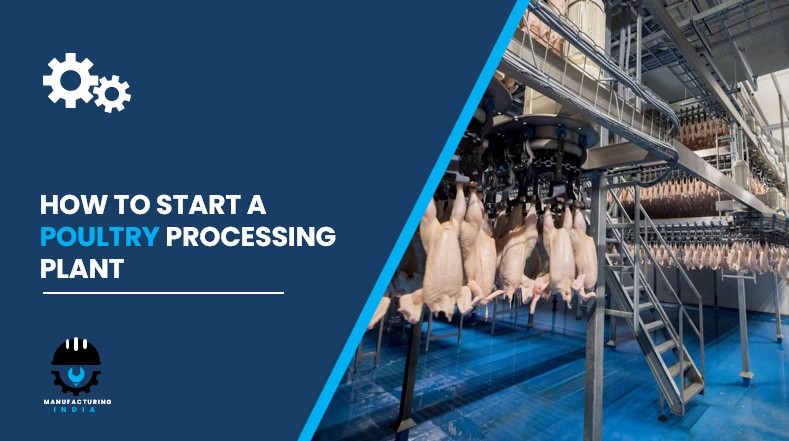
The poultry processing sequence broadly involves live bird reception and ante-mortem inspection, electrical stunning and humane slaughter, scalding and defeathering, evisceration and giblet recovery, carcass washing, chilling (air or water immersion), grading and quality inspection, cutting and portioning, deboning, value-added product manufacture, packaging and labelling, cold storage, and distribution. End-use segments include QSR chains, food service and catering, modern retail and organised grocery, food processing and further processing, healthcare and institutional catering, and poultry export markets.
Cost of Setting Up a Poultry Processing Plant
The total cost of establishing a poultry processing plant depends on several variables including plant throughput capacity (birds per hour), product mix (whole bird, fresh cuts, frozen, value-added), level of automation (semi-automatic versus fully automated lines), geographic location and proximity to farm clusters, cold storage requirements, effluent treatment infrastructure, and applicable food safety and regulatory compliance requirements. A thorough feasibility assessment covering all CapEx and OpEx components is essential before committing capital, given the perishable, food-safety-regulated, and cold-chain-dependent nature of commercial poultry processing.
1. Capital Expenditure (CapEx)
Capital investment for a poultry processing plant covers several broad cost heads. Land and site development forms a meaningful part of the overall investment, encompassing land registration charges, boundary development, drainage, site grading, and related civil infrastructure expenses. A typical commercial poultry processing facility requires a land parcel sized to accommodate the live bird receiving area and lairage, slaughter and primary processing hall, evisceration and chilling section, cutting and deboning room, value-addition and further processing area, cold storage chambers, packaging and dispatch bay, quality control laboratory, effluent treatment plant, and on-site utility installations. Investors may consider locating the facility in proximity to dense broiler farming clusters, food processing industrial parks, organised retail distribution hubs, QSR supply chain networks, or port-connected logistics centres for export-oriented strategies.
Civil works and construction costs cover the live bird receiving dock and lairage, ante-mortem inspection area, hygienic processing hall with food-grade flooring and wall cladding, evisceration area, chilling and grading section, cutting and deboning room with temperature-controlled environment, value-added processing area, packaging zone, cold storage chambers, effluent treatment plant, quality control laboratory, and the administrative block. Machinery and equipment costs represent the largest single portion of total capital expenditure. Key machinery and equipment required includes:
- Live Bird Handling and Receiving: Live bird receiving and lairage systems (hanging shackle conveyors, live bird unloading platforms, lairage with ventilation and sprinkler systems, ante-mortem inspection holding areas, and weighbridge for live weight measurement)
- Slaughter and Defeathering Equipment: Slaughter and primary processing equipment (electrical stunning baths calibrated for humane stun-to-kill, automatic neck-cutter systems, bleeding tunnel with shackle conveyors, scalding tanks with temperature control for soft scald or hard scald, drum defeathering machines, hock cutter systems, wax dipping units for specialty defeathering, and transfer systems to evisceration line)
- Evisceration Equipment: Evisceration line machinery (automatic vent opener and opening machine, automatic evisceration systems or manual evisceration tables, giblet harvesting equipment for liver, gizzard, and heart separation and cleaning, lung vacuum extraction systems, crop and oesophagus removal units, carcass washing machines with inside-outside washers, post-mortem inspection platforms, and neck skin and neck removal equipment)
- Chilling Systems: Chilling systems (continuous water immersion chiller tanks with auger conveyors for broiler carcasses, air chilling tunnels for premium and export-grade carcass chilling, ice water chilling systems, overflow chlorinated water chilling for food-safety compliance, post-chill drain and drip lines, and surface temperature verification systems for HACCP monitoring)
- Cutting, Portioning, and Deboning: Cutting, portioning, and deboning equipment (automatic cone systems for halving and quartering, robotic and manual breast deboning tables, thigh and drumstick separators, wing cutting machines, automated cut-up lines for 8-piece and 10-piece commercial cuts, portioning machines with integrated weight-grading, and mechanical deboning presses for MDM production)
- Value-Added Processing Equipment: Value-added and further processing equipment (tumbler marinators and injection systems, batter and breading applicators for nuggets and strips, impingement ovens and spiral freezers for cooked product lines, meat grinders and mixers for keema and sausage lines, sausage stuffers and linkers, smoking chambers, and steam cooking ovens)
- Packaging and Freezing Equipment: Packaging lines (automatic tray-sealing machines for retail fresh packs, MAP (modified atmosphere packaging) lines for extended shelf-life products, vacuum packaging machines for bulk and foodservice packs, IQF (individually quick frozen) tunnels, inline net weight checkers, date-code and batch printing systems, carton erectors and sealers, shrink-wrapping units, and automated palletisers)
- Cold Storage and Refrigeration Infrastructure: Cold storage and refrigeration infrastructure (pre-chilling holding rooms, blast freezers for IQF product lines, cold storage chambers at minus 18°C for frozen inventory, chiller rooms at 0°C to 4°C for fresh and chilled product holding, refrigerated dispatch docks, temperature data logging and monitoring systems, and ammonia or HFO refrigeration plant)
- Quality Control and Laboratory Equipment: Quality control and food safety laboratory equipment (pH meters, temperature probes and data loggers, microbial plate count incubators, rapid pathogen detection systems for Salmonella and Campylobacter, water activity meters, fat content analysers, spectrophotometers for chemical residue testing, and standard analytical equipment)
- Effluent Treatment Plant (ETP): Effluent treatment plant (screening and grit removal systems, dissolved air flotation units for blood and fat separation, aerobic and anaerobic biological treatment reactors, sludge thickening and dewatering presses, treated water recycling infrastructure, and effluent quality monitoring systems compliant with CPCB norms)
- Utility and Support Systems: Utility systems (electrical substations and transformers, standby diesel generators for cold chain continuity, compressed air systems, boilers for scalding and sanitation hot water, water treatment and softening systems, ammonia or HFO refrigeration plant, cooling towers, waste rendering and by-product processing equipment, and energy metering systems)
- Material Handling and Dispatch: Material handling and dispatch equipment (overhead shackle rail systems, processing floor carts and trolleys, forklift trucks and pallet jacks, refrigerated dispatch vehicles for last-mile cold chain distribution, and loading dock levellers and restraints)
Other capital costs include utility connections (electricity, water, and refrigerant supply), pre-operative expenses, plant commissioning costs, cold-room insulation panel procurement, trial production runs, import duties on specialised slaughter equipment, automated deboning systems, and MAP packaging machinery not manufactured domestically.
Request a Sample Report for In-Depth Market Insights: https://www.imarcgroup.com/poultry-processing-plant-project-report/requestsample
2. Operational Expenditure (OpEx)
The operating cost structure of a poultry processing plant is heavily weighted toward live bird raw material procurement. Live bird costs typically account for 60 to 70% of total revenue, making raw material procurement efficiency, contract farming network management, and breed and feed conversion optimisation the primary commercial priorities for operational cost control. Electricity costs for refrigeration, chilling, freezing, processing equipment, and cold storage account for approximately 5 to 10% of revenue. Water procurement, treatment, and effluent management represent an additional significant operating cost given the high-water intensity of scalding, chilling, and sanitation operations in poultry processing.
Additional operating costs include packaging materials (retail trays, MAP film, vacuum pouches, bulk cartons, and palletisation materials), cold chain transportation and last-mile delivery logistics, salaries and wages for line operators, quality control technicians, sanitation staff, veterinary officers, and delivery personnel, periodic equipment maintenance and blade sharpening, refrigerant management costs, water treatment chemical replenishment, microbiological and chemical testing consumables, and applicable FSSAI, HACCP, ISO, and export certification and renewal costs.
3. Plant Capacity
The proposed poultry processing facility is designed with a throughput capacity ranging between 1,000 to 5,000 birds per hour, enabling meaningful economies of scale while preserving operational flexibility across the full product range, from commodity-grade whole birds and fresh bone-in cuts to premium boneless fillets, MAP-packed retail products, and value-added ready-to-cook lines. Plant capacity can be customised based on the investor’s specific capital availability, target market scale, available contract farming flock base, and chosen product mix across end-use segments such as QSR chains, organised retail, institutional catering, food processing, and export markets.
Profitability improves considerably at higher capacity utilisation levels, given the significant fixed-cost component of refrigeration plant, cold storage infrastructure, and automated processing lines, making early offtake agreements with QSR chains, organised retail buyers, institutional caterers, food processing companies, and export trading houses strategically important for achieving break-even at pace.
4. Profit Margins and Financial Projections
A poultry processing plant demonstrates healthy profitability potential under normal operating conditions. Gross profit margins typically range between 25 to 40%, supported by stable and growing demand across QSR, food service, retail, institutional, and export markets; the structural formalisation of India’s poultry value chain toward certified hygienically processed supply; rising FSSAI food safety compliance requirements across organised food channels; and differentiation opportunities through premium branded, value-added, and ready-to-cook poultry product formats for modern retail, quick-commerce, and QSR chains. Net profit margins range between 10 to 18%. Financial projections incorporate NPV analysis, IRR calculations, payback period modelling, and sensitivity analysis across plant capacity utilisation, live bird price scenarios, and end-market demand conditions, providing investors with a comprehensive view of long-term financial viability.
Why Set Up a Poultry Processing Plant?
- Essential Protein Staple: Poultry is the world’s most widely consumed animal protein and serves as a daily dietary staple across virtually every segment of the retail, food service, institutional, and quick-service restaurant supply chain, making it a high-volume, structurally growing food product with sustained replacement and replenishment cycles across the global food protein ecosystem.
- Food Safety and Cold Chain Megatrend: Rising consumer awareness of food-borne illness, expanding FSSAI food safety enforcement across organised food service and retail, growing QSR chain dependence on certified processed supply, and the rapid scaling of India’s cold chain infrastructure are driving sustained demand for food-safety-certified hygienically processed poultry across emerging and developed economies.
- QSR and Food Service Sector Expansion: India’s rapidly expanding quick-service restaurant sector including global chains like McDonald’s, KFC, Domino’s, and Burger King, alongside domestic chains create escalating demand for consistent, specification-grade, hygienically processed chicken supply. The QSR sector’s dependence on certified processed poultry over live-bird wet-market procurement is creating attractive institutional supply opportunities for well-positioned processors.
- Poultry Export Growth: India is one of the world’s largest broiler producers, and the country’s growing seafood and poultry export volumes create expanding demand for export-certified, food-safety-compliant poultry processing capacity. Market access to GCC countries, Southeast Asia, and the Maldives creates additional high-value export revenue streams for well-credentialed processors.
- Retail Packaged Poultry and Modern Trade: The expansion of supermarkets, hypermarkets, convenience stores, and quick-commerce platforms is creating a growing market for branded, MAP-packed, and ready-to-cook retail processed poultry, where food-grade certification, consistent quality, and hygienic sealed packaging differentiate established commercial processors from unorganised wet-market supply and create structurally improving unit realisations.
- Healthcare and Institutional Catering: Hospitals, institutional caterers, airline catering, and corporate canteens require certified, hygienically processed, and consistently portioned poultry supply, creating a premium quality-compliance entry barrier segment with superior unit margins and recurring offtake commitments.
- Processing Technology and Automation Advances: Adoption of automated slaughter and processing lines, IoT-based temperature monitoring and HACCP compliance systems, robotic deboning and portioning, high-pressure processing (HPP) for extended shelf life, and MAP packaging for premium chilled product lines are improving yield, food safety, product shelf life, and operational efficiency across modern poultry processing facilities.
- Government Infrastructure and Food Processing Incentives: The National Livestock Mission (NLM), Animal Husbandry Infrastructure Development Fund (AHIDF), Production Linked Incentive (PLI) scheme for food processing, Pradhan Mantri Kisan Sampada Yojana (PMKSY), and state-level food processing park infrastructure incentives directly support poultry processing investment with capital subsidies, cold chain grants, and preferential land allocation.
How Poultry is Processed
The poultry processing sequence encompasses live bird receiving and ante-mortem inspection, stunning and slaughter, scalding and defeathering, evisceration and giblet recovery, carcass chilling, grading and quality inspection, cutting and deboning, value-added product manufacture, packaging, cold storage, and dispatch as the core stages of commercial production. Each stage involves specific unit operations, quality assurance checkpoints, and process control protocols aligned to food safety standards (FSSAI, BIS, ISO 22000, HACCP, FSSC 22000, and applicable export standards).
- Live Bird Reception and Ante-Mortem Inspection: Live birds received from contract farms or open market suppliers are off-loaded at the receiving dock, hung on overhead shackle conveyors, and transported through the lairage where ante-mortem inspection by a designated veterinary officer is conducted to identify sick, injured, or condemned birds before entry to the slaughter line.
- Stunning, Slaughter, and Bleeding: Birds are electrically stunned in a water-bath stunner calibrated to deliver a controlled electrical current ensuring insensibility without cardiac arrest, followed by automatic or manual neck-cutting, and bleeding in a dedicated bleeding tunnel for a specified bleed-out time to ensure complete exsanguination before scalding.
- Scalding and Defeathering: Bled carcasses pass through hot-water scalding tanks with temperature and time precisely controlled (typically 50°C to 56°C for soft scald or 58°C to 60°C for semi-scald) to loosen feather follicles, followed by drum defeathering machines that mechanically remove feathers, with a final hock cut to separate feet for by-product recovery.
- Evisceration and Giblet Harvesting: Eviscerated carcasses enter the evisceration line where automated or manual systems open the abdominal cavity, remove the visceral package intact to prevent contamination, and separate giblets (liver, gizzard, and heart) for individual cleaning, inspection, and packaging. Lungs are removed by vacuum extraction. Inside-outside carcass washers apply potable chlorinated water to remove surface contamination before post-mortem veterinary inspection and grading.
- Carcass Chilling: Post-evisceration carcasses enter continuous water immersion chilling tanks or air-chilling tunnels where carcass core temperatures are reduced to below 4°C before grading. Chilling is a critical food safety step for Salmonella and Campylobacter control. Air chilling is preferred for premium export-grade and MAP-packed retail products due to lower moisture absorption and improved carcass surface appearance.
- Cutting, Portioning, and Deboning: Chilled carcasses are graded by veterinary inspection for conformity, bruising, broken bones, and contamination, then transported by overhead conveyors or processing carts to cut-up and deboning rooms maintained at 10°C or below. Automated cut-up lines or manual stations portion carcasses into 8-piece or 10-piece commercial cut sets, while separate deboning lines produce boneless breast and thigh fillets, wings, and drumsticks. MDM presses process back and neck frames for mechanically deboned meat.
- Value-Added Product Manufacturing: Value-added product lines process selected raw material through tumbler marinators, batter and breading systems, impingement ovens, spiral freezers, and sausage and keema manufacturing lines to produce ready-to-cook and ready-to-eat product formats for retail, QSR, and food service channels.
- Packaging and Freezing: Finished products are packed on automated tray-sealing lines (retail fresh packs), MAP lines (extended shelf-life chilled products), vacuum packing lines (bulk foodservice packs), or IQF spiral freezers followed by bulk carton packing for frozen export products. Date coding, batch numbering, and inline weight checking are integrated at each packaging line.
- Quality Inspection and Release: Production samples from each lot undergo microbiological and chemical testing, temperature verification, packaging integrity inspection, and weight compliance checks. Each batch is released only upon passing all specified quality parameters under FSSAI, BIS, HACCP, and applicable export certification standards before entering cold storage or dispatch.
Key Applications
Processed poultry manufactured at a dedicated commercial facility serves a broad range of end-use channels, each with specific product type, purity, size, and packaging requirements.
- Quick-Service Restaurant (QSR) and Food Service: Global and domestic QSR chains require specification-grade, consistently sized, hygienically processed chicken cuts, fillets, and value-added products such as nuggets and strips as core menu inputs, making QSR supply the fastest-growing institutional segment for certified commercial poultry processors.
- Retail Packaged Poultry: Supermarkets, hypermarkets, and quick-commerce platforms sell branded, MAP-packed, and retail-tray fresh and frozen poultry products directly to household consumers, driving growing demand for consistently portioned, hygienically certified, and attractively packaged poultry at modern trade points.
- Food Processing and Further Processing: Further processing companies use whole eviscerated carcasses, boneless cuts, and MDM as inputs for ready-to-eat products, canned poultry, pet food, and processed meat product manufacture, creating a large-volume institutional offtake channel.
- Institutional Catering and Airline Supply: Airlines, hospitals, corporate cafeterias, and institutional caterers require consistent, certified, and hygienically processed poultry supply in specified portion weights and product formats, with documented food safety certifications as a procurement prerequisite.
- Poultry Export and Halal Markets: Export-certified processed poultry in frozen whole bird, cut, and value-added formats serves GCC, Southeast Asian, and Maldives markets, with halal-certified supply representing a growing and premium-margin export segment for Indian processors.
- By-Product and Offal Recovery: Poultry feet, liver, gizzard, heads, feathers, blood, and sludge from the effluent treatment plant are recovered as value-added by-products for export (feet to China and Southeast Asia), pet food, pharmaceutical, and fertiliser markets, contributing meaningfully to total plant revenue and waste reduction objectives.
Leading Poultry Processors
The commercial poultry processing industry is served by regional, national, and multinational companies with significant processing capacities and diverse product portfolios. Key players include:
- Suguna Foods Pvt. Ltd. (India)
- Venkateshwara Hatcheries (VH Group) (India)
- IB Group (India)
- Srinivasa Farms (India)
- Godrej Agrovet (India)
- Tyson Foods (USA)
- BRF S.A. (Brazil)
- JBS S.A. (Brazil)
- Cargill Protein (USA)
- Charoen Pokphand Foods (Thailand)
- NH Foods (Japan)
- LDC (Groupe Le Duff, France)
Recent Industry Developments
- January 2026: IB Group inaugurated a new INR 160 crore poultry processing and feed plant at Amethi, Uttar Pradesh, with a capacity to process and supply 3 lakh broiler chicks per day and 600 tonnes of poultry feed per day, strengthening the North India integrated poultry value chain and boosting supply to organised retail and QSR channels.
- June 2025: Boehringer Ingelheim launched a next-generation single-dose poultry vaccine in India providing combined protection against Bursal, Newcastle, and Marek’s disease, addressing biosecurity risks that impact live bird supply consistency and processing plant throughput reliability.
- May 2025: Marfrig announced the finalisation of its full takeover of BRF, consolidating Brazil’s position as the world’s dominant poultry processing and export nation, signalling continued global consolidation trends in integrated poultry processing that India’s domestic processors must benchmark against to remain competitive in export markets.
Timeline to Start the Plant
Investors planning a poultry processing plant should anticipate the following phased development timeline, typically ranging from 10 to 14 months depending on site development requirements, regulatory approval timelines, and the lead time for slaughter equipment, automated processing lines, cold storage chambers, and effluent treatment infrastructure:
- Feasibility study and detailed project report preparation
- Land acquisition, site assessment, and water availability evaluation
- Regulatory approvals: FSSAI Central Licence, Factory Licence, Environmental Clearance, Consent to Establish, halal certification body engagement, and utility connections
- Civil construction: live bird receiving dock, slaughter hall, evisceration area, chilling section, deboning room, cold storage chambers, packaging area, ETP, quality laboratory, and administrative block
- Specialised machinery procurement, slaughter line installation, refrigeration plant commissioning, cold-room panel installation, and utility infrastructure setup
- Live bird supply chain development through contract farming network establishment or open market procurement agreements
- Plant commissioning, refrigeration system testing, and trial production runs
- Product qualification, FSSAI food-safety certification, HACCP implementation, BIS and halal certification, and institutional buyer technical qualification
- Distribution channel development, QSR and retail key account relationships, and commercial production ramp-up to design capacity
Licences and Regulatory Requirements
Starting a poultry processing unit requires several approvals, which vary by country and jurisdiction:
- Business registration (Proprietorship, LLP, or Private Limited Company)
- FSSAI Central Licence under the Food Safety and Standards Act (mandatory for food-grade commercial poultry processing in India)
- Factory Licence under applicable factories legislation
- Industrial Entrepreneur Memorandum (IEM) filing with the Department for Promotion of Industry and Internal Trade (India)
- Environmental Clearance from the relevant national authority (where applicable based on project scale)
- Consent to Establish and Consent to Operate from the relevant State Pollution Control Board
- Slaughterhouse establishment licence from the municipal authority and veterinary department
- Ante-mortem and post-mortem inspection veterinary officer appointment as per Food Safety and Standards (Food Products Standards and Food Additives) Regulations
- Halal certification from an accredited halal certification body (mandatory for export to GCC, ASEAN, and other Muslim-majority markets)
- ISO 22000 / FSSC 22000 Food Safety Management System certification
- HACCP (Hazard Analysis and Critical Control Points) certification
- BIS certification (where applicable for specific packaged poultry product standards)
- GST Registration
- Fire Safety NOC
- Electricity Board approval and grid connectivity permits
- APEDA registration for export of processed poultry products
- Import or Export Code (IEC) for international trade
- EPR (Extended Producer Responsibility) registration for plastic packaging compliance
- ISO 9001 Quality Management System certification (recommended for institutional and export supply)
- ISO 14001 Environmental Management System certification
- ISO 45001 Occupational Health and Safety Management System certification
- MSME registration (where applicable, for access to government subsidy and incentive schemes)
- Water quality and discharge compliance permits from state water regulation authorities
Key Challenges to Consider
- Live Bird Price Volatility and Procurement Risk: Live bird raw material represents 60 to 70% of total processing revenue, making procurement cost management, contract farming network depth, bird quality consistency, and feed conversion efficiency the dominant commercial variable in poultry processing economics. Price volatility driven by seasonal demand swings, disease outbreaks, and feed cost escalation directly compresses margins and requires active procurement risk management strategies.
- Biosecurity and Disease Risk: Avian influenza outbreaks, Newcastle disease, infectious bursal disease, and other poultry health incidents cause severe disruptions to live bird supply, force processing plant stoppages, trigger market demand decline, and impose regulatory stamping-out and movement restrictions that impact revenue continuity and supply chain reliability.
- Water Intensity and Effluent Management: Poultry processing is one of the most water-intensive food-grade production operations, with large volumes required for scalding, chilling, and sanitation, and wastewater containing blood, fat, feathers, and organic matter requiring comprehensive treatment before discharge. Compliance with CPCB effluent standards, investment in ETP infrastructure, and water recycling systems are non-negotiable capital and operating requirements.
- Electricity and Cold Chain Energy Cost: Refrigeration compressors, blast freezers, cold storage, processing area air handling, and hot water for scalding and sanitation make electricity a significant operating cost component. Reliability of grid power supply for cold chain continuity and competitive industrial electricity tariff access are critical location and operating cost considerations.
- Competition from Wet Market and Unorganised Supply: India’s wet market live-bird trade, operating without FSSAI licences, food-grade certifications, or adequate hygiene protocols, competes on price through lower-cost unregulated supply, particularly in tier-2 and tier-3 markets. Investing in brand building, food safety certification visibility, FSSAI compliance visibility, and QSR and modern retail channel partnerships is critical to defending market share.
- Skilled Workforce and Labour Management: Commercial poultry processing employs a large workforce including skilled slaughter operators, deboning technicians, quality control personnel, and refrigeration technicians. Labour turnover in processing environments, availability of trained halal slaughterers for export-certified production, and occupational health and safety compliance are ongoing workforce management priorities.
- Seasonal Demand Variability: Poultry demand in India is significantly seasonal, with peak consumption during cooler months and festive periods and relative slowdowns during summer. Managing seasonal inventory across fresh, chilled, and frozen product lines, building diversified offtake channel portfolios, and maintaining cold storage buffer capacity are important strategies for revenue stability.
- Export Compliance and Halal Certification: Accessing high-value export markets in the GCC, Southeast Asia, and Maldives requires obtaining and maintaining halal certification, export veterinary health certificates, APEDA registration, and compliance with importing country-specific food safety and residue standards, creating both a significant compliance cost and a meaningful competitive barrier for certified exporters.
Project Economics
Capital Expenditure (CapEx) and Operational Expenditure (OpEx) Analysis
Capital Investment (CapEx)
Slaughter and primary processing equipment, automated evisceration lines, chilling systems, cutting and deboning machinery, cold storage and blast freezing infrastructure, and effluent treatment plant costs account for the largest portion of total capital expenditure. The cost of land and site development including civil construction of the slaughter hall, evisceration area, chilling section, deboning room, cold storage chambers, packaging area, ETP, and administrative block forms a substantial part of the overall investment, ensuring a solid foundation for safe, hygienic, and food-safety-compliant plant operations across the multi-year asset depreciation cycle.
Operating Expenditure (OpEx)
In the first year of operations, the operating cost for the poultry processing plant is projected to be significant, covering live bird procurement (accounting for approximately 60 to 70% of total revenue, the dominant OpEx component), electricity (for refrigeration, processing, chilling, freezing, and utility systems), water procurement and treatment, packaging materials, transportation and last-mile delivery logistics, salaries and wages for processing line operators, quality control staff, veterinary personnel, and delivery staff, depreciation, taxes, equipment maintenance costs, and applicable food safety certification costs. By the fifth year, the total operational cost is expected to increase due to live bird price escalation, electricity tariff increases, labour cost growth, and logistics cost inflation.
Frequently Asked Questions
1. How much does it cost to set up a poultry processing plant?
Total setup cost depends on plant throughput capacity (birds per hour), product mix (whole bird, fresh cuts, frozen, value-added), level of automation, cold storage capacity, ETP requirements, geographic location, and applicable regulatory requirements. Capital investment covers land, civil works, slaughter and defeathering equipment, evisceration line, chilling systems, cutting and deboning machinery, value-added processing equipment, packaging lines, cold storage chambers, ETP, utility infrastructure, quality control laboratory equipment, and pre-operative costs. A detailed project report provides capacity-specific cost estimates.
2. Is poultry processing profitable?
Yes. Gross profit margins typically range between 25 to 40% and net margins between 10 to 18%, supported by growing demand across QSR, food service, retail, institutional, and export markets; the structural formalisation of India’s poultry value chain toward certified hygienically processed supply; rising FSSAI food safety compliance requirements across organised food channels; and product differentiation opportunities through premium branded, value-added, and ready-to-cook poultry product formats.
3. What machinery is required for a poultry processing plant?
Essential machinery and equipment includes live bird receiving and shackle conveyors, electrical stunning systems, automatic neck cutters, scalding tanks, drum defeathering machines, evisceration line equipment (automatic or manual), inside-outside carcass washers, water immersion or air chillers, automated cut-up lines, deboning tables and equipment, value-added processing lines (marinators, breading, ovens, freezers), packaging lines (tray sealing, MAP, vacuum, IQF), cold storage refrigeration plant, effluent treatment plant, and quality control laboratory instruments.
4. What licences and approvals are required to start a poultry processing plant?
Required approvals include business registration, FSSAI Central Licence (mandatory for food-grade commercial poultry processing in India), Factory Licence, slaughterhouse establishment licence from the municipal and veterinary authority, Environmental Clearance where applicable, Consent to Establish and Operate from the State Pollution Control Board, halal certification (for export markets), ISO 22000 / FSSC 22000 food safety certification, HACCP certification, fire safety NOC, GST registration, APEDA registration for poultry export, and electricity board approval.
5. What raw materials are needed for poultry processing?
The primary raw material is live broiler birds (typically 38 to 42 days old, 2.0 to 2.5 kg live weight) sourced through contract farming networks or open market procurement. Supporting inputs include potable water (high volume for scalding, chilling, and sanitation), packaging materials (retail trays, MAP film, vacuum pouches, bulk cartons, and palletisation materials), cleaning and sanitisation chemicals, ice for supplementary chilling, and refrigerants for cold storage and processing area temperature control.
6. What are the environmental compliance requirements?
Operators must obtain Consent to Operate, comply with CPCB effluent discharge standards for slaughterhouse and food processing wastewater, invest in comprehensive ETP infrastructure including dissolved air flotation, biological treatment, and sludge management, manage solid waste including feathers, blood sludge, and condemned material through licensed disposal or rendering, and adhere to applicable water-discharge norms and air emission standards for boilers and rendering operations.
7. What is the best location to set up a poultry processing plant?
Ideal locations offer proximity to dense broiler farming clusters (minimising live bird transport stress and procurement cost), access to reliable and competitively priced electricity (a significant operating cost), availability of high-quality and high-volume water supply, compliance with industrial and slaughterhouse zoning and food-safety regulations, cold chain logistics infrastructure for last-mile distribution, and availability of skilled processing line and refrigeration workforce.
8. How long does it take to start a poultry processing plant?
The timeline typically ranges from 10 to 14 months, depending on site development requirements, regulatory approval timelines (particularly FSSAI Central Licence, slaughterhouse licence, Environmental Clearance, and ETP approval), slaughter equipment and processing line procurement lead times, civil works completion, equipment installation and commissioning, trial production runs, and product certification under FSSAI, HACCP, and applicable food-safety and export standards.
9. What government incentives are available for poultry processors?
In India, the Animal Husbandry Infrastructure Development Fund (AHIDF) provides incentivised credit for meat processing and cold chain infrastructure investment. The Production Linked Incentive (PLI) scheme for food processing, Pradhan Mantri Kisan Sampada Yojana (PMKSY), and state-level industrial promotion policies provide additional support. The National Livestock Mission (NLM) supports integrated poultry processing investment. State-level concessions on power tariffs, stamp duty, and GST reimbursement, along with priority allocation of land in food processing parks and agri-processing clusters, offer further financial benefits.
10. What is the break-even period for a poultry processing plant?
Break-even typically ranges from 4 to 6 years, depending on scale, automation level, live bird procurement cost structure, electricity tariff, product mix between commodity-grade bulk supply and premium value-added branded product formats, and customer offtake contract flow. Securing early supply agreements with QSR chains, organised retail buyers, institutional caterers, food processing companies, and export trading houses can significantly support a smoother ramp-up and faster break-even achievement.
Key Takeaways for Investors
The poultry processing plant opportunity is underpinned by sustained demand growth across QSR chains, food service, organised retail, institutional catering, food processing, poultry export, and by-product recovery all aligned with global food safety, cold chain infrastructure expansion, urbanisation, and protein consumption megatrends.
The structural formalisation of India’s poultry value chain toward certified food-grade hygienically processed supply, the growing QSR and food service sector dependence on specification-grade processed poultry, rising FSSAI food safety enforcement across organised food service and retail, the expanding halal-certified poultry export market, and the long-term scaling of India’s cold chain infrastructure create a robust and diversified demand base for well-positioned commercial poultry processors.
With a well-defined market demand base across multiple end-use segments, strong product differentiation opportunities through certified purity grades, branded packaged formats, and premium value-added ready-to-cook variants, capital-efficient processing economics once slaughter and deboning assets are fully depreciated, and the fundamental role of commercial poultry processing in delivering food safety, consistent protein supply, and cold chain integrity demanded by QSR, retail, institutional, and export customers, poultry processing offers both medium-term commercial viability and long-term demand sustainability for well-positioned processors operating at scale with strong brand, distribution, food-safety, and cold chain logistics foundations.
About the Author