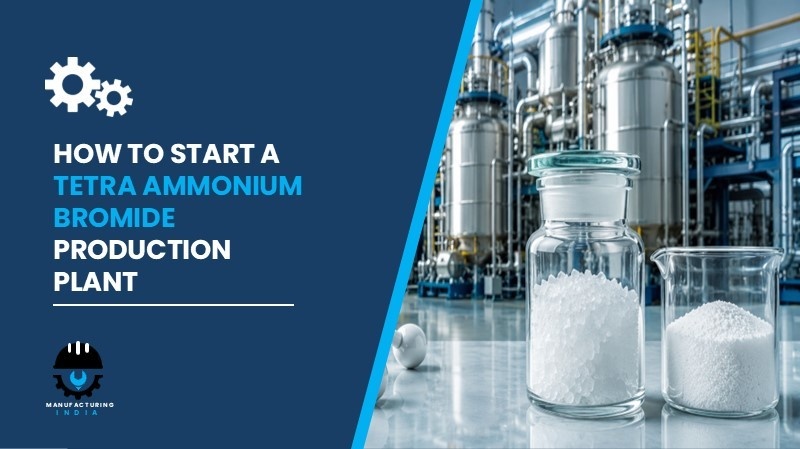
Setting up a tetra ammonium bromide production plant in India presents a compelling investment case, backed by steady demand from pharmaceuticals, chemical synthesis, electronics, and research laboratories. Tetra ammonium bromide, widely recognized as tetrabutylammonium bromide (TBAB), functions as a highly effective phase-transfer catalyst, reaction medium, ionic liquid, and thermodynamic promoter in organic synthesis. As pharmaceutical intermediate production and fine chemical synthesis expand, this specialty chemical is becoming increasingly critical to India’s chemical economy.
India’s push toward domestic chemical self-sufficiency and its expanding pharmaceutical manufacturing base make the country a strategically sound location for this production. According to IBEF, the Indian pharmaceutical market is projected to grow 7-9% in FY26, driven by strong domestic demand, product innovation, and expansion into European markets – a trend that directly supports demand for quaternary ammonium intermediates. Supportive government initiatives promoting domestic chemical manufacturing further strengthen the case for establishing this facility.
This investment combines policy support for domestic chemical manufacturing, cost-competitive operations, and dependable demand from pharmaceuticals, chemical synthesis, electronics, and research sectors. With gross margins of 26-34% and net margins of 15-21%, the case for this facility remains financially sound across a range of operating capacities.
What is Tetra Ammonium Bromide?
Tetra ammonium bromide, usually referring to quaternary ammonium bromides like TBAB, is a versatile salt composed of a bulky central nitrogen atom bound to four organic groups and a bromide anion. Typically a white crystalline powder, it acts as a highly effective phase-transfer catalyst, speeding up reactions between immiscible phases, and also serves as a reaction medium, ionic liquid, and thermodynamic promoter.
The production process uses the quaternization reaction of triethylamine with ethyl bromide as its primary method, followed by crystallization, filtration, drying, and packaging. The end-use industries served by this plant include pharmaceuticals, chemical synthesis, electronics, research laboratories, and specialty chemicals – sectors where purity, consistency, and regulatory-compliant production are essential.
Cost of Setting Up a Tetra Ammonium Bromide Production Plant in India
This cost depends on capacity, technology, location, automation, and regulatory compliance.
1. Capital Expenditure (CapEx)
Land and site development form a substantial part of the overall investment, covering land registration, boundary development, and site preparation. Investors can evaluate options within industrial estates or notified chemical zones offering established infrastructure and simplified clearances. Civil works cover the production shed, quality control laboratory, storage areas, and administrative block.
Machinery costs account for the largest portion of total capital expenditure. Key machinery required includes:
- Reaction vessels
- Raw material storage tanks
- Dosing systems
- Crystallizers
- Filtration units
- Centrifuges
- Drying systems
- Solvent recovery units
- Material handling systems
- Packaging machines
Other capital costs include pre-operative expenses, ETP installation, commissioning costs, and applicable import duties on specialized machinery.
Request a Sample Report for In-Depth Market Insights: https://www.imarcgroup.com/tetra-ammonium-bromide-manufacturing-plant-project-report/requestsample
2. Operational Expenditure (OpEx)
Raw material cost dominates the operating expense structure, with triethylamine and ethyl bromide together accounting for approximately 55-65% of total OpEx. Long-term supply contracts with reliable suppliers help mitigate price volatility and ensure consistent quality.
Utility costs, covering electricity, water, and steam, account for approximately 8-12% of OpEx. Other operating costs include transportation, packaging, salaries, maintenance, depreciation, and taxes. By the fifth year, total operational cost is expected to rise substantially due to inflation, market fluctuations, and rising raw material costs.
3. Plant Capacity
The proposed plant is designed with an annual capacity of 2,000 MT, enabling economies of scale while maintaining operational flexibility. Capacity can be customized based on individual investor requirements, market demand, and available capital, and profitability generally improves with higher capacity utilization as fixed costs spread across greater output.
4. Profit Margins and Financial Projections
This production plant demonstrates healthy profitability potential under normal operating conditions. Gross profit margins typically range between 26-34%, while net profit margins range between 15-21%, supported by stable demand and value-added applications. Financial projections also cover net present value (NPV), internal rate of return (IRR), and payback period, built on realistic assumptions about capital investment, operating costs, capacity utilization, and demand outlook.
Why Set Up a Tetra Ammonium Bromide Plant in India?
Critical Specialty Chemical for High-Value Applications: These compounds serve as phase-transfer catalysts, intermediates, electrolytes, and laboratory reagents across pharmaceuticals, fine chemicals, electronics, and research laboratories, positioning this facility to serve valuable specialty chemical demand through a reliable production process.
India’s Expanding Pharmaceutical Sector: With the Indian pharmaceutical market projected by IBEF to grow 7-9% in FY26 on strong domestic demand and product innovation, demand for pharmaceutical intermediates is set to benefit directly.
Policy and Regulatory Tailwinds: Government initiatives promoting domestic chemical manufacturing, pharmaceutical self-sufficiency, and specialty chemical exports create favorable conditions for producers of high-value chemical intermediates.
Moderate but Defensible Entry Barriers: Production requires controlled reaction conditions, high-purity raw materials, and strict quality assurance and compliance protocols – barriers that favor technically capable manufacturers with established expertise.
Active Industry Investment: In February 2026, a study published in the Journal of Molecular Liquids investigated deep eutectic compositions formed by this compound with imidazole, 2-methylimidazole, and 2-ethylimidazole, examining how alkyl chain length affects phase behavior – reflecting continued research momentum.
Supply Chain Localization and Reliability: Chemical manufacturers increasingly prefer dependable regional suppliers offering consistent quality, shorter lead times, and secure supply, creating opportunities for local producers with efficient sourcing.
Tetra Ammonium Bromide Production Process – Step by Step
This process uses the quaternization reaction as the primary method, followed by downstream unit operations.
- Quaternization Reaction: Triethylamine reacts with ethyl bromide inside reaction vessels to form the quaternary ammonium salt.
- Crystallization: The reaction mixture is processed through crystallizers to form solid tetra ammonium bromide crystals.
- Filtration: Filtration units separate the crystallized product from the mother liquor, with solvent recovery units reclaiming process solvents.
- Centrifugation and Drying: Centrifuges remove residual moisture before drying systems bring the product to its final specification.
- Packaging and Dispatch: Packaging machines prepare the finished tetra ammonium bromide for dispatch to pharmaceutical, chemical synthesis, electronics, and research laboratory customers.
Key Applications
This facility serves several high-value end-use industries where purity and consistent performance are essential.
- Pharmaceuticals: Used as a phase-transfer catalyst and intermediate in drug synthesis and active pharmaceutical ingredient (API) manufacturing.
- Chemical Synthesis: Functions as a quaternary ammonium reagent in organic reactions, catalysis, and specialty chemical production.
- Electronics: Applied in surface treatment chemicals, specialty formulations, and electronic-grade chemical processing.
- Research & Laboratories: Used in analytical chemistry, biochemical research, and synthesis of advanced materials and fine chemicals.
Leading Manufacturers
Leading producers in the global tetra ammonium bromide industry include companies with extensive production capacities and diverse application portfolios. Key players include:
- Relic Chemical
- Sisco Research Laboratories Pvt. Ltd.
Timeline to Start the Plant
- Feasibility study and project report preparation
- Land acquisition and site development
- Regulatory approvals and environmental clearances
- Factory licence and fire safety compliance
- Machinery procurement and installation
- Raw material supplier agreements and supply chain setup
- Trial production and quality testing
- Commercial production launch
Licences and Regulatory Requirements
Starting a tetra ammonium bromide production unit in India requires several approvals:
- Business registration (Proprietorship, LLP, or Pvt Ltd)
- Factory Licence under the Factories Act
- Environmental Clearance from State Pollution Control Board
- GST Registration
- Fire Safety NOC
- Hazardous/Chemical compliance for handling ethyl bromide and triethylamine
- Effluent Treatment Plant (ETP) operational clearance
- Occupational Health and Safety compliance
Key Challenges to Consider
High Capital Requirements: Machinery such as reaction vessels, crystallizers, centrifuges, and solvent recovery units represents a significant share of the total investment.
Raw Material Price Volatility: Triethylamine and ethyl bromide together account for 55-65% of OpEx, making the plant sensitive to price fluctuations in these key raw materials.
Regulatory Compliance: Chemical handling, environmental clearances, and effluent treatment obligations require ongoing investment and monitoring.
Technology and Innovation Pressure: Continued research, such as the February 2026 study on deep eutectic systems involving this compound, signals an evolving technical landscape that producers must track.
Competition: Established players such as Relic Chemical and Sisco Research Laboratories mean new entrants must differentiate on purity, reliability, and service.
Skilled Manpower: Controlled reaction conditions and strict quality protocols require trained technical personnel, making manpower availability a key consideration.
Frequently Asked Questions
1. How much does it cost to set up a tetra ammonium bromide production plant in India?
Total cost depends on capacity, technology, location, and automation level, with machinery and land development forming the largest components of capital expenditure.
2. Is tetra ammonium bromide production profitable in India in 2026?
Yes, the plant offers healthy profitability, with gross margins of 26-34% and net margins of 15-21% supported by steady demand from pharmaceuticals and specialty chemicals.
3. What machinery is required for a tetra ammonium bromide plant in India?
Essential machinery includes reaction vessels, raw material storage tanks, dosing systems, crystallizers, filtration units, centrifuges, drying systems, solvent recovery units, material handling systems, and packaging machines.
4. What licences and approvals are required to start a tetra ammonium bromide plant in India?
Requirements include business registration, Factory Licence, Environmental Clearance, GST Registration, Fire Safety NOC, hazardous chemical compliance, ETP clearance, and occupational health and safety compliance.
5. What raw materials are needed for tetra ammonium bromide production?
The primary raw materials are triethylamine and ethyl bromide, which together account for 55-65% of operating expenditure.
6. What are the environmental compliance requirements for a tetra ammonium bromide plant in India?
The plant requires Environmental Clearance from the State Pollution Control Board, an operational Effluent Treatment Plant, and adherence to hazardous chemical handling regulations.
7. What is the best location to set up a tetra ammonium bromide plant in India?
The ideal site offers easy access to raw materials such as triethylamine and ethyl bromide, proximity to target markets, reliable infrastructure, and compliance with local zoning and environmental regulations.
8. What is the break-even period for this type of plant in India?
The break-even period depends on capacity utilization and pricing trends, built around realistic capital investment and operating cost assumptions.
9. What government incentives are available for manufacturers in India?
Government initiatives supporting domestic chemical manufacturing, pharmaceutical self-sufficiency, and specialty chemical exports create favorable conditions for producers of tetra ammonium bromide.
Key Takeaways for Investors
This investment offers a strong opportunity, driven by consistent demand from pharmaceuticals, chemical synthesis, electronics, and research laboratories. The facility demonstrates sound financial viability across capacity levels, with gross margins of 26-34% and net margins of 15-21% at the proposed 2,000 MT annual capacity. With Asia-Pacific accounting for over 35% of the global market and India’s pharmaceutical sector projected to grow 7-9% in FY26 per IBEF, demand for this specialty chemical is well-positioned for sustained, long-term growth.
About the Author