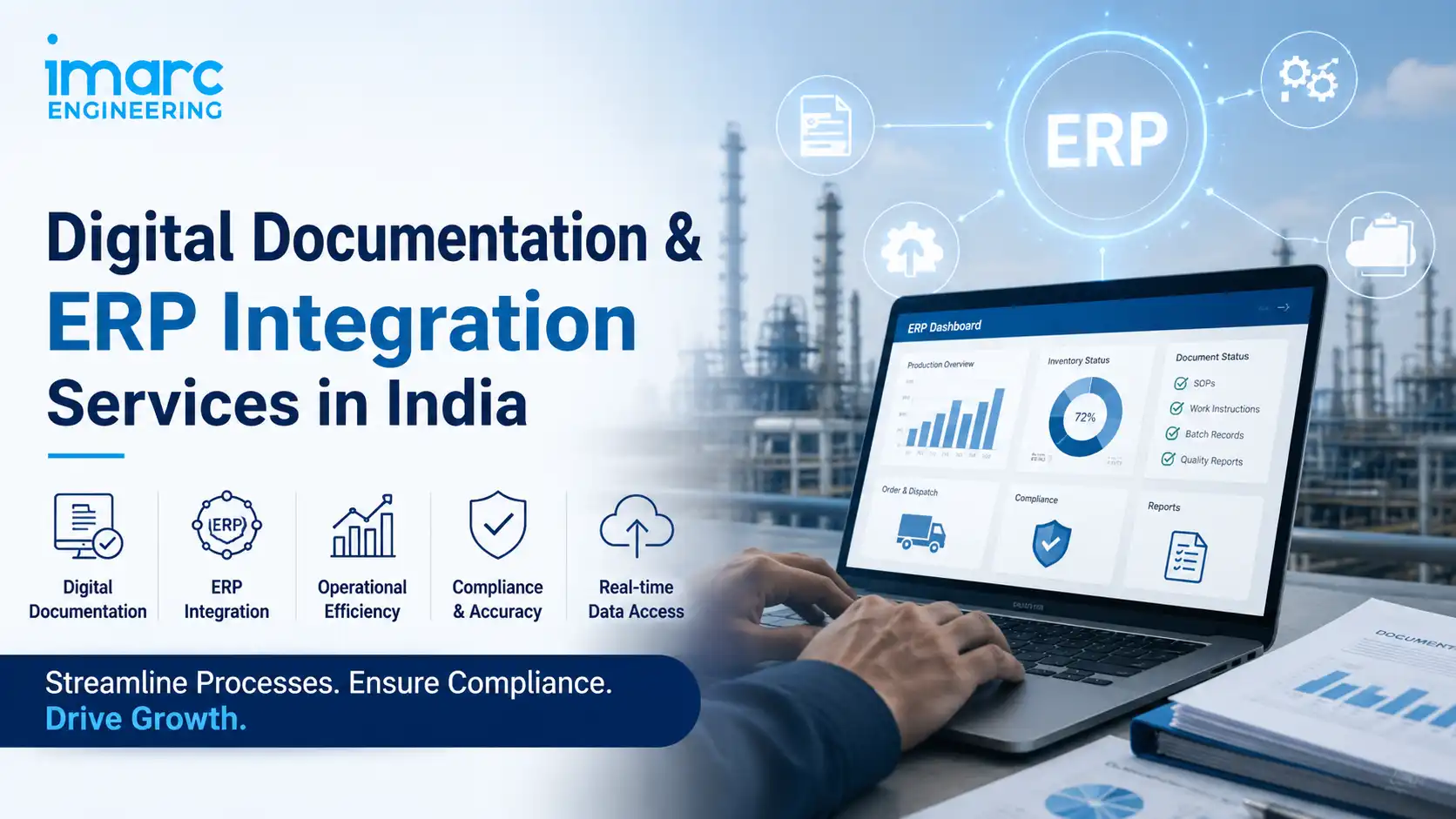
Manufacturing operations across India generate a constant stream of data: batch records, quality test results, inventory movements, machine downtime logs, and GST transaction filings. Yet a large share of Indian manufacturers still capture much of this on paper or in disconnected spreadsheets. Studies on manufacturing data practices consistently find that manual transcription between paper records and enterprise systems introduces error rates of 1-5% per data entry step, a gap that compounds sharply across facilities processing thousands of transactions a month. As Make in India and Production Linked Incentive schemes push manufacturers toward scale, digital documentation and ERP integration have moved from a back-office upgrade to an operational necessity.
Why Paper-Based Documentation Is No Longer Viable
A single mid-size pharmaceutical or chemical facility can generate several hundred batch records annually, each requiring multiple in-process test entries, sign-offs, and cross-references. Paper systems make three problems structurally unavoidable:
- Data inefficiency, since every manual transcription step between shop floor and ERP introduces a fresh chance for entry error
- Delayed reporting, because batch data, inventory positions, and quality results only reach management systems after physical records are compiled and reviewed
- Compliance risk, particularly for CDSCO Schedule M, FSSAI traceability, and 21 CFR Part 11 requirements, all of which expect audit trails and electronic signatures that paper cannot provide
For manufacturers targeting export markets, the exposure is sharper still. US FDA-regulated exporters must demonstrate 21 CFR Part 11 electronic record compliance, something no paper-based documentation system can satisfy regardless of how well it is maintained.
The GST Layer Most ERP Projects Underestimate
India’s GST framework imposes ERP configuration demands that generic international templates rarely address out of the box. Getting this wrong is costly: reconciliation failures and GSTN portal filing discrepancies can generate remediation costs that exceed the original integration budget. Correct configuration requires:
- HSN/SAC code mapping applied to every product and service transaction
- GST rate determination logic that correctly distinguishes intra-state from inter-state supply
- Input tax credit accumulation and utilisation workflows
- E-way bill generation integration, mandatory for goods movement above ₹50,000
- GSTN reconciliation workflows supporting GSTR-1, GSTR-3B, and annual return filing
A facility processing hundreds of interstate shipments monthly cannot rely on manual E-way bill generation without introducing dispatch delays and compliance gaps. Integrating this directly into the ERP’s sales and logistics modules removes that dependency.
What ERP Integration Actually Connects
The real value of ERP integration is not digitisation for its own sake. It is the connection between shop-floor events and enterprise-level decision-making. Without this link:
- Production managers schedule from memory and experience rather than real-time inventory and work-in-progress data
- Procurement teams order raw materials based on periodic physical counts instead of live consumption tracking
- Quality managers identify defect trends from manually compiled batch records instead of automated statistical process control
Integrated systems close this gap by connecting machine-level data collection, batch record systems, and quality management platforms directly to ERP production, inventory, and financial modules. The result is that a quality hold triggered on the shop floor can automatically block finished goods dispatch, and a material consumption entry from a digitised batch record can update raw material stock in real time, both without a single manual re-entry step.
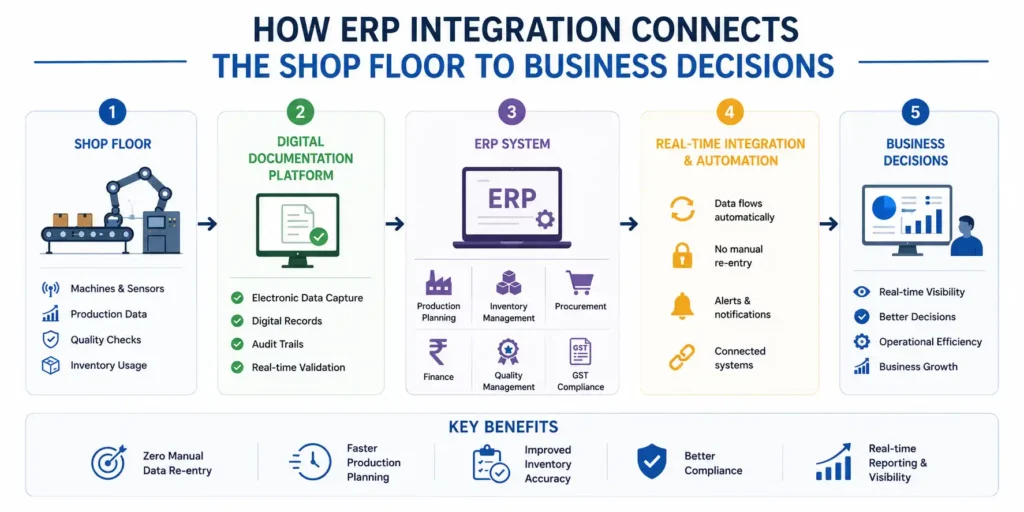
To better understand how ERP integration transforms Indian manufacturing, it’s important to look at how digital systems connect operational data with business-critical decisions.
Platform Landscape in Indian Manufacturing
Different ERP platforms dominate different segments of Indian industry. SAP S/4HANA and SAP ECC lead among large manufacturers, particularly in pharmaceuticals, chemicals, and FMCG, where the depth of quality and production functionality justifies the investment. Oracle ERP Cloud and Oracle EBS serve mid-to-large manufacturers with complex financial consolidation needs. Microsoft Dynamics 365 Business Central has gained traction among mid-size manufacturers seeking cloud-based ERP at a lower total cost of ownership. Tally ERP and Busy Accounting remain widely used among smaller manufacturers and distributors, mainly for GST compliance and basic inventory control, while sector-specific platforms like Marg ERP and Ramco Systems serve pharmaceutical distribution and manufacturing niches respectively.
Sector-Specific Documentation Requirements
Regulatory and operational demands vary sharply by sector, and generic ERP configuration rarely accounts for this properly:
- Pharmaceuticals and nutraceuticals require electronic batch manufacturing record digitisation with CDSCO Schedule M audit trail compliance, LIMS integration, and PLI production reporting modules
- Food processing and dairy need FSSAI traceability from raw material intake through to finished goods distribution, alongside HACCP digital monitoring with real-time critical control point data capture
- Chemicals require CPCB online effluent monitoring integration, IBR inspection record management, and safety interlock data capture from DCS systems
- FMCG depends on high-speed packaging line data integration for real-time OEE tracking and E-way bill generation across national distribution networks
- Medical devices need ISO 13485-compliant design history file management and CDSCO Class B and C batch record digitisation with audit trail compliance
Each of these carries a different documentation burden, and a single generic implementation approach across sectors typically underperforms.
Common Implementation Failures
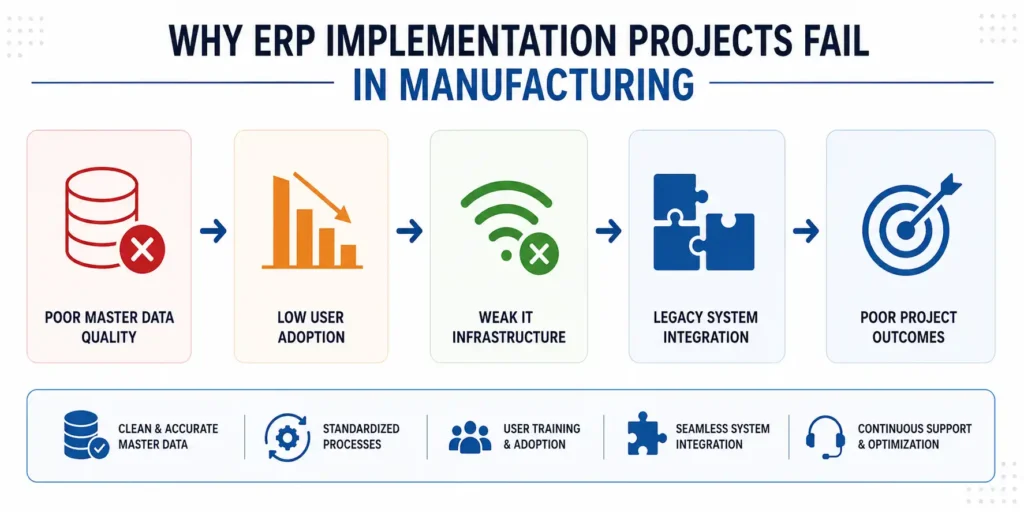
ERP projects in Indian manufacturing tend to fail for a recurring set of reasons rather than random causes:
- Master data quality gaps, where item master records, BOM structures, and vendor data in legacy systems are incomplete or inconsistent
- User adoption resistance, particularly when shop-floor operators face interfaces requiring ten or more screen transitions to complete a single test entry
- Infrastructure reliability limits, since power interruptions and connectivity gaps at Tier II industrial locations affect cloud ERP uptime
- Legacy system integration complexity, when connecting new ERP platforms to existing LIMS, SCADA, or DCS systems
User adoption failure is the most expensive of these, because a technically functional system that production teams route around through parallel paper records delivers licence and infrastructure costs with none of the operational benefit.
How IMARC Engineering Structures Implementation
IMARC Engineering approaches digital documentation and ERP integration through a four-phase framework: current state assessment and requirements definition, solution design and architecture development, implementation and system configuration, and training with ongoing optimisation support. This sequence ensures regulatory compliance architecture, including audit trail configuration and electronic signature workflows, is specified before implementation begins rather than retrofitted afterward.
Change management is treated as a core deliverable rather than an afterthought. Regional language training is delivered in Hindi, Gujarati, Marathi, Telugu, and Tamil for shop-floor teams, and every implementation includes a structured 90-day post-go-live support window to resolve usability issues before parallel paper systems have a chance to re-establish themselves.
Consult our digital documentation and ERP integration specialists: https://www.imarcengineering.com/contact?service=digital-documentation-erp-integration
Realistic Implementation Timelines
Timelines scale with scope. A focused digital documentation project, covering batch record digitisation and SOP management for a single production line, typically takes 12 to 20 weeks from system design to go-live. A full ERP implementation spanning production, quality, inventory, procurement, and financial modules for a mid-size facility generally requires 24 to 48 weeks. Adding shop-floor integration with machine data collection, LIMS, or DCS connectivity extends this by a further 8 to 16 weeks. For PLI scheme facilities working against fixed reporting deadlines, sequencing PLI production tracking capability first, ahead of the broader system rollout, is often the more practical path.
Conclusion
Digital documentation and ERP integration have become foundational infrastructure for Indian manufacturers rather than optional upgrades, driven as much by GST and PLI compliance obligations as by the operational cost of manual data handling. The projects that succeed are the ones where regulatory architecture, GST configuration, and shop-floor usability are designed in from the outset rather than added after go-live. For manufacturers evaluating this transition, the starting point is usually a current-state assessment that maps existing documentation gaps against the specific regulatory and reporting obligations their sector carries.
Contact Us:
IMARC Engineering
Phone: +91-120-433-0800
Email: sales@imarcengineering.com
India: C-130, Sector 2, Noida, Uttar Pradesh 201301
LinkedIn: https://www.linkedin.com/showcase/imarc-engineering/
About the Author