Praseodymium Oxide Production Plant
Setting up a praseodymium oxide production plant in India presents a compelling investment case of exceptional strategic and commercial importance — one where India’s newly launched INR 7,280 Crore REPM Manufacturing Scheme, its critical minerals self-sufficiency agenda, the global transition to electric vehicles and wind energy, and the government’s explicit rare earth magnet manufacturing corridors in Odisha, Kerala, Andhra Pradesh, and Tamil Nadu are all converging to create the most favourable policy environment for rare earth compound manufacturing that India has ever offered. Praseodymium oxide (Pr₆O₁₁) — the greenish-black rare earth compound that functions simultaneously as a critical component of Nd-Pr permanent magnets for electric vehicles and wind turbines, a colouring and polishing agent in specialty optical glass, a ceramic pigment, and a catalyst precursor — is at the absolute core of India’s clean energy, defence self-reliance, and advanced materials strategic priorities. As India moves decisively to reduce import dependence on rare earth materials from China, its demand for domestically processed praseodymium oxide is growing from a strategic aspiration into a government-funded commercial imperative with dedicated infrastructure corridors and production targets.
India’s government commitment to rare earth permanent magnet manufacturing — and the praseodymium oxide upstream supply chain it requires — has never been more explicitly or ambitiously articulated. The Indian government implemented its rare-earth strategy through the February 2026 launch of the INR 7,280 Crore REPM Manufacturing Scheme and Dedicated Corridors across Odisha, Kerala, Andhra Pradesh, and Tamil Nadu to increase magnet production capacity by 6,000 MTPA and decrease foreign imports while advancing clean energy, defence, and self-reliance objectives. Additionally, in October 2025, the Government of India prepared an INR 7,350-Crore scheme to boost domestic rare earth permanent magnet production, targeting 6,000 tonnes per year of sintered NdFeB magnets, with the plan focused on processing neodymium-praseodymium oxide to decrease import needs and build essential supply networks. These twin government commitments — totalling over INR 14,000 Crore in direct scheme support — create an unprecedented institutional demand signal for praseodymium oxide from India’s own magnet manufacturing industry that makes domestic production capacity both commercially necessary and strategically urgent.
Investing in a praseodymium oxide production plant in India today aligns India’s INR 7,280 Crore REPM Manufacturing Scheme, critical minerals self-sufficiency strategy, and EV and wind energy megatrend with a global praseodymium oxide market growing from 17,724.38 Tons in 2025 to 26,372.80 Tons by 2034 at a CAGR of 4.5%. With gross profit margins of 40–50% and net profit margins of 20–30% at an annual production capacity of 50–200 MT, the unit economics are extraordinary for a rare earth compound, and the investment’s positioning in India’s most strategically critical advanced materials supply chain creates exceptional long-term value.
What is Praseodymium Oxide?
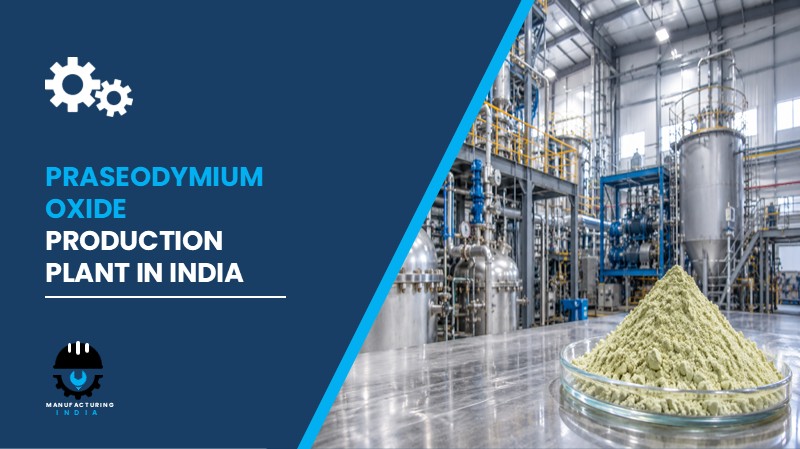
Praseodymium oxide is a rare earth compound identified by its chemical formula Pr₆O₁₁ that exhibits a greenish-black colour while maintaining high thermal stability. The production process starts with the processing and separation of rare earth ores, which include bastnäsite and monazite — the two primary rare earth mineral sources globally. The process involves precipitation, followed by calcination and purification stages that convert the separated praseodymium-bearing solution into the high-purity oxide form required for permanent magnet, glass, ceramics, and catalyst applications.
Praseodymium oxide functions as a colouring agent which glass and ceramic manufacturers use to produce yellow and green shades while improving optical characteristics. The material functions as a vital element that enhances the magnetic strength and temperature resistance of high-performance permanent magnets when used with neodymium in the Nd-Pr mixed oxide form that is the primary feedstock for sintered NdFeB permanent magnets. Praseodymium oxide serves various purposes in clean energy industries and high-technology sectors because of its role in catalysts, aerospace alloys, and advanced electronic materials — a multi-sector utility that makes it one of the most commercially and strategically important light rare earth oxide compounds in the global advanced materials market.
The primary production process covers rare earth ore beneficiation, acid leaching, solvent extraction separation, precipitation of praseodymium compounds, filtration, drying, calcination to oxide form, milling, quality inspection, and packaging. End-use industries served include permanent magnet manufacturing, glass and ceramics, automotive, renewable energy, aerospace, and electronics. Applications span Nd-Pr permanent magnets for EVs and wind turbines, specialty optical glass, ceramic pigments, catalysts, and high-strength alloys.
Cost of Setting Up a Praseodymium Oxide Production Plant in India
The cost of establishing a praseodymium oxide production plant in India depends on production capacity, rare earth ore feedstock sourcing strategy and purity grade, solvent extraction system design and selectivity, geographic location — particularly proximity to rare earth mineral sources and the government’s designated REPM Manufacturing Corridors — degree of automation, and the quality compliance requirements applicable to praseodymium oxide supplied to permanent magnet, glass, and ceramics manufacturers.
1. Capital Expenditure (CapEx)
Land and Site Development forms a foundational component of total capital investment, covering land acquisition charges, site registration, boundary development, chemical containment drainage for acid leaching and solvent extraction operations, and site utilities. The location must offer easy access to key raw materials such as rare earth ore and solvent extraction chemicals. Proximity to target markets — particularly India’s designated REPM Manufacturing Corridors in Odisha, Kerala, Andhra Pradesh, and Tamil Nadu and the growing domestic permanent magnet manufacturing clusters these corridors are designed to anchor — will help minimise distribution costs. The site must have robust infrastructure, including reliable transportation, utilities, and waste management systems. Compliance with local zoning laws and environmental regulations must also be ensured. Locations in Odisha near the rare earth mineral-bearing coastal sand deposits, or in Andhra Pradesh and Kerala near the Indian Rare Earths Limited (IREL) processing infrastructure, offer the most strategically advantaged operating environments for a praseodymium oxide producer.
Plant Layout Optimisation is critical for a praseodymium oxide production facility that integrates ore beneficiation, acid leaching, multi-stage solvent extraction, precipitation, calcination, and milling into a continuous, safely managed process flow. The layout should be optimised to enhance workflow efficiency, safety, and minimise material handling. Separate areas for raw material storage for rare earth ore and solvent extraction chemicals, ore beneficiation and leaching operations, solvent extraction contactors, precipitation and filtration stages, calcination kilns, milling and classification, quality control laboratory, and finished goods storage must be designated. Space for future expansion should be incorporated to accommodate business growth as REPM scheme magnet producer demand develops.
Machinery and Equipment represent the largest single component of total CapEx for a praseodymium oxide production plant. Essential equipment includes:
- Leaching reactors
- Solvent extraction units
- Filtration systems
- Dryers
- Rotary or tunnel calciners
- Milling machines
- Packaging systems
Other Capital Costs include effluent treatment systems to minimise environmental impact and ensure compliance with emission standards for acid leaching effluents and radioactive trace mineral waste management, advanced monitoring systems to detect leaks or deviations in the process, pre-operative expenses, rare earth processing facility environmental clearance costs, quality certification costs, commissioning charges, and import duties on specialised solvent extraction contactor systems or analytical instrumentation not available domestically.
Request a Sample Report for In-Depth Market Insights: https://www.imarcgroup.com/praseodymium-oxide-production-cost-analysis-report/requestsample
2. Operational Expenditure (OpEx)
Raw Material Cost is the overwhelmingly dominant operational expense, accounting for approximately 70–80% of total OpEx. The primary raw materials are rare earth ore and solvent extraction chemicals. Rare earth ore — as the mineral feedstock from which praseodymium is separated alongside other rare earth elements through complex hydrometallurgical processing — drives the vast majority of raw material cost and is priced in correlation with global rare earth mineral markets. India’s domestic rare earth mineral resources — including the coastal sand deposits in Odisha, Kerala, Andhra Pradesh, and Tamil Nadu that contain monazite, a thorium-bearing rare earth phosphate mineral rich in light rare earth elements including praseodymium — provide a strategic domestic feedstock basis. Solvent extraction chemicals including organophosphorus extractants such as D2EHPA and PC88A are consumed in the selective separation of praseodymium from the mixed rare earth leachate. Long-term contracts with reliable suppliers for rare earth ore and solvent extraction chemicals are essential to stabilise pricing and ensure a steady supply.
Utility Cost is the second-largest OpEx component, representing approximately 15–20% of total operating expenses, covering electricity and fuel for leaching reactor heating, solvent extraction mixer-settler operations, calcination kiln fuel consumption, milling equipment, and dryer operations. Calcination kiln fuel cost is the primary utility optimisation lever, with efficient kiln operation directly reducing per-unit production cost at commercial volumes.
Other Operating Costs include transportation and distribution to permanent magnet manufacturers, specialty glass producers, ceramics companies, catalyst manufacturers, and aerospace alloy producers, specialised packaging materials for rare earth oxide powder, salaries and wages for hydrometallurgical process engineers and analytical chemists, routine machinery maintenance including leaching reactor lining inspection and solvent extraction contactor maintenance, environmental compliance and radioactivity monitoring costs for monazite-associated thorium management, depreciation on production equipment, and applicable taxes. By the fifth year, the total operational cost is expected to increase substantially due to factors such as inflation, market fluctuations, and potential rises in the cost of key materials. Additional factors, including supply chain disruptions, rising consumer demand, and shifts in the global economy, are expected to contribute to this increase.
3. Plant Capacity
The proposed production facility for praseodymium oxide is designed with an annual production capacity ranging between 50 and 200 MT, enabling economies of scale while maintaining operational flexibility across high-purity Nd-Pr mixed oxide for permanent magnet manufacturing, praseodymium oxide for glass and ceramics applications, and catalyst-grade praseodymium compounds for chemical industry customers. Plant capacity can be customised per investor requirements and phased in line with the government’s REPM scheme magnet production targets — which at 6,000 MTPA of sintered NdFeB magnets generate specific demand for praseodymium oxide feedstock that the designated corridor facilities will need to source from domestic upstream processors.
4. Profit Margins and Financial Projections
The financial projections for a praseodymium oxide production plant demonstrate exceptional profitability potential under normal operating conditions. Gross profit margins typically range between 40–50% — reflecting the extraordinary value-added transformation of rare earth ore feedstock into a precisely separated, high-purity oxide compound that commands premium pricing in permanent magnet, optical glass, and ceramics applications. Net profit margins are projected at 20–30% — among the strongest in the advanced materials and rare earth processing sector. A comprehensive financial analysis covering NPV, IRR, payback period, and five-year projections is essential before committing capital, with projections developed based on realistic assumptions related to capital investment, operating costs, production capacity utilisation, pricing trends, and demand outlook.
Why Set Up a Praseodymium Oxide Production Plant in India?
Rising Electric Vehicle Production Driving Nd-Pr Magnet Demand. Increasing EV manufacturing boosts demand for rare earth permanent magnets containing praseodymium oxide as a critical constituent. Praseodymium is utilised in Nd-Pr permanent magnets for electric vehicles and wind turbines — the two fastest-growing rare earth magnet application markets globally. Every electric vehicle motor requires sintered NdFeB magnets containing praseodymium-neodymium mixed oxide, making EV adoption growth a direct and quantifiable driver of praseodymium oxide demand.
India’s INR 7,280 Crore REPM Manufacturing Scheme Creating Institutional Domestic Demand. The Indian government implemented its rare-earth strategy through the February 2026 launch of the INR 7,280 Crore REPM Manufacturing Scheme and Dedicated Corridors across Odisha, Kerala, Andhra Pradesh, and Tamil Nadu to increase magnet production capacity by 6,000 MTPA and decrease foreign imports while advancing clean energy, defence, and self-reliance objectives. This scheme — combined with the October 2025 INR 7,350-Crore sintered NdFeB magnet production initiative — creates direct, government-funded institutional demand for praseodymium oxide from India’s own magnet manufacturing industry that domestic producers can supply with decisive supply chain advantages over import alternatives.
Growth in Wind Energy Installations Sustaining Long-Term Magnet Demand. Offshore and onshore wind turbines require high-performance permanent magnet materials in their direct-drive generators — with large offshore wind turbines requiring several tonnes of Nd-Pr mixed oxide per turbine. India’s wind energy expansion and global offshore wind deployment create a structurally sustained and growing demand for praseodymium oxide through the wind energy supply chain that complements EV-driven demand growth with a separately growing institutional demand base.
Strategic Korea-US Rare Earth Recycling JV Confirming Market Value. In January 2026, Korea Zinc and Alta Resource Technologies established a U.S. joint venture which will produce 100 tons of high-purity rare earth oxides through permanent magnet waste processing by the year 2027. The production process will generate neodymium oxide, praseodymium oxide, dysprosium oxide, and terbium oxide, improving Korea–U.S. supply chain operations. This partnership — specifically naming praseodymium oxide as a target recovery product — directly confirms the commercial value and strategic importance of praseodymium oxide in non-Chinese supply chains that India is actively developing.
Governments Supporting Domestic Rare Earth Processing to Reduce Import Dependency. Multiple nations introduced funding initiatives to build rare-earth processing facilities and magnet production plants which will create domestic manufacturing capacity. India is participating explicitly in this global trend through its REPM scheme, while the development of solvent extraction technologies results in better separation efficiency which leads to higher product purity and enables businesses to achieve profitable production costs. New entrants who establish facilities using current state-of-the-art solvent extraction technology benefit from these efficiency improvements from the first day of production.
Expanding High-Tech Applications Ensuring Long-Term Demand Visibility. Electronics and advanced materials sectors rely on stable rare earth supply. The clean energy transition continues to drive rare earth consumption, and expanding high-tech applications in specialty glass, ceramics, aerospace alloys, and advanced electronic materials add further demand layers beyond the dominant permanent magnet application, providing the long-term demand visibility that justifies the capital investment required for a rare earth processing facility.
Production Process — Step by Step
The praseodymium oxide production process uses rare earth ore beneficiation, acid leaching, solvent extraction separation, precipitation of praseodymium compounds, filtration, drying, calcination to oxide form, milling, quality inspection, and packaging as the primary production method. Each stage requires precisely controlled acid concentration, solvent extraction parameters, precipitation conditions, and calcination temperature to produce praseodymium oxide of the target purity, particle size, and rare earth distribution required by permanent magnet, glass, and ceramics customers.
- Rare Earth Ore Receipt and Beneficiation: Rare earth mineral ore — bastnäsite, monazite, or mixed rare earth concentrate — is received from mining operations or rare earth mineral processors, quality-checked for rare earth content, and processed through beneficiation operations to produce a concentrated rare earth feedstock with reduced gangue mineral content.
- Acid Leaching in Leaching Reactors: The rare earth concentrate is processed in leaching reactors with controlled addition of hydrochloric or sulphuric acid under elevated temperature and agitation, dissolving the rare earth elements into a leach liquor while leaving gangue minerals as insoluble residue. Leach efficiency, temperature, and acid concentration are precisely controlled to achieve maximum rare earth dissolution.
- Solvent Extraction Separation: The clarified rare earth leach liquor — containing a complex mixture of rare earth elements including praseodymium, neodymium, lanthanum, cerium, and others — is processed through solvent extraction units using selective organophosphorus extractants and scrubbing and stripping stages to separate individual rare earth fractions. The praseodymium-rich fraction is selectively extracted and stripped to produce a praseodymium-enriched aqueous solution of the target purity relative to adjacent rare earth elements.
- Precipitation: The praseodymium-enriched solution is processed through controlled addition of oxalate, carbonate, or hydroxide precipitants to quantitatively precipitate praseodymium as an insoluble precursor compound, separating it from soluble impurities remaining in the aqueous phase.
- Filtration and Washing: Precipitated praseodymium compound is separated from the precipitation liquor through filtration systems and washed with water to remove residual soluble impurities, producing a clean praseodymium precursor cake for drying and calcination.
- Drying: The washed praseodymium precursor is processed through dryers at controlled temperature to remove moisture before calcination, with drying temperature selected to avoid premature decomposition of the precursor compound.
- Calcination to Oxide Form: Dried praseodymium precursor is processed through rotary or tunnel calciners at controlled high temperatures — typically 700–900°C — where thermal decomposition converts the praseodymium carbonate, oxalate, or hydroxide precursor to praseodymium oxide (Pr₆O₁₁), with calcination temperature and atmosphere precisely controlled to achieve the target crystal structure and purity.
- Milling and Classification: Calcined praseodymium oxide is processed through milling machines and classified to achieve the target particle size distribution required for permanent magnet alloy melting, glass production, or ceramics pigment applications.
- Quality Inspection: Finished praseodymium oxide undergoes comprehensive quality inspection covering rare earth purity by ICP-MS, impurity profile, particle size distribution, specific surface area, and colour, verifying compliance with permanent magnet, glass, and ceramics customer specifications before packaging.
- Packaging and Dispatch: Specification-compliant praseodymium oxide is packaged using packaging systems in sealed containers to prevent moisture absorption and contamination, then dispatched to permanent magnet manufacturers, glass producers, ceramics companies, catalyst manufacturers, and aerospace alloy producers in India and export markets.
Key Applications
Praseodymium oxide produced in India serves commercially important and structurally growing applications across the clean energy, high-technology, and advanced materials sectors:
- Permanent Magnet Industry: Utilised in Nd-Pr permanent magnets for electric vehicles, wind turbines, industrial motors, and consumer electronics — the dominant and fastest-growing application driving global praseodymium oxide demand growth.
- Glass Industry: Used as a colouring and polishing agent in specialty and optical glass, producing yellow and green shades and improving optical characteristics in lenses, fibres, and specialty glass products.
- Ceramics Industry: Applied as a pigment to achieve distinct colour properties in ceramic glazes, tiles, and technical ceramic components across industrial and decorative applications.
- Aerospace and Alloy Manufacturing: Incorporated into high-strength metal alloys for aerospace, defence, and high-temperature engineering applications requiring improved mechanical performance.
Leading Producers
The global praseodymium oxide industry is dominated by Chinese producers with extensive rare earth processing capabilities, alongside emerging non-Chinese producers developing capacity under strategic government programmes. Key players in the global market include:
- China Minmetals Rare Earth
- Longyi Heavy Rare-Earth
- Ganzhou Rare Earth Mineral Industry
- Ganzhou Qiandong Rare Earth Group
- Chenguang Rare Earth
- Jiangyin Jiahua Advanced Material Resources
Timeline to Start the Plant
Establishing a praseodymium oxide production plant in India involves a structured multi-phase development sequence. Investors should plan for the following phases:
- Feasibility study and project report preparation
- Land acquisition and site development
- Regulatory approvals and environmental clearances
- Factory licence and fire safety compliance
- Machinery procurement and installation
- Raw material supplier agreements and supply chain setup
- Trial production and quality testing
- Commercial production launch
Licences and Regulatory Requirements
Starting a praseodymium oxide production unit in India requires comprehensive approvals spanning business registration, rare earth processing, radioactive material management, environmental, and chemical safety compliance domains:
- Business registration (Proprietorship, LLP, or Pvt Ltd)
- Factory Licence under the Factories Act
- Environmental Clearance from the State Pollution Control Board, including detailed environmental assessment given radioactive thorium associated with monazite rare earth ore
- GST Registration
- Fire Safety NOC
- Atomic Energy Regulatory Board (AERB) authorisation for handling monazite and thorium-bearing rare earth processing waste, mandatory for rare earth facilities processing monazite feedstock
- Hazardous/Chemical compliance under the Manufacture, Storage and Import of Hazardous Chemical (MSIHC) Rules applicable to acid leaching chemicals and solvent extraction chemicals
- Effluent treatment systems operational clearance to minimise environmental impact and ensure compliance with emission standards
- Occupational Health and Safety compliance including radiation monitoring for thorium-bearing process streams
Key Challenges to Consider
Radioactive Thorium Management in Monazite Processing. India’s primary domestic rare earth mineral resource — coastal sand monazite — contains thorium as a naturally occurring radioactive element alongside the rare earth content. Processing monazite for praseodymium recovery requires AERB authorisation, comprehensive radiation safety management, thorium waste disposal or storage compliance, and ongoing occupational radiation exposure monitoring — regulatory and safety obligations that go substantially beyond conventional chemical plant requirements and represent the most distinctive compliance challenge in domestic Indian rare earth processing.
Rare Earth Ore and Solvent Extraction Chemical Cost Concentration. Rare earth ore and solvent extraction chemicals together account for approximately 70–80% of total OpEx — the highest raw material cost concentration in this investment guide series — with rare earth ore pricing subject to global rare earth market volatility driven by Chinese export policy decisions, energy costs at Chinese rare earth processing operations, and demand from the EV and wind energy sectors. Managing this dominant cost exposure requires long-term supply contracts with IREL or other domestic rare earth mineral suppliers and strategic inventory management.
Complex Multi-Stage Solvent Extraction Process Chemistry. Separating individual rare earth elements through solvent extraction — which exploits only marginal differences in their chemical behaviour — requires sophisticated multi-stage mixer-settler contactor systems, precisely formulated organic extractant systems, and experienced rare earth hydrometallurgical process engineers who understand the nuanced chemistry of rare earth separations at the required purity levels for permanent magnet applications. This process complexity represents the primary technical entry barrier for new rare earth oxide producers.
Chinese Market Dominance and Export Policy Risk. The competitive landscape is dominated by Chinese producers controlling the vast majority of global rare earth ore mining, processing, and oxide production capacity, with pricing and availability subject to Chinese government export policy decisions — including export quotas and taxes. New Indian producers must compete for permanent magnet manufacturer customers who have long-standing Chinese supply relationships, requiring demonstration of consistent quality, reliable delivery, and the strategic supply security value that non-Chinese supply provides.
Permanent Magnet Manufacturer Customer Qualification. Supplying praseodymium oxide to permanent magnet manufacturers for NdFeB sintered magnet production requires passage through material qualification processes verifying rare earth purity, impurity profiles, and batch-to-batch consistency — qualification cycles that may extend several months before commercial supply agreements are confirmed with the REPM scheme magnet producers that constitute the primary domestic customer base.
Environmental Compliance for Acid Leaching and Rare Earth Processing. Acid leaching operations generate large volumes of low-pH, heavy metal-bearing effluents and radioactive thorium-containing residues from monazite processing that require comprehensive effluent treatment, radioactive waste management under AERB regulations, and ongoing environmental compliance monitoring under state pollution control board standards — adding capital cost and ongoing regulatory management obligations unique to rare earth processing facilities.
Frequently Asked Questions
1. How much does it cost to set up a praseodymium oxide production plant in India?
The total capital investment depends on plant capacity, technology, feedstock strategy, and location. Equipment costs — for leaching reactors, solvent extraction units, filtration systems, dryers, rotary or tunnel calciners, milling machines, and packaging systems — represent a significant portion of capital expenditure, with AERB compliance infrastructure for monazite-associated thorium management adding additional capital requirements. A detailed project report with full CapEx and OpEx breakdowns is available on request.
2. Is praseodymium oxide production profitable in India in 2026?
Yes. The project demonstrates gross profit margins of 40–50% and net profit margins of 20–30% — among the strongest in the advanced materials manufacturing sector. India’s INR 7,280 Crore REPM Manufacturing Scheme creating 6,000 MTPA domestic magnet production demand, the October 2025 INR 7,350-Crore sintered NdFeB scheme specifically focused on neodymium-praseodymium oxide processing, and the global praseodymium oxide market growing at 4.5% CAGR all confirm the robust commercial and policy foundation for domestic praseodymium oxide production.
3. What machinery is required for a praseodymium oxide production plant in India?
Key machinery includes leaching reactors, solvent extraction units, filtration systems, dryers, rotary or tunnel calciners, milling machines, and packaging systems. Solvent extraction units — comprising multi-stage mixer-settler contactors with appropriate organic extractant systems — are the most technically critical equipment, determining the praseodymium separation efficiency and product purity that defines the facility’s commercial positioning in permanent magnet oxide supply.
4. What licences and approvals are required to start a praseodymium oxide production plant in India?
Required approvals include business registration, a Factory Licence under the Factories Act, Environmental Clearance from the State Pollution Control Board, GST registration, a Fire Safety NOC, AERB authorisation for monazite and thorium-bearing rare earth processing, MSIHC Rules compliance for acid and solvent extraction chemical handling, effluent treatment systems clearance, and Occupational Health and Safety compliance including radiation monitoring.
5. What raw materials are needed for praseodymium oxide production?
The primary raw materials are rare earth ore and solvent extraction chemicals. Rare earth ore accounts for approximately 70–80% of total operating expenses, making rare earth ore procurement strategy — including partnerships with IREL or access to domestic coastal sand rare earth mineral resources — the most critical commercial and supply chain priority for the investment.
6. What are the environmental compliance requirements for a praseodymium oxide production plant in India?
The unit must obtain Environmental Clearance from the State Pollution Control Board, AERB authorisation for thorium-bearing rare earth processing, operate effluent treatment systems to minimise environmental impact and ensure compliance with emission standards, implement advanced monitoring systems to detect leaks or deviations in the process, and maintain radiation monitoring and thorium waste management protocols under AERB regulatory requirements.
7. What is the best location to set up a praseodymium oxide production plant in India?
Optimal locations offer proximity to domestic rare earth mineral sources — particularly coastal sand deposits in Odisha, Kerala, Andhra Pradesh, and Tamil Nadu — access to IREL rare earth processing infrastructure, proximity to India’s designated REPM Manufacturing Corridors, reliable utilities, and regulatory environments with AERB compliance expertise. Locations within or adjacent to the government’s Dedicated REPM Manufacturing Corridors offer the most strategically aligned operating environments.
8. What is the break-even period for this type of plant in India?
The break-even period depends on plant capacity, REPM scheme customer qualification timelines, capacity utilisation rate, rare earth ore pricing trends, and demand conditions across permanent magnet, glass, and ceramics customer segments. A detailed financial analysis including payback period, NPV, and IRR projections is included in the full project report, available via the sample request link.
9. What government incentives are available for manufacturers in India?
The INR 7,280 Crore REPM Manufacturing Scheme and Dedicated Corridors, the INR 7,350-Crore sintered NdFeB magnet production scheme, and India’s critical minerals strategy provide direct government support for rare earth processing investments, with potential for capital subsidies, infrastructure support within designated corridors, and preferential procurement under government magnet production targets. State-level industrial incentives in Odisha, Kerala, Andhra Pradesh, and Tamil Nadu further support the investment case.
Key Takeaways for Investors
A praseodymium oxide production plant in India represents the most strategically significant advanced materials manufacturing investment available in the country today — positioned at the absolute centre of India’s twin strategic priorities of clean energy self-sufficiency and critical minerals supply chain sovereignty, anchored by the government’s historic INR 7,280 Crore REPM Manufacturing Scheme launching Dedicated Corridors in Odisha, Kerala, Andhra Pradesh, and Tamil Nadu with a 6,000 MTPA sintered NdFeB magnet production target that creates direct institutional demand for domestically processed praseodymium oxide. The project demonstrates exceptional financial viability across annual production capacities of 50–200 MT, with gross profit margins of 40–50% and net profit margins of 20–30% confirming extraordinary unit economics driven by the complex, technically demanding rare earth separation process that converts low-cost ore feedstock into a precisely characterised, high-purity rare earth compound essential to next-generation energy and technology infrastructure. The global praseodymium oxide market, measured at 17,724.38 Tons in 2025, is projected to reach 26,372.80 Tons by 2034, growing at a CAGR of 4.5%, with EV adoption, wind energy expansion, and India’s own clean energy transition creating structurally growing and government-validated institutional demand. With the Korea Zinc and Alta Resource Technologies January 2026 joint venture naming praseodymium oxide as a target recovery product for North American supply chains, and India’s twin government schemes collectively committing over INR 14,000 Crore to build the domestic magnet manufacturing demand base that praseodymium oxide will serve, demand sustainability for India-based praseodymium oxide production is not merely commercially compelling — it is a nationally strategic imperative anchored by the most direct and financially committed government support framework that any industrial investment category in India’s advanced materials sector has ever received.
About the Author