Setting up a battery charger manufacturing plant in India presents a compelling investment case driven by the rising use of consumer electronics, the rapid growth of electric vehicles, expanding renewable energy storage systems, the proliferation of power tools and UPS systems, and favourable government incentives for EV adoption and energy-efficient charging solutions. Battery chargers – electrical devices that provide controlled current and voltage to replenish the energy of rechargeable batteries – have transitioned from a consumer convenience to a critical infrastructure component embedded across smartphones, laptops, EV batteries, solar storage systems, industrial equipment, and medical devices. As India’s EV ecosystem scales and its renewable energy capacity expands, the demand for efficient, intelligent, and reliable charging solutions is growing at a pace that strongly favours domestic manufacturing capacity investment over import dependence.
India’s structural advantages make this investment strategically compelling. As per the IEA, over 20% of new cars sold worldwide in 2024 were electric, with global sales exceeding 17 million – a 25% rise from 2023. This global EV adoption surge is directly driving procurement volumes for EV battery chargers, onboard chargers, and auxiliary charging systems. Developing nations – including India – are playing a significant role in this growth through accelerating electronic consumption, industrial and residential infrastructure development, and government policies favouring clean energy and EV adoption. The global battery charger market was valued at USD 28.04 billion in 2025 and is expected to reach USD 40.71 billion by 2034, exhibiting a CAGR of 4.2% from 2026 to 2034 according to IMARC Group estimates – positioning a domestic battery charger manufacturing plant in India at the centre of one of the fastest-growing electronics manufacturing categories in Asia.
India’s accelerating EV adoption, expanding renewable energy storage infrastructure, growing consumer electronics base, and a global battery charger market growing from USD 28.04 billion in 2025 to USD 40.71 billion by 2034 make a battery charger manufacturing plant a high-growth, policy-supported, and financially well-grounded investment. With gross margins of 30–40% and net margins of 12–18% across a capacity of 5–10 million units annually, the project delivers strong returns aligned with India’s electrification and clean energy megatrends.
What is a Battery Charger?
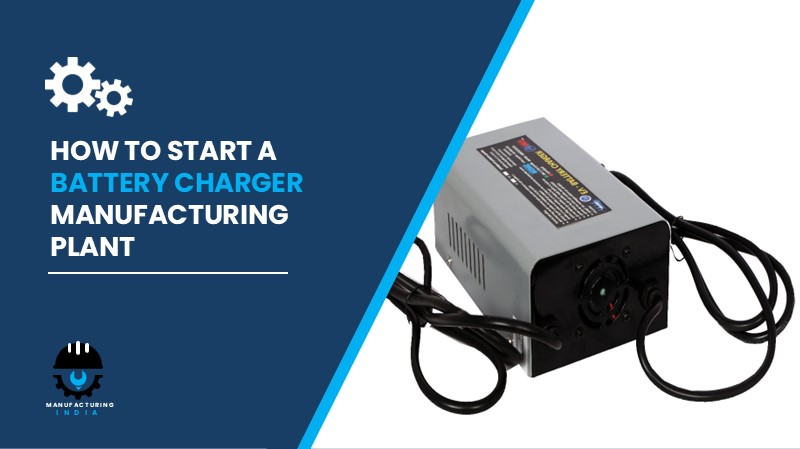
A battery charger is an electrical device that operates by providing a controlled current and voltage to replenish the energy of rechargeable batteries. Chargers are built to work with different types of batteries such as lithium-ion, lead-acid, nickel-metal hydride (NiMH), and nickel-cadmium (NiCd), hence their compatibility among different applications. Depending on the requirement, chargers vary from basic linear models to sophisticated smart chargers with microcontrollers, overcharge protection, temperature monitoring, and fast-charging features.
These devices are not only essential but have also found their way into a wide range of applications including consumer electronics, electric vehicles, industrial equipment, renewable energy storage systems, medical devices, and backup power solutions. As the use of rechargeable batteries continues to grow, efficient and reliable battery chargers have become a necessity in both everyday and specialised industrial applications. Continuous technological innovations – including smart chargers with microcontrollers, temperature monitoring, and adaptive charging protocols – are improving performance and user-friendliness, while manufacturers are prioritising compact designs, fast charging, better safety features, and energy efficiency standards compliance to meet evolving market expectations.
The primary production method is circuit design, PCB fabrication, component mounting (SMT/THT), soldering, firmware programming, enclosure assembly, wiring, functional testing, quality inspection, labelling, and packaging – a multi-stage precision electronics manufacturing process. End-use industries served include consumer electronics, electric vehicles, renewable energy, industrial equipment, telecommunications, automotive, and power backup systems.
Cost of Setting Up a Battery Charger Manufacturing Plant in India
The cost of establishing this facility depends on capacity, technology selection, plant location, degree of automation, and regulatory compliance requirements.
1. Capital Expenditure (CapEx)
Total capital investment for a battery charger manufacturing plant in India covers land acquisition, site preparation, civil construction, machinery, and pre-operative expenses. The cost of land and site development – including charges for land registration, boundary development, and other related expenses – forms a substantial part of the overall investment. This allocation ensures a solid foundation for safe and efficient plant operations. Investors can reduce land acquisition costs by locating the unit in an electronics manufacturing cluster, Special Economic Zone (SEZ), or industrial estate with established EV component and power electronics manufacturing infrastructure, which also provide shared utilities and potential state-level fiscal incentives aligned with India’s PLI scheme for advanced chemistry cells and electronics.
Civil works and construction cover the main PCB assembly and charger manufacturing production building – incorporating ESD (electrostatic discharge) protection and climate-controlled workstations – raw material storage areas for PCBs, transformers, capacitors, casings, and cables, a quality control laboratory, a finished goods warehouse, and an administrative block.
Machinery costs account for the largest portion of total capital expenditure. Key machinery required includes:
- SMT (Surface Mount Technology) lines
- Wave soldering machines
- Reflow ovens
- Testing benches
- Programming stations
- Automated packaging systems
All machinery must be high-quality and corrosion-resistant, tailored for battery charger manufacturing, and must comply with industry standards for safety, efficiency, and reliability. Other capital costs include the effluent treatment plant (ETP), advanced process monitoring systems, pre-operative expenses, trial production costs, and commissioning charges.
Request a Sample Report for In-Depth Market Insights: https://www.imarcgroup.com/battery-charger-manufacturing-plant-project-report/requestsample
2. Operational Expenditure (OpEx)
The operating cost structure of a battery charger manufacturing plant is primarily driven by raw material consumption, particularly PCBs, which account for approximately 70–80% of total operating expenses (OpEx). Transformers, capacitors, casings, and cables are the secondary raw material inputs. Securing long-term supply agreements with reliable electronic component suppliers is essential to mitigate price volatility and ensure a consistent supply of quality components. Minimising transportation costs by selecting nearby suppliers is essential, and long-term contracts should be negotiated to stabilise pricing and ensure a steady supply.
Utility costs – comprising electricity for SMT lines, wave soldering machines, reflow ovens, testing benches, and programming stations, as well as water – account for 5–10% of total OpEx. Other ongoing operating costs include transportation, packaging, salaries and wages, depreciation, taxes, equipment repairs and maintenance, and other miscellaneous expenses.
In the first year of operations, the operating cost for the battery charger manufacturing plant is projected to be significant, covering raw materials, utilities, depreciation, taxes, packing, transportation, and repairs and maintenance. By the fifth year, the total operational cost is expected to increase substantially due to factors such as inflation, market fluctuations, and potential rises in the cost of key materials. Additional factors, including supply chain disruptions, rising consumer demand, and shifts in the global economy, are expected to contribute to this increase.
3. Plant Capacity
The proposed manufacturing facility is designed with an annual production capacity ranging between 5 million and 10 million units, enabling economies of scale while maintaining operational flexibility. Battery charger production can be scaled efficiently through automation, improving output, consistency, and cost-effectiveness. Capacity can be customised per investor requirements based on target consumer electronics, EV, renewable energy, or industrial equipment market segments, available capital, and chosen automation level. Profitability improves materially with higher capacity utilisation, making domestic off-take agreements with EV manufacturers, consumer electronics brands, and UPS system producers a commercial priority from the commissioning stage. Break-even in a battery charger manufacturing business typically ranges from 3 to 5 years, depending on production scale, market demand, pricing strategy, and operational efficiency.
4. Profit Margins and Financial Projections
The project demonstrates healthy profitability potential under normal operating conditions. Gross profit margins typically range between 30–40%, supported by stable demand and value-added applications. Net profit margins range between 12–18%. A comprehensive financial model covering NPV (net present value), IRR (internal rate of return), payback period, liquidity analysis, uncertainty analysis, sensitivity analysis, and a full five-year profit and loss account provides investors with a rigorous analytical framework for assessing financial viability and long-term sustainability across different capacity and pricing scenarios.
Why Set Up a Battery Charger Manufacturing Plant in India?
Expanding Adoption Across Multiple Industries Driving Consistent Volume. The increasing implementation of rechargeable batteries across consumer, industrial, and commercial sectors enhances the need for chargers consistently across all demand segments. Industries increasingly require chargers tailored to specific battery types, capacities, and operational needs – creating opportunities for specialised domestic solutions that address India’s unique EV battery chemistry mix, power grid voltage specifications, and consumer charging behaviour.
Strong Growth in Electric Vehicles and Renewable Energy Storage. The rise of EVs and renewable energy systems significantly boosts the need for efficient battery charging solutions. As per the IEA, over 20% of new cars sold worldwide in 2024 were electric, with global sales exceeding 17 million – a 25% rise from 2023. India’s own EV adoption – driven by government FAME subsidies and PLI incentives – is directly translating into growing domestic procurement demand for EV battery chargers and onboard charging systems manufactured domestically.
Continuous Innovation in Fast and Smart Charging Technologies. Advances in fast-charging, intelligent, and protective charger technologies enhance performance, safety, and user convenience. Manufacturers are prioritising compact designs, fast charging, better safety features, and energy efficiency standards compliance. Smart chargers with microcontrollers, temperature monitoring, and adaptive charging protocols are improving performance and user-friendliness, creating premium product differentiation opportunities that support higher average selling prices and gross margins for innovative domestic producers.
Scalable Manufacturing with Automation Potential. Battery charger production can be scaled efficiently through automation, improving output, consistency, and cost-effectiveness – a characteristic that makes this manufacturing category highly suited to India’s expanding electronics component manufacturing ecosystem, where labour cost advantages and growing automation capability can be combined to produce competitive unit cost economics at the 5–10 million unit annual scale.
High Demand for Customised and Application-Specific Chargers. Industries increasingly require chargers tailored to specific battery types, capacities, and operational needs, creating opportunities for specialised solutions. This product customisation imperative creates a favourable commercial environment for domestic manufacturers who can develop application-specific charger designs for Indian EV OEMs, solar storage system integrators, and industrial UPS system producers – building proprietary customer relationships that are difficult for commodity import suppliers to displace.
Active Global Industry Developments Confirming Innovation Momentum. In October 2025, Bel Fuse launched the BCF19-700-8, a 19.2 kW liquid-cooled onboard battery charger for HEVs and EVs – offering 94% efficiency, 450–900 VDC output, and protections against over-temperature, voltage, and current, while supporting CAN bus communication, rapid charging, and compatibility with diverse high-voltage battery systems. In March 2025, BYD launched its Super e-Platform with Megawatt Flash Charging batteries, 30,000 RPM motor, and next-generation SiC chips – featuring 1 MW charging capability, with the flash charging battery providing 400 km range in just 5 minutes, matching gasoline refueling speeds, with Han L and Tang L models available for pre-order in China. These launches confirm that the global battery charger category is actively advancing its technology frontier with commercial momentum that directly validates domestic manufacturing investment.
Manufacturing Process – Step by Step
The battery charger manufacturing process uses circuit design, PCB fabrication, component mounting (SMT/THT), soldering, firmware programming, enclosure assembly, wiring, functional testing, quality inspection, labelling, and packaging as the primary production method. Each stage is precision-controlled to ensure electrical performance, safety compliance, and the reliability standards required by consumer electronics, EV, renewable energy, industrial, and medical device customers.
- Raw Material Receipt and Inspection: PCBs, transformers, capacitors, casings, and cables are received at the facility and subjected to incoming quality checks for component specification, dimensional compliance, and electrical characterisation before entering the production line.
- Circuit Design and PCB Layout: Engineering teams develop and validate the charger circuit design – specifying component values, thermal management solutions, safety protection circuits, and PCB layout geometry for the target charger type, power level, and application.
- Component Procurement and Kitting: Electronic components are procured, inspected, and kitted to each production work order according to the bill of materials for the target charger variant – ensuring traceability and component quality control throughout the production batch.
- PCB Assembly – SMT/THT Mounting: Bare PCBs are populated with surface-mount (SMT) and through-hole (THT) electronic components using SMT lines – including automated component placement, reflow soldering in reflow ovens, and wave soldering in wave soldering machines for through-hole components requiring solder bath processing.
- Soldering and Inspection: Soldered PCB assemblies are inspected for solder joint quality using automated optical inspection (AOI) systems before proceeding to firmware programming and final assembly stages.
- Firmware Programming: Microcontroller-based smart charger PCBs are programmed using programming stations with the validated firmware that controls charging algorithm, overcharge protection, temperature monitoring, and adaptive charging protocol logic.
- Enclosure Assembly and Wiring: Programmed and tested PCB assemblies are integrated into the charger housing – manufactured from plastic or metal casing – using enclosure assembly tools. Internal wiring, connectors, and thermal management components are installed according to the assembly specification.
- Functional Testing: Fully assembled chargers are evaluated on testing benches for electrical performance – including output voltage, current regulation, efficiency, protection trigger levels, and thermal performance – under simulated load conditions representing the target application’s battery charging profile.
- Quality Inspection and Certification Testing: Finished chargers are subjected to quality inspection for dimensional compliance, labelling accuracy, safety compliance testing, and any applicable third-party certification requirements (BIS, CE, UL) before release for packaging.
- Labelling and Packaging: Approved chargers are labelled with product specification, safety information, regulatory compliance markings, and traceability data, then packed into retail or industrial packaging using automated packaging systems and dispatched to end-use customers across consumer electronics, electric vehicles, renewable energy, industrial equipment, telecommunications, automotive, and power backup sectors.
Key Applications
The battery charger manufacturing plant serves a diverse and commercially significant range of end-use sectors across India’s electronics, automotive, and energy economy.
- Consumer Electronics: Chargers for smartphones, laptops, tablets, and wearables – the largest volume application segment driven by India’s vast and growing consumer electronics user base and the increasing adoption of multi-device households requiring multiple concurrent charging solutions.
- Electric Vehicles: Charging units for EV batteries and auxiliary systems – a fast-growing application aligned with India’s EV adoption trajectory, government FAME subsidies, and the IEA’s confirmation of 17 million global EV sales in 2024.
- Renewable Energy Systems: Battery charging solutions for solar and wind energy storage – serving India’s rapidly expanding rooftop solar and grid-scale battery storage sectors where reliable, efficient charging is critical for energy system performance.
- Industrial Equipment: Chargers for power tools, forklifts, and machinery – a consistent institutional procurement channel across India’s manufacturing, logistics, and construction sectors.
- Backup Power Systems: UPS and inverter battery chargers – a large and recurring demand segment in India where power outage frequency drives strong domestic consumption of UPS systems across residential, commercial, and industrial applications.
- Medical Equipment: Reliable battery charging solutions for portable medical devices and hospital equipment – a growing high-specification segment requiring regulatory-compliant charger designs with enhanced safety and reliability features.
Leading Manufacturers
The global battery charger industry is served by several established multinational manufacturers with extensive production capacities and diverse application portfolios. Key players operating in this market include:
- Battery Tender
- Ctek
- Delta-Q Technologies Corp.
- Interstate Batteries
- IOTA Engineering
- Lester Electrical
- Minn Kota
- NOCO
- ProMariner
- Quick USA
Additional key manufacturers in the global battery charger market include Accutronics Limited, Analytic Systems Ware Ltd., Anoma Corporation, Associated Equipment Corporation, Energizer Holdings Inc., Exide Technologies, Ferro Magnetics Corporation, FRIWO AG, HindlePower, and Panasonic Corporation of North America – all of which serve end-use sectors including consumer electronics, electric vehicles, renewable energy, industrial equipment, telecommunications, automotive, and power backup systems.
Timeline to Start the Plant
Investors should plan for a structured pre-production and commissioning phase covering the following key stages:
- Feasibility study and project report preparation
- Land acquisition and site development
- Regulatory approvals and environmental clearances
- Factory licence and fire safety compliance
- Machinery procurement and installation
- Raw material supplier agreements and supply chain setup
- Trial production and quality testing
- Commercial production launch
The timeline to start a battery charger manufacturing plant typically ranges from 12 to 18 months, depending on factors like securing licences, acquiring machinery, setting up infrastructure, and hiring skilled labour. Regulatory approvals and supplier lead times can also affect the setup period.
Licences and Regulatory Requirements
Starting a battery charger manufacturing unit in India requires several approvals:
- Business registration (Proprietorship, LLP, or Private Limited Company)
- Factory Licence under the Factories Act
- Environmental Clearance from the State Pollution Control Board
- GST Registration
- Fire Safety NOC
- BIS (Bureau of Indian Standards) product certification for battery chargers and power supply equipment sold in India
- Effluent Treatment Plant (ETP) operational clearance
- Occupational Health and Safety compliance
Key Challenges to Consider
High Capital Requirements. Establishing a fully equipped battery charger manufacturing plant – with SMT lines, wave soldering machines, reflow ovens, testing benches, programming stations, and automated packaging systems – at the 5–10 million unit annual capacity range requires significant upfront capital investment. Access to PLI scheme incentives for electronics manufacturing, MSME credit-linked subsidy schemes, and electronics SEZ infrastructure support can help manage this requirement.
Raw Material Price Volatility. PCBs – accounting for 70–80% of total OpEx – are subject to global semiconductor component price cycles and supply chain availability constraints, as demonstrated by global chip shortages in recent years. Transformers and capacitor prices are linked to copper and ceramic commodity markets respectively. Long-term procurement contracts with reliable electronic component suppliers and a diversified sourcing strategy are the primary risk mitigation measures for protecting the plant’s 30–40% gross margin profile.
Regulatory Compliance. Battery charger manufacturing facilities in India must comply with BIS certification requirements for power supply and charging equipment. Safety protocols must be implemented throughout the manufacturing process, advanced monitoring systems installed to detect deviations, and effluent treatment systems maintained to minimise environmental impact and ensure compliance with applicable emission standards.
Technology and Innovation Pressure. The global battery charger sector is actively advancing toward 1 MW flash charging – as demonstrated by BYD’s March 2025 Super e-Platform launch – and high-efficiency liquid-cooled onboard chargers for EV applications, as confirmed by Bel Fuse’s October 2025 BCF19-700-8 launch. Domestic manufacturers must invest continuously in R&D and technology adoption to remain competitive as global charging performance benchmarks continue to advance rapidly.
Competition from Established Global and Domestic Players. Established multinational manufacturers – including NOCO, Ctek, Delta-Q Technologies Corp., FRIWO AG, Panasonic Corporation, and others – set high benchmarks for product quality, safety certification, and pricing. Indian manufacturers must compete through localisation, competitive cost structures, India-specific product customisation, and the ability to meet BIS certification and EV OEM supplier qualification standards.
Skilled Manpower. Operating SMT lines, reflow ovens, wave soldering machines, and functional testing benches in a precision electronics manufacturing environment requires trained electronics engineers, SMT technicians, firmware programmers, and quality assurance personnel. Recruiting, training, and retaining qualified technical staff – particularly for firmware development and EV charger application engineering – is a recurring operational challenge in India’s competitive electronics manufacturing labour market.
Frequently Asked Questions
1. How much does it cost to set up a battery charger manufacturing plant in India?
Capital requirements generally include land acquisition, construction, equipment procurement – including SMT lines, wave soldering machines, reflow ovens, testing benches, programming stations, and automated packaging systems – installation, pre-operative expenses, and initial working capital. The total amount varies with capacity, technology, and location. A detailed feasibility study is recommended to generate accurate project-specific cost estimates.
2. Is battery charger manufacturing profitable in India in 2026?
Yes. The project delivers healthy financial performance, with gross margins of 30–40% and net profit margins of 12–18% under normal operating conditions. The global battery charger market was valued at USD 28.04 billion in 2025 and is projected to reach USD 40.71 billion by 2034 at a CAGR of 4.2% according to IMARC Group, with India’s EV adoption, renewable energy expansion, and consumer electronics growth providing strong domestic demand drivers.
3. What machinery is required for a battery charger manufacturing plant in India?
Essential equipment includes SMT lines, wave soldering machines, reflow ovens, testing benches, programming stations, and automated packaging systems. Additional tools include multimeters, oscilloscopes, and ESD-safe workbenches.
4. What licences and approvals are required to start a battery charger manufacturing plant in India?
Typical requirements include business registration, factory licence, environmental clearances, fire safety certifications, BIS product certification for battery chargers, ETP operational clearance, and Occupational Health and Safety compliance applicable under local, state, and national regulations.
5. What raw materials are needed for battery charger manufacturing?
The primary raw materials are PCBs, transformers, capacitors, casings, and cables. Battery charger production also requires electronic components such as resistors, diodes, ICs, wires, and connectors, as well as packaging materials, labelling items, and quality control components like fuses and thermal protection devices. PCBs are the dominant cost driver, accounting for 70–80% of total operating expenses.
6. What are the environmental compliance requirements for a battery charger manufacturing plant in India?
The facility must obtain Environmental Clearance from the State Pollution Control Board, operate an approved ETP, and install advanced monitoring systems to detect leaks or deviations in the process. Effluent treatment systems are necessary to minimise environmental impact and ensure compliance with emission standards applicable to electronics manufacturing operations.
7. What is the best location to set up a battery charger manufacturing plant in India?
The location must offer easy access to key raw materials such as PCBs, transformers, capacitors, casings, and cables, while proximity to target markets minimises distribution costs. The site must have robust infrastructure including reliable transportation, utilities, and waste management systems. Electronics manufacturing clusters in Tamil Nadu, Karnataka, Uttar Pradesh (Noida), Maharashtra, and Gujarat offer strong supplier ecosystems, skilled technical labour, and EV OEM proximity.
8. What is the break-even period for this type of plant in India?
Break-even in a battery charger manufacturing business typically ranges from 3 to 5 years, depending on production scale, market demand, pricing strategy, and operational efficiency. Strong distribution channels and brand presence can accelerate the break-even point.
9. What government incentives are available for manufacturers in India?
Governments may offer incentives such as capital subsidies, tax exemptions, reduced utility tariffs, export benefits, or interest subsidies to promote manufacturing under various national or regional industrial policies. India’s PLI scheme for electronics and advanced chemistry cells provides direct financial incentives for qualifying battery charger manufacturers. Financing can be arranged through term loans, government-backed schemes, private equity, equipment leasing, or strategic partnerships.
Key Takeaways for Investors
A battery charger manufacturing plant in India offers a high-growth and commercially well-grounded investment opportunity anchored by expanding demand across consumer electronics, electric vehicles, renewable energy, industrial equipment, telecommunications, automotive, and power backup systems – all of which depend on battery chargers as critical, recurring-consumption electronic components. The project is financially viable across the 5–10 million unit annual capacity range, with gross margins of 30–40% and net margins of 12–18% supported by a break-even horizon of 3 to 5 years at efficient capacity utilisation. According to IMARC Group estimates, the global battery charger market is set to grow from USD 28.04 billion in 2025 to USD 40.71 billion by 2034 at a CAGR of 4.2%, and the IEA’s confirmation that over 20% of new cars sold globally in 2024 were electric – with sales exceeding 17 million, a 25% rise from 2023 – directly confirms the scale and pace of EV adoption that is translating into structural procurement demand for EV battery chargers. With global technology innovation accelerating through BYD’s March 2025 Megawatt Flash Charging platform and Bel Fuse’s October 2025 high-efficiency liquid-cooled EV charger launch, the long-term demand sustainability for domestically produced battery chargers in India is structurally sound across all investment planning horizons.
About the Author