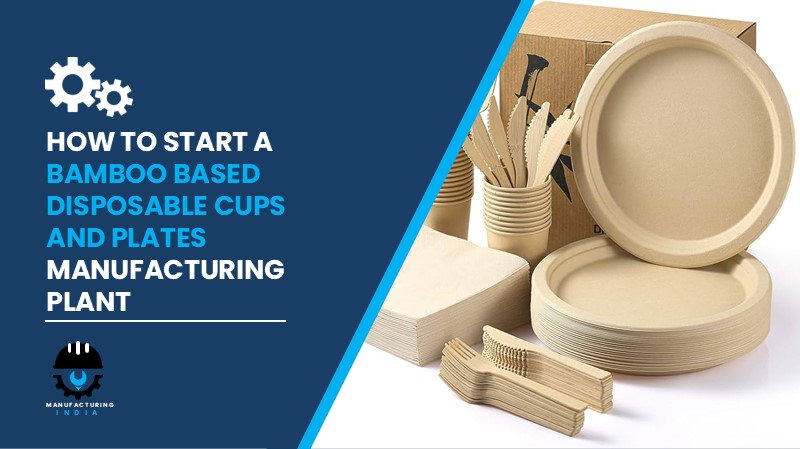
Setting up a bamboo based disposable cups and plates manufacturing plant in India presents a compelling investment case driven by growing awareness of environmental sustainability, government regulations on single-use plastics, rising demand for eco-friendly food packaging, and the increasing presence of cafes, restaurants, and catering services adopting biodegradable products. Bamboo based disposable cups and plates serve as environmentally friendly substitutes for standard plastic and paper tableware – products that lack the dangerous chemicals, microplastics, and typical coatings found in standard disposable products, while enabling worldwide progress toward circular economies and decreasing the use of single-use plastic items. As India enforces its single-use plastic ban and its organised foodservice sector expands rapidly, the domestic demand for compliant, sustainable, and high-quality disposable tableware alternatives is structurally positioned for sustained long-term growth.
India’s structural advantages make this investment strategically compelling. India’s Gross National Disposable Income (GNDI) for FY 2024–25 (PE) reached INR 3,05,94,001 crore, rising from INR 2,73,39,378 crore the previous year – reflecting an 11.9% increase. This rise in disposable income is expected to boost consumer spending, driving higher demand for eco-friendly products like bamboo-based disposable cups and plates across both household and commercial channels. Urbanisation, rising disposable income, and changing consumer lifestyles are the two main factors driving people to use biodegradable products in commercial and home settings. The Asia-Pacific region – led by India and China – already holds the largest share of this market, accounting for over 40.8% of global market share according to IMARC Group estimates, positioning a domestic bamboo based disposable cups and plates manufacturing plant in India at the most commercially active centre of global demand for this sustainable product category.
India’s 11.9% GNDI growth in FY 2024–25, Asia-Pacific’s dominant 40.8% share of the global bamboo disposable tableware market, and the government’s single-use plastic ban creating structural demand for biodegradable alternatives make a bamboo based disposable cups and plates manufacturing plant a financially sound, policy-backed, and sustainability-aligned investment. With gross margins of 30–40% and net margins of 12–20% across a capacity of 50–200 million pieces annually, the project delivers strong returns anchored by India’s eco-packaging megatrend.
What are Bamboo Based Disposable Cups and Plates?
Bamboo based disposable cups and plates serve as environmentally friendly substitutes for standard plastic and paper tableware. The products use bamboo fibres and bamboo pulp as materials, which undergo moulding, pressing, and heat treatment to create durable, biodegradable cups and plates. The materials possess natural strength together with water resistance and moderate heat resistance, which enables their use for both hot and cold beverages and meals.
The disposable products maintain safety for consumers while protecting the environment because they lack the dangerous chemicals, microplastics, and typical coatings found in standard disposable products. Cafes, restaurants, events, and households are adopting bamboo-based cups and plates because they offer sustainable solutions that match modern design and composting requirements. The products enable worldwide progress toward circular economies while decreasing the use of single-use plastic items – a positioning that resonates strongly with India’s regulatory environment and with the global corporate sustainability commitments of the foodservice sector.
The primary production method is bamboo fibre pulping, moulding, pressing, heat treatment, drying, quality inspection, and packaging – a multi-stage biomass processing operation. End-use industries served include the foodservice and HoReCa sector, the catering industry, retail and household use, event management services, and eco-friendly packaging distributors.
Cost of Setting Up a Bamboo Based Disposable Cups and Plates Manufacturing Plant in India
The cost of establishing this facility depends on capacity, technology selection, plant location, degree of automation, and regulatory compliance requirements.
1. Capital Expenditure (CapEx)
Total capital investment for a bamboo based disposable cups and plates manufacturing plant in India covers land acquisition, site preparation, civil construction, machinery, and pre-operative expenses. The cost of land and site development – including charges for land registration, boundary development, and other related expenses – forms a substantial part of the overall investment. This allocation ensures a solid foundation for safe and efficient plant operations. Investors can reduce land acquisition costs by locating the unit in an agro-processing zone, bamboo industry cluster, or Special Economic Zone (SEZ), which also provide shared utility infrastructure and potential state-level fiscal incentives aligned with India’s agro-processing and sustainable packaging manufacturing agenda.
Civil works and construction cover the main pulping, moulding, and drying production building, raw material storage areas for bamboo pulp/bamboo and binding agents, a quality control laboratory, a finished goods warehouse, and an administrative block. Given that bamboo based disposable cups and plates manufacturing involves pulping and heat treatment operations requiring steam and high-temperature equipment, civil infrastructure must incorporate appropriate ventilation, heat-resistant construction elements, and waste management provisions for bamboo processing effluents.
Machinery costs account for the largest portion of total capital expenditure. Key machinery required includes:
- High-quality pulpers
- Moulds
- Presses
- Dryers
- Heat treatment units
- Quality control systems
- Packaging machines
All machinery must be high-quality and corrosion-resistant, tailored for bamboo based disposable cups and plates production, and must comply with industry standards for safety, efficiency, and reliability. Other capital costs include the effluent treatment plant (ETP), advanced process monitoring systems, pre-operative expenses, trial production costs, and commissioning charges.
Request a Sample Report for In-Depth Market Insights: https://www.imarcgroup.com/bamboo-based-disposable-cups-plates-manufacturing-plant-project-report/requestsample
2. Operational Expenditure (OpEx)
The operating cost structure of a bamboo based disposable cups and plates manufacturing plant is primarily driven by raw material consumption, particularly bamboo pulp/bamboo, which accounts for approximately 40–50% of total operating expenses (OpEx). Binding agents are the secondary raw material input. Securing long-term supply agreements with reliable bamboo pulp and bamboo suppliers located in proximity to India’s major bamboo-growing regions is essential for cost stability and production continuity. Minimising transportation costs by selecting nearby suppliers is essential, and long-term contracts should be negotiated to stabilise pricing and ensure a steady supply.
Utility costs – comprising electricity and steam for pulpers, presses, dryers, and heat treatment units, as well as water – account for 20–25% of total OpEx, reflecting the energy-intensive nature of bamboo pulp processing and heat treatment operations. This elevated utility cost proportion underscores the importance of securing reliable and competitively priced electricity and steam supply at the chosen plant location. Other ongoing operating costs include transportation, packaging, salaries and wages, depreciation, taxes, equipment repairs and maintenance, and other miscellaneous expenses.
In the first year of operations, the operating cost for the bamboo based disposable cups and plates manufacturing plant is projected to be significant, covering raw materials, utilities, depreciation, taxes, packing, transportation, and repairs and maintenance. By the fifth year, the total operational cost is expected to increase substantially due to factors such as inflation, market fluctuations, and potential rises in the cost of key materials. Additional factors, including supply chain disruptions, rising consumer demand, and shifts in the global economy, are expected to contribute to this increase.
3. Plant Capacity
The proposed manufacturing facility is designed with an annual production capacity ranging between 50 million and 200 million pieces, enabling economies of scale while maintaining operational flexibility. Bamboo pulp moulding is a moderate-capital operation with potential for expansion and mass production – a scalable production model that allows investors to progress from initial capacity to full-scale operation in line with market penetration timelines. Capacity can be customised per investor requirements based on target foodservice, catering, retail, or event management market segments, available capital, and degree of automation. Profitability improves materially with higher capacity utilisation, making domestic supply agreements with restaurant chains, catering companies, event management firms, and eco-friendly packaging distributors a commercial priority from the commissioning stage.
4. Profit Margins and Financial Projections
The project demonstrates healthy profitability potential under normal operating conditions. Gross profit margins typically range between 30–40%, supported by stable demand and value-added applications. Net profit margins range between 12–20%. A comprehensive financial model covering NPV (net present value), IRR (internal rate of return), payback period, liquidity analysis, uncertainty analysis, sensitivity analysis, and a full five-year profit and loss account provides investors with a rigorous analytical framework for assessing financial viability and long-term sustainability across different capacity and pricing scenarios.
Why Set Up a Bamboo Based Disposable Cups and Plates Plant in India?
Rising Environmental Awareness Driving Consumer and Corporate Adoption. Consumers and businesses increasingly prefer biodegradable alternatives to reduce plastic pollution. The implementation of India’s single-use plastic ban and growing awareness of climate change effects are the primary regulatory and societal drivers accelerating adoption of bamboo-based disposable tableware across the foodservice, catering, and household segments. This policy-driven demand is structural and recurring, ensuring a durable and government-backed market pull for domestic manufacturers.
Government Regulations and Incentives Creating Mandatory Market. The implementation of single-use plastic bans has resulted in increased demand for bamboo tableware products. India’s prohibition on single-use plastic items – phased in from July 2022 – directly mandates the adoption of biodegradable alternatives across foodservice, retail, and institutional settings. This regulatory imperative creates a mandated commercial transition from plastic to bamboo-based disposable tableware that domestic manufacturers are uniquely positioned to serve with lower logistics cost and faster delivery than imported alternatives.
Expanding Foodservice Sector Generating Consistent Institutional Demand. The growth of cafes, restaurants, and catering services is boosting demand for disposable, eco-friendly products. India’s organised foodservice sector – including quick-service restaurants, cloud kitchens, event caterers, and hotel banqueting operations – is one of the fastest-growing in Asia, creating consistent and large-scale institutional procurement volumes for biodegradable disposable cups and plates that comply with environmental regulations and corporate sustainability commitments.
India’s Rising Disposable Income Fuelling Household Adoption. India’s GNDI for FY 2024–25 (PE) reached INR 3,05,94,001 crore – an 11.9% increase from INR 2,73,39,378 crore the previous year. This rise in disposable income is expected to boost consumer spending, driving higher demand for eco-friendly products like bamboo-based disposable cups and plates as households upgrade from conventional disposable tableware to sustainable alternatives for home use, social gatherings, and festival celebrations.
Product Differentiation Opportunities Supporting Premium Positioning. Manufacturers provide businesses and events with the option to create their own unique sizing and design elements, which include printed branding. This product customisation capability – enabling restaurant chains, event organisers, and corporate buyers to specify branded, dimensionally customised bamboo tableware – supports premium pricing above commodity disposable alternatives and builds long-term, loyalty-anchored customer relationships that provide revenue visibility and switching cost advantages.
Active Industry Developments Confirming Innovation and Adoption Momentum. In January 2025, Pacing Grass – a start-up incubated at IIT Kanpur – developed an eco-friendly crockery line combining bamboo with agricultural waste to create durable, lightweight, microwave-safe, and dishwasher-friendly products designed for everyday use, developed with technical support from IIT-K’s Start-Up Incubation and Innovation Centre. In October 2024, Southwest Airlines rolled out cold beverage cups made from a 75% bamboo pulp and 25% paper blend, paired with FSC-certified birch wood stirrers, in a move to reduce single-use plastics and enhance sustainability across its operations – with the airline expecting to cut over 1.5 million pounds of single-use plastics annually. These developments confirm that bamboo-based disposable tableware is actively transitioning from a niche sustainable alternative to a mainstream institutional procurement specification across multiple large-scale buyer categories.
Manufacturing Process – Step by Step
The bamboo based disposable cups and plates manufacturing process uses bamboo fibre pulping, moulding, pressing, heat treatment, drying, quality inspection, and packaging as the primary production method. Each stage is precision-controlled to ensure product dimensional consistency, structural integrity, water and heat resistance, and full compliance with the food safety and biodegradability standards required by foodservice, catering, retail, and institutional customers.
- Raw Material Receipt and Inspection: Bamboo pulp/bamboo and binding agents are received at the facility and subjected to incoming quality checks for bamboo fibre grade, moisture content, pulp consistency, and binding agent specification compliance before entering the production line.
- Bamboo Fibre Pulping: Bamboo culms or bamboo pulp sheets are processed through high-quality pulpers to produce a uniform bamboo fibre slurry at the required concentration and fibre length distribution for moulding – the critical first processing stage that determines the structural properties and surface quality of the finished product.
- Moulding: The bamboo fibre slurry is introduced into precision moulds shaped for the target product – cups, plates, bowls, or other tableware items – where the fibre network is formed to the specified dimensions and depth profile of the finished product design.
- Pressing: Moulded bamboo fibre preforms are subjected to controlled pressing pressure in presses to consolidate the fibre structure, expel excess water, and achieve the target wall thickness, dimensional accuracy, and structural rigidity of the finished cup or plate.
- Heat Treatment: Pressed preforms are processed through heat treatment units under controlled temperature and dwell time conditions to cure the binding agents, develop the product’s water resistance and heat tolerance characteristics, and achieve the dimensional stability and strength specification required for safe use with hot and cold beverages and meals.
- Drying: Heat-treated products are processed through dryers to remove residual moisture to within the specification limit required for product stability, packaging integrity, and shelf life performance.
- Quality Inspection: Finished cups and plates are evaluated on quality control systems for dimensional compliance, structural integrity, water resistance, surface finish, and food safety compliance – including microbiological testing where required – before release for packaging.
- Packaging and Dispatch: Approved bamboo based disposable cups and plates are packed using packaging machines and dispatched to end-use customers across the foodservice and HoReCa sector, the catering industry, retail and household use channels, event management services, and eco-friendly packaging distributors.
Key Applications
The bamboo based disposable cups and plates manufacturing plant serves a diverse and commercially significant range of end-use sectors across India’s sustainable packaging and foodservice economy.
- Foodservice and HoReCa Sector: Provides restaurants, hotels, and cafes with environmentally friendly tableware products that meet their hygiene requirements and need for disposable utensils – the largest institutional procurement channel for domestic bamboo disposable tableware manufacturers.
- Catering and Events: Provides biodegradable tableware solutions for use at major events, wedding receptions, and social gatherings – a high-volume, recurring seasonal demand channel aligned with India’s large and active wedding, festival, and corporate events market.
- Retail and Household Use: Offers environmentally friendly single-use cups and plates which customers can use at home – a growing consumer retail channel accessed through modern trade, e-commerce grocery platforms, and specialty eco-products retail formats.
- Eco-Packaging Distributors: Assists companies that focus on creating environmentally friendly packaging products – serving as a B2B supply channel for organised eco-packaging distributors who aggregate biodegradable tableware for resale across multiple end-use buyer categories.
- Airlines and Transportation: Large-scale institutional buyers such as Southwest Airlines – which rolled out 75% bamboo pulp cold beverage cups in October 2024 expecting to cut over 1.5 million pounds of single-use plastics annually – represent a growing premium procurement channel for certified, food-safe bamboo disposable cups at high volumes.
- Corporate and Institutional Catering: Office cafeterias, hospital food services, and educational institution canteens that have adopted sustainability mandates are transitioning to biodegradable disposable tableware as a systematic replacement for plastic or polystyrene alternatives.
Leading Manufacturers
The global bamboo based disposable cups and plates industry is served by several established manufacturers with extensive production capacities and diverse application portfolios. Key players operating in this market include:
- Anhui Bochen Eco Co.
- Xiamen Forever Rise Imp Exp Co., Ltd.
- GeoTegrity Eco Pack (Xiamen) Co., Ltd.
- Shandong Upmax Packaging Group Co., Ltd.
All of these manufacturers serve end-use sectors including foodservice, catering, retail households, and the sustainable packaging distributors segment – the same markets that a domestic Indian bamboo based disposable cups and plates manufacturing plant can target, with India’s regulatory tailwinds, bamboo abundance, and growing foodservice sector providing strong commercial advantages over imported Chinese product.
Timeline to Start the Plant
Investors should plan for a structured pre-production and commissioning phase covering the following key stages:
- Feasibility study and project report preparation
- Land acquisition and site development
- Regulatory approvals and environmental clearances
- Factory licence and fire safety compliance
- Machinery procurement and installation
- Raw material supplier agreements and supply chain setup
- Trial production and quality testing
- Commercial production launch
Licences and Regulatory Requirements
Starting a bamboo based disposable cups and plates manufacturing unit in India requires several approvals:
- Business registration (Proprietorship, LLP, or Private Limited Company)
- Factory Licence under the Factories Act
- Environmental Clearance from the State Pollution Control Board
- GST Registration
- Fire Safety NOC
- FSSAI food business operator licence for food contact material products used in contact with beverages and meals
- Effluent Treatment Plant (ETP) operational clearance
- Occupational Health and Safety compliance
Key Challenges to Consider
High Capital Requirements. Establishing a fully equipped bamboo based disposable cups and plates manufacturing plant – with high-quality pulpers, precision moulds, presses, heat treatment units, dryers, quality control systems, and packaging machines – at the 50–200 million piece annual capacity range requires significant upfront capital investment. Access to agro-processing MSME credit-linked schemes, National Bamboo Mission support, and state government eco-packaging investment incentives can help bridge funding requirements.
Raw Material Price Volatility. Bamboo pulp/bamboo – accounting for 40–50% of total OpEx – is subject to seasonal bamboo harvest availability and transportation cost variability depending on proximity to bamboo-growing regions. Long-term supply contracts with reliable bamboo farmers or bamboo pulp processors in Assam, Meghalaya, Tripura, Odisha, and other bamboo-rich states are essential for production cost stability and consistent material quality throughout the year.
High Utility Cost Intensity. Utilities – at 20–25% of total OpEx – represent a significantly elevated cost component driven by the energy demands of bamboo pulp processing, heat treatment operations, and drying systems. Securing reliable and cost-competitively priced electricity and steam supply is a critical site selection criterion for managing operating cost efficiency and protecting the plant’s 30–40% gross margin profile.
Regulatory Compliance. Bamboo based disposable cups and plates manufacturing facilities must comply with FSSAI food contact material regulations, environmental compliance for bamboo pulp processing effluent, and applicable waste management regulations. Advanced monitoring systems must be installed to detect deviations in the heat treatment or pulping process, and effluent treatment systems are mandatory throughout operations.
Competition from Established Asian Producers. Established manufacturers from China – including Anhui Bochen Eco Co., GeoTegrity Eco Pack (Xiamen) Co. Ltd., and Shandong Upmax Packaging Group Co. Ltd. – hold strong global market positions and export significant volumes of bamboo disposable tableware to India and other markets. Domestic Indian manufacturers must compete through shorter supply chains, faster delivery, India-specific product customisation, and the commercial preference of Indian institutional buyers for locally sourced, FSSAI-certified biodegradable tableware products.
Skilled Manpower. Operating high-pressure pulpers, moulding presses, heat treatment systems, and quality control equipment in a food-contact manufacturing environment while maintaining FSSAI compliance documentation requires trained food processing technicians and quality assurance personnel. Recruiting, training, and retaining qualified production and quality staff is a recurring operational challenge in India’s agro-processing sector.
Frequently Asked Questions
1. How much does it cost to set up a bamboo based disposable cups and plates manufacturing plant in India?
Total setup cost depends on plant capacity, location, machinery selection, and automation level. Key cost components include land and site development, civil construction, machinery (high-quality pulpers, moulds, presses, dryers, heat treatment units, quality control systems, packaging machines), and pre-operative expenses. A detailed feasibility study is recommended to generate accurate project-specific cost estimates.
2. Is bamboo based disposable cups and plates manufacturing profitable in India in 2026?
Yes. The project delivers healthy financial performance, with gross margins of 30–40% and net profit margins of 12–20% under normal operating conditions. Asia-Pacific holds over 40.8% of global market share per IMARC Group, and India’s 11.9% GNDI growth in FY 2024–25, single-use plastic ban, and expanding foodservice sector provide strong and policy-backed domestic demand drivers.
3. What machinery is required for a bamboo based disposable cups and plates plant in India?
Essential equipment includes high-quality pulpers, moulds, presses, dryers, heat treatment units, quality control systems, and packaging machines.
4. What licences and approvals are required to start a bamboo based disposable cups and plates plant in India?
Required approvals include business registration, Factory Licence, Environmental Clearance from the State Pollution Control Board, GST Registration, Fire Safety NOC, FSSAI food contact material licence, ETP operational clearance, and Occupational Health and Safety compliance.
5. What raw materials are needed for bamboo based disposable cups and plates manufacturing?
The primary raw materials are bamboo pulp/bamboo and binding agents. Bamboo pulp/bamboo is the dominant cost driver, accounting for 40–50% of total operating expenses, and must be sourced from reliable suppliers meeting the fibre grade, moisture, and pulp consistency specifications required for the target product’s structural and food-safety performance.
6. What are the environmental compliance requirements for a bamboo based disposable cups and plates plant in India?
The facility must obtain Environmental Clearance from the State Pollution Control Board, operate an approved ETP for bamboo pulp processing effluent management, and install advanced monitoring systems to detect leaks or deviations in the process. Effluent treatment systems are necessary to minimise environmental impact and ensure compliance with emission standards applicable to biomass processing operations.
7. What is the best location to set up a bamboo based disposable cups and plates plant in India?
The location must offer easy access to key raw materials such as bamboo pulp/bamboo and binding agents, while proximity to target markets minimises distribution costs. The site must have robust infrastructure including reliable transportation, utilities, and waste management systems. States with established bamboo growing clusters – including Assam, Meghalaya, Tripura, Odisha, Karnataka, and Maharashtra – combined with proximity to foodservice and catering end-user markets are the strongest location candidates.
8. What is the break-even period for this type of plant in India?
The break-even period depends on plant capacity, total capital investment, product selling price across foodservice, retail, and institutional segments, and capacity utilisation rate. A comprehensive financial analysis covering NPV, IRR, payback period, and uncertainty and sensitivity analysis is the most reliable method for generating project-specific break-even timelines.
9. What government incentives are available for manufacturers in India?
Bamboo based disposable cups and plates manufacturers in India can access National Bamboo Mission (NBM) grants for bamboo-based industry development, MSME credit-linked capital subsidy schemes, state government agro-processing investment promotion subsidies, and export promotion incentives for certified sustainable packaging products. The government’s single-use plastic ban creates a mandated market transition that effectively functions as structural policy support for biodegradable tableware manufacturers through regulatory demand creation.
Key Takeaways for Investors
A bamboo based disposable cups and plates manufacturing plant in India offers a well-grounded, sustainability-aligned investment opportunity anchored by growing demand across the foodservice and HoReCa sector, the catering industry, retail and household use, event management services, and eco-friendly packaging distributors – all of which are actively transitioning from conventional plastic disposable tableware to biodegradable bamboo alternatives under India’s single-use plastic regulatory framework. The project is financially viable across the 50–200 million piece annual capacity range, with gross margins of 30–40% and net margins of 12–20% providing a strong return framework for investors at multiple capital scales. Asia-Pacific already holds over 40.8% of global bamboo disposable tableware market share per IMARC Group, positioning India – with its vast bamboo reserves, 11.9% GNDI growth in FY 2024–25, and one of Asia’s most active regulatory transitions away from single-use plastic – as one of the most commercially compelling manufacturing and consumption markets in this category. With active domestic innovation confirmed by IIT Kanpur’s Pacing Grass January 2025 eco-crockery launch and global institutional adoption confirmed by Southwest Airlines’ October 2024 bamboo cup rollout targeting 1.5 million pounds of annual plastic reduction, the long-term demand sustainability for domestically produced bamboo based disposable cups and plates is structurally sound across all investment planning horizons.
About the Author