Introduction
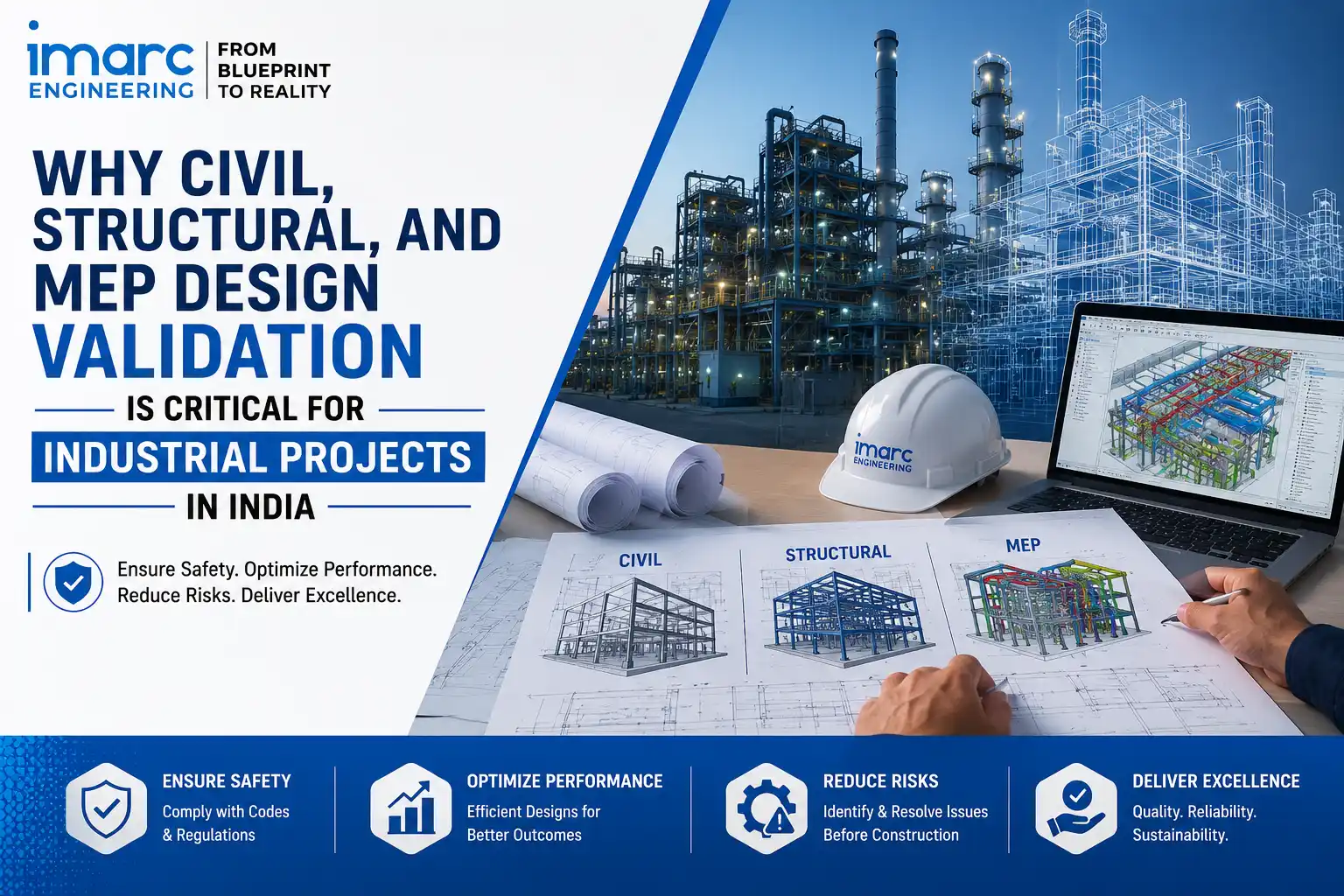
Civil, structural and MEP design validation is one of the most important quality gates in an industrial project — and one of the most frequently compressed when schedules are tight.
Once foundations are cast, steel is fabricated or utility routes are fixed, the hidden problems surface: structural capacity that does not match equipment loads, MEP clashes with process layout, inadequate access for maintenance, fire and safety gaps, and costly rework that delays commissioning. Many of these risks remain unnoticed when each discipline is reviewed separately. They are typically identified only when civil, structural and MEP designs are assessed together against process requirements, applicable codes, and constructability before major site work begins.
IMARC Engineering provides industrial design coordination and project advisory support across India. This article explains why civil, structural and MEP design validation is critical for industrial projects, which checks matter most, and how early validation protects cost, schedule and operational performance.
Why Design Validation Matters for Industrial Projects in 2026
India’s manufacturing investment continues to expand under policy support and rising capacity demand.
Manufacturing is estimated to grow around 7% at constant prices in FY 2025-26, according to MoSPI’s First Advance Estimates. FDI into manufacturing rose 18% in FY 2024-25 to US$19.04 billion, as reported by the Ministry of Commerce and Industry and DPIIT. The Production Linked Incentive (PLI) scheme has attracted cumulative investment exceeding ₹2.16 lakh crore, with cumulative production and sales surpassing ₹20.41 lakh crore as of December 2025, per PIB.
As more greenfield plants and brownfield expansions move into detailed design and construction, the cost of late design changes has risen. Logistics costs have improved to an estimated 7.97% of GDP (DPIIT-NCAER study), yet project-level overruns still often trace back to incomplete coordination between civil, structural and MEP disciplines. Validating these designs before construction is one of the highest-return controls available to project owners.
What Civil, Structural and MEP Design Validation Covers
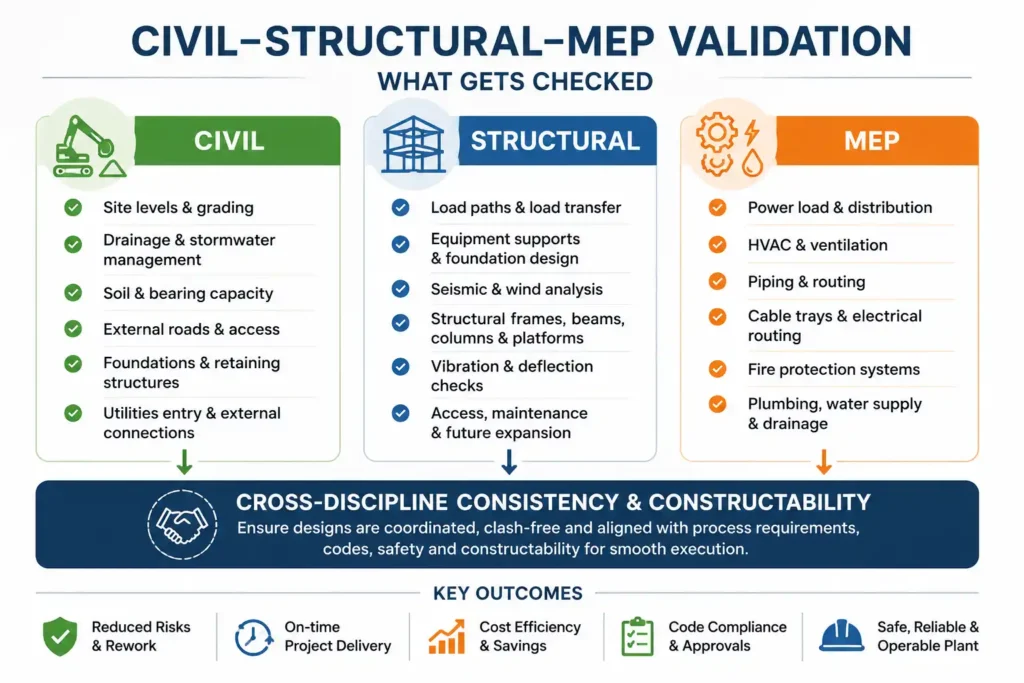
Validation is more than a drawing check. It confirms that the three disciplines form a coherent, buildable and operable system.
Civil design covers site grading, drainage, roads, foundations and external works that must support equipment loads, vehicle movement and long-term site conditions.
Structural design covers buildings, frames, platforms and supports that must carry process equipment, dynamic loads, seismic and wind requirements, and future access needs.
MEP design covers mechanical, electrical and plumbing systems — power, lighting, HVAC, water, effluent, fire protection and related services — that must fit the layout, serve the process and remain maintainable.
The review assesses whether these designs are consistent with each other, aligned with the process layout, compliant with applicable codes, and practical for construction, operation, and long-term maintenance.
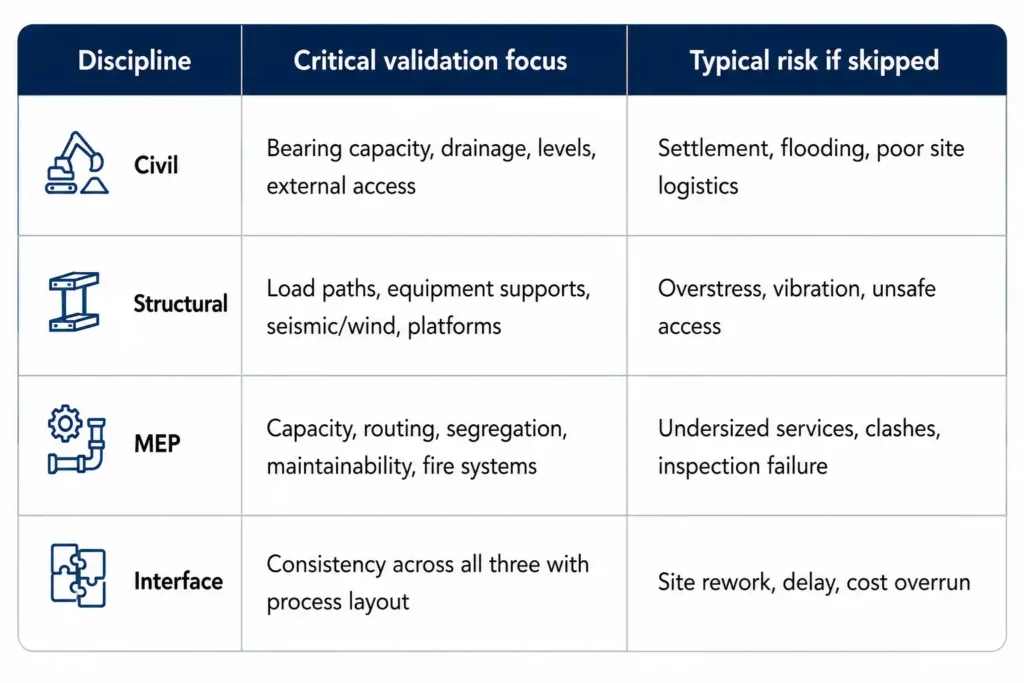
Key Risks of Skipping Civil, Structural and MEP Design Validation
When civil, structural and MEP designs are developed in isolation or frozen too early, projects typically face:
- Clashes and rework: Ducts, cable trays, pipe racks or equipment foundations that conflict and force site changes
- Under-designed structures: Frames or foundations that cannot safely support final equipment weights or dynamic loads
- Utility shortfalls: Power, water, HVAC or drainage capacity that does not match process demand
- Access and maintenance problems: Equipment or services installed without clear routes for operation and repair
- Safety and code gaps: Fire protection, emergency egress or environmental provisions that fail inspection or consent conditions
- Schedule and cost impact: Late discoveries that delay procurement, fabrication or commissioning
These outcomes are largely preventable when validation is treated as a formal project stage rather than an optional review.
How Early Design Validation Improves Project Outcomes
When civil, structural and MEP designs are validated together, project owners typically gain:
- Fewer site clashes and variation orders
- Higher confidence that structures and services match final equipment and process loads
- Clearer constructability and maintenance access before fabrication
- Better alignment with factory, fire and environmental approval expectations
- More reliable schedules because major interface issues are resolved on paper, not on site
- Stronger basis for contractor pricing and reduced claims related to design ambiguity
This review process does not eliminate every design change, but it identifies issues early—when they can be resolved more efficiently and at a lower cost.
Key Validation Checks That Protect Industrial Projects
A practical validation review focuses on the points that most often drive rework and delay if left unresolved.
How IMARC Engineering Supports Design Validation
IMARC Engineering helps industrial clients strengthen coordination between civil, structural and MEP design so that projects move from drawing to construction with fewer interface surprises.
- Review of civil, structural and MEP packages against process layout and project requirements
- Identification of capacity, access, clash and constructability gaps
- Support in prioritising design corrections before procurement and site mobilisation
- Alignment inputs with operational, safety and statutory expectations
- Advisory for both greenfield plants and brownfield expansion projects
IMARC Engineering works with manufacturers and project teams across pharmaceuticals, food and beverage, chemicals, auto components, electronics, FMCG and discrete industrial sectors.
Contact IMARC Engineering’s team for civil, structural and MEP design validation support across India: https://www.imarcengineering.com/contact?service=civil-structural-mep-design-and-validation
Common Mistakes in Civil, Structural and MEP Design
- Freezing civil and structural work before final equipment data is available
- Developing MEP routes without a coordinated 3D or clash-aware review
- Ignoring maintenance access and future expansion in initial design
- Treating fire, drainage and environmental provisions as late add-ons
- Assuming separate discipline reviews are enough without a combined validation step
- Starting construction on partial packages while interfaces remain unresolved
Conclusion
Industrial projects in India are being delivered under stronger investment momentum and tighter expectations on cost and schedule. Civil, structural and MEP design validation is critical because these disciplines determine whether the plant can be built safely, operated efficiently and expanded without major rework.
When validation confirms load capacity, service adequacy, routing consistency, access and code alignment before construction, projects reduce clash-driven delays, protect CapEx and improve the quality of the asset that is finally handed over. In a manufacturing environment supported by PLI, rising FDI and improving logistics, that discipline is a practical advantage, not a bureaucratic extra.
Through coordinated design review and interface-focused advisory, IMARC Engineering helps industrial projects in India move from design intent to buildable, operable reality with lower risk.
Contact Us:
IMARC Engineering
Phone: +91-120-433-0800
Email: sales@imarcengineering.com
India: C-130, Sector 2, Noida, Uttar Pradesh 201301
LinkedIn: https://www.linkedin.com/showcase/imarc-engineering/
About the Author