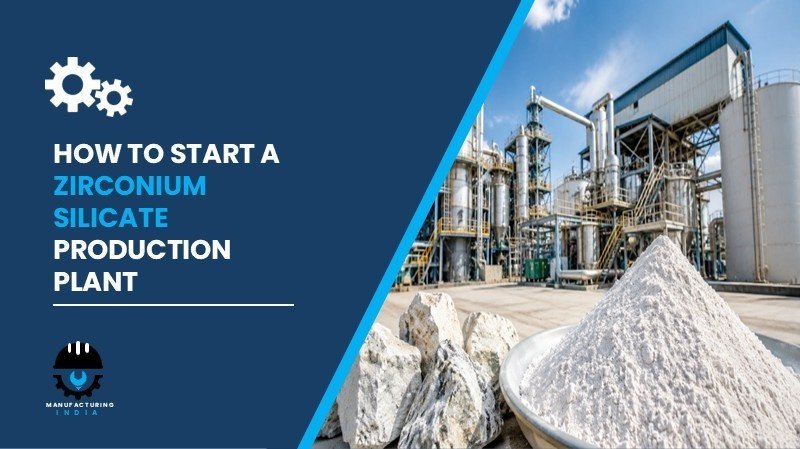
A zirconium silicate production plant setup in India presents a compelling investment case, driven by expanding demand from the ceramics, foundry, refractories, glass, and zirconium chemicals sectors. As a highly durable, heat-resistant compound valued for its chemical stability, extreme hardness, and high refractive index, zirconium silicate functions as a primary opacifier in ceramic glazes and a critical input for advanced electronic components, specialized paints, and industrial coatings, making it indispensable to India’s construction and industrial manufacturing base.
India’s growing urbanisation, rising infrastructure development, and expanding housing and commercial construction activity continue to lift consumption of ceramic tiles, sanitaryware, and refractory products, all of which rely on zirconium silicate as a performance-enhancing raw material. Government investment in housing, commercial construction, and domestic manufacturing further strengthens indirect demand for this compound, positioning India as a strategically sound base for a new production facility.
The zirconium silicate production plant opportunity in India is underpinned by steady demand from ceramics, foundry, and refractory end-users, moderate but defensible entry barriers, and healthy profitability, with gross margins of 24-32% and net margins of 14-20% supporting a viable break-even outlook across plant capacities.
What is Zirconium Silicate?
Zirconium silicate is a highly durable, heat-resistant compound found in nature as the mineral zircon. Known for its chemical stability, extreme hardness, and high refractive index, it serves as a primary opacifier in ceramic glazes, giving them a brilliant, glossy, and uniform white finish. Beyond ceramics, its exceptionally high melting point makes it well suited for refractory materials, precision casting, and advanced electronic components, and it is also widely used in specialized paints and industrial coatings. Chemically, the compound is represented as ZrSiO₄.
This production sequence relies on milling, classification, surface treatment, and drying as its core stages. The compound serves a wide span of end-use industries, including ceramics, foundries, refractories, abrasives, paints & coatings, electronics, and automotive, reflecting its versatility as a functional additive and opacifying agent across industrial applications.
Cost of Setting Up a Zirconium Silicate Production Plant in India
The cost of setting up a zirconium silicate production plant depends on capacity, technology, location, automation level, and regulatory compliance requirements.
1. Capital Expenditure (CapEx)
Capital investment for the facility covers land acquisition, site preparation, and the infrastructure needed to support production. Site selection should prioritise easy access to key raw materials such as zircon sand, sodium hydroxide, and water, along with proximity to target markets to minimise distribution costs, robust transportation and utility infrastructure, and compliance with local zoning and environmental regulations. Civil works cover the construction of the production shed, laboratory, storage areas, and administrative block, with the plant layout optimised for workflow efficiency, safety, and future expansion.
Machinery costs represent the largest share of total capital expenditure for the unit. Key machinery required includes:
- Crushers
- Grinding mills
- Magnetic separators
- Flotation units
- Calciners
- Refining furnaces
- Sieving systems
- Packaging machines
Other capital costs include effluent treatment systems needed to minimise environmental impact and ensure compliance with emission standards, along with advanced monitoring systems installed to detect leaks or process deviations. Together, land and site development, civil works, machinery, and these other capital costs form the complete capital expenditure base for the plant.
Request a Sample Report for In-Depth Market Insights: https://www.imarcgroup.com/zirconium-silicate-manufacturing-plant-project-report/requestsample
2. Operational Expenditure (OpEx)
Raw material cost is the single largest component of operating expenditure for a zirconium silicate production plant, with zircon sand, sodium hydroxide, and water accounting for approximately 50-60% of total OpEx. Securing reliable suppliers and negotiating long-term contracts helps stabilise pricing, mitigate volatility, and ensure a consistent supply of these materials.
Utility costs, covering electricity, water, and steam, account for roughly 11-15% of operating expenditure. Other operating costs include transportation, packaging, salaries and wages, maintenance, depreciation, and taxes. In the first year of operations, the operating cost for the plant is projected to be significant, and by the fifth year, total operational cost is expected to increase substantially due to inflation, market fluctuations, potential rises in the cost of key materials, supply chain disruptions, rising consumer demand, and shifts in the global economy.
3. Plant Capacity
The proposed zirconium silicate production facility is designed with an annual capacity of 15,000 MT, enabling economies of scale while maintaining operational flexibility. Plant capacity can be customised based on individual investor requirements, and financial projections for the project are developed around assumptions that include production capacity utilisation alongside capital investment, operating costs, pricing trends, and demand outlook.
4. Profit Margins and Financial Projections
The project demonstrates healthy profitability potential under normal operating conditions. Gross profit margins typically range between 24-32%, while net profit margins range between 14-20%, supported by stable demand and value-added applications. Financial analysis for the plant covers liquidity, profitability, payback period, net present value (NPV), and internal rate of return (IRR), giving investors a comprehensive view of the project’s financial viability and long-term sustainability.
Why Set Up a Zirconium Silicate Plant in India?
Critical Raw Material for Ceramic and Refractory Industries: Zirconium silicate is a key opacifier and performance-enhancing material used extensively in ceramic tiles, sanitaryware, tableware, foundry applications, refractories, and specialty coatings, making it an essential input for construction, industrial, and consumer goods manufacturing.
Alignment with Construction and Industrial Growth Trends: Rising urbanisation, infrastructure development, housing construction, and growth in the ceramics sector are driving sustained demand for zirconium silicate. Expanding production of premium ceramic tiles and sanitaryware, particularly in emerging economies, continues to support long-term market growth.
Infrastructure and Manufacturing Support: Government investments in housing, commercial construction, industrial development, and domestic manufacturing initiatives indirectly strengthen demand for zirconium silicate through increased consumption of ceramic products, refractories, and industrial materials.
Moderate but Defensible Entry Barriers: Although production is less capital-intensive than advanced specialty chemicals, stringent quality requirements, precise particle-size control, purity specifications, and consistency standards create meaningful entry barriers that favour established producers with technical expertise and reliable processing capabilities.
Active Industry Investment: In May 2026, a research study published in the Journal of Materials Science: Materials in Engineering detailed the hydrothermal synthesis and characterisation of nanostructured zirconium silicate (ZrSiO₄) and its incorporation as a filler into a Poly Methyl Methacrylate (PMMA) matrix to form nanocomposites, reflecting continued innovation in the space.
Supply Chain Localisation and Security: Ceramic and industrial manufacturers increasingly prefer dependable regional suppliers to reduce lead times, manage raw material sourcing risks, and ensure consistent product availability, creating opportunities for local zirconium silicate producers with efficient operations and stable supply networks.
Zirconium Silicate Production Process – Step by Step
The zirconium silicate production process uses milling, classification, surface treatment, and drying as the primary production method, supported by a defined sequence of unit operations, material handling, and quality checks.
- Crushing: Raw zircon sand is broken down using crushers to prepare it for further size reduction.
- Grinding/Milling: Grinding mills reduce the material to the fine particle size required for downstream processing.
- Magnetic Separation: Magnetic separators remove unwanted magnetic impurities from the processed material.
- Flotation: Flotation units are used to further purify and concentrate the zirconium silicate content.
- Calcination: Calciners process the concentrated material under controlled conditions to achieve the required properties.
- Refining: Refining furnaces further treat the material to meet purity and quality specifications.
- Sieving/Classification: Sieving systems classify the finished material by particle size to meet technical specifications.
- Surface Treatment and Drying: The classified material undergoes surface treatment and drying to achieve final product consistency.
- Packaging and Dispatch: Packaging machines prepare the finished zirconium silicate for dispatch to ceramics, foundry, refractory, glass, and zirconium chemicals end-users.
Key Applications
Zirconium silicate serves a wide span of industrial and consumer-facing end-use industries:
- Ceramics: Used in the production of ceramic tiles, sanitaryware, tableware, and technical ceramics.
- Foundry: Used in mould and core manufacturing for precision metal casting applications.
- Refractories: Used in the manufacturing of refractory bricks, kiln linings, and high-temperature insulation materials.
- Glass: Functions as an opacifier and strengthening agent in specialty glass and glass-ceramic products.
- Zirconium Chemicals: Serves as a raw material for the production of zirconium oxide, zirconium chemicals, and advanced zirconium-based materials.
Leading Zirconium Silicate Producers
The global zirconium silicate industry includes several multinational companies with extensive production capacities and diverse application portfolios. Key players include:
- Yixing Yaoguang Group Co., Ltd.
- Chilches Materials
- Imerys
- Industrie Bitossi
- HakusuiTech Co., Ltd.
Timeline to Start the Plant
- Feasibility study and project report preparation
- Land acquisition and site development
- Regulatory approvals and environmental clearances
- Factory licence and fire safety compliance
- Machinery procurement and installation
- Raw material supplier agreements and supply chain setup
- Trial production and quality testing
- Commercial production launch
Licences and Regulatory Requirements
Starting a zirconium silicate production unit in India requires several approvals:
- Business registration (Proprietorship, LLP, or Pvt Ltd)
- Factory Licence under the Factories Act
- Environmental Clearance from State Pollution Control Board
- GST Registration
- Fire Safety NOC
- Chemical handling compliance for raw materials such as sodium hydroxide
- Effluent Treatment Plant (ETP) operational clearance
- Occupational Health and Safety compliance
Key Challenges to Consider
High Capital Requirements: Machinery costs, including crushers, grinding mills, magnetic separators, flotation units, calciners, refining furnaces, sieving systems, and packaging machines, account for the largest share of total capital expenditure, making upfront investment a key consideration.
Raw Material Price Volatility: Zircon sand, sodium hydroxide, and water together make up 50-60% of operating expenditure, so price fluctuations in these inputs can materially affect margins.
Regulatory and Environmental Compliance: Effluent treatment systems, emission standards, and environmental clearances require ongoing monitoring and investment to maintain compliance.
Quality and Precision Pressure: Stringent quality requirements, precise particle-size control, and purity specifications create meaningful entry barriers that demand consistent technical expertise.
Competition from Established Players: Producers such as Yixing Yaoguang Group Co., Ltd., Chilches Materials, Imerys, Industrie Bitossi, and HakusuiTech Co., Ltd. have extensive production capacities and diverse application portfolios, raising the competitive bar for new entrants.
Skilled Manpower: Reliable processing capabilities and consistent product quality depend on a technically trained workforce, making human resource planning a critical part of plant setup.
Frequently Asked Questions
1. How much does it cost to set up a zirconium silicate production plant?
Total cost depends on plant capacity, technology, automation level, and location, and covers land and site development, civil works, machinery, and other capital costs.
2. Is zirconium silicate production profitable in India in 2026?
Yes, the project shows healthy profitability potential, with gross margins of 24-32% and net margins of 14-20% under normal operating conditions.
3. What machinery is required for a zirconium silicate plant in India?
Key machinery includes crushers, grinding mills, magnetic separators, flotation units, calciners, refining furnaces, sieving systems, and packaging machines.
4. What licences and approvals are required to start a zirconium silicate plant in India?
Requirements include business registration, a Factory Licence, Environmental Clearance, GST Registration, Fire Safety NOC, and Effluent Treatment Plant clearance, among others.
5. What raw materials are needed for zirconium silicate production?
The primary raw materials are zircon sand, sodium hydroxide, and water.
6. What are the environmental compliance requirements for a zirconium silicate plant in India?
Plants require effluent treatment systems, environmental clearance from the State Pollution Control Board, and monitoring systems to detect leaks or process deviations.
7. What is the best location to set up a zirconium silicate plant in India?
The location should offer easy access to zircon sand, sodium hydroxide, and water, proximity to target markets, robust infrastructure, and compliance with zoning and environmental regulations.
8. What is the break-even period for this type of plant in India?
The report’s financial analysis covers payback period, net present value, and internal rate of return to determine break-even timelines based on plant-specific assumptions.
9. What government incentives are available for producers in India?
Government investment in housing, commercial construction, industrial development, and domestic manufacturing initiatives indirectly supports demand for zirconium silicate producers.
Key Takeaways for Investors
A zirconium silicate production plant in India offers a compelling opportunity backed by sustained demand from ceramics, foundry, refractories, glass, and zirconium chemicals sectors. Overall, a well-run zirconium silicate production plant can achieve stable returns even amid input-cost fluctuations. Financial viability is supported by gross margins of 24-32% and net margins of 14-20% across a 15,000 MT annual capacity, which can be customised to individual investor requirements. The global zirconium silicate market, valued at USD 1.6 Billion in 2025, is projected to reach USD 2.4 Billion by 2034, growing at a CAGR of 4.22% from 2026 to 2034. With construction, infrastructure, and ceramics demand expected to remain resilient, the long-term outlook for zirconium silicate production in India remains firmly positive.
About the Author