Key takeaways
- India’s lithium-ion battery waste stream is climbing as the first large wave of EVs, e-rickshaws, and consumer electronics from the past decade reaches end of life, creating a feedstock base that did not exist at meaningful scale even five years ago.
- Extended Producer Responsibility targets under the Battery Waste Management Rules, 2022 are pushing battery producers toward structured recovery obligations, which is shifting recycler revenue toward contracted offtake and processing fees rather than open-market sales alone.
- India currently imports the large majority of its lithium, cobalt, and nickel, which makes domestic battery recycling a direct import-substitution opportunity for critical minerals, not just a waste management category.
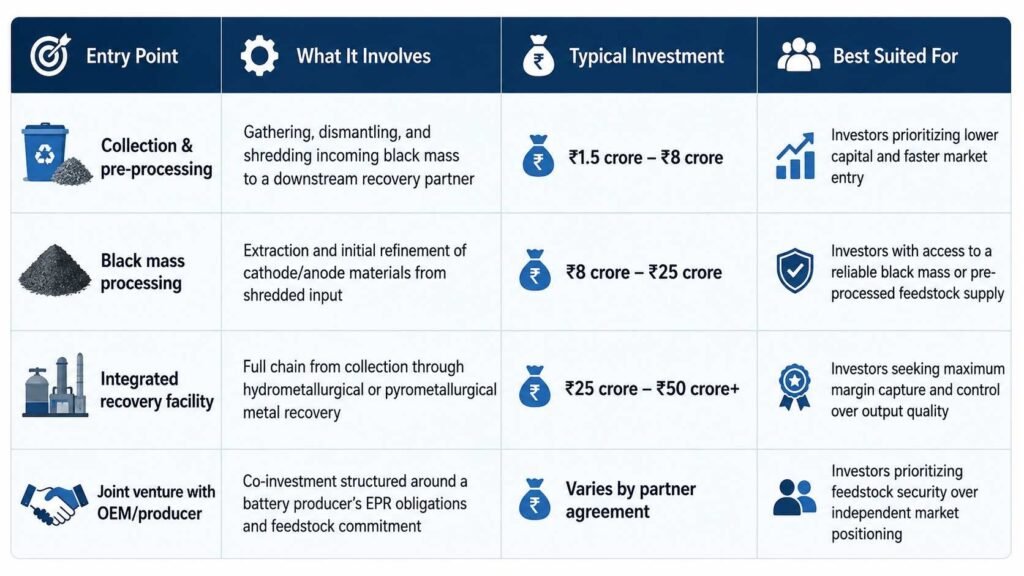
- Investment models range from small mechanical pre-processing units for around ₹1.5 crore to fully integrated recovery facilities exceeding ₹50 crore, and the right entry point depends more on available feedstock access than on capital alone.
- Government support currently includes a Basic Customs Duty exemption on cobalt powder and waste lithium-ion batteries introduced in the Union Budget 2025-26, alongside a Ministry of Mines scheme worth roughly ₹1,500 crore offering capex support and capacity-linked incentives to recyclers.
- Risk in this business concentrates in two places: feedstock security and metal price exposure. A plant with strong technology but no contracted battery supply, or one overly dependent on spot commodity pricing for its margins, carries meaningfully more downside than one with both secured.
Introduction
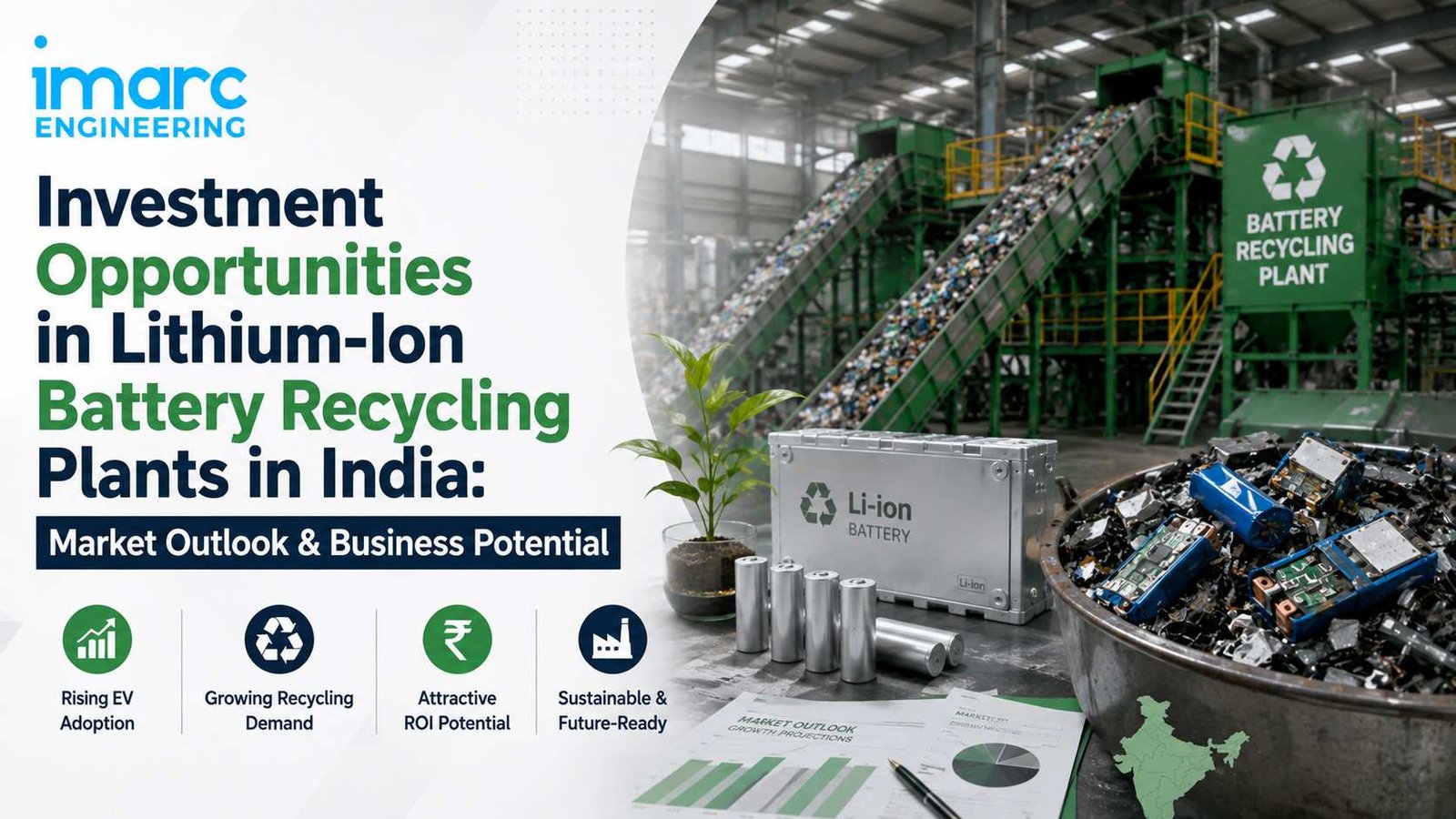
India’s lithium-ion battery market has expanded rapidly over the past decade, driven by the adoption of electric vehicles, consumer electronics, and energy storage systems. As the first generation of these batteries approaches end of life, Lithium-Ion Battery Recycling Plants in India are emerging as a high-potential investment opportunity, supported by growing feedstock availability, supportive regulations, and the need to recover critical minerals domestically.
This guide explains the key drivers behind investment in lithium-ion battery recycling, available business opportunities, regulatory requirements, technology options, investment considerations, and the major risks investors should evaluate before entering this sector.
The opportunity is backed by strong market fundamentals. The India lithium-ion battery market was valued at USD 3.59 billion in 2025 and is projected to reach USD 9.79 billion by 2034, growing at a CAGR of 11.78% during 2026–2034. As battery adoption continues to accelerate, the volume of end-of-life batteries is expected to increase significantly, creating sustained demand for organized recycling infrastructure.
What’s Driving The Market
- EV and e-mobility adoption: India’s electric two- and three-wheeler fleet, the largest and fastest-growing segment of EV adoption in the country, is now old enough that batteries sold in the earliest adoption years are beginning to reach end of life, creating a feedstock base that will keep expanding through the rest of the decade.
- EPR-linked recovery obligations: The Battery Waste Management Rules, 2022 place Extended Producer Responsibility targets on battery producers, which is shifting how recyclers structure revenue, increasingly through contracted offtake and processing arrangements tied to a producer’s compliance obligations, rather than relying solely on open-market metal sales.
- Critical mineral import substitution: India currently sources the large majority of its lithium, cobalt, and nickel from imports, which makes domestic recovery of these metals from waste batteries a strategic, not just environmental, opportunity, and one that aligns with broader government critical minerals policy.
- Direct policy support: The Union Budget 2025-26 introduced a Basic Customs Duty exemption on cobalt powder, waste lithium-ion batteries, and other critical minerals, lowering feedstock import costs, while a Ministry of Mines scheme worth approximately ₹1,500 crore now offers capex support and capacity-linked incentives to recyclers.
- OEM and battery manufacturer offtake demand: Domestic battery and cell manufacturers are increasingly interested in recycled lithium, cobalt, and nickel as a lower-cost, lower-import-dependency input, creating a growing buyer base for recyclers beyond commodity metal traders.
Investment Entry Points
Capital requirements and business models in this category vary considerably, and the table below outlines the main entry points available to investors at different capital levels.
Where The Risk Actually Sits
- Feedstock security: This is the single largest risk factor in the category. A technically sound plant with no contracted, reliable supply of end-of-life batteries or manufacturing scrap will consistently underperform its projected utilization, regardless of how well the recovery technology itself performs.
- Metal price exposure: Lithium, cobalt, and nickel prices are set by volatile global commodity markets, and a business model dependent entirely on spot pricing carries meaningfully more margin risk than one anchored by locked-in offtake agreements.
- Regulatory execution risk: Authorization as a hazardous waste handler and registration under the Battery Waste Management Rules generally take longer than equipment procurement, and a project that does not sequence these approvals early can see its launch timeline slip well past its financial projections.
- Technology-feedstock mismatch: A recovery process chosen without validating it against the actual chemistry and contamination profile of the available feedstock can underperform its designed recovery yield, directly compressing margins.
What Returns Look Like in 2026
Plants in this category are currently reporting net margins in the 12 to 20% band, with projected IRR in the 15 to 25% range and payback typically falling between 3 and 6 years under normal operating conditions and healthy capacity utilization. These figures depend heavily on the specific entry point chosen, feedstock cost, and recovery yield, and should be validated against a project-specific feasibility study rather than treated as guaranteed outcomes for any plant in the category.
Two factors are shaping how these returns are trending into 2026. First, the Basic Customs Duty exemption on cobalt powder and waste lithium-ion batteries is lowering input cost for recyclers sourcing feedstock internationally, which directly improves margin for plants dependent on imported black mass or scrap. Second, as EPR-linked offtake arrangements with battery producers become more standardized, a growing share of recycler revenue is shifting toward contracted processing fees rather than spot metal sales, which is making projected returns somewhat more predictable for plants that secure these arrangements early.
Investors modeling returns for a 2026 entry should treat the higher end of the IRR range as achievable only where feedstock is contracted and recovery yield is validated against the actual battery chemistry being processed, not assumed from category-wide averages.
How IMARC Engineering Helps in Establishing a Lithium-Ion Battery Recycling Plant in India
IMARC Engineering provides end-to-end engineering and project advisory support for lithium-ion battery recycling projects, including feasibility studies, feedstock assessments, technology evaluation, Detailed Project Report (DPR) preparation, plant layout and process design, regulatory approvals, machinery selection, and implementation planning.
The team also supports investors with hazardous waste authorization, Battery Waste Management Rules compliance, feedstock sourcing strategies, and offtake planning to help develop commercially viable and technically robust recycling facilities.
Consult IMARC Engineering for Lithium-Ion Battery Recycling Plant Setup: https://www.imarcengineering.com/contact-us
Final Thoughts
Lithium-ion battery recycling in India is a genuine investment opportunity backed by real feedstock growth, supportive policy, and a clear strategic case around critical mineral import substitution. It is not, however, a uniformly low-risk one, and the investors who perform best in this category are consistently the ones who treated feedstock security and offtake certainty as seriously as the technology and capital decisions from day one.
Contact Us:
IMARC Engineering
Phone: +91-120-433-0800
Email: sales@imarcengineering.com
India: C-130, Sector 2, Noida, Uttar Pradesh 201301
LinkedIn: https://www.linkedin.com/showcase/imarc-engineering/
About the Author