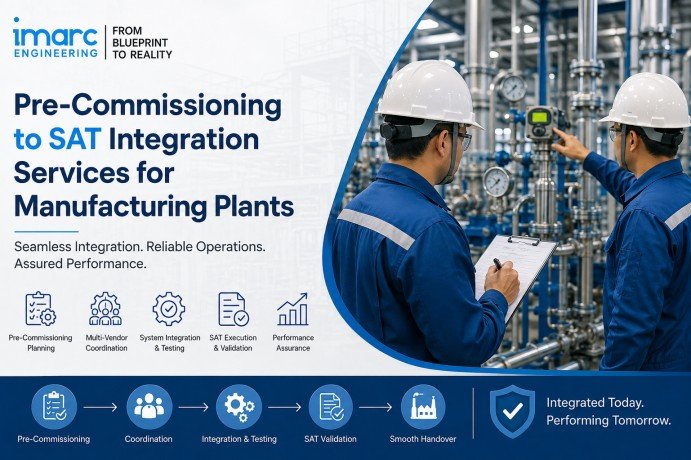
Pre-Commissioning to SAT Integration Services for Manufacturing Plants,
Every manufacturing project reaches a point where engineering drawings, procurement schedules, and construction milestones give way to a harder question: will the plant actually run the way it was designed to? That question is answered not in a single test, but across a continuum, from pre-commissioning checks and loop verification, through Factory Acceptance Testing (FAT), to Site Acceptance Testing (SAT) on the live plant floor. When these phases are planned as one integrated sequence rather than disconnected milestones, projects reach stable production faster and with fewer surprises. When they are not, the consequences surface exactly when a company can least afford them: during start-up, in front of investors, customers, and regulators.
This guide lays out a practical framework for planning Pre-Commissioning to SAT Integration Services for Manufacturing Plants, along with the technology, compliance, and sector-specific factors shaping how Indian manufacturers approach this phase in 2026.
Why Commissioning Integration Deserves Its Own Plan
Commissioning is frequently treated as a downstream checklist rather than a phase that needs its own integration plan. That assumption is costly. A production line that has not been properly tested, calibrated, and integrated before commercial operations begin may struggle to achieve design capacity during ramp-up, resulting in rework, delayed production targets, and weaker returns on invested capital .
The core issue is that FAT and SAT test fundamentally different conditions. FAT verifies equipment at the vendor’s premises under controlled, simulated inputs, catching assembly and software defects before shipment. SAT, by contrast, happens on the client’s site after installation and evaluates real-world performance, including inter-system integration and site-specific environmental variables a factory floor cannot replicate. A system that passes FAT cleanly can still fail SAT if the integration plan does not account for this gap.
Industry data reinforces the stakes: up to 70 percent of commissioning delays originate from software and integration errors that surface too late, well after the cost of correcting them has multiplied . Planning commissioning as an integrated, cross-functional exercise rather than isolated tests is what closes this gap.
The Commissioning Continuum: Understanding Each Stage
Before building an integration plan, it helps to be precise about what each stage is actually verifying:
- Pre-commissioning: Static checks before any system is energized, including loop checks, insulation resistance testing, alignment verification, and utility tie-in confirmation.
- Mechanical and electrical completion: Confirmation that installed equipment matches design specifications and is ready for energization.
- FAT: Vendor-site testing under simulated conditions, typically led by the OEM with the client or an independent consultant as witness.
- Cold and hot commissioning: Sequential activation of systems, first without process media, then under actual operating conditions.
- SAT: On-site validation of the fully installed system under real operating conditions, confirming inter-system communication, control logic, and safety interlocks function as intended.
- Performance demonstration: Sustained operation at design parameters, often the final gate before handover.
Treating these as a single continuum, rather than isolated milestones owned by different teams, is the foundation of an effective integration plan.
Building the Integration Framework
A structured commissioning integration plan typically works through the following stages:
1. Define system boundaries and interfaces early. Before construction is complete, map every point where mechanical, electrical, control, and software systems intersect. For modern manufacturing projects, this scope increasingly extends to data communications, historian integration, and OT cybersecurity resilience, alongside traditional mechanical and electrical interfaces.
2. Align acceptance criteria to specific references. Every test case should tie back to a customer specification, a P&ID reference, or an applicable standard, agreed upon before testing begins rather than negotiated during it (Source: Sarom Global, 2026).
3. Establish witness and hold-point requirements up front. Identify which tests require formal sign-off and who must be present, so FAT and SAT do not stall waiting for approvals that could have been scheduled in advance.
4. Build regulatory document traceability into the same workflow. Calibration certificates, test logs, and as-built drawings should be captured as part of the integration exercise itself, not compiled retroactively.
5. Sequence cutover for brownfield and live-plant environments carefully. Brownfield expansion is becoming increasingly important across pharmaceuticals, FMCG, chemicals, steel, and automotive manufacturing in India, driven by PLI targets and China+1 supply chain shifts (Source: IMARC Engineering, 2026). Brownfield integration is inherently harder: new systems must interface with legacy equipment while production continues elsewhere on site, making phased cutover and interface testing non-negotiable.
6. Provision working capital for the commissioning window. Projects that fail to provision four to six months of working capital before first revenue frequently face cash flow pressure precisely during commissioning, when operational focus is needed most (Source: IMARC Engineering, 2026).
The Role of Digital Twins and Virtual Commissioning
One of the most significant shifts in commissioning integration planning for 2026 is the move toward virtual commissioning using digital twins. Rather than discovering integration errors on the physical line, teams simulate control logic, robotics paths, and system interactions against a virtual replica before physical installation begins.
The returns being reported are substantial:
- Virtual commissioning market growing at approximately 15.2 percent CAGR (Source: iFactory, 2026)
- 53 percent of manufacturers report measurably reduced integration errors, with simulation before purchase cutting CapEx by 10 to 15 percent (Source: iFactory, 2026)
- Overall commissioning time reduced by 50 to 75 percent, with production ramp-up accelerated by up to 40 percent (Source: iFactory, 2026)
For projects with complex automation packages, the pre-commissioning-to-SAT plan should specify where and how virtual validation occurs before physical testing, rather than treating simulation as an optional add-on.
Cybersecurity and IT/OT Convergence in the Integration Plan
Commissioning integration in 2026 can no longer be scoped as a purely mechanical and electrical exercise. As enterprise resource planning and IT systems become central to production continuity, the ISA-95/IEC 62264 framework for integrating enterprise and control systems, and the ISA/IEC 62443 series for operational technology cybersecurity, can provide important reference frameworks for commissioning projects involving connected automation and IT/OT integration. Building cybersecurity verification, including access control and network segmentation checks, into the SAT protocol itself, rather than addressing it after go-live, is becoming standard practice among automation-heavy projects.
Sector-Specific Considerations
- Pharmaceuticals and biologics: Loop checks and SAT protocols must align with GMP documentation, where every calibration certificate and test log becomes part of the regulatory record (Source: Manufacturing Plant India, 2026).
- Chemicals and process industries: Gas detector verification and safety-interlock testing require dedicated integration windows given the consequences of a missed fault condition.
- Semiconductor and electronics manufacturing: Among the most technically demanding integration categories, requiring ultra-pure water systems, vibration-isolated cleanrooms, and precisely sequenced tool installation (Source: IMARC Engineering, 2026).
- Automotive and heavy engineering: High robotics and AGV integration makes virtual commissioning valuable for path planning and collision detection before physical trials.
Common Pitfalls to Avoid
- Treating FAT sign-off as equivalent to system readiness, without accounting for site-specific integration variables SAT is designed to catch.
- Assigning commissioning ownership to a single discipline instead of a cross-functional team spanning mechanical, electrical, controls, IT, and quality.
- Deferring documentation and regulatory traceability until after testing is complete.
- Underestimating brownfield cutover complexity when new and legacy systems must coexist during transition.
- Excluding cybersecurity and data integration checks from the SAT protocol itself.
How IMARC Engineering Can Help
IMARC Engineering supports manufacturing companies and EPC/EPCM teams in planning and executing commissioning integration across the full pre-commissioning-to-SAT continuum. This includes:
- Defining system boundaries and interface maps ahead of construction completion
- Structuring FAT and SAT protocols against verifiable acceptance criteria
- Coordinating cross-functional commissioning teams across mechanical, electrical, controls, and IT disciplines
- Building regulatory documentation traceability into the commissioning workflow from day one
- Planning phased cutover sequences for brownfield expansions that protect ongoing production
- Advising on where virtual commissioning and digital twin validation can reduce risk before physical testing begins.
Speak With an Engineering Consultant: https://www.imarcengineering.com/contact?service=multi-vendor-coordination-and-integration
Conclusion
Commissioning integration is not a final checklist before handover; it is a planning discipline that begins the moment engineering scope is defined. Manufacturers that treat pre-commissioning, FAT, and SAT as one continuous plan, supported by clear acceptance criteria, documentation traceability, and virtual commissioning tools, reach stable production faster and with fewer surprises during start-up. As Indian manufacturing scales through brownfield expansion, semiconductor investment, and rising automation complexity, a structured integration plan from pre-commissioning through SAT is becoming the baseline expectation, not a practice reserved for the largest projects alone.
Contact Us:
IMARC Engineering
Phone: +91-120-433-0800
Email: sales@imarcengineering.com
India: C-130, Sector 2, Noida, Uttar Pradesh 201301
LinkedIn: https://www.linkedin.com/showcase/imarc-engineering/
About the Author