Setting up a biodegradable wipes manufacturing plant in India represents a highly attractive investment proposition underpinned by robust and structurally growing demand from health- and hygiene-conscious consumers, the expanding personal care and baby care industries, the healthcare and institutional cleaning sectors, and the hospitality and travel segment. As environmental awareness accelerates, regulatory restrictions on single-use plastics tighten, and consumer preference shifts toward plant-based, compostable alternatives to conventional synthetic wipes, biodegradable wipes made from bamboo, cotton, and wood pulp cellulose occupy an increasingly important position across household retail, healthcare, and eco-friendly consumer goods channels. This growth trajectory, combined with moderate capital intensity, established nonwoven manufacturing technology, and strong brand partnership potential with FMCG, hospitality, and healthcare buyers, creates a highly favourable manufacturing environment for new entrants with efficient production and quality systems.
What are Biodegradable Wipes?
Biodegradable wipes are sustainable hygiene products designed to break down naturally through microbial action, offering an eco-friendly alternative to conventional wipes that contain plastics. Made from plant-based materials such as bamboo, cotton, or wood pulp cellulose, these wipes are free from plastic fibres and synthetic polymers, ensuring they return to the earth without releasing harmful microplastics. They are engineered to degrade in landfills or compost, typically within months rather than the centuries required for synthetic alternatives and are often gentler on sensitive skin due to fewer additives.
Biodegradable wipes are manufactured through nonwoven web formation, hydroentanglement, and biodegradable saturant application, and are sold across personal care, healthcare, hospitality, institutional cleaning, baby care, and eco-friendly retail channels. Beyond household and personal hygiene use, the wipes serve facial cleansing, surface disinfection, baby diaper changing, bathroom tissue replacement, spill cleanup, and compostable wet wipe applications, while remaining unsuitable for flushing due to the plumbing and septic risks this poses even for biodegradable substrates.
The global biodegradable wipes market was valued at approximately USD 6.50 Billion in 2025 and is expected to reach USD 12.78 Billion by 2034, exhibiting a CAGR of 7.8% from 2026 to 2034, supported by heightened hygiene awareness, tightening single-use plastic regulations, and growing demand for compostable personal care and cleaning products.
Cost of Setting Up a Biodegradable Wipes Manufacturing Plant
The total capital investment required to establish a biodegradable wipes manufacturing plant is shaped by several key parameters: annual production capacity (the proposed facility is designed around 8,800 tons per annum), the process route adopted (airlay or carding-based nonwoven web formation combined with hydroentanglement and saturation), the level of automation across web formation, bonding, saturation, and packaging sections, facility specification, raw material sourcing strategy, and applicable regulatory and environmental compliance requirements. Below is a structured breakdown of the major cost components.
1. Capital Expenditure (CapEx)
Total capital investment in a biodegradable wipes manufacturing plant covers the following major heads:
Land and Site Development
This encompasses land acquisition or lease, site preparation, boundary development, and utilities connectivity. Site selection should prioritise proximity to sources of cellulose pulp and viscose fibre (wood-based) to ensure a steady, low-transport-cost raw material supply, along with access to target consumer and industrial markets to minimise distribution costs. Reliable power and water supply infrastructure, strong road logistics for inbound fibre and outbound finished wipes, robust effluent and waste management systems, and a trained workforce for plant operations and quality control are critical site selection criteria. Compliance with industrial zoning regulations, environmental clearance requirements, and fire safety norms must be assessed from project initiation.
Civil Works and Construction
Building costs cover the main processing facility including the fibre and raw material storage section, nonwoven web formation and hydroentanglement house, saturation and drying area, slitting and folding section, automated packaging and dispatch infrastructure, quality control laboratory, administrative block, and utility infrastructure including power backup, water purification and treatment systems, compressed air systems, and effluent treatment plant. Construction must comply with applicable factory act requirements, environmental clearance conditions, and fire and safety norms.
Machinery and Equipment
Machinery represents the single largest CapEx component. Key equipment required for a biodegradable wipes manufacturing plant includes:
- Fibre Opening and Blending Lines: Bale openers, fibre blending, and cleaning systems that prepare bamboo, cotton, or wood pulp cellulose and viscose fibres for web formation while removing foreign matter and impurities
- Airlay or Carding Machines: Nonwoven web formation systems that convert prepared fibres into a uniform, consistent-weight nonwoven web suited to downstream bonding
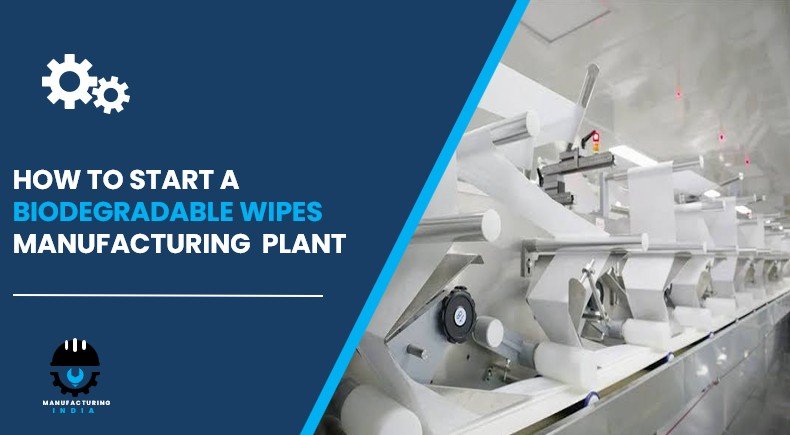
- Hydroentanglement (Spunlace) Units: High-pressure water jet systems that entangle the fibre web mechanically without adhesives or binders, producing a strong, soft, and fully biodegradable nonwoven substrate
- Drying Ovens: Through-air or cylinder drying systems that remove moisture from the entangled nonwoven web prior to spooling, saturation, or conversion
- Spooling Systems: Winding equipment that collects the finished nonwoven substrate into master rolls for storage and downstream saturation and converting operations
- Saturators and Wetting/Dosing Systems: Equipment for preparing and applying biodegradable, skin-safe wetting solutions and formulations, including mixing tanks for liquid formulation, dosing pumps, and saturation baths or spray systems
- Slitting Stations: Machinery for cutting master rolls of saturated nonwoven substrate into the width required for individual wipe formats
- Folding, Sealing, and Packaging Machines: Automated systems for folding and stacking moist wipes, sealing individual packs and resealable lids, labelling, and cartoning finished biodegradable wipe packs for retail and institutional dispatch
- Water Purification Systems: Reverse osmosis and purification equipment to ensure process water used in saturation and hydroentanglement meets the quality standards required for skin-contact hygiene products
- Quality Control Laboratory Equipment: Equipment for testing tensile strength, absorbency, pH, biodegradability, and microbial safety to verify compliance with applicable hygiene and environmental standards
- Material Handling and Warehousing: Conveyors, roll handling systems, raw material storage racking, and finished goods warehousing with FIFO stock management
Other Capital Costs
These include pre-operative expenses, commissioning charges, import duties on specialised nonwoven and hydroentanglement equipment, staff training and competency development, initial raw material and consumable inventory for production commissioning, and regulatory compliance setup including factory licensing, environmental clearances, and quality management system establishment costs.
Request a Sample Report for In-Depth Market Insights: https://www.imarcgroup.com/biodegradable-wipes-manufacturing-plant-project-report/requestsample
2. Operational Expenditure (OpEx)
Raw materials principally cellulose pulp and viscose fibres (wood-based), along with wetting solution ingredients, preservatives, and biopolymer coatings constitute the dominant operating cost, typically representing 50–60% of total OpEx. Utility costs, driven primarily by electricity consumption of web formation and hydroentanglement equipment, water purification, and drying operations, account for 15–20% of OpEx. Labour, maintenance, quality control, packaging, transportation, depreciation, taxes, and overhead costs constitute the remainder of the operating cost base.
3. Plant Capacity
The proposed biodegradable wipes manufacturing facility is designed with an annual production capacity of 8,800 tons, enabling economies of scale while maintaining operational flexibility. This capacity supports a diversified product portfolio spanning personal care, healthcare, household cleaning, and hospitality and travel wipe formats, serving domestic retail markets, institutional buyers, and export channels.
4. Profit Margins and Financial Projections
The project demonstrates healthy profitability potential under normal operating conditions. Financial projections encompass capital investment, operating costs, capacity utilisation ramp-up schedule, product mix across personal care, healthcare, household, and hospitality wipe formats, and forward demand outlook underpinned by rising hygiene awareness and sustainability-driven demand. A comprehensive feasibility analysis includes sensitivity analysis, Net Present Value (NPV), Internal Rate of Return (IRR), and Payback Period calculations. Gross profit margins for biodegradable wipes manufacturing typically range from 35–45%, supported by stable demand and value-added, sustainability-positioned applications. Net profit margins of 18–25% are achievable with disciplined cost management, optimal capacity utilisation, and effective raw material sourcing.
Why Set Up a Biodegradable Wipes Manufacturing Plant?
Essential Hygiene and Convenience Product
Biodegradable wipes serve as widely used hygiene solutions across personal care, baby care, healthcare, household cleaning, and travel, positioning them as a daily-use consumable that combines convenience with responsible disposal. This broad-based, repeat-purchase demand profile provides resilience against single-segment demand volatility for manufacturers.
Megatrend Alignment with Sustainability
Growing consumer awareness around sustainability, plastic reduction, and eco-friendly lifestyles is driving a structural shift away from conventional synthetic wipes toward plant-based, compostable alternatives. Demand is expanding steadily across baby care, cosmetics, hospitality, and healthcare sectors as brands reformulate product lines to meet consumer sustainability expectations.
Favourable Policy and Regulatory Environment
Government regulations restricting single-use plastics, waste management rules, and sustainability initiatives are accelerating adoption of biodegradable products across major markets. Policies promoting environmentally responsible manufacturing and packaging further support the growth outlook for eco-friendly wipe producers.
Moderate but Meaningful Entry Barriers
While manufacturing is less capital-intensive than heavy process industries, maintaining consistent quality in biodegradable substrates, skin-safe formulations, moisture balance, packaging technology, and regulatory compliance creates practical entry barriers that favour disciplined, quality-focused producers over undifferentiated new entrants.
Supply Chain Localisation and Brand Partnership Opportunities
FMCG brands, hospitals, airlines, and hospitality companies increasingly prefer reliable regional manufacturers to ensure consistent supply, faster delivery, and better cost control. This trend opens opportunities for manufacturers capable of stable raw material sourcing, scalable production, and private-label partnerships with established consumer and institutional brands.
Urbanisation and Rising Hygiene Awareness
Approximately 45% of the world’s 8.2 billion people resided in urban areas in 2025, according to the United Nations World Urbanization Prospects 2025 report by UN DESA. Rising urban lifestyles, increasing reliance on convenient hygiene products, and growing disposable incomes among urban consumers are supporting higher consumption of biodegradable wipes across personal care, household, and institutional channels, providing a structural demand tailwind for manufacturers with strong retail and institutional distribution.
Scalable and Technologically Established Operations
The biodegradable wipes value chain, spanning nonwoven web formation, hydroentanglement, and saturation, relies on established nonwoven manufacturing technology that allows processors to begin operations at a moderate scale and expand capacity or add converting lines as volumes grow. This phased investment approach allows new entrants to manage capital deployment while building operational expertise across product formats.
Manufacturing Process Overview
The biodegradable wipes manufacturing operation transforms raw plant-based and regenerated cellulose fibres into finished, saturated, and packaged wipes through a sequence of web formation, bonding, saturation, and packaging operations. The key process stages are:
- Raw Material Selection and Preparation: Biodegradable nonwoven fibres such as bamboo, cotton, wood pulp cellulose, and viscose or lyocell fibres are selected, opened, cleaned, and blended to remove impurities and achieve a consistent fibre feedstock prior to web formation
- Nonwoven Web Formation: Prepared fibres are fed into airlay or carding machines to form a uniform nonwoven web of consistent weight and thickness suited to downstream bonding
- Hydroentanglement (Spunlace Bonding): The nonwoven web passes through high-pressure water jet systems that mechanically entangle the fibres without adhesives or binders, producing a strong, soft, fully biodegradable substrate
- Drying: The entangled nonwoven substrate is dried using through-air or cylinder drying systems to remove residual moisture before spooling
- Spooling and Storage: The finished nonwoven substrate is wound into master rolls and stored pending saturation and converting operations
- Wetting Solution Preparation: A natural, biodegradable wetting and cleansing formulation is prepared in mixing tanks using purified water, plant-derived cleansing agents, preservatives, and, where required, biopolymer coatings such as chitosan or alginates for added functionality
- Saturation: Nonwoven substrate is fed into saturators where the prepared wetting solution is applied evenly across the web to achieve the target moisture and formulation content for the intended application
- Slitting: Saturated master rolls are slit to the width required for individual wipe formats intended for personal care, healthcare, household, or travel applications
- Folding and Stacking: Slit and saturated wipes are folded and stacked using automated folding equipment to prepare them for packaging
- Sealing, Labelling, and Packaging: Folded wipes are sealed into individual packs or resealable tubs, labelled, and cartoned under hygienic packaging conditions suited to personal care and healthcare use
- Quality Testing: Finished wipes are tested for tensile strength, absorbency, pH balance, microbial safety, and biodegradability to verify compliance with applicable hygiene and environmental standards before release
- Storage and Distribution: Finished, quality-approved biodegradable wipes are stored under appropriate conditions and dispatched to personal care, healthcare, household, and hospitality distribution channels
Key Applications of Biodegradable Wipes
The biodegradable wipes market serves several major end-use segments across personal care, healthcare, household, and hospitality sectors:
- Personal Care: Baby wipes, facial cleansing wipes, and makeup removal wipes formulated for gentle, skin-safe use in daily personal hygiene routines
- Healthcare: Antibacterial wipes, medical surface wipes, and patient hygiene wipes used across hospitals, clinics, and care facilities requiring reliable hygiene performance
- Household Cleaning: Kitchen wipes, disinfectant wipes, and multipurpose cleaning wipes positioned as eco-friendly alternatives to conventional synthetic cleaning wipes
- Hospitality and Travel: Refreshing wipes, travel hygiene wipes, and on-the-go cleaning wipes supplied to airlines, hotels, and travel retail channels seeking sustainable amenity products
Global Biodegradable Wipes Market Outlook
The global biodegradable wipes market was valued at approximately USD 6.50 Billion in 2025. According to IMARC Group estimates, the market is expected to reach USD 12.78 Billion by 2034, exhibiting a CAGR of 7.8% from 2026 to 2034. The biodegradable wipes market benefits from multiple structural demand drivers:
- Rising hygiene awareness and growing consumer preference for eco-friendly personal care, baby care, healthcare, and household cleaning products across urban populations globally
- Continued urbanisation, with approximately 45% of the world’s population residing in urban areas as of 2025, supporting higher consumption of convenient, branded hygiene products in city-based households and institutional channels
- Stricter environmental regulations and bans on single-use plastics accelerating the shift from conventional synthetic wipes toward plant-based, compostable alternatives
- Expanding healthcare sector adoption of biodegradable wipes due to their hygiene performance and environmental benefits relative to conventional synthetic alternatives
- Growing demand from hospitality, travel, and institutional cleaning sectors seeking sustainability-positioned amenity and cleaning products
- Continued advancements in nonwoven manufacturing processes improving the performance, softness, and affordability of biodegradable wipe substrates
- Increasing supply chain localisation and brand partnership opportunities as FMCG, healthcare, and hospitality buyers prefer reliable regional manufacturers
- Supportive national policy initiatives, such as India’s biodegradable plastics market being projected to grow to USD 223 million by 2030 according to IBEF estimates, as single-use plastic ban enforcement escalates
Leading manufacturers in the global biodegradable wipes industry include Kimberly-Clark Corporation, The Procter & Gamble Company, Nice-Pak Products, Inc., Essity Aktiebolag, and Rockline Industries, serving end-use sectors including personal care, healthcare, hospitality, institutional cleaning, baby care, and eco-friendly retail.
Latest Industry Developments
- March 2026: Biom introduced Biom Disinfecting Wipes, positioned as the first disinfecting wipe available at mass retail that is both quat-free and made with a 100% plant-based, biodegradable wipe material, powered by plant-derived citric acid and marketed as effective against a broad range of bacteria and viruses without bleach, quats, ammonia, parabens, or phthalates.
- September 2025: WaterWipes announced the launch of an updated, more durable wipe range described as stronger, thicker, and softer, offering an effective clean while gently caring for sensitive skin, alongside an updated embossed pattern made with softer, finer fibres.
Licenses and Regulatory Requirements
Establishing a biodegradable wipes manufacturing unit requires a range of approvals and certifications, which may vary by country and jurisdiction, including:
- Business registration and company incorporation under applicable company law
- Factory License under applicable state Factories Act provisions for manufacturing operations
- Environmental clearances and Pollution Control Board Consent to Establish (CTE) and Consent to Operate (CTO) for manufacturing operations involving effluent generation
- Fire safety certification for the manufacturing facility and finished goods warehousing
- Product safety and quality compliance applicable to personal care and hygiene products in the target market
- ISO 9001:2015 Quality Management System Certification for quality management infrastructure compliance
- ISO 14001 Environmental Management System Certification supporting sustainability and biodegradability claims
- Weights and Measures (Legal Metrology) registration for packaged commodity labelling and net quantity declaration
- Export-Import Code (IEC) for international market access
- Trademark and Brand Registration for proprietary branded product launch
- Occupational Health and Safety management compliance (ISO 45001 / Factories Act provisions) for manufacturing worker safety
Key Challenges to Consider
Raw Material Supply Consistency
Cellulose pulp and viscose fibres, which account for 50–60% of total operating costs, are subject to price volatility and supply availability influenced by global pulp markets and forestry supply chains. Securing long-term supply arrangements with reliable fibre suppliers and diversifying sourcing across bamboo, cotton, and wood pulp cellulose feedstocks are critical operational priorities to manage cost and supply risk.
Maintaining Genuine Biodegradability and Skin-Safety Standards
Formulating wipes that are simultaneously biodegradable, skin-safe, and effective at their intended hygiene function requires disciplined process control and rigorous testing. Any lapse in formulation consistency or biodegradability verification can undermine brand credibility, expose manufacturers to greenwashing scrutiny, and disrupt market access with sustainability-focused retail and institutional buyers.
Consumer Confusion Around Flushability
Biodegradable does not mean flushable, and consumer misunderstanding of this distinction can result in improper disposal, plumbing and septic system damage, and associated reputational or regulatory risk for manufacturers. Clear labelling, consumer education initiatives, and compliance with applicable flushability and disposal labelling standards are important risk mitigation measures.
Price Competition from Conventional Synthetic Wipes
Biodegradable wipes typically carry a cost premium over conventional synthetic wipes due to higher-cost plant-based and regenerated cellulose fibres. Periods of price-sensitive consumer demand or slower-than-expected regulatory enforcement against single-use plastics can compress adoption rates, requiring manufacturers to manage cost structures and articulate clear value propositions to maintain margins.
Capital Intensity of Quality Infrastructure
While nonwoven wipe manufacturing is less capital-intensive than heavy process industries, achieving consistent quality across hydroentanglement, saturation, and packaging operations requires meaningful investment in process control, water purification, and quality testing infrastructure. New entrants must carefully evaluate the phasing of investment between basic production capability and the quality systems required to serve premium personal care and healthcare buyers.
Frequently Asked Questions (FAQs)
1. How much does it cost to set up a biodegradable wipes manufacturing plant?
The total investment depends on plant capacity (the proposed facility is designed around 8,800 tons per annum), the process technology adopted (airlay or carding-based web formation with hydroentanglement and saturation), automation level, facility specification, location, and target market certifications. Costs cover land, civil construction (web formation, hydroentanglement, and saturation sections, storage, quality laboratory, utilities), machinery (fibre opening lines, airlay or carding machines, hydroentanglement units, saturators, drying ovens, slitting stations, and packaging lines), quality certifications, working capital, and regulatory compliance. A comprehensive feasibility study from IMARC Group provides detailed, capacity-specific cost estimates covering all CapEx and OpEx components.
2. Is biodegradable wipes manufacturing a profitable business in 2026?
Yes. Sustained demand from health- and hygiene-conscious consumers, tightening single-use plastic regulations, and the expanding personal care, healthcare, and hospitality sectors, combined with gross margins of 35–45% and net profit margins of 18–25%, make biodegradable wipes manufacturing financially attractive. Profitability depends on manufacturing efficiency, pricing strategy, raw material cost management, and operational scale, with margins generally improving as capacity utilisation increases.
3. What machinery and equipment are required for a biodegradable wipes manufacturing plant?
Key equipment includes fibre opening and blending lines, airlay or carding machines for nonwoven web formation, hydroentanglement (spunlace) units, drying ovens, spooling systems, saturators and wetting/dosing systems with mixing tanks for liquid formulation, slitting stations, folding and sealing units, water purification systems, labelling machines, and quality control instruments for tensile strength, absorbency, pH, and biodegradability testing.
4. What raw materials are required for biodegradable wipes manufacturing?
Biodegradable wipes manufacturing requires natural, plant-based fibres such as bamboo, wood pulp, and cotton, as well as regenerated cellulose fibres including viscose and lyocell. In addition to the base nonwoven material, other raw materials include cleansing ingredients, preservatives, purified water, and biopolymer coatings such as chitosan or alginates for added functionality.
5. What licenses and approvals are required?
Required approvals typically include business registration, Factory License, environmental clearances and Pollution Control Board consents, fire safety certification, product safety compliance applicable to personal care and hygiene products, and ISO 9001 and ISO 14001 management system certifications. Requirements vary by country, state, and target export market.
6. How long does it take to commission a biodegradable wipes manufacturing plant?
Typically, 12–24 months from project initiation to commercial production launch, depending on project scale, facility construction timeline, equipment procurement lead times for nonwoven and hydroentanglement systems, environmental clearances, and trial run and safety measure completion, which should be initiated early in the project to avoid delays to commercial launch.
7. What are the key steps involved in biodegradable wipes manufacturing?
The main steps generally include selection of biodegradable nonwoven fabric, preparation of a natural wetting solution, feeding fabric into the cutting or slitting machine, wetting and saturation with the liquid formula, folding and stacking of moist wipes, sealing, labelling, and hygienic packaging, quality testing for safety and biodegradability, and storage and distribution.
8. What is the break-even period for a biodegradable wipes manufacturing plant?
Break-even typically ranges from 3 to 6 years, depending on scale, regulatory compliance costs, raw material pricing, and market demand. Efficient manufacturing, disciplined raw material sourcing, and export opportunities can help accelerate returns.
9. Who are the top biodegradable wipes manufacturers in the world?
Leading global manufacturers include Procter & Gamble, Kimberly-Clark, Nice-Pak Products, Rockline Industries, and Diamond Wipes International, serving personal care, healthcare, hospitality, institutional cleaning, baby care, and eco-friendly retail end-use sectors.
10. What government incentives are available for biodegradable wipes manufacturers?
Governments may offer incentives such as capital subsidies, tax exemptions, reduced utility tariffs, export benefits, or interest subsidies to promote sustainable and biodegradable product manufacturing under various national or regional industrial and single-use plastic reduction policies.
Key Takeaways for Investors
The biodegradable wipes manufacturing industry represents a structurally resilient and financially attractive investment opportunity positioned at the intersection of rising global hygiene awareness, tightening single-use plastic regulations, and accelerating consumer demand for sustainable personal care and cleaning products. Stable demand from personal care, healthcare, household cleaning, and hospitality channels provides resilience against single-segment demand volatility, while established nonwoven manufacturing technology allows new entrants to enter with moderate capital intensity relative to heavy process industries. Growing supply chain localisation trends and brand partnership opportunities with FMCG, healthcare, and hospitality buyers provide meaningful routes to scale for manufacturers capable of stable raw material sourcing and consistent quality. The scalable nature of the value chain, from basic nonwoven production to fully integrated saturation and converting operations, allows investors to phase capital deployment according to risk appetite and target market positioning, while continued brand innovation in the biodegradable wipes category reflects strong confidence in the long-term growth and profitability of the sector.
About the Author