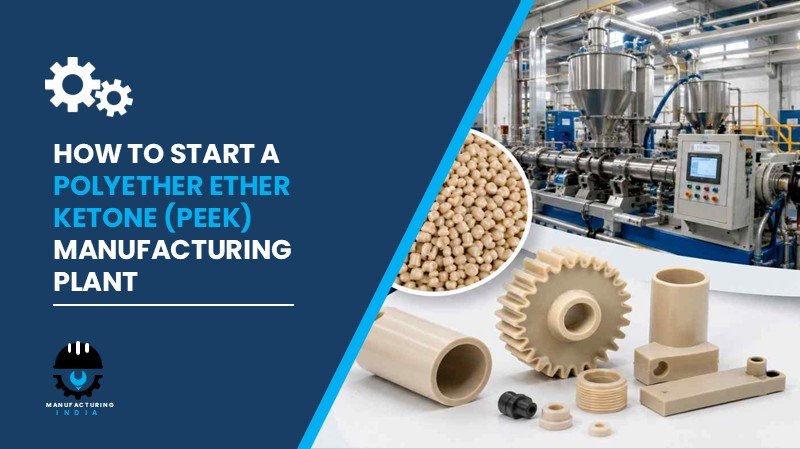
A PEEK manufacturing plant setup in India presents a compelling investment case for entrepreneurs targeting the high-performance engineering plastics segment. Demand is driven by industries that need lightweight, wear-resistant, and chemically stable components in place of metal – automotive, aerospace, electrical and electronics, medical devices, semiconductors, oil and gas, chemical processing, and industrial machinery. As metal-replacement trends accelerate across electric vehicle powertrains, aircraft interiors, and orthopedic implants, this high-performance polymer has moved from a niche specialty material to a strategic input across some of India’s fastest-growing manufacturing sectors.
India’s expanding infrastructure, growing electronics and automotive base, and the Make in India policy push make the country a strategically sound base for this venture. States such as Gujarat and Maharashtra, with established chemical and polymer processing clusters, offer ready access to industrial estates, port connectivity, and skilled manpower – supporting cost-competitive production. The Government of India’s ChemIndia portal identifies PEEK as a performance plastic relevant to aerospace, medical implants, and industrial applications, underlining its strategic importance to India’s manufacturing ambitions.
A PEEK manufacturing plant combines a globally growing addressable market with rising domestic policy support, cost-competitive land and labour, and healthy gross margins of 28-40%. With India’s medical devices sector receiving direct production-linked incentives and demand from aerospace, EV, and semiconductor supply chains rising in parallel, a well-capitalised plant is positioned for viable break-even economics and long-term sustainability.
What is Polyether Ether Ketone (PEEK)?
PEEK is a high-performance thermoplastic polymer known for its exceptional thermal and chemical resistance. With a semi-crystalline structure, it offers high mechanical strength and dimensional stability, making it suitable for harsh operating environments, and is valued for its ability to withstand high temperatures, resist wear, and tolerate chemical exposure.
The material is supplied in multiple product forms, including pellets, compounds, films, powders, rods, sheets, tubes, and finished components. In aerospace, it is used in fuel systems, landing gear, and structural brackets; in automotive applications, it serves in engine components, bearings, and transmission parts. The electronics sector uses it for cable insulation, connectors, and semiconductor parts, while the medical sector relies on its biocompatibility and sterilisability for surgical instruments and orthopedic devices. The industrial sector uses it for pump components and seals, reflecting a versatile application scope across automotive, aerospace, electrical and electronics, medical devices, semiconductors, oil and gas, chemical processing, and industrial machinery.
Cost of Setting Up a PEEK Manufacturing Plant in India
Setup cost for a PEEK manufacturing plant depends on capacity, technology, automation level, location, and regulatory compliance requirements.
1. Capital Expenditure (CapEx)
Capital investment covers land acquisition, site preparation, and infrastructure, and the facility can be developed on an industrial estate or SEZ plot to benefit from established utilities and compliance frameworks. Civil works costs cover construction of the production shed, quality-control laboratory, storage areas, and the administrative block. Within the overall capital structure, machinery costs account for the largest portion of total expenditure, while land and site development – including land registration and boundary development – forms a substantial part of the investment.
Key machinery required includes:
- Polymerization reactors
- High-temperature heating systems
- Inert-gas systems
- Filtration units
- Solvent-recovery systems
- Washing systems
- Dryers
- Twin-screw extruders
- Compounding machines
- Pelletizers
- Cooling systems
- Injection-molding machines
- Compression-molding machines
- Film-extrusion lines
- Powder-processing equipment
- CNC machining equipment
- Additive-manufacturing systems
- Quality-testing equipment
Other capital costs for the PEEK manufacturing plant cover effluent treatment systems, pre-operative expenses, and commissioning, ensuring the facility meets safety and emission-compliance standards from day one.
Request Sample: https://www.imarcgroup.com/polyether-ether-ketone-manufacturing-plant-project-report/requestsample
2. Operational Expenditure (OpEx)
The operating cost structure is primarily driven by raw material consumption. Core raw materials – 4,4′-Difluorobenzophenone, Hydroquinone, potassium carbonate (K₂CO₃) or sodium carbonate (Na₂CO₃), and diphenyl sulfone – together account for approximately 60-70% of total operating expenses. Securing these inputs through long-term supplier contracts helps mitigate price volatility and ensures consistent supply.
Utility costs – electricity, water, and steam – represent approximately 14-18% of OpEx, reflecting the energy-intensive nature of polymerization and high-temperature processing. Other operating costs include transportation, packaging, salaries and wages, repairs and maintenance, depreciation, and applicable taxes. By the fifth year of operations, total operational cost is expected to rise substantially due to inflation, market fluctuations, potential increases in raw material costs, supply chain disruptions, and shifts in the global economy.
3. Plant Capacity
A PEEK manufacturing plant can be designed with annual production capacity ranging between 3,000-10,000 MT, enabling economies of scale while maintaining operational flexibility. Capacity can be customised to investor requirements, and profitability generally improves with higher capacity utilisation as fixed costs spread across greater output volumes.
4. Profit Margins and Financial Projections
The project demonstrates healthy profitability potential under normal operating conditions. Gross profit margins typically range between 28-40%, supported by stable demand and value-added applications, while net profit margins range between 10-18%. Financial projections are built on realistic assumptions related to capital investment, operating costs, capacity utilisation, pricing trends, and demand outlook, and cover ROI, net present value (NPV), payback period, and long-term financial sustainability.
Why Set Up a PEEK Plant in India?
Rising High-Performance Material Demand: The material provides a combination of mechanical, thermal, chemical, and wear resistance required across automotive, aerospace, electronics, and medical devices, supporting a diversified revenue base for the plant.
Metal Replacement in Electric Vehicles: A high strength-to-weight ratio allows PEEK to replace metals in selected applications, supporting the lightweighting trend as EV powertrains and electrical systems increasingly need materials that handle heat, electrical loads, and chemical exposure.
Aerospace and Semiconductor Applications: Low weight and high performance create opportunities in aircraft components and semiconductor equipment – both expanding manufacturing verticals in India.
Policy and Regulatory Tailwinds: The ChemIndia portal identifies PEEK as a performance plastic used in aerospace, medical implants, and industrial applications. The government has also allocated ₹3,420 crore under the Production Linked Incentive (PLI) Scheme for Medical Devices, supporting domestic manufacturing of high-end medical devices and implants – creating direct opportunities for PEEK grades used in medical components.
Advanced Manufacturing Compatibility: The material is increasingly compatible with additive manufacturing, and producers can supply pellets, compounds, films, powders, rods, sheets, tubes, and finished components from the same facility, adding flexibility to the product mix.
Broad-Based Industrial Demand: Beyond automotive and aerospace, demand extends to oil and gas (seals, backup rings, connectors, downhole tools), chemical processing (pump components, valve seats, seals), and industrial machinery, giving the plant multiple demand channels.
Manufacturing Process – Step by Step
The PEEK manufacturing process uses a multi-step polymerization-based production method as its primary route.
- Raw-material preparation: Core inputs are prepared and metered for the reaction stage.
- Polymerization: Materials are reacted in polymerization reactors under controlled high-temperature and inert-gas conditions.
- Filtration: Output passes through filtration units to remove impurities and unreacted residues.
- Drying: Dryers remove residual moisture and solvents.
- Compounding: Compounding machines blend the base polymer with additives to achieve required product-grade properties.
- Pelletizing: Pelletizers convert compounded material into uniform pellets.
- Extrusion: Twin-screw extruders and film-extrusion lines shape the material into rods, sheets, tubes, or films.
- Molding: Injection-molding and compression-molding machines shape pellets or compounds into components.
- Finishing: CNC machining and additive-manufacturing systems handle precision finishing for tight-tolerance parts.
- Quality testing: Equipment verifies mechanical properties, thermal stability, and chemical resistance against industry standards.
- Packaging: Finished products from the PEEK manufacturing process are packaged and dispatched to end-use industries including automotive, aerospace, electronics, medical device, and industrial machinery manufacturers.
Each stage of the PEEK manufacturing process is monitored for consistency, since deviations at the polymerization or compounding stage can affect downstream product quality.
Key Applications
The plant serves a wide spread of high-value industries that require lightweight, heat-resistant, and chemically stable components.
- Automotive: Transmission components, thrust washers, seal rings, bearings, and other wear-resistant parts.
- Aerospace: Lightweight structural components, brackets, clips, fasteners, insulation, and aircraft interior parts.
- Medical: Orthopedic implants, spinal fusion cages, dental components, and surgical instruments.
- Oil & Gas: Seals, backup rings, connectors, and downhole tools exposed to demanding conditions.
- Chemical Processing: Pump components, valve seats, and seals exposed to aggressive chemicals.
- Additive Manufacturing: Specialised, lightweight, customised components for aerospace, medical, automotive, and industrial applications.
- Electrical & Electronics: Cable insulation, connectors, and semiconductor parts.
Leading Manufacturers
Leading players in the global PEEK manufacturing plant landscape include:
- Caledonian Industries Ltd.
- Celanese Corporation
- Saudi Basic Industries Corporation (SABIC)
- Parkway Products, LLC
- Victrex plc
These companies serve end-use sectors spanning aerospace, automotive, electronics, medical, and industrial applications, and represent the competitive benchmark for a new PEEK manufacturing plant entering the market.
Timeline to Start the Plant
- Feasibility study and project report preparation
- Land acquisition and site development
- Regulatory approvals and environmental clearances
- Factory licence and fire safety compliance
- Machinery procurement and installation
- Raw material supplier agreements and supply chain setup
- Trial production and quality testing
- Commercial production launch
Licences and Regulatory Requirements
Starting a PEEK plant in India requires several approvals:
- Business registration (Proprietorship, LLP, or Pvt Ltd)
- Factory Licence under the Factories Act
- Environmental Clearance from State Pollution Control Board
- GST Registration
- Fire Safety NOC
- Hazardous/chemical handling compliance for reactive intermediates such as diphenyl sulfone and potassium/sodium carbonate
- Effluent Treatment Plant (ETP) operational clearance
- Occupational Health and Safety compliance
Key Challenges to Consider
High Capital Requirements: For a PEEK manufacturing plant, machinery costs account for the largest share of capital expenditure, given the need for polymerization reactors, high-temperature systems, and precision molding and finishing equipment.
Raw Material Price Volatility: With raw materials such as 4,4′-Difluorobenzophenone, Hydroquinone, and diphenyl sulfone accounting for 60-70% of OpEx, price fluctuations can materially affect margins.
Regulatory Compliance: Environmental clearances, effluent treatment obligations, and hazardous-material handling requirements demand sustained compliance investment throughout the plant’s operating life.
Process Precision: The multi-step PEEK manufacturing process – from polymerization through filtration, compounding, and finishing – requires tightly controlled operating conditions and skilled process oversight.
Competition from Established Players: Companies such as Celanese Corporation, SABIC, and Victrex plc have established production capacity and customer relationships, requiring new entrants to differentiate on cost, quality, or specialised grades.
Skilled Manpower: Operating polymerization reactors, extrusion lines, and precision molding equipment requires trained technical personnel, particularly for quality assurance and process control.
Frequently Asked Questions
1. How much does it cost to set up a PEEK manufacturing plant in India?
Cost depends on capacity (typically 3,000-10,000 MT annually), automation level, and location, with machinery accounting for the largest share of capital expenditure.
2. Is PEEK manufacturing profitable in India in 2026?
Yes – the plant demonstrates healthy profitability potential, with gross margins of 28-40% and net margins of 10-18% under normal operating conditions.
3. What machinery is required for a PEEK plant in India?
Key machinery includes polymerization reactors, high-temperature heating systems, filtration units, dryers, twin-screw extruders, compounding machines, pelletizers, molding machines, and quality-testing equipment.
4. What licences and approvals are required to start a PEEK manufacturing plant in India?
Requirements include business registration, a Factory Licence, Environmental Clearance, GST Registration, Fire Safety NOC, hazardous-material handling compliance, ETP clearance, and occupational health and safety compliance.
5. What raw materials are needed for PEEK manufacturing?
Core raw materials are 4,4′-Difluorobenzophenone, Hydroquinone, potassium carbonate (K₂CO₃) or sodium carbonate (Na₂CO₃), and diphenyl sulfone.
6. What are the environmental compliance requirements for a PEEK plant in India?
Plants require Environmental Clearance from the State Pollution Control Board, an operational Effluent Treatment Plant, and adherence to emission and hazardous-handling standards.
7. What is the best location to set up a PEEK manufacturing plant in India?
Locations with established chemical and polymer-processing infrastructure, such as industrial estates in Gujarat and Maharashtra, offer strong site options given access to utilities, ports, and skilled manpower.
8. What is the break-even period for this type of plant in India?
The break-even period depends on capacity utilisation, pricing trends, and demand outlook, and is assessed as part of the plant’s ROI, NPV, and payback-period analysis.
9. What government incentives are available for manufacturers in India?
The Production Linked Incentive (PLI) Scheme for Medical Devices, backed by a ₹3,420 crore allocation, supports domestic manufacturing of high-end medical devices and implants – creating direct incentive alignment for PEEK grades used in medical components.
Key Takeaways for Investors
A PEEK manufacturing plant taps into rising demand from automotive, aerospace, electronics, medical devices, semiconductors, oil and gas, chemical processing, and industrial machinery sectors, positioning it as a diversified, high-value investment. Financial viability holds across capacities in the 3,000-10,000 MT range, with gross margins of 28-40% and net margins of 10-18% supporting sound returns. The global market for this polymer, valued at USD 986.5 million in 2025, is projected to reach USD 1,613.4 million by 2034 at a CAGR of 5.50%, reflecting sustained long-term growth. With India’s policy support through the ChemIndia portal and the PLI Scheme for Medical Devices reinforcing domestic demand, a well-planned facility is positioned to capture durable, long-term investment value.
About the Author