Every hour a production line stops unexpectedly, it takes more than output with it. It takes labour cost, missed delivery schedules, and often the trust of a downstream customer waiting on that shipment.
Indian manufacturers are responding to this pressure by shifting maintenance from a reactive, break-fix activity to a scheduled, data-informed discipline. Preventive Maintenance Services sit at the centre of this shift, replacing guesswork with a structured schedule of inspections, part replacements, and condition checks designed to catch wear before it becomes failure.
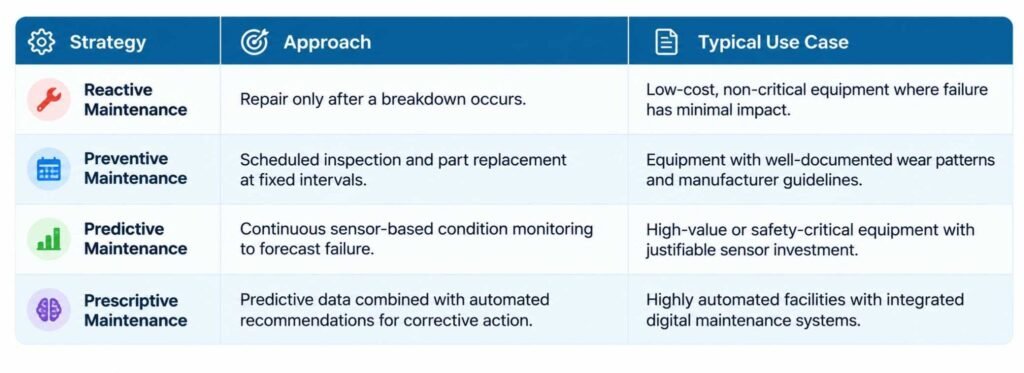
Preventive maintenance differs from both reactive maintenance, which waits for a breakdown, and predictive maintenance, which relies on continuous sensor data to forecast failure. It sits in between: a time- or usage-based schedule built from equipment history, manufacturer guidelines, and operating conditions, executed consistently regardless of whether a fault is visibly imminent.
Why Indian Manufacturers Are Prioritising Preventive Maintenance Now
Maintenance is no longer treated as a cost centre to be minimised. It is increasingly viewed as a lever for output reliability.
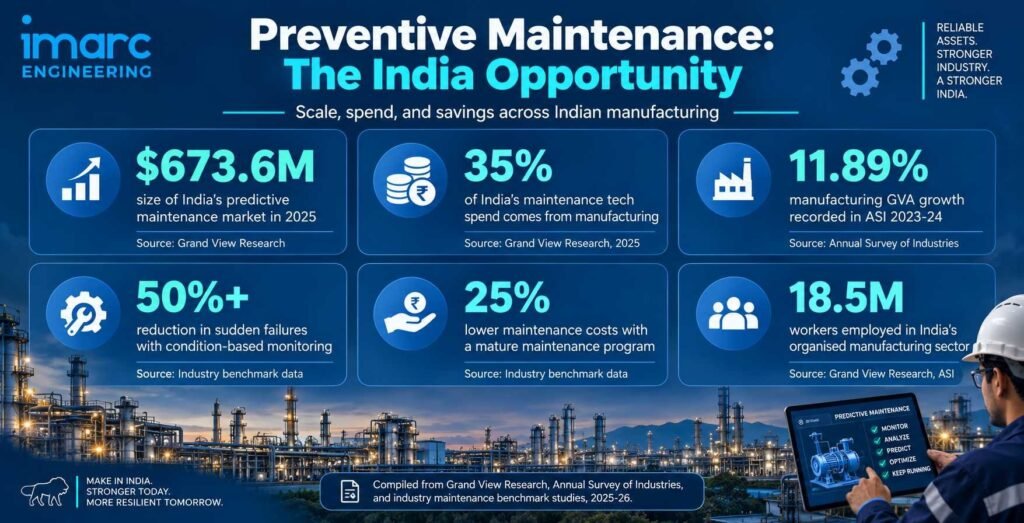
- The Annual Survey of Industries 2023-24 recorded manufacturing Gross Value Added growth of 11.89%, reflecting a sector adding capacity fast enough that unplanned stoppages carry a rising opportunity cost
- India’s organised manufacturing sector employs over 18.5 million workers, and every hour of unplanned downtime affects labour utilisation across this workforce, not just machine output
- Market research estimates that manufacturing accounted for about 35% of India’s predictive maintenance market in 2025, the largest share of any industry vertical
- India’s predictive maintenance market alone was valued at USD 673.6 million in 2025 and is projected to grow at a CAGR of 32.5% through 2033, reaching USD 6,145.9 million, with services being the fastest-growing component within it
Structured preventive schedules are what make this spend productive. Sensors and analytics platforms generate data, but a preventive maintenance framework is what turns that data into a scheduled work order before a component actually fails.
What Skipping a Structured Maintenance Schedule Actually Costs
The financial case for preventive maintenance becomes clear once the cost of its absence is measured directly.
- Published industry studies report meaningful reductions in maintenance cost and downtime when manufacturers rely more heavily on preventive and predictive strategies, although the actual benefit varies by asset and operating context.
- Condition-based inspection and monitoring can reduce the frequency of unexpected failures when the monitored failure modes are detectable and the maintenance response is timely
- Emergency repairs following an unplanned breakdown typically cost 2 to 3 times more than the same repair carried out during a scheduled maintenance window, once expedited parts and overtime labour are factored in
- Globally, only 59% of manufacturing facilities operate on a centralised maintenance management system, leaving a large share of plants without structured scheduling or historical equipment data to plan around
These figures point to the same conclusion from different angles: the cost of maintaining equipment on a schedule is consistently lower than the cost of repairing it after failure.
Preventive Maintenance Impact: The India Snapshot
The infographic below summarises the scale and financial case for preventive maintenance across Indian manufacturing.
Core Components of a Preventive Maintenance Program
A preventive maintenance service is not a single activity but a structured set of routines built around equipment criticality and failure history.
- Asset criticality mapping: Ranking equipment by the operational and safety impact of its failure, so maintenance frequency matches actual risk rather than a uniform schedule
- Time and usage-based scheduling: Setting inspection and replacement intervals based on manufacturer specifications, run-hours, or cycle counts rather than waiting for visible wear
- Standard operating checklists: Documenting exactly what needs inspection, lubrication, calibration, or replacement at each interval to remove dependency on individual technician memory
- Spare parts planning: Forecasting consumable and critical spare part requirements against the maintenance calendar to avoid delays caused by part unavailability
- Maintenance history logging: Recording every intervention against an asset to build a failure pattern history that refines future scheduling accuracy
- CMMS integration: Centralising work orders, schedules, and technician assignments in a computerised maintenance management system rather than spreadsheets or manual logs
Maintenance Strategy Comparison
Choosing the right maintenance strategy, or the right combination of strategies, depends on equipment criticality, failure cost, and available data.
Sectors Gaining the Most from Preventive Maintenance Services
Some sectors carry a disproportionately high cost per hour of downtime, making structured maintenance scheduling a higher priority.
- Automotive and auto-component manufacturing, where a single line stoppage can cascade across just-in-time supplier schedules
- Pharmaceutical and process manufacturing, where equipment failure risks batch loss and regulatory non-compliance simultaneously
- Food processing and FMCG plants, where preventive checks on refrigeration and hygiene-critical equipment protect both output and compliance
- Chemicals and heavy process industries, where scheduled inspection of pressure vessels, pumps, and rotating equipment is tied directly to safety compliance
- Cement, steel, and metals, where continuous-process equipment has extremely high replacement lead times, making planned maintenance windows essential
For detailed insights into Preventive Maintenance Planning, read IMARC Engineering’s comprehensive guide: https://www.imarcengineering.com/blog/how-preventive-maintenance-planning-india-prevent-equipment-failures
How IMARC Engineering’s Expertise Can Help in Preventive Maintenance Planning
- Building asset criticality frameworks specific to a facility’s equipment mix, rather than applying a generic maintenance calendar
- Designing maintenance schedules aligned with manufacturer specifications, operating conditions, and historical failure data from the facility itself
- Structuring spare parts inventory planning around the maintenance calendar to reduce delays caused by part unavailability
- Supporting CMMS selection and rollout so schedules, checklists, and technician assignments move out of spreadsheets and into a centralised system
- Aligning maintenance planning with safety and compliance requirements for pressure equipment, electrical systems, and fire safety installations
- Advising on a phased path from preventive to predictive maintenance as sensor data and equipment history mature
Consult IMARC Engineering to build a preventive maintenance schedule tailored to your facility’s equipment and operating conditions: https://www.imarcengineering.com/contact?service=preventive-maintenance-planning
Conclusion
Preventive maintenance has moved from a housekeeping function to a measurable driver of plant reliability and cost control in Indian manufacturing. With maintenance technology spend concentrated in manufacturing and unplanned downtime remaining an expensive, recurring risk, facilities that build structured, criticality-based maintenance schedules are positioned to run at higher uptime and lower total cost than those relying on reactive repair. The next stage of operational efficiency in Indian plants will be built as much in the maintenance calendar as on the production line itself.
Frequently Asked Questions
What is the difference between preventive and predictive maintenance?
Preventive maintenance follows a fixed schedule based on time, usage, or manufacturer guidelines, regardless of the equipment’s current condition. Predictive maintenance uses continuous sensor data to forecast failure and schedules intervention only when a fault signature actually appears.
How often should preventive maintenance be scheduled?
Frequency depends on equipment criticality, manufacturer recommendations, and operating conditions. Critical, high-utilisation equipment typically needs shorter inspection intervals, while non-critical assets can follow longer cycles based on documented wear patterns.
Can preventive maintenance reduce overall operating costs?
Yes. Facilities running mature preventive maintenance programs report cost reductions of up to 25% along with meaningful uptime gains, largely because scheduled repairs avoid the premium pricing and cascading losses associated with emergency breakdowns.
Is preventive maintenance suitable for small and mid-sized manufacturing plants?
Yes. A criticality-based preventive maintenance schedule can be implemented without the sensor infrastructure predictive maintenance requires, making it an accessible starting point for facilities with limited digital maturity.
What role does a CMMS play in preventive maintenance?
A computerised maintenance management system centralises schedules, checklists, work orders, and equipment history in one place, replacing spreadsheets or manual logs. This makes it easier to track compliance with maintenance intervals, spot recurring failure patterns, and plan spare parts inventory around actual usage rather than guesswork.
Contact Us:
IMARC Engineering
Phone: +91-120-433-0800
Email: sales@imarcengineering.com
India: C-130, Sector 2, Noida, Uttar Pradesh 201301
LinkedIn: https://www.linkedin.com/showcase/imarc-engineering/
About the Author