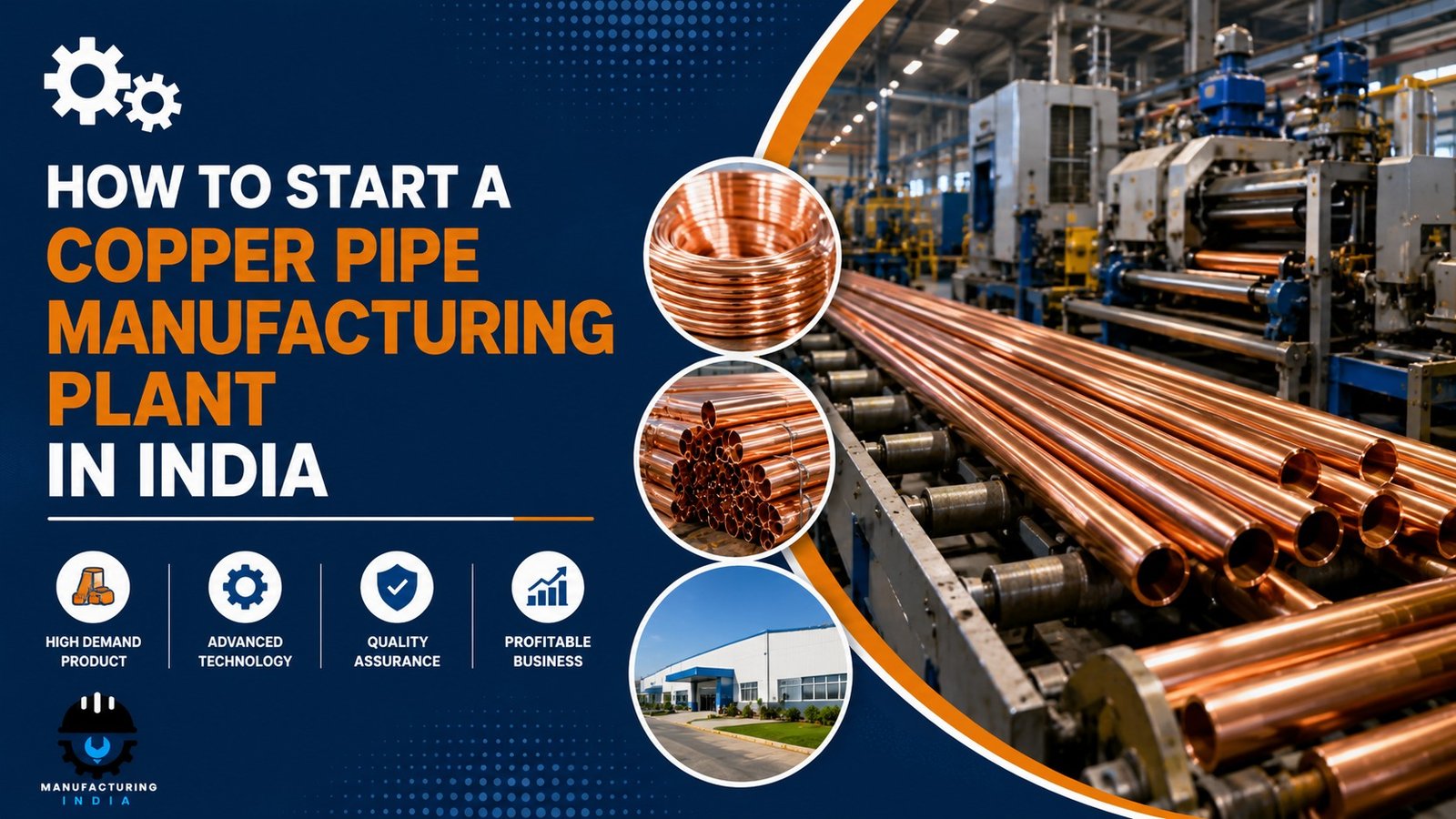
Setting up a copper pipe manufacturing plant in India presents a compelling investment case, driven by demand from construction, plumbing, HVAC & refrigeration, automotive, industrial machinery, and renewable energy industries. Copper pipes serve water supply lines, cooling coils, heat exchangers, HVACR circuits, gas distribution, and hydraulic systems, and their corrosion resistance, strength, malleability, and thermal conductivity make them the material of choice for fluid transfer.
The global copper pipes and tubes market is dominated by Asia Pacific, propelled by industrial expansion, fast-paced urbanization, and construction and plumbing needs from large-scale infrastructure investments. China and India demonstrate double-digit annual growth in AC installations, and India’s industry is moving to reduce import dependence through new domestic manufacturing partnerships, discussed further below.
This plant’s investment case rests on Asia-Pacific-led demand growth, gross margins of 12–18%, and a medium-scale capacity of 3,000–4,000 MT that lets investors size the operation to local demand while targeting measurable payback through NPV and IRR analysis.
What is Copper Pipe?
Copper pipe is a cylindrical metallic tube manufactured from high-purity copper and widely used for fluid transfer applications due to its exceptional corrosion resistance, strength, malleability, and thermal conductivity. It is produced by melting refined copper cathodes, casting billets, and shaping them into pipes through extrusion, rolling, and drawing operations, followed by annealing for the desired mechanical properties and dimensional precision.
Key characteristics include excellent thermal conductivity, superior corrosion resistance in water and atmospheric conditions, malleability and ductility that allow bending without cracking, lighter weight than steel piping, and full recyclability without loss of material properties. Copper pipes also resist internal scaling, microbial growth, and high temperatures, making them reliable for plumbing, refrigeration, and HVAC systems.
The copper pipe manufacturing process begins with melting pure cathodes into molten copper, casting billets, and extruding or piercing them into hollow tubes, followed by cold-drawing and annealing. Output serves construction, plumbing, HVAC & refrigeration, automotive, industrial machinery, and renewable energy applications.
Cost of Setting Up a Copper Pipe Manufacturing Plant in India
Cost depends on capacity, technology, location, automation, and regulatory compliance.
1. Capital Expenditure (CapEx)
CapEx begins with land and site development, including registration, boundary development, and related expenses, with options such as industrial estates or SEZ-linked plots. Civil works cover the raw material handling area, melting and casting section, hot working area, cold drawing section, heat treatment zone, finishing area, warehouse, and administrative block.
Machinery costs account for the largest portion of total capital expenditure. Key machinery required includes:
- Induction and reverberatory furnaces
- Casting machines
- Extrusion presses
- Piercing mills
- Billet preheating equipment
- Multi-draw benches
- Pilger mills
- Straightening machines
- Continuous or batch annealing furnaces
- Controlled atmosphere systems
- Cooling conveyors
- Cutting and chamfering machines
- Hydrostatic and eddy current testing equipment
- Dimensional inspection stations
- Water treatment plant
- Compressed air systems
- Cooling towers
Other capital costs include utilities and auxiliary systems, initial working capital, pre-operative expenses, and contingency provisions.
Request a Sample Report for In-Depth Market Insights: https://www.imarcgroup.com/copper-pipe-manufacturing-plant-project-report/requestsample
2. Operational Expenditure (OpEx)
OpEx is dominated by raw material cost. Copper cathodes, deoxidizing agents, and lubricants together account for 65-70% of operating expenses, making copper price fluctuations the most significant cost factor. Utility cost — electricity, water, fuel, and compressed air – accounts for 8-10% of OpEx. Other costs include transportation, packaging, salaries, depreciation, and maintenance, with total operational cost expected to rise from year one to year five due to inflation and market fluctuations.
3. Plant Capacity
A medium-scale unit typically runs at an annual capacity of 3,000-4,000 Metric Tons Per Annum. Capacity can be customised to individual investor requirements, and profitability generally improves with higher capacity utilisation.
4. Profit Margins and Financial Projections
Financial projections cover liquidity assessment, profitability ratios, payback period, net present value (NPV), internal rate of return (IRR), and uncertainty and sensitivity analysis. Gross profit typically comes to around 12-18% and net profit around 5-10%, giving a realistic basis for assessing viability and long-term profitability.
Why Set Up a Copper Pipe Manufacturing Plant in India?
Asia-Pacific-Led Demand Growth. The global copper pipes and tubes market is dominated by Asia Pacific, where industrial expansion, fast-paced urbanization, and large-scale infrastructure investment are driving construction and plumbing demand.
Rising HVAC and AC Installation Growth. The refrigeration and air-conditioning sector accounts for approximately 45% of global demand, and China and India demonstrate double-digit annual growth in AC installations, expanding due to stricter energy-efficiency standards and rising temperatures.
Active Domestic Industry Investment. In July 2025, Adani Enterprises Limited and MetTube Mauritius Private Limited formed a 50:50 joint venture to boost India’s copper tube production and reduce import dependence, leveraging Adani’s copper ecosystem and MetTube’s manufacturing expertise for HVAC, refrigeration, and plumbing applications.
Sustainability-Driven Material Preference. Copper’s complete recyclability without property degradation aligns with environmental initiatives such as the EU’s Circular Economy Action Plan and sustainability programs in Japan and South Korea, increasingly favouring copper over plastic alternatives.
Global Capital Commitment to the Segment. In March 2025, Lawton Tubes announced a £20 million investment to enhance copper tubing production capabilities, while Mueller Industries acquired Elkhart Products Corporation in August 2024, reflecting active consolidation across the industry.
Renewable Energy and Infrastructure Tailwinds. Renewable energy applications in solar thermal and geothermal systems are opening new opportunities, alongside U.S. construction spending exceeding USD 2 trillion annually and federal procurement spending surpassing USD 760 billion favouring durable, low-impact materials.
Manufacturing Process – Step by Step
The copper pipe manufacturing process uses melting, casting, extrusion, and drawing as its primary production method.
- Melting: Pure copper cathodes are melted into molten copper.
- Casting: Molten copper is cast into billets.
- Extrusion or Piercing: Billets are heated and extruded or pierced to form hollow tubes.
- Cold Drawing: Tubes are cold-drawn through dies to achieve precise dimensions.
- Intermediate Annealing: Annealing at 500-650°C restores ductility between draws.
- Automated Processing: Advanced automated systems enhance throughput across drawing stages.
- Quality Control: Final pipes undergo strict quality control for dimensions, pressure tolerance, and surface finish.
- Packaging and Dispatch: Pipes are bundled in hexagonal packs of 5-20 pieces or coiled on wooden or steel reels before dispatch to construction, plumbing, HVAC & refrigeration, and industrial customers.
Key Applications
Copper pipe output serves a wide range of downstream industries.
- Water Supply Lines: Copper pipe is used in plumbing systems for potable water distribution.
- Cooling Coils: Copper’s thermal conductivity makes it suited to refrigeration cooling coils.
- Heat Exchangers: Copper pipe forms the core of many heat exchanger designs.
- HVACR Circuits: Copper tubing is used throughout HVAC and refrigeration circuits.
- Gas Distribution: Copper pipe carries gas in distribution systems.
- Hydraulic Systems: Copper pipe is used in hydraulic fluid transfer applications.
Leading Manufacturers
Leading manufacturers in the global copper pipe industry include several multinational companies with extensive production capacities, including:
- Mueller Industries
- Wieland Group
- KME Germany
- Hailiang Group
- MetTube
Timeline to Start the Plant
- Feasibility study and project report preparation
- Land acquisition and site development
- Regulatory approvals and environmental clearances
- Factory licence and fire safety compliance
- Machinery procurement and installation
- Raw material supplier agreements and supply chain setup
- Trial production and quality testing
- Commercial production launch
Licences and Regulatory Requirements
Starting a copper pipe manufacturing unit in India requires several approvals:
- Business registration (Proprietorship, LLP, or Pvt Ltd)
- Factory Licence under the Factories Act
- Environmental Clearance from State Pollution Control Board
- GST Registration
- Fire Safety NOC
- Hazardous/Chemical compliance for furnace and deoxidizing-agent handling
- Effluent Treatment Plant (ETP) operational clearance
- Occupational Health and Safety compliance
Key Challenges to Consider
High Capital Requirements. Machinery costs account for the largest portion of total capital expenditure, with furnaces, extrusion presses, and drawing benches representing significant upfront investment.
Raw Material Price Volatility. Copper cathodes and other raw materials account for 65-70% of OpEx, making copper price fluctuations the most significant cost factor in pipe manufacturing.
Regulatory Compliance. Environmental clearances, effluent treatment obligations, and factory licensing require ongoing attention and resourcing.
Technology and Process Efficiency Pressure. Manufacturing innovations including continuous extrusion and automated multi-draw systems are needed to enhance production efficiency while reducing costs.
Competition from Established Players. Global producers such as Mueller Industries, Wieland Group, KME Germany, Hailiang Group, and MetTube operate extensive production capacities, creating a competitive landscape.
Skilled Manpower. Operating specialised equipment such as extrusion presses, pilger mills, and annealing furnaces requires trained technical staff.
Frequently Asked Questions
1. How much does it cost to set up a copper pipe manufacturing plant in India?
Cost depends on capacity, machinery, automation, and site development, covering land, civil works, machinery, and other capital costs.
2. Is copper pipe manufacturing profitable in India in 2026?
Gross profit typically comes to around 12-18% and net profit around 5-10%, supported by steady Asia-Pacific demand.
3. What machinery is required for a copper pipe plant in India?
Induction and reverberatory furnaces, casting machines, extrusion presses, piercing mills, multi-draw benches, pilger mills, annealing furnaces, and testing equipment.
4. What licences and approvals are required to start a copper pipe plant in India?
Business registration, a Factory Licence, Environmental Clearance, GST Registration, Fire Safety NOC, ETP clearance, and occupational health and safety compliance.
5. What raw materials are needed for copper pipe manufacturing?
High-purity copper cathodes, deoxidizing agents such as phosphorus or magnesium, and lubricants for drawing operations.
6. What are the environmental compliance requirements for a copper pipe plant in India?
Environmental Clearance from the State Pollution Control Board, an operational ETP, and hazardous/chemical and occupational health and safety compliance.
7. What is the best location to set up a copper pipe plant in India?
Sites offering efficient access to raw materials, infrastructure, and transportation networks, selected through location and environmental impact analysis.
8. What is the break-even period for this type of plant in India?
Break-even depends on capacity utilisation and the CapEx-OpEx structure, assessed through payback period, NPV, and IRR analysis.
9. What government incentives are available for manufacturers in India?
India’s push to reduce import dependence, illustrated by the July 2025 Adani-MetTube joint venture, points to structural policy support for domestic copper tube production.
Key Takeaways for Investors
This plant taps into consistent demand from construction, plumbing, HVAC & refrigeration, automotive, industrial machinery, and renewable energy sectors. Financial viability holds at the medium-scale 3,000-4,000 MT capacity range, with gross margins of 12-18% and net margins of 5-10%. The global copper pipes and tubes market, valued at 5.02 Million Tons in 2024 and projected to reach 6.55 Million Tons by 2033 at a CAGR of 3.00%, underscores sustained demand that should remain durable beyond the current investment cycle.
About the Author