On-Site Technical Troubleshooting
A machine that ran fine in the vendor’s factory acceptance test starts tripping every third shift once it’s on your floor. A new production line hits 70% of its rated output and won’t budge, no matter how many settings the operator changes. A pump “repaired” twice this quarter fails again in week three. The real cost is rarely limited to the repair itself,it includes lost production, delayed dispatches and engineering hours spent investigating an issue nobody has fully resolved.
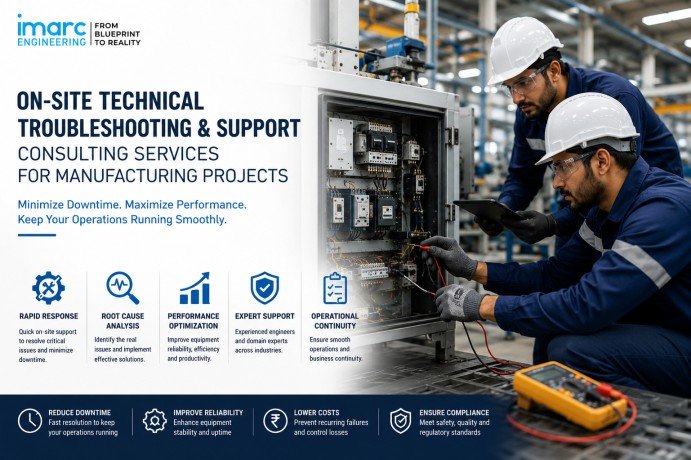
This guide explains what end-to-end on-site troubleshooting and support consulting involves across manufacturing projects, from identifying recurring equipment failures and diagnosing technical issues to implementing corrective actions and verifying performance. It also examines when independent technical support can add value, particularly during commissioning, production ramp-up, and complex equipment failures. The guide highlights how structured root-cause investigation differs from routine repair visits and helps manufacturers address problems at their source.
Why It’s Fixed Doesn’t Always Mean It’s Fixed
Most in-house maintenance teams and OEM service engineers are very good at one thing: getting equipment running again. That’s not a criticism , it’s the job they’re resourced and trained for. But getting equipment running again and understanding why it stopped in the first place are two different tasks, and plants frequently pay for the first while assuming they’ve received the second.
The gap shows up as a pattern: the same motor trips every few weeks, the same line loses throughput at the same point in the shift, the same joint leaks again six months after a “permanent” fix. Each incident gets closed as an isolated event, so nobody asks the question that would actually stop it recurring: what changed, or what was always wrong, at the point the failure originates?
What Makes Manufacturing Technical Problems Cross-Disciplinary?
A large share of shop-floor failures don’t stay inside the discipline they first appear in. A “faulty sensor” can trace back to poor electrical grounding; a pump losing pressure can trace back to a piping change made during an unrelated project months earlier.
This matters because most troubleshooting happens in silos. The mechanical technician checks the mechanical side, the electrician checks the electrical side, and if a fault sits at the boundary between disciplines , which, on automated equipment, it often does , nobody owns the full investigation, and the problem keeps returning in a different form.
Common areas where this cross-over causes stuck problems:
- Mechanical ↔ Electrical: vibration or bearing-related symptoms that may be influenced by motor imbalance, alignment, electrical loading, or power-quality conditions
- Controls ↔ Process: PLC alarms that are really a symptom of a process condition drifting outside its normal range
- Utilities ↔ Equipment: equipment “malfunctions” that are actually compressed air, cooling water, or power supply instability
- Installation ↔ Performance: underperforming equipment that was never installed or aligned to the vendor’s specification in the first place
When Should a Plant Bring In Independent Technical Support?
Not every fault needs an outside investigation , plenty are legitimately routine. It’s worth bringing in independent technical troubleshooting support when one or more of these apply:
- A failure keeps recurring despite repairs, part replacements, or vendor visits
- New equipment won’t reach rated output even after commissioning is technically complete
- Responsibility is disputed between an OEM, contractor, and in-house team, and the fault remains unresolved
- A problem crosses disciplines and no single internal team owns the full picture
- A production ramp-up has stalled and the bottleneck isn’t obvious from the data already reviewed
- The in-house team is confident in a fix but the failure returns anyway , a strong sign the wrong cause was treated
These situations sit at the core of manufacturing equipment troubleshooting and root-cause investigation work. If none apply, an in-house team or the OEM’s service desk is usually the right first call.
Our On-Site Technical Troubleshooting Services
A genuine end-to-end engagement moves across the following areas, since a fault rarely announces which discipline it belongs to:
- Mechanical & rotating equipment , pumps, compressors, motors, gearboxes, conveyors, mixers, fans
- Electrical systems , drives, MCCs, panels, switchgear, transformers, power-distribution interfaces
- Instrumentation & automation , PLC, HMI, SCADA, sensors, actuators, control loops, interlocks
- Utilities , compressed air, chilled water, cooling water, steam, HVAC, process water, electrical supply
- Production & process systems , line bottlenecks, equipment integration, process instability, capacity constraints
What a Genuine Root-Cause Investigation Looks Like
A repair visit and a root-cause investigation can look similar from the outside. The difference is in sequence and depth.
- Establishing the actual condition, not the assumed one. Before touching the equipment, a proper investigation checks what’s actually happening against what’s documented , operating parameters, installation records, maintenance history, prior interventions.
- Following the evidence across disciplines. Rather than starting from “this is mechanical” or “this is electrical,” the investigation follows alarms, trends, and physical evidence wherever they lead, even across team boundaries.
- Distinguishing symptom from cause. A tripped breaker is a symptom; what caused the overcurrent is the question worth answering. Most repair-only visits stop at the symptom.
- Verifying the fix under real operating conditions. A corrective action isn’t confirmed by the machine restarting , it’s confirmed by the equipment holding its performance over a genuine operating period, not the ten minutes after a technician leaves.
- Documenting the cause, not just the repair. A closure note that only says “component replaced” leaves a plant exactly as exposed to recurrence as before. A useful report records what actually caused the failure.
Technical Troubleshooting During Commissioning & Production Ramp-Up
Troubleshooting isn’t only for equipment that’s already broken. Some of the highest-value work happens during commissioning and early ramp-up, when a plant is trying to move from “installed” to “performing at rated capacity,” and a single unresolved issue can hold up an entire startup schedule.
Common friction points: equipment that starts but won’t sustain rated throughput, interlocks or sequencing that behave differently under real production load than during testing, unclear vendor responsibility for an open punch-list item, and quality deviations that appear only once continuous production begins.
A workaround adopted during a stressful startup window tends to become standard practice , an operator learns to nudge a parameter to avoid an alarm, and within months nobody remembers it started as a symptom. By the time someone investigates, the original cause is buried under months of adapted behavior, and the eventual fix costs far more than it would have at commissioning.
Troubleshooting for Greenfield Manufacturing Projects
A greenfield plant has no operating history to compare against, so the priority is establishing what “normal” should look like and closing the gap between design intent and actual performance.
Troubleshooting for Brownfield Plant Expansion Projects
A brownfield expansion often has years of operating data to draw on, but the challenge is isolating what’s genuinely new about the added equipment from what was already a latent issue in the existing plant.
Both rely on the same underlying discipline , comparing actual conditions against intended design and following evidence rather than assumptions , but the starting point differs in each case.
Typical Deliverables
- Site diagnostic assessment and technical investigation report
- Root-cause analysis and corrective-action recommendations
- Vendor/OEM technical observations
- Commissioning troubleshooting and performance verification reports
- Recurrence-prevention recommendations
Manufacturing Sectors We Support
Pharmaceutical manufacturing, food processing, chemical manufacturing, automotive, medical devices, plastics, and general engineering and machinery production environments.
Performance Areas We Assess
Equipment availability, unplanned downtime, MTBF, MTTR, production throughput, cycle time, OEE, energy consumption, repeat-failure frequency, and commissioning punch-point closure , tracked to show whether a fix actually held, not just whether the equipment restarted.
How IMARC Engineering Can Help
IMARC Engineering supports manufacturing plants and greenfield/brownfield projects with on-site technical troubleshooting across mechanical, electrical, instrumentation, automation, and utility systems. This can include:
- On-site diagnostic visits for equipment that’s failed, underperformed, or failed repeatedly despite prior repairs
- Structured root-cause investigations that document the actual cause, not just the corrective action taken
- Technical support during commissioning and production ramp-up, including performance verification against the rated specification
- Coordination between plant teams, contractors, and OEMs when responsibility for an issue is unclear
- Post-fix performance verification, so an issue is closed only once it’s demonstrated to hold under real conditions
The intent isn’t to compete with a plant’s maintenance team or an OEM’s service desk, but to support cases where a problem has already resisted the obvious fixes and needs an independent, cross-disciplinary look at the evidence.
Speak With An Expert: https://www.imarcengineering.com/contact?service=on-site-troubleshooting-technical-support
Conclusion
The real cost of a technical failure is rarely the repair itself , it’s the output lost while the problem is misdiagnosed, and the cost of solving it again months later. The distinction between a repair and a resolution comes down to one question: did the investigation stop at the symptom, or follow the evidence back to the actual cause?
For problems that keep recurring, that cross discipline boundaries, or that surface during a commissioning window where every day of delay has a cost, an independent technical troubleshooting engagement is worth the investment , not because in-house teams and OEMs aren’t capable, but because a fresh, cross-disciplinary look at the evidence is often exactly what a stuck problem needs.
Contact Us:
IMARC Engineering
Phone: +91-120-433-0800
Email: sales@imarcengineering.com
India: C-130, Sector 2, Noida, Uttar Pradesh 201301
LinkedIn: https://www.linkedin.com/showcase/imarc-engineering/
About the Author