Introduction
Rising demand for cleaning, personal-care, agri-input and household liquid packaging has pushed several first-time investors toward manufacturing plastic dispensing pumps in India. A trigger sprayer looks like a small, simple part, but setting up a plant for it involves the same engineering discipline as any precision plastic-components project.
Anyone researching how to start trigger pump manufacturing in India needs to consider more than machinery selection. Tooling, capacity, quality and supplier planning can shape the project’s cost, timeline and production readiness. For manufacturers planning a Manufacturing Plant Setup in India, IMARC Engineering supports this type of pre-investment and plant-execution planning.
Understanding the Trigger Pump / Trigger Sprayer Manufacturing Project
In trade usage, the terms trigger pump, trigger sprayer and trigger spray pump are generally interchangeable. It refers to a manually operated dispensing pump fitted onto a bottle neck, actuated by squeezing a lever to draw liquid through a dip tube and release it through a nozzle.
Trigger sprayers of this general type are used across categories such as household cleaning, gardening, agri-input dispensing and personal care, though the exact end-use for a given project should be confirmed before design work begins.
Product specification and confirmed end-use, not the generic product category, determine which polymer grades, testing protocols and packaging-compliance requirements apply.
Key Components Used in Trigger Sprayers
A trigger sprayer is built from several small precision-moulded and metal parts that must work together consistently across thousands of actuation cycles. Exact component configuration varies by product design and neck-fitment standard.
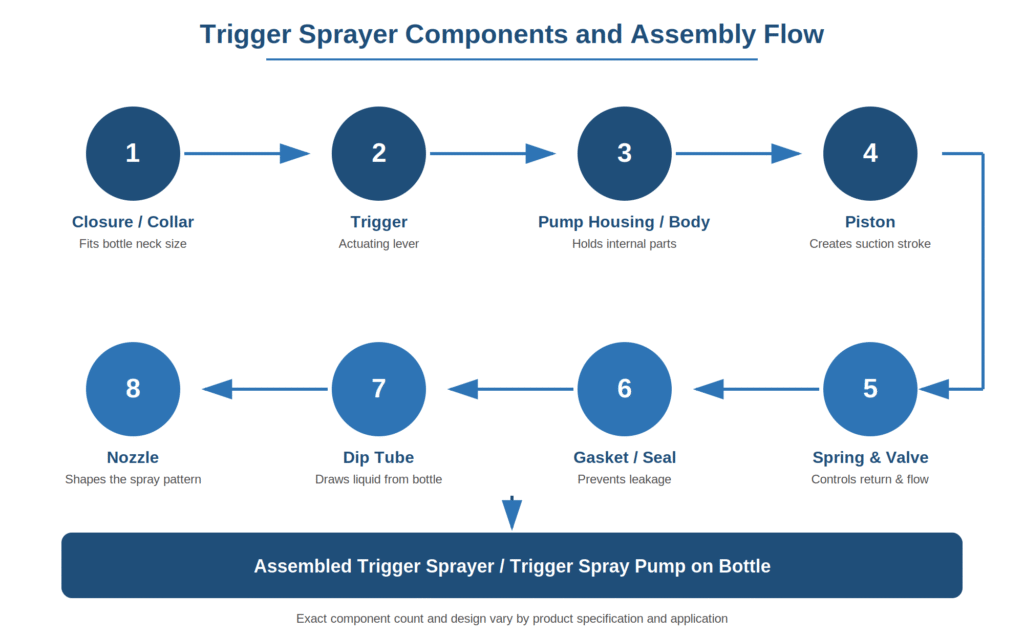
[INFOGRAPHIC 1 — Trigger Sprayer Components and Assembly Flow]
- Trigger: lever pressed to actuate the pump stroke.
- Pump housing/body: main moulded body holding the internal mechanism.
- Piston: creates suction and discharge strokes inside the housing.
- Spring: returns the trigger and piston to start position after each stroke.
- Valve(s): control one-way liquid flow through the pump chamber.
- Nozzle: shapes the discharge into a stream, spray or mist pattern.
- Gasket/seal: prevents leakage at joints between moving and static parts.
- Closure/collar: locks onto the bottle neck; must match the neck-finish standard.
- Dip tube: extends into the bottle to draw liquid up to the pump.
Some designs add locking clips, over-caps or child-resistant features depending on application, finalised once the specification is confirmed.
Trigger Pump Manufacturing Process
At a project level, manufacturing moves through product specification, design and tooling, component production, inspection, assembly, dip-tube fitting, functional and leak testing, and packing. Each stage carries a project decision that affects cost, quality or timeline.
- Product specification: locks the neck size, material, colour and performance targets that guide subsequent design and production decisions
- Design and tooling: mould design and cavitation decide achievable capacity and per-part cost for the tool’s life.
- Component production: moulding of plastic parts, alongside sourcing of springs, valves and other bought-out items.
- Inspection: incoming and in-process checks catch dimensional and moulding defects before assembly.
- Assembly: manual, semi-automatic or automatic integration of the components into the completed trigger sprayer.
- Dip-tube fitting: tube length must match bottle height, tying this step to bottle specification.
- Functional and leak testing: actuation-cycle and leak checks validate performance before packing.
- Packing: format depends on whether pumps ship loose, boxed or pre-fitted to bottles.
Machinery and Equipment Required
Machinery planning should be organised by category rather than by machine count, since the right configuration depends on product design and target output.
- Injection moulding machines sized to the shot weight and clamping tonnage required.
- Moulds/tooling, typically multi-cavity, built for the component set and material.
- Material handling and auxiliaries: dryers, loaders, chillers, mould-temperature controllers.
- Assembly equipment: manual fixtures, semi-automatic stations or automatic lines.
- Component feeding systems for automated or semi-automated assembly.
- Dip-tube cutting and insertion equipment.
- Testing and inspection equipment for dimensions, leaks and actuation cycles.
- Packing equipment matched to the finished packing format.
Selection depends on component size, material grade, cavity count, cycle time, automation level and target capacity; two plants at the same volume can need different configurations if automation differs.
How to Plan Production Capacity
Capacity planning connects commercial demand to a physical machine and manpower plan, and should be revisited whenever an input assumption changes.
- Annual demand the plant is expected to serve, including seasonality if relevant.
- Working days and shift pattern.
- Cycle time per shot for each moulded component.
- Number of cavities per mould, which multiplies output per cycle.
- Machine utilisation/OEE assumptions, since actual uptime trails theoretical capacity.
- Assembly-line capacity, which can bottleneck even sufficient moulding capacity.
- A rejection allowance for moulding and assembly defects.
- Headroom for future expansion in layout and utility sizing.
Since capacities, cycle times and rejection rates vary by design and supplier, capacity plans should use validated project-specific data rather than generic industry figures.
Raw Materials, Tooling and Supplier Planning
Material and supplier decisions made early are difficult and costly to reverse once tooling is committed.
- Polymer selection: the grade should follow the confirmed application, component requirements and chemical compatibility with the liquid.
- Bought-out components: springs, valves, seals and dip tubes are often outsourced to specialised vendors.
- Mould/tooling quality: tool steel grade and finish affect cavity life and dimensional consistency.
- Supplier qualification: assess vendors on quality systems, sample consistency and ramp-up support.
- Lead time: build tooling and critical-component lead times into the schedule, with backup sourcing for single-source items.
- Make-versus-buy: evaluate each component on volume, tooling cost and in-house capability rather than defaulting to in-house.
Factory Layout and Utility Planning
Layout decisions made at the planning stage are far cheaper to correct than problems discovered after installation.
- Material flow from storage through moulding, assembly, QC, packing and dispatch.
- Moulding area sized for machine footprint, mould-change access and material handling.
- Dedicated component storage kept close to the assembly line.
- Finished-goods movement and dispatch access.
- Electrical load planning matched to the machinery configuration.
- Compressed air and other utilities relevant to moulding and assembly.
- Maintenance and safety access around machinery and utility lines.
Utility sizing should follow the confirmed machinery list to reduce the risk of changes or rework during installation.
Quality Control and Leakage Prevention
Leakage and inconsistent spray performance are important quality risks in trigger sprayer manufacturing, and both are largely influenced by upstream design, moulding and assembly controls.
- Incoming inspection of polymer batches and bought-out components.
- Dimensional checks on critical mating surfaces around the housing, piston and closure.
- Monitoring for moulding defects such as flash, short-shots and warpage.
- Assembly consistency checks, since manual variability can contribute to inconsistent sealing and intermittent leakage.
- Leak testing and spray-pattern/actuation-force checks against specification.
- Closure and neck-fitment compatibility verification against the bottle.
- Seal and gasket performance checks after repeated actuation cycles.
- Chemical compatibility checks where the application involves aggressive liquids.
Building these checks into mould design and supplier qualification is more effective than relying on final inspection alone.
Greenfield vs Existing Facility Setup
The planning sequence differs depending on whether the project starts on a new site or within an existing facility.
- Greenfield: building design, utilities and layout are planned from a blank slate, giving flexibility but a longer timeline.
- Existing/brownfield: requires assessing existing structural, electrical and utility capacity, and planning installation around ongoing operations.
Both routes need equipment integration and commissioning planned against the confirmed machinery specification; the difference is how much infrastructure must be created versus adapted.
Project Implementation Roadmap
- Product and market definition
- Feasibility and capacity planning
- Process and make/buy decision
- Layout and utility planning
- Machinery and tooling specification
- Supplier/vendor evaluation
- Procurement
- Installation
- Trial production
- Quality validation
- Commercial production
- Operational readiness
Locking product specification before tooling, and confirming supplier qualification before procurement, avoids the rework that comes from reversing a decision after capital is committed.
How IMARC Engineering Can Support Trigger Pump Manufacturing Projects
Trigger pump manufacturing projects involve the same pre-investment and execution decisions as other precision plastic-component projects. IMARC Engineering supports manufacturers across this project lifecycle:
| Project Requirement | How IMARC Engineering Can Support |
|---|---|
| Feasibility and project planning | Market and location assessment, capacity assumptions review, and business-case validation before capital is committed. |
| CAPEX planning | Structuring cost heads for land, building, machinery, utilities and working capital so investment decisions are based on a complete project scope. |
| Plant layout and engineering coordination | Process-flow-based layout planning covering moulding, assembly, QC, storage and utility areas, coordinated with civil and MEP design. |
| Machinery/package planning | Defining machinery and equipment specifications aligned with product design, capacity targets and automation level. |
| Vendor/supplier evaluation | Structured evaluation of machinery suppliers, mould makers and component vendors on capability, quality systems and delivery reliability. |
| Utility and infrastructure planning | Power, compressed air, water and other utility planning integrated with the overall facility design. |
| Project implementation support | Coordination across engineering, procurement and construction during plant execution. |
| Commissioning/operational readiness | Supporting installation supervision, trial-run coordination and production readiness activities ahead of commercial operation. |
Start your trigger pump manufacturing project in India with expert support from IMARC Engineering: https://www.imarcengineering.com/contact-us
Conclusion
A successful trigger pump manufacturing project brings product specifications, tooling, equipment, utilities, supplier readiness and quality validation together before commercial production begins. Planning these interfaces early can help manufacturers reduce avoidable rework during installation, trials and production ramp-up.
For manufacturers planning trigger pump production in India, early alignment between project, engineering, procurement and quality decisions can create a clearer path from concept to commercial operation. IMARC Engineering supports this coordinated planning and execution across the project lifecycle.
Frequently Asked Questions
What machinery is required to manufacture trigger sprayers?
Core requirements include injection moulding machines and moulds, material-handling auxiliaries, assembly equipment, dip-tube insertion systems, testing equipment and packing equipment. The exact configuration depends on product design, material and target capacity.
What raw materials are used in trigger sprayer manufacturing?
Moulded components require polymer grades selected according to the application and liquid compatibility. Springs, valves, seals and dip tubes can be sourced as bought-out components depending on the project’s make-versus-buy strategy.
How is trigger sprayer production capacity planned?
Production capacity should be based on demand, shifts, cycle time, mould cavities, utilisation, assembly capacity and planned expansion headroom.
What causes trigger sprayer leakage?
Leakage typically stems from dimensional inconsistency in moulded parts, moulding defects such as flash or warpage, assembly variability, and mismatched or degraded seals, gaskets or closures relative to the bottle neck.
Should trigger sprayer components be manufactured in-house or outsourced?
This depends on volume, tooling investment, in-house capability and quality-control requirements for each component. Many manufacturers mould core plastic parts in-house while sourcing springs, valves and seals from specialised vendors.
What should be considered before setting up a trigger sprayer plant in India?
Key considerations include product specification and application, make-versus-buy decisions, machinery and tooling planning, capacity assumptions, factory layout and utilities, supplier qualification, and the regulatory and packaging-compliance requirements that apply to the confirmed application.
Is regulatory approval required for trigger sprayer manufacturing in India?
Requirements depend on the product’s application, packaging structure and target market rather than applying uniformly to every trigger sprayer. Regulatory requirements depend on the trigger sprayer’s application, the manufacturer’s role in the supply chain, the packaging structure and the target market. Where the product or business model falls within the applicable plastic-packaging framework, the relevant Plastic Waste Management Rules and EPR requirements must be assessed.
Contact Us:
IMARC Engineering
Phone: +91-120-433-0800
Email: sales@imarcengineering.com
India: C-130, Sector 2, Noida, Uttar Pradesh 201301
LinkedIn: https://www.linkedin.com/showcase/imarc-engineering/
About the Author