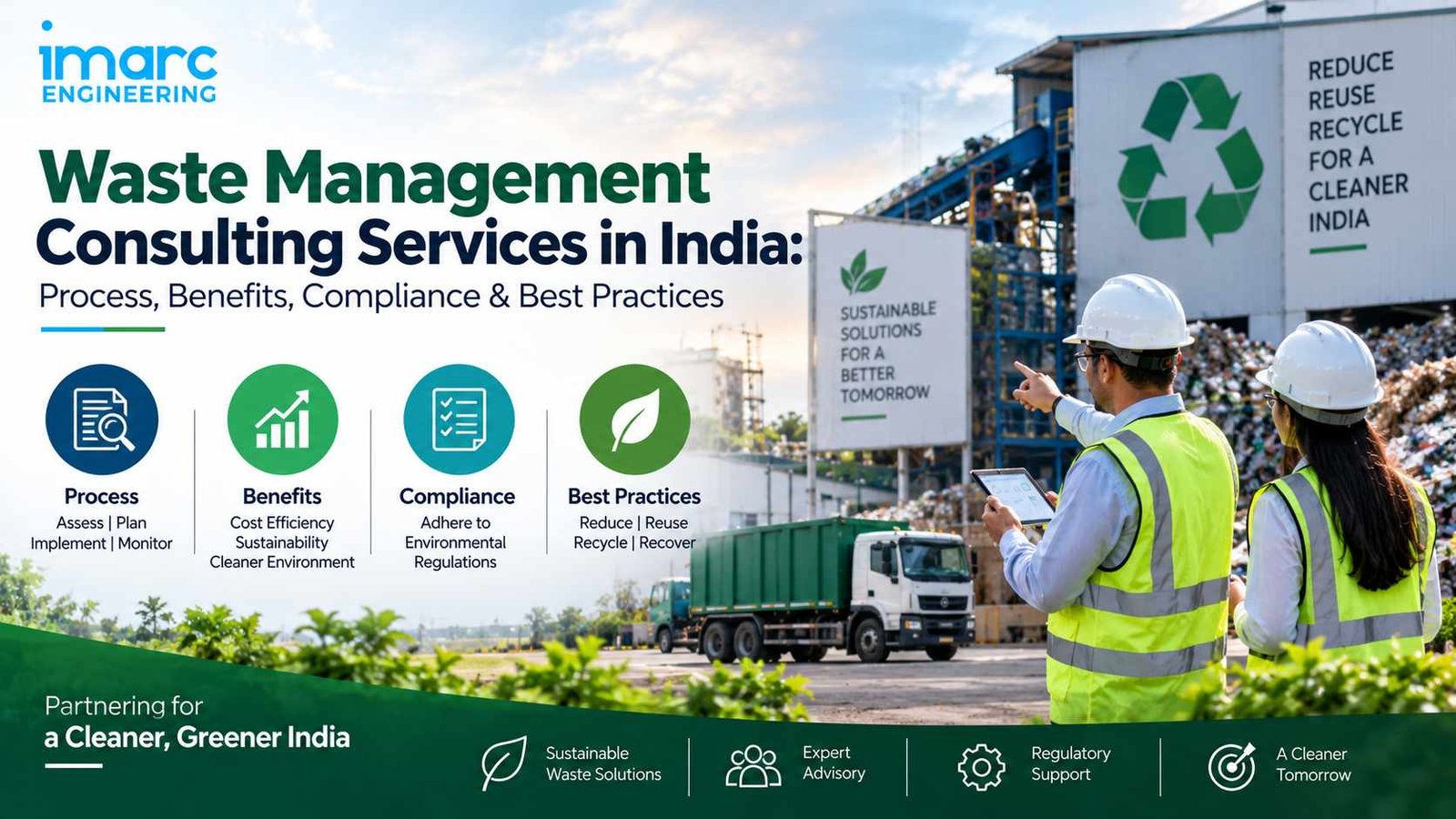
Waste management in Indian manufacturing has moved well past compliance paperwork. It now sits directly on a plant’s cost sheet, its environmental clearance status, and its ability to keep operating without regulatory interruption.
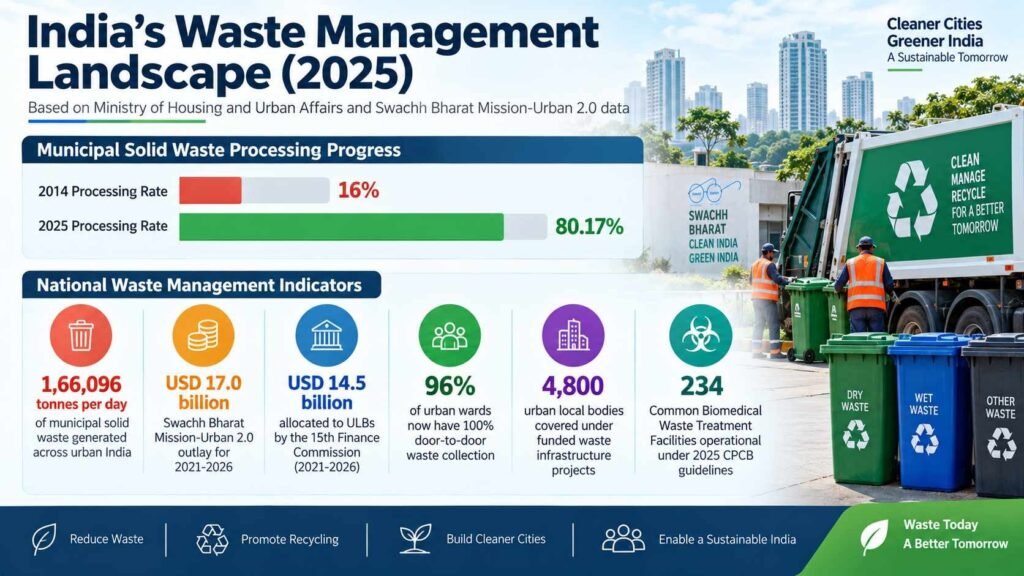
As per the Ministry of Housing and Urban Affairs, India’s urban areas generated 1,66,096 tonnes per day of municipal solid waste in 2025, of which 1,33,164 tonnes per day was processed, representing a processing rate of 80.17%, up sharply from just 16% in 2014. Industrial and hazardous waste streams sit alongside this, governed by a separate and more stringent set of rules that most manufacturing units are not equipped to navigate on their own.
This is where structured Waste Management Consulting Services become critical, not as a one-time compliance exercise, but as an ongoing system that connects waste generation, segregation, treatment, and disposal to a facility’s operating license.
Why Waste Management Consulting Matters Right Now
The regulatory and infrastructure push behind this shift is substantial. Swachh Bharat Mission-Urban 2.0 carries a total outlay of USD 17.0 billion for its 2021-2026 cycle, funding material recovery facilities, transfer stations, composting plants, and waste-to-energy installations across 4,800 urban local bodies. Separately, the 15th Finance Commission allocated USD 14.5 billion to urban local bodies over the same period, with performance-linked components tied directly to waste segregation rates and processing capacity utilization.
On the ground, this has translated into measurable coverage. Over 96% of urban wards now have 100% door-to-door waste collection across 4,372 urban local bodies, converting collection from a discretionary municipal function into a legally enforceable service obligation. For manufacturing units, the practical implication is straightforward:
- Non-compliance is far easier to detect today than it was even three years ago
- Municipal and pollution control authorities are increasingly linking waste data to renewal of consents and licenses
- Facilities without a documented waste management system face longer approval cycles for expansions and new project clearances
- Investors and buyers now routinely ask for waste handling records during due diligence, not just at audit time
The Waste Management Consulting Process
A structured consulting engagement typically moves through five distinct stages, each building the documentation and system needed for the next.
- Waste audit and characterization: Quantifying waste streams by category (municipal, hazardous, biomedical, e-waste, construction and demolition) and mapping generation points across the facility
- Regulatory mapping: Identifying which central and state rules apply based on waste category, industry sector, and generation quantity
- System design: Structuring segregation protocols, on-site storage specifications, and selecting authorized third-party treatment, storage and disposal facility (TSDF) partners
- Authorization and documentation: Preparing applications for Consent to Operate, hazardous waste authorization, and Extended Producer Responsibility (EPR) registration where applicable
- Monitoring and reporting systems: Setting up manifest tracking, annual return filing, and internal audit schedules to sustain compliance beyond the initial setup
India’s Waste Management Landscape (2025)
The scale of India’s waste management push becomes clearer when the funding, coverage, and processing numbers are placed side by side. The snapshot below summarizes the key national indicators shaping compliance requirements for manufacturing units today.
Regulatory Compliance Requirements
Waste management in India is governed by category-specific rules, and manufacturing units are often subject to more than one framework simultaneously.
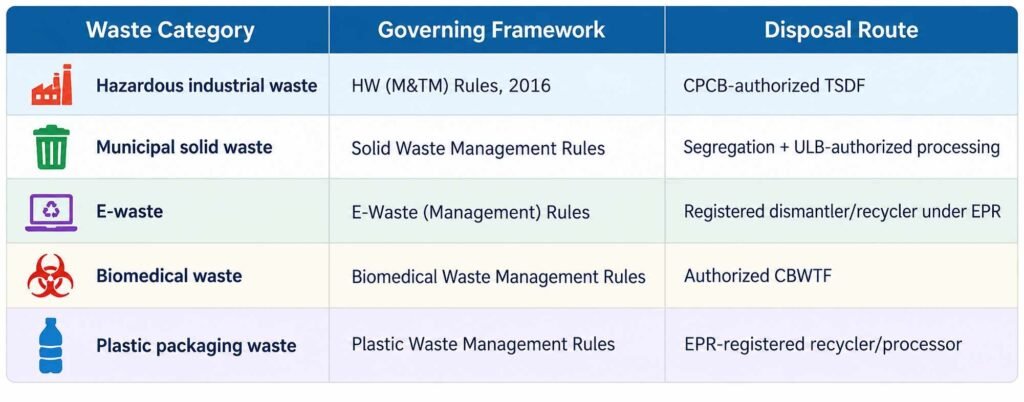
- Hazardous and industrial waste generators must obtain authorization under the Hazardous and Other Wastes (Management and Transboundary Movement) Rules, 2016, and route waste only to CPCB-authorized Treatment, Storage and Disposal Facilities
- Solid waste falling outside hazardous categories is governed by the Solid Waste Management Rules, with segregation at source now a mandatory requirement for bulk generators
- Producers, importers, and brand owners across plastic, e-waste, battery, and tyre categories carry Extended Producer Responsibility obligations, tracked through category-specific EPR portals
- Biomedical waste generators must route waste exclusively through authorized Common Biomedical Waste Treatment Facilities, of which 234 are currently operational nationally under the updated 2025 CPCB guidelines
- Annual returns, manifest documentation, and Consent to Operate renewals must align with actual waste generation and disposal records, since discrepancies are now a common trigger for regulatory scrutiny
Key Benefits of Professional Waste Management Consulting
- Reduces the risk of penalties, show-cause notices, and consent suspension by keeping documentation aligned with actual site operations
- Shortens approval timelines for facility expansions, since a documented waste management system is increasingly a prerequisite rather than an afterthought
- Lowers disposal costs over time through better waste segregation, which increases the share of material that can be recycled or recovered rather than sent for costly hazardous disposal
- Improves audit readiness for ESG disclosures, buyer due diligence, and bank or investor evaluations that now routinely include waste handling records
- Reduces long-term liability exposure tied to improper hazardous waste disposal, which can trigger both regulatory action and reputational damage
Best Practices for Industrial Waste Management
- Segregate waste at the point of generation rather than relying on downstream sorting, since mixed hazardous and non-hazardous waste is treated as hazardous by default
- Maintain a waste inventory register updated in real time, not reconstructed at the time of annual filing
- Conduct third-party TSDF audits periodically rather than assuming authorization status remains valid indefinitely
- Train shop-floor staff on category-specific labeling and storage requirements, since most compliance failures originate at the handling stage, not the disposal stage
- Build waste reduction targets into production planning, treating waste volume as a process efficiency metric alongside yield and downtime
For detailed insights read IMARC Engineering’s guide on Industrial Waste Management System in India: https://www.imarcengineering.com/blog/how-to-plan-an-industrial-waste-management-system-in-india
Waste Category Compliance Reference Table
Each waste category carries a distinct authorization pathway and disposal route, and mismatching these is one of the most common compliance failures in manufacturing units. The table below summarizes the core requirements by category.
How IMARC Engineering’s Expertise Can Help in Waste Management Consulting
- Conducting comprehensive waste audits that classify generation streams accurately against applicable central and state rules
- Structuring segregation, storage, and handling protocols tailored to the specific waste categories generated at a facility
- Identifying and vetting authorized TSDF, CBWTF, and EPR-registered partners to eliminate disposal-chain compliance gaps
- Preparing and managing Consent to Operate, hazardous waste authorization, and EPR registration documentation end to end
- Setting up manifest tracking and annual return systems that keep a facility audit-ready throughout the year, not only at renewal time
- Advising on waste reduction and material recovery opportunities that lower disposal costs alongside compliance risk
Get in Touch With Our Team: https://www.imarcengineering.com/contact?service=waste-management-system-planning
Frequently Asked Questions
What is the difference between waste management and waste management consulting?
Waste management refers to the physical handling, treatment, and disposal of waste, while waste management consulting covers the audit, regulatory mapping, system design, and documentation that ensures those physical processes stay compliant with applicable rules.
Which industries need hazardous waste authorization in India?
Any facility generating waste listed under the Hazardous and Other Wastes (Management and Transboundary Movement) Rules, 2016, including chemical processing, pharmaceuticals, metal finishing, and battery manufacturing, must obtain authorization before generating, storing, or transporting such waste.
How often should a manufacturing unit conduct a waste audit?
An annual audit aligned with Consent to Operate renewal is the minimum standard, though units with variable production mixes or frequent process changes benefit from more frequent internal reviews to catch classification errors early.
Can poor waste management delay a facility’s environmental clearance?
Yes. Regulatory authorities increasingly review historical waste handling records during clearance and expansion applications, and undocumented or non-compliant waste streams are a common reason for delayed approvals.
Conclusion
Waste management consulting has shifted from a compliance formality to a direct driver of operating continuity, cost control, and audit readiness for Indian manufacturers. As processing infrastructure and enforcement both scale nationally, facilities with structured, documented waste systems will consistently clear approvals faster and absorb less regulatory risk than those still managing waste reactively.
Contact Us:
IMARC Engineering
Phone: +91-120-433-0800
Email: sales@imarcengineering.com
India: C-130, Sector 2, Noida, Uttar Pradesh 201301
LinkedIn: https://www.linkedin.com/showcase/imarc-engineering/
About the Author